
SUBSCRIBE TO OUR FREE NEWSLETTER
Daily news & progressive opinion—funded by the people, not the corporations—delivered straight to your inbox.
5
#000000
#FFFFFF
To donate by check, phone, or other method, see our More Ways to Give page.


Daily news & progressive opinion—funded by the people, not the corporations—delivered straight to your inbox.
"With what Trump and Musk have been doing, it's more important than ever to get union people, working people, into Congress."
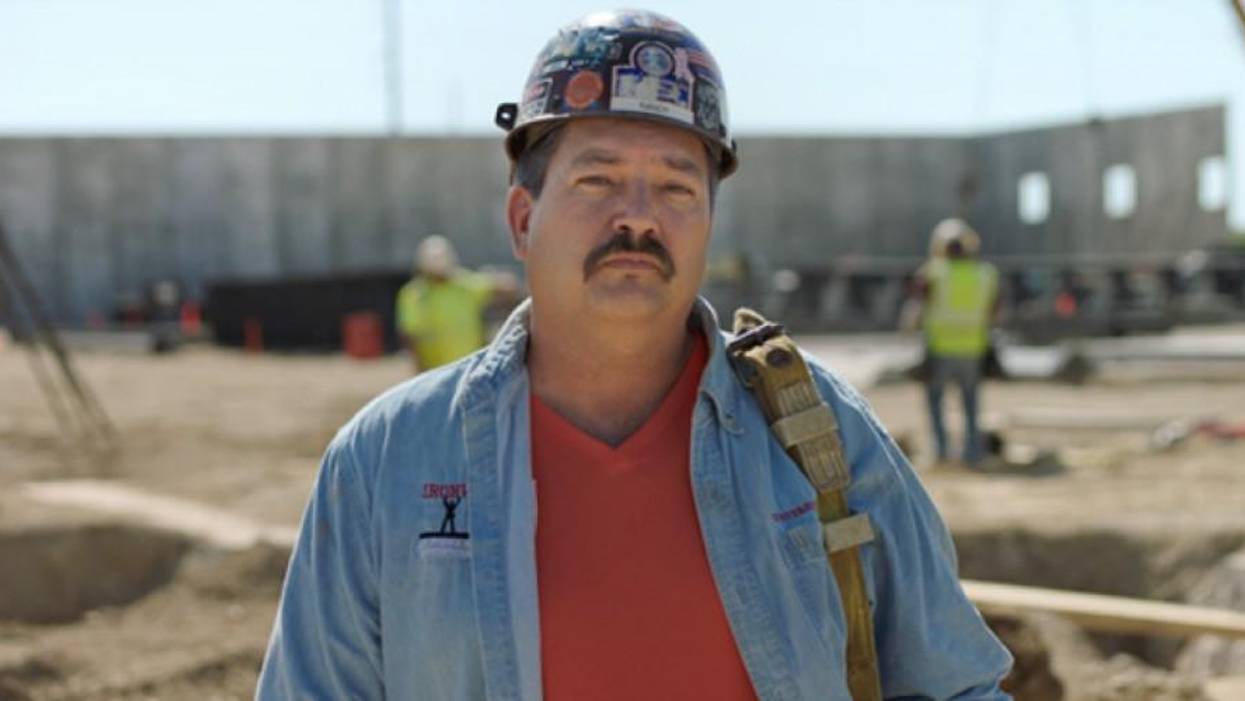
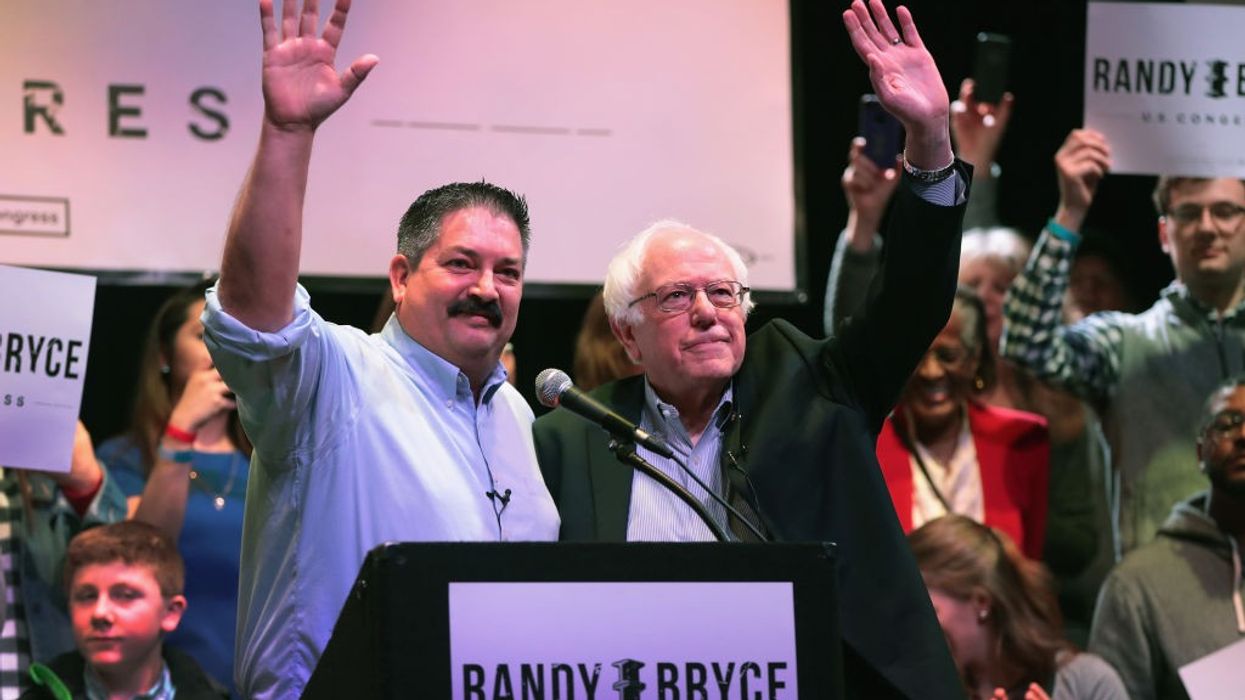
As congressional Republicans and the administration of President Donald Trump set their sites on slashing vital social services, former union ironworker-turned-progressive Democratic U.S. House candidate Randy Bryce announced Tuesday that he will seek to oust the incumbent Trump ally in 2026 and help save Medicaid, Medicare, and Social Security.
Bryce—also known as the "Iron Stache" due to his prominent moustache—is a disabled veteran who launched his 2018 campaign with a viral video skewering then-House Speaker Paul Ryan's (R-Wis.) attacks on healthcare. Bryce, who raised over $7 million with donations averaging around $25, won the Democratic primary but lost to Rep. Bryan Steil (R-Wis.) in the 2018 general election.He aims to face Steil in the next cycle.
"Every great story begins with a spark. Ours began in 2018, when one man stood up to Washington," Bryce said in an ad released Tuesday announcing his new campaign for Wisconsin's 1st Congressional District seat. "Now, as old enemies come out of the shadows, we need him one more time."
"Trump promised to bring manufacturing back," Bryce continued. "Eight years later, we're still waiting. We can't afford to wait any longer—not for jobs, or healthcare, or a damn living wage."
"This isn't about left versus right," he added. "This about the billionaires versus the rest of us, and we've got the numbers!"
As the Milwaukee Journal Sentinel reported Tuesday:
At the time, Bryce ran on supporting "Medicare for All" legislation, raising the minimum wage to $15 per hour, and boosting unions. He remains a member of the Ironworkers Local 853 and in the years since his first campaign, he said, has served as a union representative, worked with Social Security Works, an advocacy group seeking to expand Social Security, and more recently has helped people with disabilities find work.
Like his ally Sen. Bernie Sanders (I-Vt.), Bryce believes that Democrats lack a coherent vision for defeating Trumpism and the oligarchy that's enriching itself at the expense of working-class Americans.
The solution? "With what Trump and Musk have been doing, it's more important than ever to get union people, working people, into Congress," Bryce told Capital Times associate editor and Nation national affairs correspondent John Nichols on Tuesday, referring to de facto Department of Government Efficiency chief and world's richest person, Elon Musk.
Working-class Dem Randy Bryce Takes On Trump Ally Bryan Steil For Key Wisconsin House Seat. — Bryce is the union Ironworker whose 2018 challenge to Speaker Paul Ryan went viral and, ultimately, saw Ryan decide to quit. Bryce says he’s running in 2026 to save Medicaid, Medicare and Social Security.
[image or embed]
— John Nichols (@nicholsuprising.bsky.social) May 20, 2025 at 8:20 AM
"What Trump's doing, and what Bryan Steil is helping him do, is really scaring people," Bryce told Nichols. "I'm talking to veterans, to people who rely on Medicaid, to families that can't keep up with rising prices, to workers. They're all angry."
"You've got an administration that is strangling the Social Security system, laying off people, cutting services," he added. "The Republicans in Washington are pulling what's left of the rug out from under us. I just think this is a going to be an election where people in the 1st District say, Enough!"
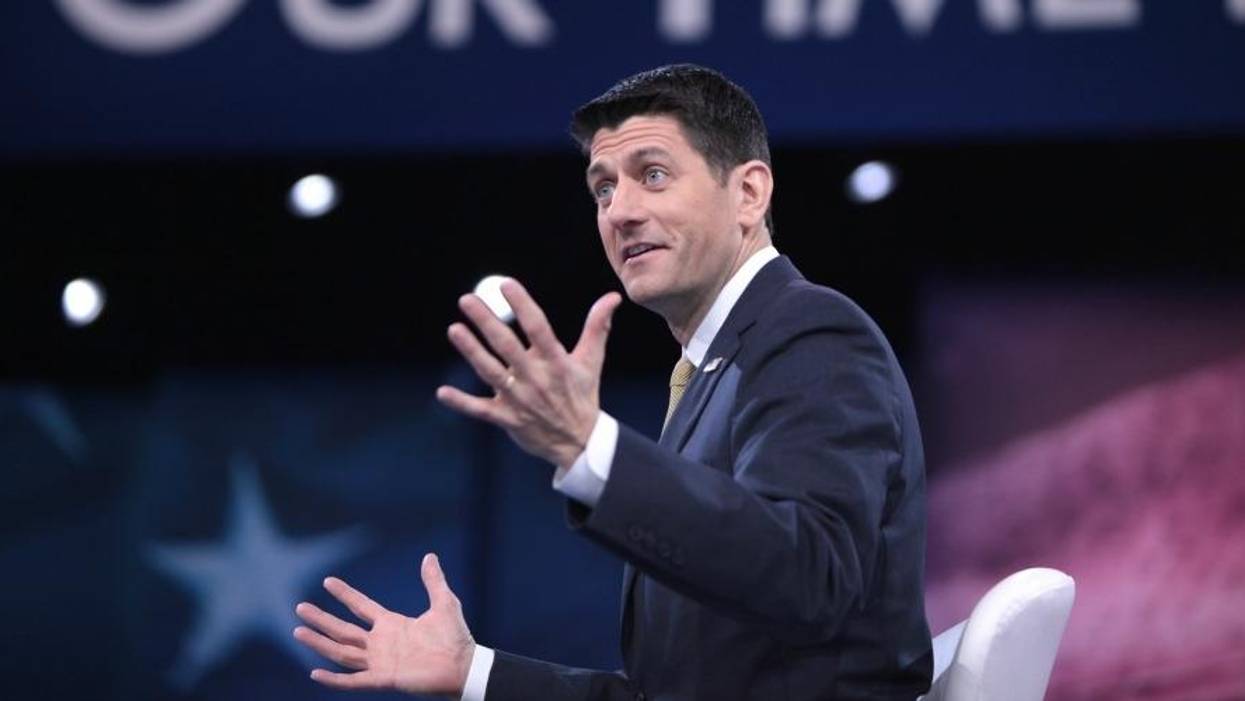
Paul Ryan's farewell tour is going about as well as you might imagine. The retiring speaker of the House, who made a career out of promoting his aw-shucks humility, has presided over the revealing of not one but three painted portraits of himself. In less-controlled settings, his interviews with media outlets have, rather than provide a victory lap, only served to highlight the emptiness of Ryan's words and the failures of his time in office. Speaking of those empty words, Ryan was also set to leave us with a formal farewell address at the Library of Congress earlier this week--until George H.W. Bush's funeral threw off the plans. It was yet another reminder that history has rarely been on Ryan's side.
Not surprisingly, that's not Ryan's own assessment of his time in public life. In a recent interview with the Washington Post, Ryan blithely proclaimed that "history is going to be very good to this majority"--the same majority that had just suffered the worst Republican losses since Watergate. Like so many of Ryan's supposed grand ideas, the comment was little more than mere grandstanding. And it betrayed what has always been at the heart of his rise to power and his fall: a plain disconnection from the reality around him.
Given the breathless media coverage Ryan enjoyed throughout his career, it's perhaps remarkable how thoroughly both pundits and partisans are now ragging on him. Criticism from places like Salon and Vanity Fair was predictable, but conservative voices have also joined in, such as the libertarian outlet Reason, which pronounced Ryan an "abject failure," and the conservative columnist Jennifer Rubin, who provided a scathing review of his tenure. "Good riddance, Paul Ryan," a headline in The Week happily announced.
From his entrance onto the national political stage in 1998 when he won a seat in Congress from his moderate district in Wisconsin, Ryan has presented himself as a serious policy wonk and a devoted disciple of Reaganomics. At the end of the 20th century, anyone spouting faith in trickle-down economics should have been roundly dismissed, but the media lapped it up. Ryan was portrayed as the bright new hope of the GOP, although it was as much his youthful looks and biceps that earned him that honor as it was his questionable ideas.
The irony was that while Ryan's Randian ideas put him on the back end of history, the actions he took in Congress put him squarely within the Republican Party's profligate ways during the George W. Bush years. Ryan went along with Bush's massive government expansion and big spending, supporting the president's reckless wars and voting for costly programs of varying merit, including a Medicare expansion, No Child Left Behind, the Patriot Act, and the Troubled Asset Relief Program.
None of that stopped Ryan from cultivating his image as a deficit hawk at the same time. When Barack Obama was elected president in 2008, Ryan threw his sermonizing into overdrive, appearing nonstop on Fox News and other conservative outlets to warn about how the new president's budget plans would drive the economy into a ditch, as if he hadn't helped Bush do just that for the previous eight years.
But that blindness--or, more accurately, hypocrisy--never proved a handicap for Ryan. Indeed, it was essential to his rise to power, from House Budget Committee chairman in 2011, to being chosen as Mitt Romney's running mate in 2012, to taking the speakership in 2015.
It also perfectly primed him for the Trump era, where the Republican Party's duplicity wasn't so much exposed as it was exploited for electoral effect. Another speaker--say, one in the mold of Tip O'Neill or even John Boehner--might have seized the opportunity to stand up to a president like Trump. In doing so, Ryan could have safeguarded his supposed principles while also planting the seeds for a future presidential run as a true conservative.
Instead, Ryan rolled over for Trump, allowing and even protecting his worst abuses of office. While Ryan occasionally slapped Trump on the wrist, like his scolding of Trump's lovefest with Vladimir Putin last summer, such moments only highlighted Ryan's willing collusion with Trump's broader assault on American democracy.
Ryan refused to pass legislative protection for special counsel Robert Mueller or to establish a select committee for investigating Russian involvement in the 2016 election. He allowed Devin Nunes to continue serving as chair of the House intelligence committee even after tape recordings showed Nunes pledging to protect the president over the Constitution and after Nunes publicly worked to discredit the FBI and other law enforcement. And Ryan turned a blind eye rather than conducting oversight of the numerous scandals emerging from the Trump White House, including improper handling of security clearances and mounting financial scandals.
That Ryan did nothing to pressure Trump into cutting ties to his businesses or stop earning foreign emoluments, a plain violation of the Constitution, looks all the more devastating in light of the news this week that Saudi-financed lobbyists have shelled out thousands of dollars for more than 500 nights of reservations at Trump's D.C. hotel.
But Ryan allowed it all in order to get his treasured tax cut package, a disastrous piece of legislation that threw billions to Wall Street at the expense of ordinary Americans, like his own constituents back in Wisconsin.
Was it worth it? Ryan thinks so. Yet as the tax cut's promised boom looks to be a bust, General Motors closes its plants, and the stock market shudders, Ryan ought to re-evaluate.
Yet those facts probably won't stop Ryan from taking some pundit spot on Fox News or at a conservative think tank where he'll make good money shilling the same ideas he sold out. As the Trump presidency and the GOP continue to fall apart, Ryan will likely be hailed again for his intellectual clout, the kind of grown-up who could steer the party back to sound conservatism.
Too bad that throughout his career, Paul Ryan showed he was not so much a policy genius as he was a political hack. It's just that in the eyes of a Republican Party that has capitulated to Trump at almost every turn, those are one and the same.
Democrat Randy Bryce didn't win his race for Congress. But as he thanked his supporters on Election Night, after the race was called for Republican Brian Steil, the fifty-four-year-old ironworker took a longer view.
"I've said it many times," Bryce told the crowd of staffers, volunteers, and admirers who filled the hall in Racine, Wisconsin. "It's not just about just winning one seat--the First District Congressional seat in southeast Wisconsin. It was never about that.
"It's about not being a backdrop any more--not having working people be the backdrop, but actually coming up and grabbing the microphone. Because it's about time that we're heard."
Given the heady excitement that Bryce's campaign for the seat now held by Republican House Speaker Paul Ryan had sparked among Democrats, the loss might have been expected to cast a shadow over the evening. Yet instead of gloom, Bryce and his supporters seemed to exude an air of gritty resolve.
"We really did build something cool here," retired letter carrier Jody Spencer told The Progressive as she reflected on her months of volunteering for the campaign and, later, working temporarily for the AFL-CIO in getting out union voters on Election Day.
Bryce, she said, set an example for the kind of persistence that will be needed to sustain what the campaign started. "He really gave it his all."
And despite Bryce's loss, the campaign, and the candidate, point to a path forward for progressives, Racine state representative Greta Neubauer told The Progressive in the hours after the polls closed.
That path? "It is continuing the model of grass-roots organizing that Randy brought to the district," Neubauer said.
Paul Ryan has represented Wisconsin's First Congressional District since 1998, and for election cycle after election cycle, Democrats despaired of ever being able to unseat him. Yet months after Bryce launched his campaign with an online video that went viral, Ryan suddenly opted not to run for reelection.
"Randy brought hope," Neubauer said, explaining that this was reflected in Bryce's own working-class identity. "We saw through this race how much it resonated that he was a working person. People want their representatives to look like them, and have lives like them."
"Randy brought hope. People want their representatives to look like them, and have lives like them."
And to connect, Neubauer continued, there is no substitute for going door to door, the ultimate in retail political organizing. "Getting out there and sharing stories," she said. "It is hard. It is hard work and it takes a lot of hours."
For Racine alderman John Tate II, a Bryce campaign volunteer, the evidence that kind of work can pay off showed itself in turnout that "exploded" in Racine. "We had people who typically don't vote who turned out," Tate said.
They turned out, he suggested, because Bryce wasn't just another lawyer or other wealthy professional of the sort who disproportionately make up Congress, state legislatures and other government posts. And Bryce received their support despite being plagued by personal scandal including a history of arrests.
Skilled tradespeople like Bryce, or social workers (Tate's occupation), or people from any number of ordinary walks of life need the opportunity and encouragement to pursue political office. "We have to have a diverse perspective," Tate said. "We have to have more women, more people of color, more non-traditional people."
Echoing a remark Bryce had made to the crowd earlier, Tate said this loss was simply one chapter in a much longer story.
"Movements don't happen in a single cycle," he said, flashing a smile.
After launching his campaign with a viral video that targeted retiring Republican House Speaker Paul Ryan's devotion to ripping healthcare away from millions of sick and impoverished Americans, Randy "IronStache" Bryce won the Democratic primary in Wisconsin's 1st District Tuesday night.
"It's a win for working families all across this district, this state, and the entire country. Working people have been shut out of politics. Working families have been forgotten by their representatives," Bryce said in his victory speech. "But we took a stand. We fought back. Together, we made our voice heard, and the GOP is running scared, with good reason. They see the movement that we're building."
Bryce supports Medicare for All, criminal justice reform, stricter gun control, a Green New Deal, reproductive rights, tuition-free public college, and a path to citizenship for recipients of the Deferred Action for Childhood Arrivals (DACA) program.
"From the beginning, we've known that replacing Paul Ryan with a true representative from our district would be no easy task," Mary Jonker, Chair of Wisconsin's 1st District Democrats, said Tuesday. "I'm thrilled that union ironworker, Army veteran, and cancer survivor Randy Bryce put together a strong campaign that is already poised for victory in November."
His victory was celebrated by progressives and advocacy groups not only within his district but across the nation:
The ironworker-turned-congressional candidate will face off against former Ryan aide Bryan Steil, who secured the outgoing speaker's endorsement and won a crowded GOP primary. Following the primaries, Bryce tweeted, "Lyin' Bryan Steil, [is] running against us, but we can beat him and the GOP billionaires who want to uphold the status quo that has enriched them and screwed us over and over again."
Bryce's win Tuesday came after what the Washington Post described as a "primary brawl" with challenger Cathy Myers, a local teacher and school board member. He and Myers ran on similar platforms, but Bryce's viral ad quickly "made him a left-wing sensation"--which she was never able to attain. "With so little separating her from Bryce, Myers went all in on character," slamming the ironworker for past indiscretions reported by local and national media.
While Myers attacked Bryce last November for previously falling behind on child support payments, his campaign said that the candidate and his ex-wife made sure their son had everything he needed, and Bryce's experiences with financial hardship made him more relatable to voters.
"Unlike Ryan, he knows what it's like to struggle and will approach his job from a place of deep understanding as opposed to zero empathy," campaign manager David Keith had said at the time, before Ryan announced his retirement from Congress in April.
And, in response to CNN's July report on his past arrests, Bryce told The Capital Times' John Nichols, "I screwed up, but I learned from my mistakes." Pointing to his experiences fighting community hunger, union organizing, and becoming a father, he added, "I realized a long time ago that I never wanted to be in that position again."
Acknowledging other Wisconsin politicians who have overcome similar revelations, Nichols posited: "Voters understand that candidates, especially working-class contenders who are not political careerists, may arrive on the campaign trail with some history. If candidates are forthcoming in discussing their mistakes, the voters can be forgiving."
"Bryce has also learned a thing or two about politics," Nichols noted. "He knows Republicans will attack him as the election approaches. So he'll talk about his mistakes, as part of a campaign that has often turned personal as Bryce has discussed his struggle with cancer and the painful financial burdens it placed on him and on his family."
Watch Bryce's victory speech:
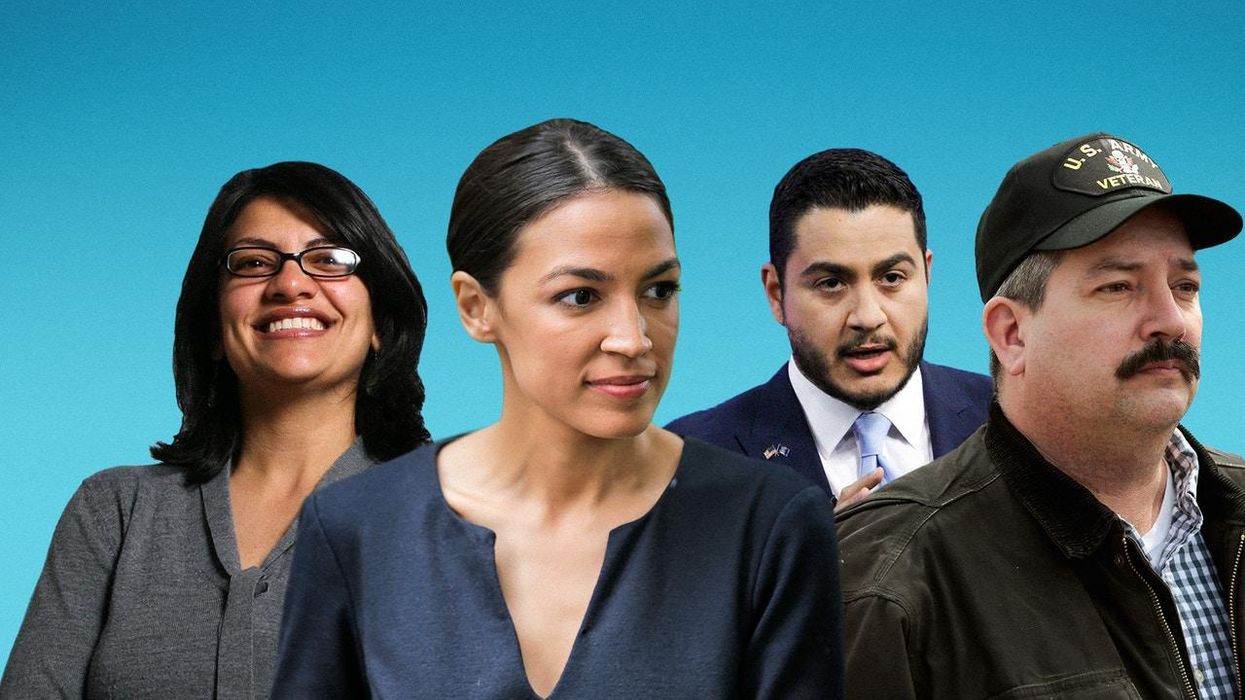
On the same day that Alexandria Ocasio-Cortez won an upset victory in her primary against Wall Street-friendly incumbent Joe Crowley -- one of the most powerful Democrats in the House -- a New Yorker nearly 50 years her senior fed rumors that he would seek the highest office in the land.
Aside from pouring $80 million to support a set of handpicked Democratic congressional hopefuls, billionaire former New York City Mayor Michael Bloomberg once again seems to be angling to run for president. Business Insider columnist Daniella Greenbaum took the opportunity to assert: "Democrats need to choose: Are they the party of Alexandria Ocasio-Cortez or the party of Michael Bloomberg?"
She sided with the latter, but the question is a valid one. The differences between Bloomberg and Ocasio-Cortez are difficult to stuff into a single paragraph, but let's try: He's one of the richest men in the world who made his fortune on Wall Street and, in his tenure as mayor, went out of his way to make the financial sector feel at home. She's a democratic socialist who until last year bartended in Manhattan and campaigned to make housing a human right -- something Bloomberg made a more difficult goal to attain for her future constituents.
But one key difference might be less obvious and a bellwether for climate politics post-2018 if a blue wave sweeps Democrats back into power on Capitol Hill: how they plan to tackle climate change.
Read the full article at The Intercept.
While progressives issued warnings to retirees, Republican lawmakers were being denounced on Friday for celebrating a federal appeals court ruling against an Obama-era rule that required financial advisers to prioritize clients' interests over their own when providing investment advice.
In a 2-1 decision on Thursday, the U.S. Court of Appeals for the Fifth Circuit vacated the so-called fiduciary rule by the Labor Department. The department said Friday that it will respect the court decision and temporarily hold off on enforcing the rule.
In response to the ruling, the Economic Policy Institute (EPI) said in a statement: "This common-sense rule has survived repeated court challenges, but special interests with deep pockets can persevere until they get the result they want. All this proves is how much conflicted advice contributes to Wall Street profits at the expense of retirement savers."
Meanwhile, House Speaker Paul Ryan (R-Wis.) claimed on Twitter that the decision was "good news for the economy," neglecting to mention the impact it will have on those seeking trustworthy guidance on retirement accounts and 401(k)s.
Ryan, however, was quickly shut down by independent journalist David Sirota as well as Randy "IronStache" Bryce, a Democrat who is challenging Ryan in the 2018 midterms.
The fiduciary rule, which has been strongly supported by consumer advocates, partially took effect in June 2017, but the Trump administration delayed its full implementation until at least July 2019. Now, its future is even more uncertain.
The two judges who opposed the rule on Thursday determined that the Labor Department had acted "beyond its expressly defined authority," while the sole judge who dissented asserted that the department acted "well within the confines set by Congress in implementing the challenged regulatory package."
"The court misapplied the law, deviated from the decisions of every other court to consider the rule, turned a blind eye to dramatic changes in the retirement landscape over the last 40 years, and worst of all, ignored the plight of tens of millions of Americans who lose tens of billions of dollars a year."
--Stephen W. Hall,
Better Markets
Stephen W. Hall, legal director and securities specialist for consumer advocacy group Better Markets, said the majority decision was "riddled with flaws."
"The court misapplied the law, deviated from the decisions of every other court to consider the rule, turned a blind eye to dramatic changes in the retirement landscape over the last 40 years, and worst of all, ignored the plight of tens of millions of Americans who lose tens of billions of dollars a year in lost retirement savings due to financial advisers' conflicts of interest," Hall explained.
"This decision is also a slap in the face to the dedicated and hardworking public servants at the [department] who labored for more than five years conducting rigorous analysis and outreach to all affected groups, including most prominently industry, who insisted on--and received--unprecedented access and input," Hall added, urging the department to "pursue every possible avenue for challenging the court's decision."
The Labor Department must now decide how to proceed with the case, considering that the 10th Circuit Court upheld the rule--"albeit in narrower context"--earlier this week. It may request a ruling from a full appeals court, and the fight could eventually escalate to the U.S. Supreme Court.
Marcia S. Wagner, an employee benefits lawyer, told the New York Times she believes that "even though the Trump administration is not a strong supporter of the fiduciary rule, it will likely continue to defend the fiduciary rule against legal challenges."
Another option for protecting consumers from investors' conflicts of interest could come from the U.S. Securities and Exchange Commission, if the Labor Departments opts to end its effort.
"The SEC has said that it will propose a fiduciary rule for retail investment advice this year," Investment News reported Thursday. "It could come out as soon as the second quarter."
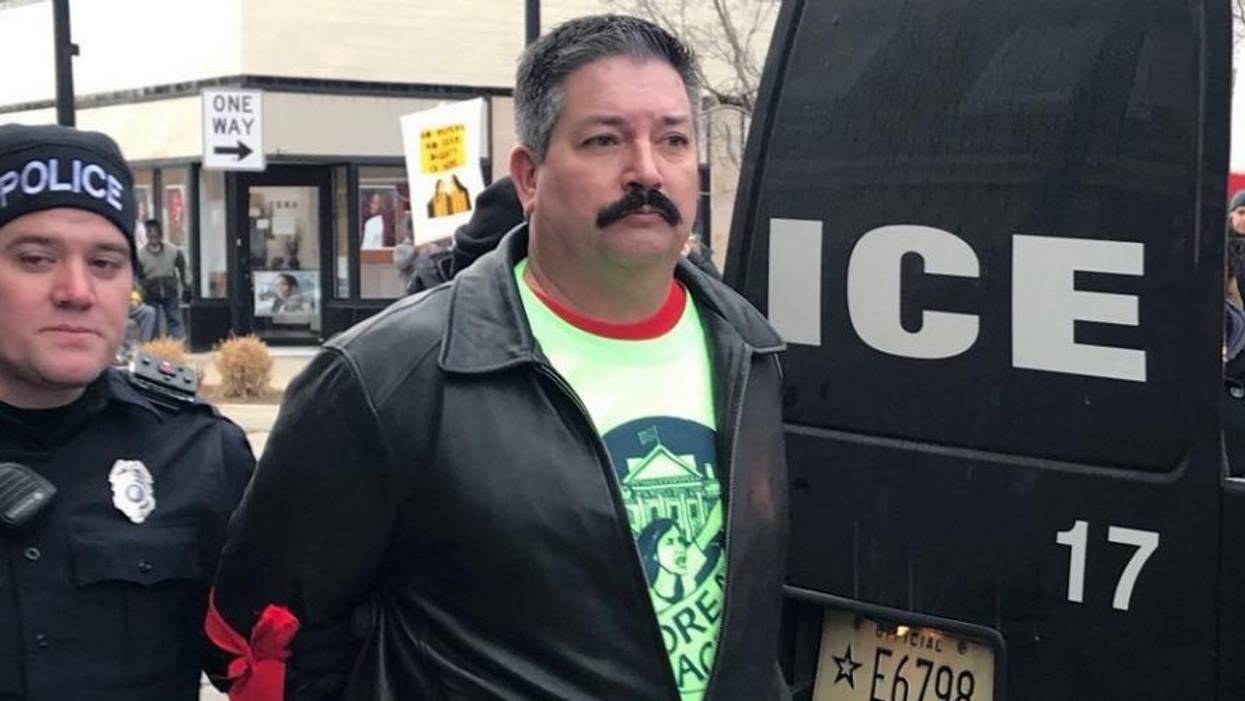
Two Democratic challengers--including outspoken progressive Randy "Ironstache" Bryce--who hope to oust Speaker of the House Paul Ryan in his home Wisconsin district this November were among the nearly dozen immigrant rights advocates arrested outside Ryan's offices in Racine on Monday.
Bryce and Myers joined about 200 community members, including many high school students, to demand that Ryan allow representatives to vote on a clean Dream Act, which would allow young undocumented immigrants to attend school and work as part of a pathway to citizenship.
When a local reporter asked Bryce if his support for immigrants was worth being detained, he replied, "Absolutely."
"We cannot be silent on DACA," said State Rep. JoCasta Zamarripa, who was also arrested. "We will march. We will call. We will email & tweet. We will sit in nonviolent protest. And we will vote. You're either on the side of humanity or against it."
Monday marked the day President Donald Trump had decided DACA--the Obama-era executive order which offered protection to young immigrants in the absence of the Dream Act--would officially end, before a Supreme Court ruling last month delayed the deadline.
Bryce will challenge Ryan in the November midterm election, should he win Wisconsin's Democratic primary in August. The union ironworker raised $1.2 million in the fourth quarters of 2017, with donations flooding in from across the country and averaging $24-25 each.
On social media, Ironstache supporters praised Bryce for his activism on the front lines of the fight to protect young immigrants.
Republican Speaker of the House Paul Ryan was pilloried overnight and into Sunday morning after posting a tweet on Saturday--one he later deleted--bragging about the $1.50 per week a public school employee was "pleasantly surprised" to find in her paycheck following the passage of last year's tax cuts which gave the nation's corporations and richest people cuts worth millions, and in many cases billions, of dollars.
Back in his home district, Ryan's 2018 Democratic challenger Randy Bryce, a progressive-minded ironworker with the moniker @IronStache, immediately leapt into action.
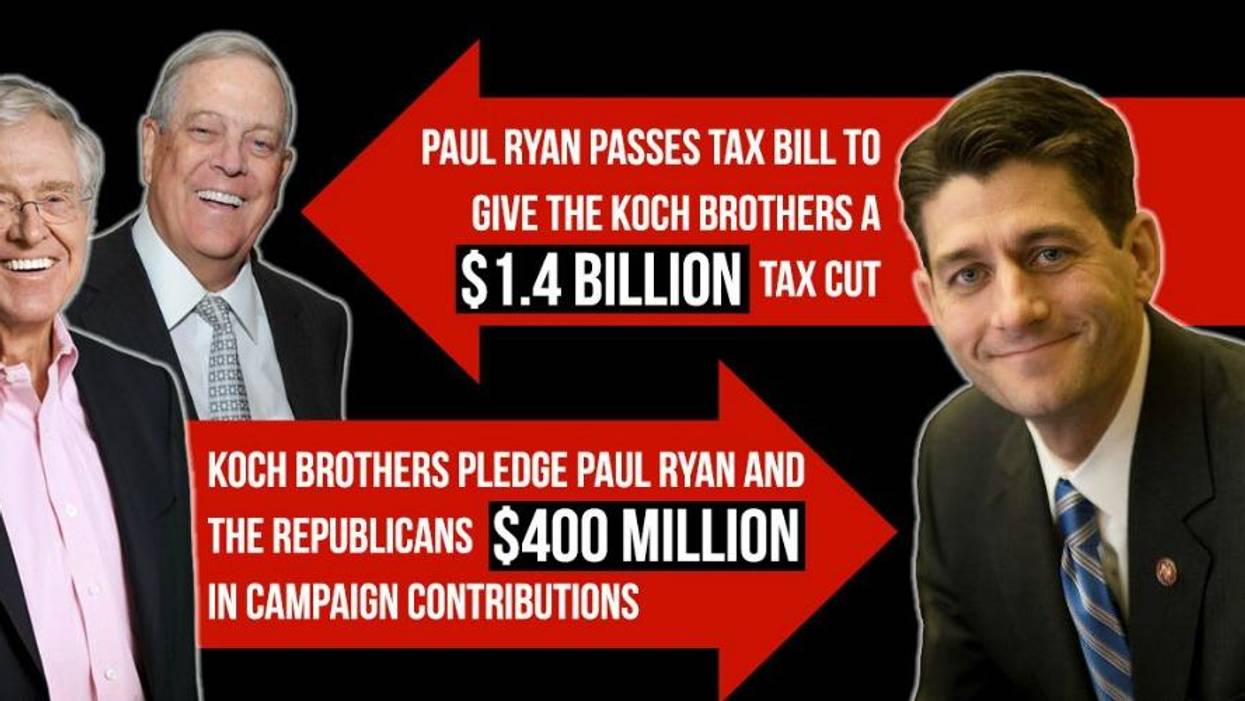
Bryce shamed the Speaker--whose political machine was showered with $500,000 in contributions from the billionaire Koch Brothers just days after the #GOPTaxScam was signed into law in December--by pointing out how the Kochs measure their tax windfalls in the billions of dollars, as opposed to quarters or dimes:
An analysis released by Americans for Tax Fairness last month showed that while the Kochs spent an estimated $20 million to promote last year's tax bill, they stand to save between $1 billion and $1.4 billion in income taxes per year as a result of its passage. For the 2018 mid-terms, the Koch network is reportedly prepared to spend $400 million to back Republican candidates.
Not long after Bryce pointed some of this out, Ryan deleted the tweet.
It was clear that Ryan had been "suitably shamed." Even the secretary, Julia Ketchum, originally quoted in the article Ryan shared and who spoke to CBS News later on Saturday night, said she was surprised her story had been used to "sell" the tax bill. "So it shows me," Ketchum said, "he may not have read the whole article."
Topher Spiro, a senior fellow at the Center for American Progress, sent out this message on his personal Twitter account which was then retweeted tens of thousands of times:
And because the Internet never forgets, the damage was already done. Behold, the #WithABuckFiftyAWeek hashtag was born: