

SUBSCRIBE TO OUR FREE NEWSLETTER
Daily news & progressive opinion—funded by the people, not the corporations—delivered straight to your inbox.
5
#000000
#FFFFFF
To donate by check, phone, or other method, see our More Ways to Give page.
Daily news & progressive opinion—funded by the people, not the corporations—delivered straight to your inbox.

"The court has rejected AstraZeneca's self-serving arguments and essentially said the company didn't have a leg to stand on," said one advocate.
The president of consumer advocacy group Public Citizen on Friday urged Big Pharma to "drop its far-fetched lawsuits and accept that the era of Medicare price negotiation is here to stay," after a federal judge in Delaware rejected drug company AstraZeneca's case challenging provisions under the Inflation Reduction Act.
AstraZeneca Pharmaceuticals LP et al. v. Becerra et al. is one of several cases that drug companies have filed against the federal government seeking to block Medicare from negotiating drug prices on behalf of patients—as the governments of every other high-income country do, with Americans paying as much as four times what people in countries such as the United Kingdom and Canada pay for their medications.
The company claimed that the Centers for Medicare & Medicaid Services violated the Administrative Procedure Act.
Chief Judge Colm Connolly in the U.S. District Court for the District of Delaware ruled that "because AstraZeneca's participation in Medicare is not involuntary, AstraZeneca does not have a protected property interest in selling drugs to the government at prices the government will not agree to pay. Accordingly, AstraZeneca's due process claim fails as a matter of law."
"Drug corporations have no constitutional right to price gouge Medicare, contrary to Big Pharma's claims."
In other words, said Patients for Affordable Drugs (P4AD), the judge emphasized that "the company's desire for higher prices does not supersede the government's ability to protect patient interests."
"On behalf of patients across this country, we are encouraged but not surprised that the court has rejected AstraZeneca's self-serving arguments and essentially said the company didn't have a leg to stand on," said Merith Basey, the group's executive director. "This ruling sends a clear message that Big Pharma's greed cannot continue to be prioritized over patients' well-being and underscores the importance of Medicare negotiation to begin to rein in exorbitant drug prices."
"The judge's decision reaffirms that pharmaceutical companies like AstraZeneca have the option to participate in Medicare voluntarily, accepting slightly lower negotiated prices if they wish to access a market worth billions," added Basey. "Once again, a judge has reviewed drug company claims, and the result has gone against the drug company and for the people of the United States."
AstraZeneca's drug Farxiga, which is used to treat Type 2 diabetes, was one of 10 medications selected by the Biden administration last year for the first round of negotiations under the Inflation Reduction Act's (IRA) Medicare Drug Price Negotiation Program. In 2022, the company reported nearly $4.4 billion in revenue from Farxiga.
P4AD said Connolly's ruling was a victory for patients like Karen, a Pueblo West, Colorado resident.
"I am on Medicare and was prescribed Farxiga with a bill of over $600 for a three-month supply. I am on a fixed income and can no way afford that amount of money," Karen told the group, which has signed onto amicus briefs in seven different cases regarding Medicare price negotiations.
Tony Carrk, executive director of Accountable.US, noted that Big Pharma previously spent millions lobbying against the drug price negotiation provisions in the IRA.
“Big drug company executives are stopping at nothing to price gouge Americans and pad their profits," said Carrk. "Now they are trying to do it by clogging the judicial system with meritless lawsuits. Today's ruling is a victory for the Biden administration's historic cost-lowering program and for seniors who need lower prescription drug costs."
Robert Weissman, president of Public Citizen, pointed out that the IRA's restraints on Big Pharma's price gouging are only "modest" but will make a difference to seniors, saving $100 billion over a decade.
"In response, Big Pharma has launched a flurry of preposterous lawsuits against the Medicare drug negotiation provisions in the Inflation Reduction Act," said Weissman. "As Public Citizen has argued in amicus briefs, drug corporations have no constitutional right to price gouge Medicare, contrary to Big Pharma's claims."
Weissman said his expects that with seven pending cases, "today's decision is the first of many rejecting Big Pharma's attack on the act's effort to rein in exorbitant prescription drug prices."
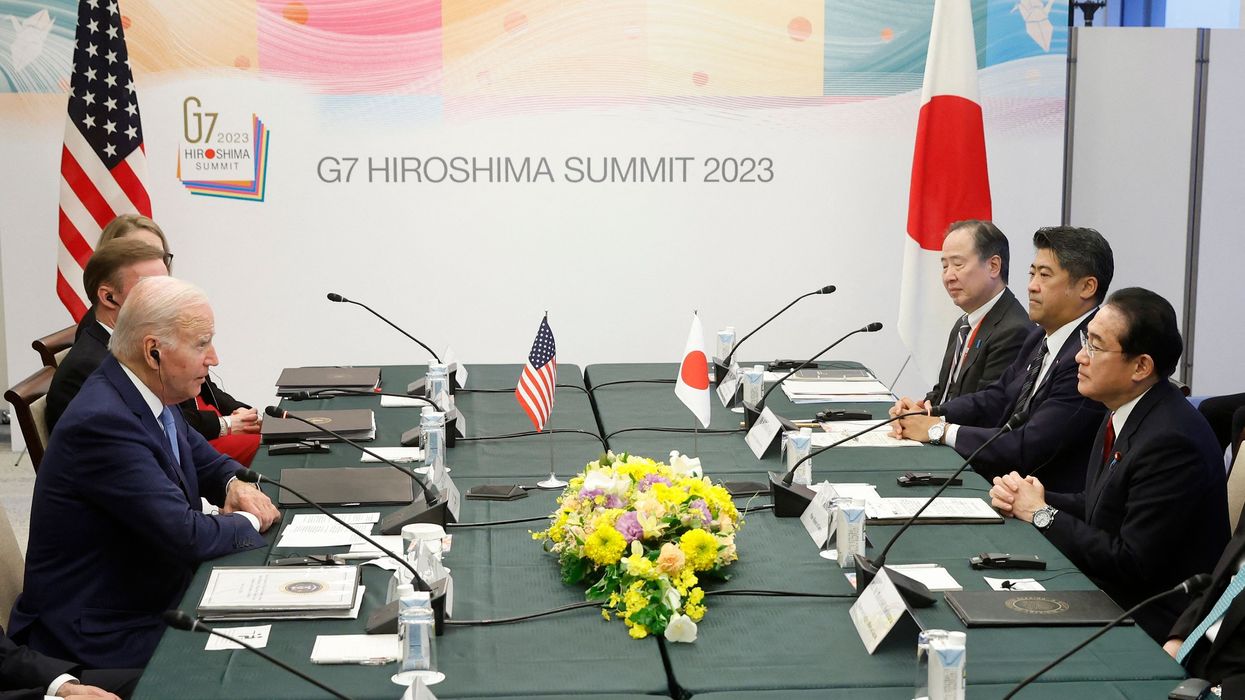
"The pharmaceutical industry will always lobby to maximize their own profits, regardless of the impact on public health, but G7 leaders must resist."
A group of scientists warned the leaders of rich countries on Thursday that the world is badly unprepared for the next pandemic and must urgently lay the groundwork for a swift, equitable global response that puts lives over pharmaceutical industry profits.
In a letter to the heads of G7 nations as they gathered in Hiroshima for their annual summit, 16 scientists from South Africa, Brazil, the U.S., the United Kingdom, Japan, Indonesia, and other nations wrote that "it is critical that in the next health crisis the world rapidly deploys medical countermeasures in every country, regardless of their ability to pay," invoking the deadly failure to ensure sufficient access to Covid-19 vaccines in poor nations.
A just response, the scientists wrote, "requires removing every barrier to the development and production of medicines and vaccines—an area where the world failed during the Covid-19 and AIDS pandemics."
"Upholding strict intellectual property rules secured monopolies for pharmaceutical companies and prevented the widespread production of affordable generic vaccines and medicines in developing countries," they continued. "We write to you to emphasize and ask that you center the protection of human rights, such as the right to health and the right to benefit from scientific progress, over windfall profits."
The scientists' letter comes weeks after two dozen pharmaceutical company CEOs—including Eli Lilly chief David Ricks—met with Japanese Prime Minister Fumio Kishida to discuss ways to "strengthen the power of science and an innovation ecosystem built on the protection of intellectual property rights and free access to pathogens."
That was how the International Federation of Pharmaceutical Manufacturers and Associations (IFPMA)—a powerful industry trade group whose membership list includes Pfizer, Moderna, and Merck—described the meeting with Kishida, which took place less than a month after the World Health Organization (WHO) formally declared the coronavirus pandemic over as a global health emergency.
The death toll from the pandemic is believed to be in the tens of millions, and research has shown that many deaths could have been averted with more equal vaccine access worldwide.
But efforts to remove barriers that hindered vaccine production and distribution—including patent laws—were blocked by rich countries at the behest of the pharmaceutical industry, which furiously opposed any changes that threatened their monopoly control over the lifesaving shots.
IFPMA was at the center of those aggressive lobbying efforts.
"We cannot double-down on implementation of intellectual property rules that make pandemics longer, costlier, and deadlier."
In their letter to G7 leaders—a group that includes Kishida, U.S. President Joe Biden, and Canadian Prime Minister Justin Trudeau—the scientists expressed dismay that the pharmaceutical industry is still "advocating a maximalist approach to intellectual property, disregarding the impact on public health."
"This is an extreme view that flies in the fact of mainstream scientific opinion," they wrote. "This position endangers the kind of scientific collaboration that is essential to properly prevent, prepare for, and respond to health crises, especially infectious diseases. It condemns most people who live in low and middle-income countries to remain at the back of the line in any future pandemic and exposes them inequitably to death and devastation for longer than people in high-income countries."
Dr. Craig Spencer, associate professor of the practice at Brown University School of Public Health and one of the new letter's signatories, said in a statement Thursday that "we believe that the right to health is more important than windfall profits, particularly in a health crisis."
"The pharmaceutical industry will always lobby to maximize their own profits, regardless of the impact on public health, but G7 leaders must resist," said Spencer. "We cannot double-down on implementation of intellectual property rules that make pandemics longer, costlier, and deadlier."
Another letter signatory, Dr. Quarraisha Abdool Karim of the Center for the AIDS Program of Research in South Africa (CAPRISA), added that "G7 Health Ministers have discussed preparing for the next pandemic but have not considered important lessons from Covid-19."
The letter cited one model that put the possibility of another pandemic as deadly as Covid-19 within the next 10 years at 27.5%. It also points to a study published in Proceedings of the National Academy of Sciences suggesting that "the annual probability of extreme epidemics occurring could increase threefold in the coming decades."
While the scientists said they were encouraged by elements of the WHO's draft pandemic treaty, noting that it includes "provisions to increase the transfer of medical technology to developing countries and to support the suspension of intellectual property rules," they expressed concern that those proposals could suffer the same fate as earlier efforts to waive patent rules.
"We are not asking you to force or demand that institutions are uncompensated for their work, but we urge you make sure compensation is fair and just, and to resist the lobbying of institutions that have prioritized profits over people and public health needs," the scientists wrote. "There is no time to waste."