SUBSCRIBE TO OUR FREE NEWSLETTER
Daily news & progressive opinion—funded by the people, not the corporations—delivered straight to your inbox.
5
#000000
#FFFFFF
To donate by check, phone, or other method, see our More Ways to Give page.
Daily news & progressive opinion—funded by the people, not the corporations—delivered straight to your inbox.
Given the increasing violence across the world, it is essential that the international community more seriously address the environmental impacts of war as a persistent threat to the biosphere.
By any measure, Homo sapiens is one of the most violent animals on Earth. At any one time today, humans are engaged in over 100 armed conflicts and wars across the world, many with a resource component—oil, diamonds, gold, timber, territory, water. In the 20th century alone, over 130 million people were killed directly in war, 210 million if including government killings in non-war situations. The United Nations now reports that the world is entering “a new era” of increasing violence and conflict, and that “unresolved regional tensions, a breakdown in the rule of law, absent or co-opted state institutions, illicit economic gain, and the scarcity of resources exacerbated by climate change, have become dominant drivers of conflict.” Such extraordinary intraspecific violence seems to be unique to humans.
Strict economic losses from war exceed $1 trillion each year, and global military spending continues to rise, now approaching $3 trillion annually, compared to roughly $5 billion (0.2%) per year spent on peacekeeping. Global arms sales now exceed $150 billion each year, and there are over 500 million military assault weapons in circulation.
And often overlooked in assessing the toll of war is that, in addition to its humanitarian and economic cost, war often causes severe, long-lasting impacts on the natural environment.
War significantly impacts every part of the environment—air, water, land, habitat, biodiversity. This includes massive oil spills (e.g. enormous amounts of oil and other hazardous substances spilled from thousands of ships sunk in war, Iraqi forces during the 1990-1991 Persian Gulf War intentionally releasing over 4 million barrels of oil into the Gulf and setting wellheads ablaze, the 2006 Israeli bombing of fuel depots in Lebanon causing the large Eastern Mediterranean oil spill, and millions of barrels of oil spilled in the Niger Delta conflict); air pollution from explosive detonations and fires; land contamination; wildfires; deforestation (the loss of millions of hectares of forests in Vietnam from the spraying millions of gallons of the toxic defoliant “Agent Orange,” and vast areas burned by incendiary napalm); habitat destruction (thousands of hectares of mangroves lost in Vietnam); physical impacts to land (erosion, compaction) from war machinery; and mortality of wildlife (killing tens of thousands of Norwegian reindeer during WWII, and thousands of camels killed during the 1990-1991 Gulf war). Fuel use and carbon emissions during war, and in preparation for war, are enormous, and the US military is the world’s largest institutional user of petroleum.
War and environment are reciprocal drivers of decline—environmental degradation leads to war, and war leads to environmental degradation.
But perhaps the most troubling aspect of modern civilization is the development and threatened use of nuclear weapons, now numbering roughly 14,000 across the world, with a combined explosive yield more than 360,000 times that of the Hiroshima detonation. This global nuclear weapons stockpile, many of which are on a hair-trigger ready to launch, creates significant risk of accidental launch, as well as unsecured weapons (“loose nukes”) being acquired and used by malevolent actors.
The environmental effects of full-scale nuclear war would put at risk much of human civilization and the planetary biosphere. Firestorms from a full-scale nuclear war would suspend millions of tons of black soot into the upper atmosphere, leading to abrupt and unprecedented climate impacts including “nuclear winter,” with global cooling and reduced photosynthesis, causing years of crop failures, famine, and ecological collapse.
As nuclear tensions have risen, the Bulletin of Atomic Scientists has now set its “Doomsday Clock” at 85 seconds to midnight, closer than ever in history to nuclear annihilation, a move it says “should be taken as an indication of extreme danger and an unmistakable warning that every second of delay in reversing course increases the probability of global disaster.”
We are, and must be, better than this.
UN secretaries general have called the environmental consequences of war widespread, devastating, and debilitating, prompting the initiation of the United Nations’ International Day for Preventing the Exploitation of the Environment in War and Armed Conflict (November 6).
Theoretically, all nations are governed by international rules of war, and those rules specifically prohibit inflicting unnecessary environmental harm.
For instance, Paragraph 18 of the Geneva Conventions stipulates that:
All armed forces, whether regular or irregular, should continue to observe the principles and rules of international environmental and humanitarian law to which the parties to the conflict are bound in times of peace. Natural and cultural resources shall not be pillaged under any circumstances.
In Additional Protocol I, Article 35 states:
It is prohibited to employ methods or means of warfare which are intended, or may be expected, to cause widespread, long-term, and severe damage to the natural environment.
And Protocol I, Article 55—Protection of the Natural Environment—states:
1. Care shall be taken in warfare to protect the natural environment against widespread, long-term, and severe damage. This protection includes a prohibition of the use of methods or means of warfare which are intended or may be expected to cause such damage to the natural environment and thereby to prejudice the health or survival of the population.
2. Attacks against the natural environment by way of reprisals are prohibited.
It is notable that while the US has signed, but not ratified, Protocol I, it is generally felt that the Protocol has achieved status as Customary International Law that is to be abided by all nations, irrespective of ratification.
As well, the Statute of the International Criminal Court (ICC), established by the 1998 Rome Statute, stipulates in Article 8(2)(b)(iv) that the following constitutes a war crime:
Intentionally launching an attack in the knowledge that such an attack will cause incidental loss of life or injury to civilians or damage to civilian objects or widespread, long-term, and severe damage to the natural environment which would be clearly excessive in relation to the concrete and direct overall military advantage anticipated.
While there are 129 nation-state members to the ICC-Rome Statute, several countries with significant military activities are not, and thus do not abide by its rules—e.g., the US, China, Russia, India, Israel, Egypt, Sudan, Iran, and Syria.
And unfortunately, the laudable provisions cited above are often ignored by both state actors and non-state actors, without consequence. The terms widespread, long-term, and severe are not specifically defined. And the ICC statute requires evidence of intent and knowledge in order to prosecute violators, as such, it has yet to be employed due to this high threshold. Perhaps most importantly, these rules of war lack clarity regarding accidental or collateral environmental damage, which is by far the largest environmental impact of war.
War and environment are reciprocal drivers of decline—environmental degradation leads to war, and war leads to environmental degradation. Put simply, war and environment don’t mix—war is hell on people and the natural environment.
Given the increasing violence across the world, it is essential that the international community more seriously address the environmental impacts of war as a persistent threat to the biosphere. The Geneva Conventions must be updated to specifically and unambiguously define their environmental protections; to establish an international legal mechanism—independent of nation-states—to arbitrate and prosecute claims of environmental damage from war and to impose sufficient consequences for violators; and to hold the perpetrators of conflict financially liable for environmental damage and restoration post conflict.
For now, all combatants, including those in the current Persian Gulf war, must abide by these agreed environmental protections during conflict.
Jackson was ahead of his time in seeing not only problems in agriculture but what he called the problem of agriculture, the millennia of soil erosion and soil degradation caused by plowing and planting annual grains such as wheat.
Wes Jackson’s career demonstrates that sometimes the race goes not to the swift but to the unconventional, that the battle can be won not only by the strong but by the stubborn. Straight-A students don’t always lead the way.
Jackson, one of the last half-century’s most innovative thinkers about regenerative agriculture, has won a MacArthur Fellowship, the so-called “genius grant.” He also received the Right Livelihood Award, often called the “alternative Nobel Prize,” in addition to dozens of other awards from various philanthropic, academic, and agricultural organizations. Life Magazine tagged him one of the “100 Important Americans of the 20th Century.”
But mention any of those accolades to Jackson—who was one of the first people to use the term “sustainable agriculture” in print—and he likely will tell the story of almost getting a D in a botany course and describe himself as a misfit.
Jackson’s education started in a two-room school near his family’s farm in North Topeka, Kansas, where classes met for only eight months because students were needed for planting and harvest. He was an uneven student whose classroom performance varied depending on the quality of the teacher and his interests at the moment. He went to nearby Kansas Wesleyan University in Salina, focusing as much on football and track as on academics. “I wasn’t what you would call a top student,” Jackson said. “I had a lot of Cs and Bs, an A here and there, but also my share of Ds.”
Jackson said the central question on his mind is much the same as when he was creating that Survival Studies curriculum nearly six decades ago—how is our species going to make the transition from a high-energy, high-technology world of 8 billion people to a smaller population that doesn’t draw down the ecological capital of Earth?
One of those D grades came in botany. “I went to the prof and explained that I couldn’t have a D in my major field, which was biology,” Jackson said. The response: “Well, you got one.” Then the professor said he would give Jackson six weeks to study for a makeup exam, and if Jackson got an A on that he would receive a C in the course. Jackson made the grade, and later that professor wrote him a glowing recommendation for the MA program in botany at the University of Kansas, which he completed in 1960. After that, Jackson was back in the classroom, teaching first in a Kansas high school and then at KWU, before heading to North Carolina State University for the PhD program in genetics.
“I guess you could say I was sort of in business for myself, and so I wasn’t worrying about grades,” Jackson said. “I either did it or didn’t, according to what was satisfying.”
I was teaching at the University of Texas at Austin when I first heard those stories, and I recounted them to many students, especially those who seemed too concerned about being a “good student” as the path to a “successful career.” Jackson’s story illustrates that we don’t always have to do as we are told.
I used another Jackson story to make the point that striving for the highest status job isn’t the only path to fulfillment. After earning that PhD in genetics in 1967, Jackson had a lot of options, including an offer from the University of Tennessee for a tenure-track teaching job that would have allowed him to continue the genetics research that he loved, at a time when the federal government was throwing lots of grant money at scientists. Instead, he returned to KWU to teach the same biology classes he had been teaching before the doctoral program. Why did he turn down a job at a Research 1 university to return to a small liberal arts college in a rural area?
“I suppose I’m something of a homing pigeon,” Jackson said. “I wanted back to that prairie landscape. And there was family back there, too.” But when pressed, Jackson acknowledged that he still isn’t sure why he made that choice. “I don’t know why I did what I did,” he said. “People would ask me why I turned down that job and I couldn’t give them any decent sort of answer.”
While teaching at KWU that second time, when the environmental movement was taking off, Jackson said students started pressing him to make biology courses more “relevant.” His response was to design a “Survival Studies” program that took seriously the deepening ecological crises, and he also began work on one of the emerging discipline’s first collections of readings, Man and the Environment. By the time that curriculum was in place, Jackson had been hired by California State University, Sacramento to create and run one of the first environmental studies programs in the country. But after a few years, the restless Jackson was back in Kansas on leave, dreaming of starting an alternative school that would combine book learning with hands-on work on the land. He gave up the security of his California job and, with his then-wife, Dana, created that school, The Land Institute, which is celebrating its 50th anniversary this year.
Back to my students. After telling Jackson’s story, I asked them whether he had been foolish to walk away from the more prestigious job. There’s no right answer, of course. I just wanted my high-achieving students—the ones who had been earning good grades and building stellar resumes since grade school—to realize they had options, that success can come in many forms down many roads.
Back to Jackson, who is a curious mix of humility and self-confidence. He accumulated all those accolades because he never let his critics slow him down. Jackson was ahead of his time in seeing not only problems in agriculture but what he called the problem of agriculture, the millennia of soil erosion and soil degradation caused by plowing and planting annual grains such as wheat.
For decades, Jackson said agronomists politely told him that his plan to breed perennial grains was interesting but unworkable. Today, plant breeders at The Land Institute and around the world are working on what Jackson calls “Natural Systems Agriculture,” growing perennial grains in mixtures. There’s a long way to go before those crops can feed the world, but there are perennial grains in commercial production (especially perennial rice in China) and more in development (such as varieties of wheat).
He called me one morning to describe in detail a spider web between two trees that he had been studying and then asked me a rhetorical question that goes to the core of our ecological crises: “Why is this not enough?”
Jackson jokes that he enjoys people “praising me,” but his humility is real. I worked with him on books that were published in 2021 (my summary of his key ideas, The Restless and Relentless Mind of Wes Jackson: Searching for Sustainability, and his book of stories, Hogs Are Up: Stories of the Land, with Digressions) and 2022 (the co-authored An Inconvenient Apocalypse: Environmental Collapse, Climate Crisis, and the Fate of Humanity). I have no specialized training in the areas we wrote about, but Jackson never discounted my contributions. He enjoyed being challenged and always took my ideas seriously. In fact, he attributes his success to his argumentative friends and colleagues.
There’s a story about his debt to comrades that Jackson loves to tell. One day his brother Elmer noted that Jackson was always quoting others in his writing and asked, “Don’t you have a mind of your own?” Jackson readily conceded that he did not. “I don’t know what I think until I talk to my friends,” Jackson said, emphasizing how much he has benefited from the insights of others. That’s the way it should be, Jackson said, because no one has a mind of their own, as we all puzzle through life’s challenges together.
Jackson was the only one of six siblings who earned advanced degrees, and his connection to his family is another source of the humility that keeps his hard-charging intellect grounded.
For example, when he received his MA from the University of Kansas, his parents made the 30-mile drive from North Topeka to Lawrence for the ceremony, but Jackson said that they left once he crossed the stage and didn’t hang around for the graduation reception. Why? “I didn’t ask them,” Jackson said. “I just assumed they had chores that needed to get done.” Jackson said they were proud of his accomplishments but didn’t consider those more important than his siblings’ work in farming, nursing, and business.
Another example: When Jackson was building the house and structures that became The Land Institute, he was surprised one day to see Elmer pull up with a tractor. “Elmer simply said, ‘You’re going to need this’ and told me that I owed him $800,” said Jackson, who paid off the debt as he had the money. That was typical, not only of Jackson’s family but of many rural people who had lived through the Great Depression, which Jackson said is part of why he stayed close to home, both geographically and culturally.
Jackson, the youngest in the family, is the only sibling still living. This year he will turn 90, and he and his wife, Joan, still live in that house Jackson built from scratch—no blueprints and a limited budget—with the help of family and friends in the early 1970s. After doing his best to ignore the aging process, Jackson finally has slowed down. In 2016 he stepped down as president and in 2024 he retired completely from The Land Institute, which had evolved from an alternative school to a full-fledged research institution, a hub for the worldwide work on perennial grains. But Jackson said the central question on his mind is much the same as when he was creating that Survival Studies curriculum nearly six decades ago—how is our species going to make the transition from a high-energy, high-technology world of 8 billion people to a smaller population that doesn’t draw down the ecological capital of Earth?
Can we manage such a down powering? Jackson is not naïve about our chances but wants to help a younger generation continue the work on his property, on The Land. He doesn’t have a specific program for them to follow but hopes they will be open to unpredictable possibilities, most of which he thinks won’t come by sticking to typical career paths.
Jackson said his own idiosyncratic choices simply may be the result of being a misfit. “I have never really fit anywhere,” he said. “I don't fit in genetics anymore. I didn’t fit in the nonprofit world. I certainly wouldn’t fit in any university. And I don’t think I would fit as a farmer.”
Jackson may be a misfit in human enterprises, but he continues to feel at home on his 30 acres of Kansas prairie, where even a short walk reignites his sense of wonder. He called me one morning to describe in detail a spider web between two trees that he had been studying and then asked me a rhetorical question that goes to the core of our ecological crises: “Why is this not enough?” Why are people not satisfied, he asked, with all the beauty, creativity, and complexity of the ecosystems around us?
If that were to be enough for more people, Jackson mused, the human species just might have a chance.
“Prairie Prophecy,” a documentary about Jackson’s work, will air on public television stations around the United States in spring 2026. For more information, visit https://www.prairieprophecy.com/. For extended audio conversations with Jackson, listen to “Podcast from the Prairie” at https://podcastfromtheprairie.com/.
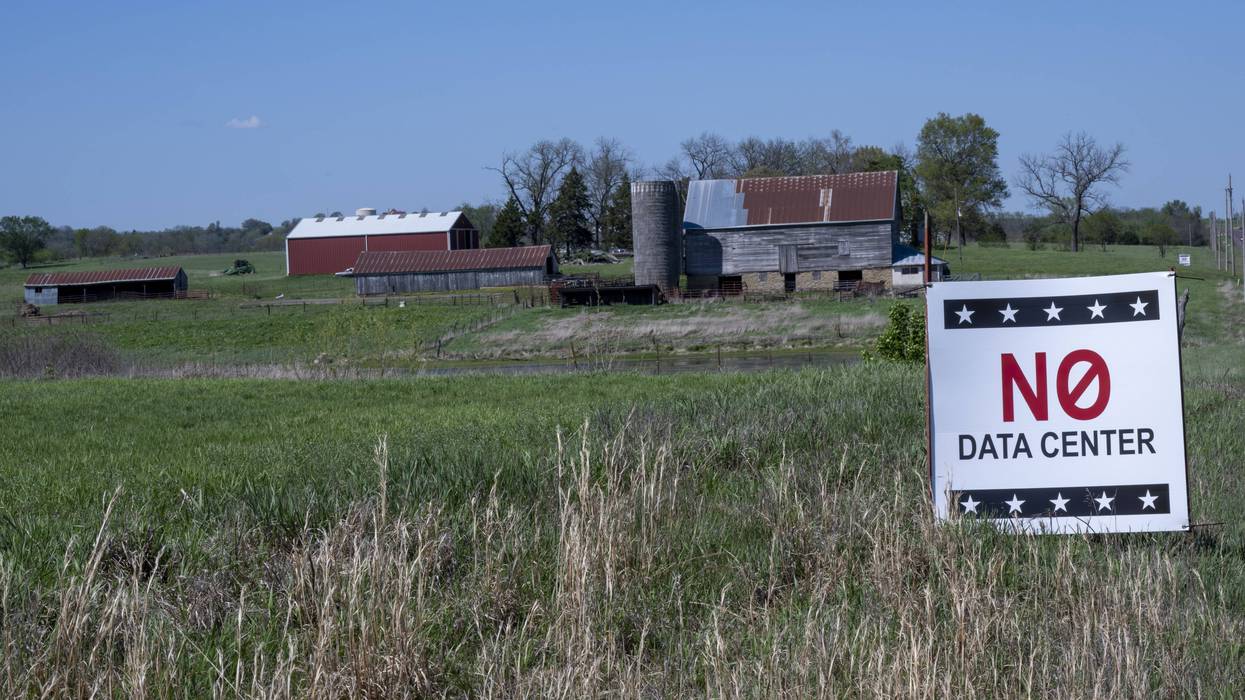
"It's time to build communities, not data centers," said one local activist.
The New Brunswick, New Jersey City Council voted Wednesday to cancel plans to construct an artificial intelligence data center and instead build a new public park where the 27,000-square foot facility would have gone.
Artificial intelligence data centers—which house the servers and other infrastructure needed to train and power AI models—have major environmental and climate impacts, as they consume massive amounts of electricity and water, as well as rare earth metals and other resources.
According to New Brunswick Patch, hundreds of people packed into Wednesday evening's city hall meeting to voice concerns that the proposed data center would send their electricity and water bills skyrocketing, and that the facility would harm the environment.
"Many people did not want this in their neighborhood," New Brunswick NAACP president Bruce Morgan said during the council meeting. "We don't want these kinds of centers that's going to take resources from the community."
The site of the nixed data center, 100 Jersey Avenue, is already slated for development including 600 new apartments—10% of which will be affordable housing units—and warehouses for startups and other small businesses. Now, thanks to Wednesday's vote, a park is on the agenda too.
"This is great news, no data center," New Brunswick resident Anne Norris told Patch.
"My kids went through the public school system; we didn't pay for lunch because we have so many families under the poverty line," Norris said before taking aim at what she said was the dearth of affordable housing approved for the site.
"Given the economic status of the people who live in New Brunswick, I don't think 10% is really sufficient," she contended.
Following the council meeting, jubilant residents celebrated the data center's cancellation, chanting slogans including, "The people united will never be defeated!"
"We say a big 'fuck you' to Big Tech!" local organizer Ben Dziobek shouted to the crowd. "We say a big 'fuck you' to private equity! And it's time to build communities, not data centers."