SUBSCRIBE TO OUR FREE NEWSLETTER
Daily news & progressive opinion—funded by the people, not the corporations—delivered straight to your inbox.
5
#000000
#FFFFFF
To donate by check, phone, or other method, see our More Ways to Give page.
Daily news & progressive opinion—funded by the people, not the corporations—delivered straight to your inbox.
Our present course puts humans on track to be among the species that expire in Earth's ongoing sixth mass extinction. In my conversations with thoughtful people, I am finding increasing acceptance of this horrific premise.
The COVID-19 pandemic, along with climate change, drives home the lesson that we must honor and care for Earth. The increasing frequency of the appearance of deadly viruses reminds us of the consequences of disrupting the natural systems by which life on Earth organizes to create and maintain the conditions essential to both its own existence and ours.
This is a time for learning and conscious collective choice like no other in the human experience. Defining lessons are coming from a variety of "teachers," including the pandemic and climate change, protests against systemic racism, and oddly enough, Donald Trump.
Perhaps we can now recognize and accept the limits of Earth's regenerative systems and our need to help Earth heal from the damage of our recklessness. The Earth is strong, but also vulnerable. As Earth cares for us, we either care for it or bear the consequences of our recklessness.
The pandemic may be seen as a not-so-subtle warning to humanity that we may be sacrificed, if necessary, to protect the health of the planet. On the path to human extinction, the most vulnerable will go first, but there will be no human winners.
"Returning to business as usual is neither possible nor desirable."
COVID-19's attack also exposes the culpability of the economic system that bears major responsibility for our assault against Earth and each other. We now see with ever greater clarity the disconnect between two economies. One is a financial economy devoted to generating unearned profits for monopolists and speculators. The other is an economy of Earth's regenerative systems and humans doing work essential to the well-being of people and planet. We can get along just fine without financial speculation, and labor devoted to wasteful or destructive purposes to make money for rich people. We cannot survive without the regenerative systems of a living Earth and the beneficial labor of both human and nonhuman beings.
We also see more clearly the devastating consequences of concentrating power in the hands of the financial elite. For example, the pandemic has exposed the long and vulnerable supply chains that only serve the interests of exploiters who locate industry where wages and taxes are lowest and environmental regulations are most lax to produce consumer goods for the world's affluent. Disruptions of those supply lines led to shortages of critical products, such as nose swabs and face masks, that we're only now realizing can be more quickly and securely obtained through local producers--assuming we still have some that can take on the job.
Another lesson we're learning involves the nature of money. COVID-19 prompted the U.S. Congress and Federal Reserve to create trillions of dollars in instant money for purposes both good and bad. Never has it been so clear that money is just a number that national governments can create from nothing. Consequently, lack of money should never be a society's defining constraint so long as idle or misdirected resources are available for new money to put to work meeting real needs.
Of course, meeting essential needs is very different from creating money to keep stock prices inflated and to bail out businesses, such as the corporate travel industry that electronic communication may have rendered obsolete. Too much of the money instantly created by Congress and the Fed was aimed at propping up financial markets while the real economy floundered. Therein lies another lesson: Follow the money and know its purpose, which takes us to the lessons of the Trump disaster.
With his perpetual deceptions, his assaults on the integrity and competence of government, and his persistent denial of responsibility for their devastating consequences, Trump reminds us of how much we depend on honest and functioning government at all system levels. He is forcing state and local governments (and also other nations) to take on new responsibilities because they know they cannot wait for leadership from his feckless administration.
In sending unidentified Department of Homeland Security officers to impose his will on the people of Portland, Oregon, and other cities, Trump is reminding us of the dangers of tyranny and the importance of having political leaders who are honest, intelligent, of sound mind, and committed to a strong democracy. We are becoming ever more conscious of the fatal error of electing politicians who believe government is inherently burdensome and best minimized.
These are all lessons essential to the future we seek and to our choices in the upcoming election.
During a July 23 webinar hosted by YES! Media that I took part in, Nafeez Ahmed, executive director of the System Shift Lab and research fellow at the Schumacher Institute for Sustainable Systems, noted that the emergence of the new depends on the disintegration of the old. While many of us have been eager to welcome the new, we are not always so ready to accept the disintegration of the old. Yet the point that Nafeez drove home in our webinar is that both are part of the process of transformation.
As the institutions of the imperial civilization of our past disintegrate, it exposes the extent to which their power has rested on a foundation of war, racism, and violence devoted to enforcing mass servitude and securing the rights of property owners. Succumbing to the enticements of money worship, we celebrate the successes of a miniscule super-wealthy minority, and the fiction that we might one day join them.
Let us welcome the growing recognition that returning to business as usual is neither possible nor desirable. We must accept our current mission to birth a new civilization devoted to the well-being of people and Earth: A civilization in which money is just a tool, and nurturance of life is the prime purpose.
I just returned from a conference of influential decision-makers in China, where I presented on economics for an ecological civilization in the 21st century. China and the United States are very different, but when it comes to current threats and missed opportunities, we share a great deal more than we may realize.
The message I took to China will be familiar to readers of my column. It begins with recognizing the fundamental truth that humans are born of and nurtured by a living Earth. Forgetting that basic fact, we became captive to a deeply flawed economic theory that gained global prominence in the mid-20th century, is destroying Earth's capacity to sustain life, and puts us on a path to self-extinction.
The countries that embraced the fallacies of 20th century economics now face an imperative to transform their culture, institutions, technology, and infrastructure to align with the eight principles of a 21st century economics outlined in my previous YES! column. Among other things, these principles call on us to abandon the goal of increasing GDP through consumption in favor of growing the well-being of people and Earth by supporting culturally rich, low-consumption lifestyles. Also, we must dismantle profit-maximizing corporations and convert the pieces to worker and community ownership. And we must redesign urban infrastructure to eliminate most dependence on automobiles.
I was eager to learn how these principles would be received in a country with a population more than four times that of the United States, devastating environmental problems, and the world's most aggressive capitalist economy managed by a Communist Party that is nominally committed to an ecological civilization.
I find China especially interesting because of its government's demonstrated ability to make big changes in the country's direction with seemingly impossible speed, which we must now do as a species if we are to find our way to a viable future.
What I experienced during my brief visit was a deeply conflicted country with a political system that offers little room for open public debate, and which is stuck in an economic framework known in China as the Two Mountains theory. One "mountain" represents a commitment to a healthy environment of clean water and vibrant mountains lush with life. The other represents a commitment to maintaining one of the world's highest GDP growth rates by catering to the interests of big business. An article by economic historian Richard Smith on China's recent economic history underscored for me the deep and largely irreconcilable conflict between environmental health and maximizing GDP.
The conflict between growth and sustainability is all too frequently resolved in China by prioritizing the second mountain--with harsh consequences for human and environmental health. It seems closely connected to the conflict between the presumed commitment of China's government to advancing the interests of workers, who struggle under harsh conditions and low pay, and an economy that churns out new billionaires at a rate of two per week.
My overall message in China boiled down to this: If your goal is to turn out billionaires, then concentrate on growing GDP by giving control of the economy to profit-maximizing corporations. If your goal is instead to increase the well-being of people and the Earth, then abandon GDP as a relevant indicator and focus instead on growing indicators of the outcomes you want while shifting power to people and community.
We assume that once elected, the new president will single-handedly wipe away the corruption.
Seems like a rather straightforward choice for a government dedicated to an ecological civilization and workers' well-being. Indeed, it would seem to be such for all governments that presume to represent the interests of their people. Given the extent to which my message challenged the official commitment to growing consumption to grow GDP, it seemed to get a remarkably positive hearing.
I was still sorting out the contradictions when I returned home to the U.S. just in time to view the most recent round of debates in the contest to choose the Democratic Party's 2020 presidential candidate. Both the Republican and Democratic parties are controlled by their corporate establishment wings, and our political debates are controlled by these same parties and by the corporate media. As the CNN moderators pounded the candidates with questions scripted from far-right talking points, I asked myself, "Could our politicians feel as constrained as most Chinese political figures do by the equivalent of a Two Mountains theory?"
Surely politicians like Bernie Sanders and Elizabeth Warren don't sound constrained. But no one among the current candidates is suggesting that we abandon GDP as our primary measure of economic performance. While some have called to break up big tech giants, no one suggests we break up and restructure all big corporations and subordinate them to the communities in which they do business. And no one is suggesting restructuring urban areas so that most people have no need of cars.
Yet corporate media pundits dismiss "unserious" proposals, such as Medicare for All and increasing taxes on corporations, as too extremist to win against presumably mainstream Republicans, who want to eliminate all public health care and environmental regulations, continue to separate children from their parents at the border, block any meaningful reform of gun laws, and are working to make abortion illegal nationwide.
Our political system has become so deeply divided by a psychopathic fringe intent on growing their own fortunes that we can't even assure all Americans have access to basic health care and a quality education, let alone an adequate means of living in return for honest labor. We are so caught up in debates about who is most oppressed and who most deserves what reparations that we don't even ask how we might create a society free from oppression in which all people can have lives of material sufficiency and spiritual abundance on a beautiful and healthy Earth.
We act as if we believe that we need only figure out who among 20 candidates has all the best answers to the problems that confront us. We assume that once elected, the new president will single-handedly wipe away the corruption, restore the integrity and competence of government, secure the health of the environment, liberate the oppressed, and secure good jobs for all in the face of relentless opposition from powerful psychopaths protecting their interests.
We should be spending far less time debating the relative merits of 20 presidential candidates, and far more time bridging all the divides that separate us. We should be building an unstoppable movement of the world's people that crosses all boundaries, united in a commitment to create a world that truly works for all. The deep transformation of culture, institutions, technology, and infrastructure on which our common future depends will be a difficult struggle and will require persistent and determined support from powerful social movements.
We the people will need to lead that discussion and demand that the politicians follow. We will need to frame the possibilities of that future and the path to its achievement through countless overlapping conversations in forums open to everyone.
Let us not be distracted from that cause by political debates structured by corporate media to divert our attention from proposals that might break the power of the corrupt system. It is a tall order, but so, too, at this moment is human survival.
"I believe that for a moment I thought the explosion might set fire to the atmosphere and thus finish the Earth, even though I knew that this was not possible."
These words of Manhattan Project physicist Emilio Segre, quoted by Richard Rhodes in his book The Making of the Atomic Bomb, refer to the Trinity blast on July 16, 1945, at Alamogordo, N.M., the first atomic explosion in history and, so it appears, a turning point for all life on this planet.
The atmosphere didn't catch fire at 5:30 that morning, but Segre's words remain relevant, sort of like radioactive fallout. They encapsulate what may be history's ultimate moment of human arrogance: the belief in a sense of separateness from and superiority to nature so thorough that we have, with our monstrous intelligence, the ability and therefore the right to play Bad God and make the whole planet go poof.
Turns out the Trinity test set into motion something even more profound than the nuclear era. The bomb didn't just "defeat" Japan and define the Cold War, with its suicidal nuclear arms race. It is also, at least symbolically, marks the beginning of what has come to be known as the Anthropocene: an era of profound climate and "Earth system" destabilization caused by human activity and therefore, like it or not, establishing humans as co-equal participants in activity of the natural world.
Any institution founded on such myths and illusions - that the planet is ours to exploit, that some people matter more than others, that national borders are real, that dehumanizing and killing one another (a little activity called war) keeps us safe, that money equals God - cannot and will not survive the Anthropocene.
There's more to this "co-equal" status than nuclear weapons, of course. They may be the tip of our arrogance, but we've been exploiting and rearranging the planet for nearly 12,000 years, since the beginning of the era we are now leaving, the Holocene, an era of climate stability in which human civilization and all written history emerged. From the development of agriculture to the industrial revolution - the plundering of the Earth for oil and coal, the spewing of infinitesimal plastic nurdles across the planet, the creation of continent-sized trash mounds afloat in the oceans, the replacement of biodiversity with monoculture, the poisoning of the air and water and, yes, nuclear testing and the spread of radioactive fallout - humanity, or at least a small portion of it, has exercised an intelligence with a serious moral void.
And now the chickens are coming home to roost. Or as David Korten put it: "Humans might be the first species to knowingly choose self-extinction."
What's crucial about all this goes well beyond the dangers of climate change and the need for techno-fixes to our socioeconomic structures. History professor Julia Adeney Thomas puts it this way: "The Anthropocene's interrelated systematicity presents not a problem, but a multidimensional predicament. A problem might be solved, often with a single technological tool produced by experts in a single field, but a predicament presents a challenging condition requiring resources and ideas of many kinds. We don't solve predicaments; instead, we navigate through them."
She adds: ". . . the hardest challenges will be about how to alter our political and economic systems."
These aren't just technical problems for "experts" to solve while the rest of look on (or go shopping). What's emerging from all this for me is that humanity has to evolve for its own survival, and evolution is going to take all of us - or at least all of us who can think beyond the structures of thought in which we grew up, in which we came of age. The first premise for navigating the Anthropocene may be this: We're all in it together.
Simple as this sounds, the implications of such a statement, if it is true, begin mushrooming into unfathomable complexity, especially when "all" refers not simply to all 7.4 billion human beings out there but all of life: the biosphere, the planet. We have to rethink who we are in a way that has, quite likely, never before happened.
"In the Anthropocene the old simplicities are gone," writes Mark Garavan. "We are no longer human subjects acting upon an objective nature 'outside' us. Nature and human are now bound together. Free nature is over. Free humanity is over. They are relics of the Holocene. In our new age, Earth and Human are entangled irrevocably together. Welcome to the era of Earth-bound responsibility! The assumptions, the myths, the illusions of the Holocene no longer apply."
And any institution founded on such myths and illusions - that the planet is ours to exploit, that some people matter more than others, that national borders are real, that dehumanizing and killing one another (a little activity called war) keeps us safe, that money equals God - cannot and will not survive the Anthropocene, and the "solutions" that emerge from such institutions, e.g., solving the climate crisis, are rooted in failure. "The challenge," says Garavan, "is to re-think and re-inhabit our planet."
That is to say, we have to start over.
And I think that's what's happening. New values are percolating. So are old values - the values human beings once embraced as they claimed the right to occupy Planet Earth. These values include interdependence and cooperation, and profound reverence for the planet. Rupert Ross, in his book Returning to the Teachings, points out, for instance: "The Lakotah had no language for insulting other orders of existence: "pest . . . waste . . . weed."
Indigenous understanding is not "primitive." It includes cooperation and compassion in its grasp of how things work, of what it means to live within the circle of life. The indigenous peoples of the planet have remained its protectors.
As Jade Begay and Ayse Gursoz point out at EcoWatch: "Even the seemingly groundbreaking Paris agreement neither includes human rights in its text nor acknowledges Indigenous rights -- even though lands and waters stewarded by Indigenous communities make up 80 percent of the world's biodiversity. What we need is for climate policy and the overall climate movement to address problems of inequality, because climate change is just as much a social issue as it is an environmental issue."
In other words, biodiversity and social diversity are both precious. Knowing this means re-inhabiting the planet, not setting it on fire.
This month the Green New Deal was introduced in the U.S. Congress with much fanfare, and its opponents quickly mobilized.
The resolution is more than a set of specific legislative proposals. It is a framework for an ambitious commitment to address climate change through eliminating fossil fuels and reducing agricultural emissions while also reducing inequality, creating well-paying green jobs, and providing people the skills to fill them. Given the threat the climate crisis poses to the future of humanity, it is arguably more important than was Franklin Roosevelt's bold New Deal response to the Great Depression.
What followed was predictable: Opponents, both on the right and in the middle, immediately attacked the plan as unaffordable far-left socialist overreach, clearly hoping that the socialist label would scare people away. I'm sensing that for most of today's electorate, the threat posed by wildfires, floods, mass extinctions, rising sea levels, and a shifting polar vortex is far more frightening than simplistic political labels.
That's especially the case for labels like "socialism" and "communism," which date from a time that for many is ancient history.
Our living spaceship is dying by our hand, and there are no escape capsules, and no place to go if there were. So people, especially the young, are mobilizing to act and to demand action from both government and business.
Some of my generation, however, may stumble on the political labels wielded by the opponents of such a bold vision as the Green New Deal. If the new young leaders are to bring the reluctant along, they will need to understand how terms like socialism and communism gained such a negative hold on our psyche. My own experience has unique elements, but my response to the political labels of our time was fairly typical.
I was born in 1937 and grew up in the post-Depression years in a family of self-identified conservatives in a small town with thriving unionized lumber, pulp, and aluminum plants. The plants' workers were the customers on which our family retail business depended. We were proud to view America as a middle-class nation free of the extremes of wealth and poverty that characterized so much of the rest of the world. In my innocence, I assumed all Americans belonged to the middle class--that America was in effect a classless society.
Neither the capitalist, socialist, nor communist labels adequately capture such diversity.
My political consciousness was formed during a time of confrontation between the United States and the Soviet Union. We lived with the ever-present threat of mutual nuclear annihilation. We perceived communism--and socialism by extension--as a mortal threat. To be identified as a communist or socialist was a ticket to social and political exclusion.
It was my personal fear of the global threat of spreading communist revolutions that led me, the oldest son, to turn away from heading the family business. I chose to devote my life instead to the cause of ending poverty in formerly colonized nations by spreading the secrets of U.S. business success, with a goal of making all nations middle-class societies like the United States.
With time my understanding of the world's social, environmental, economic, and political realities expanded. My critique of capitalism grew steadily stronger. But my fear of association with a socialist or communist label remained, partly for fear of rejection and partly because it was clear that neither socialism nor communism in their commonly understood expressions offered a solution.
A few days ago I read a thoughtful response from a reader to my most recent column, "Capitalism vs. Socialism Is a False Choice." The comment included a link to an article that reinforced the key argument of my column. And yet, most of the author's references were to Karl Marx.
Not long ago, I would have been uneasy with such association. This time I was not. As I reflected on why, I realized that the labels that had previously been so frightening no longer seem to hold consequential public sway. I don't think I am alone in this. I sense the public may be ready for a thoughtful search for solutions that link public and private initiative beyond the grand labels--a search reflected in the substance of the Green New Deal.
Such a liberation of the public debate is long overdue. The world of my earlier years has changed beyond recognition. The Soviet Union, along with its celebration of armed revolution and the collapse of its self-proclaimed dictatorship of the proletariat, disintegrated almost 30 years ago. The Russia that has emerged is an unabashed capitalist dictatorship of the mafia. China's Communist party now rules the world's most aggressive and successful capitalist economy. And in the United States, the middle class is disappearing as the division between rich and poor becomes ever more extreme.
It is now evident to most people that we face a desperate need for deep change. There may be no place in a viable human future for profit-driven global megacorporations. There surely will be a continuing need for democratic governments, public services, nonprofit civic organizations, and a vast variety of family and cooperative businesses. Neither the capitalist, socialist, nor communist labels adequately capture such diversity.
When we talk about the Green New Deal, let's forget the labels and talk about how to mount an effort up to the existential challenges of our time.
We grow up in the United States proud of our nation's historic role in leading humanity's transition from monarchy to democracy. We rarely ask, however, whether the system we have truly fits the definition of democracy.
Merriam-Webster defines democracy as "government by the people." What we have in the United States more closely resembles the Merriam-Webster definition of plutocracy, "government by the wealthy." A nation ruled by big money is not a democracy.
The 2018 midterm elections inserted a wave of new political blood into Congress and many state houses--younger, more female, more racially and religiously diverse, less beholden to big money, and attuned to a strong public desire for change.
At the national level, the new representatives of a restless electorate encounter a system in political lockdown, at least until the next election. That makes this is a good time for a serious reality check on what will be required to achieve the democracy we thought we had and a future that truly works for everyone.
In the United States, we grow up schooled in our national mythology: our nation was created as a democracy by brave founders, who crafted a constitution that initiated a global transition from monarchy, and who were driven by a vision that makes the United States a beacon of hope and possibility for the world. We are taught that our laws now and forever must hold to the founders' original intent.
We are not taught, and it is rarely mentioned, that the Constitution the founders crafted was designed to secure economic power for themselves, and that economic power has been the ultimate foundation of political power for all of human history.
Political power ultimately resides with those who control our access to a means of living. When that access is controlled by the few, the result is plutocracy--a reality deeply embedded in both U.S. and world history. The democratization of political power therefore depends on the democratization of economic power.
The wealthy White men who stepped forward to lead the war for America's independence from Britain put their lives and fortunes on the line. Their leadership liberated the original 13 colonies from British rule to birth a new and independent nation. It was not, however, a totally selfless act. In so doing, they also freed themselves from deference to and taxation by the British crown, while positioning themselves to subsequently write the rules by which the new nation would govern itself. They had no intention, however, of sacrificing the privilege that came from their ownership of lands stolen from Native Americans, slaves abducted from Africa, and other commercial, manufacturing, and financial assets that gave them their distinctive social, economic, and political power and privilege.
To the contrary, they wrote the new nation's Constitution to secure the power and privilege of men like themselves, while securing it against expropriation by any among them who might aspire to be anointed king. By establishing elections of members of Congress and a president, they precluded a hereditary monarchy. But by limiting the vote to White male property owners like themselves, they stripped political power from all but those of their own race, gender, and class.
The original Constitution thus affirmed slavery, secured the rights of property, and limited the vote to White male property owners. Voting rights for other Americans--women, Native Americans, Blacks, and those with no property, including Whites--came slowly and to this day remain to be fully secured.
We could argue about whether the resulting government ever worked for more than a minority of America's people. Clearly a substantial majority--including most White males--do not feel it is working for them today.
In a 2018 Gallup poll on confidence in U.S. institutions, Congress--the branch of government that is supposed to best represent the will of the American people, and the branch with the power to impeach corrupt presidents and judges--came in rock bottom. Only 11 percent of those polled expressed "a great deal of confidence" or "quite a lot of confidence" in Congress. It is surely no coincidence that Congress is also the branch of government most visibly corrupted by big money political donations and the revolving door between government service and lucrative careers in lobbying for the industries they are charged with regulating.
A recent poll by the Pew Research Center, found that a strong majority of Americans, irrespective of political alignment, consider democratic ideals and values important and believe we fall far short in living up to them. Only 18 percent of Americans feel democracy is working "very well," while 61 percent feel fundamental changes are needed in the design and structure of the American government. This includes the majority (68 percent) of Democrats and 50 percent of Republicans. Of those that Pew identified as least politically engaged, 71 percent support significant institutional change.
These data help to explain why the U.S. ranks near the bottom among the world's democracies in voter turnout . In the 2016 presidential election, only 55.7 percent of Americans of voting age voted, compared to recent turnout rates of 85.8 percent in Sweden (2014) and 80.3 percent in Denmark (2015). The turnout in the 2018 U.S. midterm elections was 50.3 percent, the highest in a midterm since 1914 and up from 36.7 percent in 2014. But that's still well below the all-time highest turnout rate in any federal election: 82.6 percent in 1876.
Low turnout rates tend to reflect the mood of the country. The more you feel the system is rigged and the more difficult that system makes it for you to vote, the less likely you are to try.
We are not experiencing a failure of democracy. The failure we experience is the failure of the institutions of a plutocracy. Such a system, structured and managed to secure rule by the rich, is indifferent to the needs of the many. The unusual levels of voter and candidate enthusiasm displayed during the 2018 midterm elections showed the desire to clean up a deeply corrupted political system. But it will take far more than the modest proposals currently on the table to move beyond a two-party duopoly beholden to corporate money. My next column will look at what the transition to an authentic democracy will require.
It's not likely that many of us will mourn the passing of 2018. It's been a deeply troubled year defined by wildfires, floods, earthquakes, water shortages, financial chaos, political gridlock, flows of displaced persons, growth in the gap between rich and poor, the rise of dictatorial leaders, and a dire consensus warning from scientists on the impact of climate change.
I've been pondering my New Year's resolution for 2019. Deep change is clearly needed. But what can I do that might measure up to the magnitude of the problem? A promise to turn down my thermostat? Buy an electric car? Give to a charity? Take in a refugee? The possibilities that come to mind--even those that might involve serious commitment--seem trivial, given the scale of the problem.
The problem isn't me. It isn't you. Nor is it those folks over there. The problem is we. The big we, humanity: What we believe, how we live, how we relate to one another and Earth. We have gotten something terribly wrong that we must now get right. But what? Do we even agree on the problem?
"The problem is we. The big we, humanity: What we believe, how we live, how we relate to one another and Earth. We have gotten something terribly wrong that we must now get right. But what? Do we even agree on the problem?"
Perhaps moving forward begins with honoring our African roots--the birthplace of our species that produced the wisdom of "Ubuntu," often translated as "I am because we are." Ubuntu is a profound truth long ignored by so-called Western civilization, but now confirmed by the leading edge of contemporary science: Complex life exists--can exist--only in living communities in which organisms together create and maintain the conditions essential to their individual and collective existence.
Not only do we depend on one another, but our ability to live rests on the services contributed by the many members of Earth's community of life--the bees that pollinate the flowers, the trees essential to the water cycle, the beetles that aid the decomposition of plants after their death, the microbes that digest my food so my body can use its energy and nutrients. Without these many, wondrously diverse beings, Earth would be just another dead rock floating in space.
I sense that humanity is awakening to a profound truth: We--the big we--thrive together, or we expire together. This comes with a recognition that many of the myths by which we live are falsehoods so divorced from reality that they threaten our mutual existence.
It is deeply deflating to realize just how much of what we call Western civilization is built on deceptions: The myth of the lone individual; the myth of freedom without responsibility for our neighbor; the myth that societies built on the exploitation of people and nature are advanced civilizations morally superior to the peoples they devastate; the myth that rule by the richest among us is a form of democracy.
"It is deeply deflating to realize just how much of what we call Western civilization is built on deceptions."
And also, our society is built on the myth that our well-being is enhanced by institutions, technologies, and infrastructure that substitutes financial transactions for caring relationships, isolates us from one another to the point that too many of us live alone, moving us in single-person cars, and encouraging us to buy whatever we need from Amazon.com with no need for contact with another living being. As we celebrate our "freedom," we wonder why mental health declines and suicides grow.
As we approach 2019, I see hopeful signs of widespread awakening to the truth that either we embrace the responsibilities of community life and thereby thrive, or we will perish together in the faux freedom of our isolation.
Everywhere I turn--from the spontaneous conversation a few nights ago with neighbors gathered for Christmas, to recent meetings in South Korea that included the mayor of Seoul, and to global strategy conversations with fellow members of the Club of Rome in Europe and Africa--I am finding an eager readiness for discussions about our global crisis and the path beyond it. These discussions cross the lines of race, religion, and class beyond anything I've previously experienced.
Conditioned to think and act as an isolated "me," we may find it difficult to hold to the "we" space. Yet the "we" conversation is essential to the task of creating a truly civilized and democratic civilization that works for the whole of life.
So, my resolution for the New Year? To devote my time and energy at every opportunity to encouraging and engaging these conversations about getting from me to we. I hope you may consider making this a resolution for yourself as well.
When I ask an audience, "Who believes we are on a path to self-extinction?" nearly every hand goes up. It's a sign of a growing awareness that humanity is on a path to self-imposed environmental and social collapse. For me, that awareness is a source of hope.
I recently discovered an even deeper source of hope on a trip to South Korea. There I was involved in a remarkable series of international discussions on the transition to "ecological civilization." I had the privilege of keynoting a conference on the transition hosted by Park Won-soon, the mayor of Seoul, and joined him in an interview with one of Seoul's daily newspapers.
The concept is gaining traction elsewhere as well. China has embedded its commitment to ecological civilization in its constitution.
Last week, I explored the idea of an ecological civilization in a lively discussion with the Metropolitan Democratic Club of Seattle. Next week I join four leading contributors to the ecological civilization dialogue--Jeremy Lent, Matthew Fox, John B. Cobb Jr., and my wife, Fran Korten--to explore the idea at the Parliament of the World's Religions conference in Toronto.
I find the term "ecological civilization" especially well-suited to the changes we must achieve to have a viable future. "Ecological" focuses our attention on the active interdependence of all living organisms and their ability to self-organize into diverse, symbiotic communities. "Civilization" evokes the depth of the cultural and institutional transformation required to create a human future of peace, justice, and environmental health that is truly civil.
The vision of an ecological civilization is related to terms used elsewhere. Latin Americans speak of buen vivir and sumac kawsay (good living), a commitment now enshrined in the constitutions of Bolivia and Ecuador. Africans speak of ubuntu (humanity), often translated as "I am because we are." Ecological civilization embraces both of these frames and more.
A transformation to ecological civilization is both possible and essential to the future of humanity. It's spurred by growing awareness of the extent to which past cultural, institutional, and infrastructure choices disrupt our connections to one another and Earth to serve the interests of the very rich at the expense of the well-being of everyone else. This now poses an existential threat to our future. But evidence that this awareness is spreading gives me a renewed hope that humanity can and will rise to the challenge of the transition.
We humans now have the knowledge and technology to move beyond the violence, fear, and daily struggle for survival that besets the lives of so many. We have the capacity to secure a world of peace, beauty, diversity, creativity, material sufficiency, and spiritual abundance for all people, and have all that in balance with Earth's ecosystems. Achieving such a goal requires that we make this vision our common goal and transform our cultural narratives, institutions, and infrastructure accordingly--a steep but imperative challenge.
Success requires leadership from all levels of society, including from people everywhere working to grow community-facilitating cultural values, institutions, and infrastructure in the places where they live. Together we need to achieve four conditions critical to the transition.
1. Earth balance. We must reduce humanity's total environmental burden to bring us into sustainable balance with the capacity of Earth's generative systems. This requires immediate action to eliminate nonessential consumption--including fossil fuels and weaponry. Longer-term action is needed to create institutional and physical structures that make doing the right thing easy and enjoyable--for example, designing urban environments to make the essentials of daily living readily accessible by biking, or walking in safe and pleasant neighborhoods connected by convenient mass transit.
2. Equitable distribution. We must achieve an equitable distribution of wealth and power. Immediate action is required to stop the further concentration of wealth while advancing equitable cooperative ownership, restoring the commons, and connecting the rights of ownership with corresponding responsibilities.
3. Life-serving technologies. We must advance technologies that strengthen rather than impair life's regenerative capacity. Immediate action is required to roll back use of harmful technologies, including the use of toxic chemicals in agriculture and our dependence on carbon and nuclear energy. Longer-term action is needed to develop and apply technologies that better meet human needs while simultaneously restoring the environment, such as developing greener agricultural practices and creating buildings designed for natural heating and cooling.
4. Living communities. We must rebuild relationships of people to one another and to nature to create strong, healthy, deeply democratic living communities. This will involve reducing dependence on money while encouraging sharing and mutual self-help in the places where people live. Immediate action is required to block further concentration of corporate power, while taking longer-term steps to break up existing concentrations, secure the accountability of governments to the people, advance equitable participation in local cooperative ownership and shared housing, and establish rules that assure the accountability of businesses to the communities in which they operate.
The transition will test the limits of human creativity, social intelligence, and commitment to collaborate in the face of relentless establishment opposition. We now equate money to wealth and see making money as the key to well-being and happiness. In doing so, we ignore the reality that we are living beings born of and nurtured by a living Earth. Money is merely a number that has no intrinsic value. To destroy life only so that the financial assets of billionaires can grow is a monumental act of collective stupidity.
Forward-looking communities around the world are engaged in advancing these transformations on both micro and macro scales. Their activities must become the norm everywhere, with all peoples and governments freely sharing the lessons of their efforts to develop proven, deeply democratic approaches to local self-reliance and liberation from corporate rule. The well-being of people and planet will rise, as corporate profits fall.
It is time to unite as families, communities, and nations in our common identity as members of an ecological civilization, with a commitment to creating the possible world of our shared human dream.
We've now been warned by the world's leading climate scientists that we have just twelve years to limit climate catastrophe. The UN's International Panel on Climate Change (IPCC) has put the world on notice that going from a 1.5deg to 2.0deg C rise in temperature above preindustrial levels would have disastrous consequences across the board, with unprecedented flooding, drought, ocean devastation, and famine.
Meanwhile, the world's current policies have us on track for more than 3deg increase by the end of this century, and climate scientists publish dire warnings that amplifying feedbacks could make things far worse than even these projections, and thus place at risk the very continuation of our civilization. We need, according to the IPCC, "rapid, far-reaching and unprecedented changes in all aspects of society." But what exactly does that mean?
Last month, at the Global Climate Action Summit (GCAS) in San Francisco, luminaries such as Governor Jerry Brown, Michael Bloomberg, and Al Gore gave their version of what's needed with an ambitious report entitled "Unlocking the Inclusive Growth Story of the 21st Century by the New Climate Economy." It trumpets a New Growth Agenda: through enlightened strategic initiatives, they claim, it's possible to transition to a low-carbon economy that could generate millions more jobs, raise trillions of dollars for green investment, and lead to higher global GDP growth.
But these buoyant projections by mainstream leaders, while overwhelmingly preferable to the Republican Party's malfeasance, are utterly insufficient to respond to the crisis facing our civilization. In promising that the current system can fix itself with a few adjustments, they are turning a blind eye to the fundamental drivers propelling civilization toward collapse. By offering false hope, they deflect attention from the profound structural changes that our global economic system must make if we hope to bequeath a flourishing society to future generations.
That's because even the climate emergency is merely a harbinger of other existential threats looming over humanity as a result of ecological overshoot--the fact that we're depleting the earth's natural resources at a faster rate than they can be replenished. As long as government policies emphasize growing GDP as a national priority, and as long as transnational corporations relentlessly pursue greater shareholder returns by ransacking the earth, we will continue accelerating toward global catastrophe.
Currently, our civilization is running at 40% above its sustainable capacity. We're rapidly depleting the earth's forests, animals, insects, fish, freshwater, even the topsoil we require to grow our crops. We've already transgressed three of the nine planetary boundaries that define humanity's safe operating space, and yet global GDP is expected to more than double by mid-century, with potentially irreversible and devastating consequences. By 2050, it's estimated, there will be more plastic in the world's oceans than fish. Last year, over fifteen thousand scientists from 184 countries issued an ominous warning to humanity that time is running out: "Soon it will be too late," they wrote, "to shift course away from our failing trajectory."
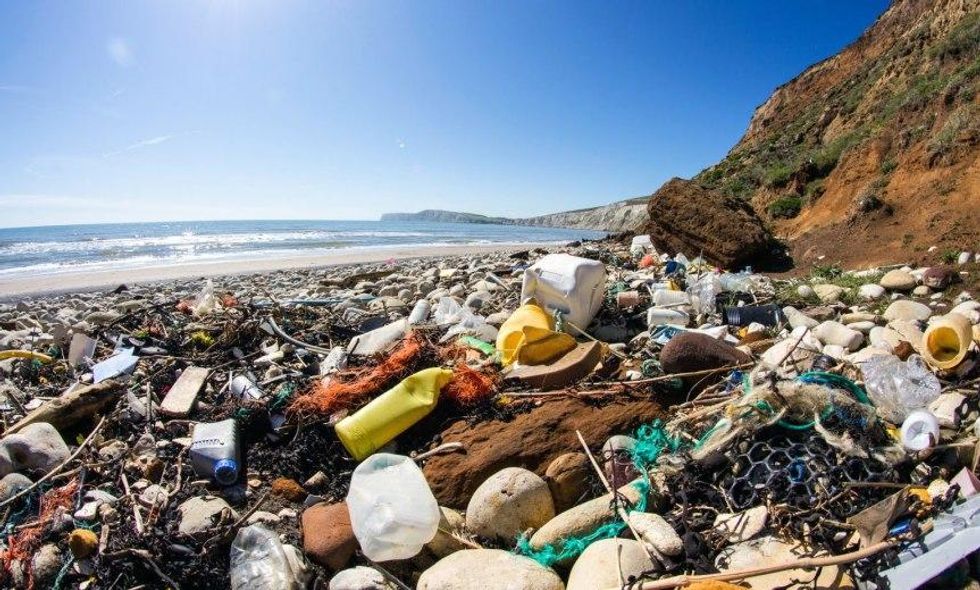
Techno-optimists, including many of the GCAS dignitaries, like to dismiss these warnings with talk of "green growth"--essentially decoupling GDP growth from increased use of resources. While that would be a laudable goal, a number of studies have shown that it's simply not feasible. Even the most wildly aggressive assumptions for greater efficiency would still result in consuming global resources at double the sustainable capacity by mid-century.
A desperate situation indeed, but one that need not lead to despair. In fact, there is a scenario where we can turn around this rush to the precipice and redirect humanity to a thriving future on a regenerated earth. It would, however, require us to rethink some of the sacrosanct beliefs of our modern world, beginning with the unquestioning reliance on perpetual economic growth within a global capitalist system directed by transnational corporations driven exclusively by the need to increase shareholder value for their investors.
In short, we need to change the basis of our global civilization. We must move from a civilization based on wealth production to one based on the health of living systems: an ecological civilization.
The crucial idea behind an ecological civilization is that our society needs to change at a level far deeper than most people realize. It's not just a matter of investing in renewables, eating less meat, and driving an electric car. The intrinsic framework of our global social and economic organization needs to be transformed. And this will only happen when enough people recognize the destructive nature of our current mainstream culture and reject it for one that is life-affirming--embracing values that emphasize growth in the quality of life rather than in the consumption of goods and services.
A change of such magnitude would be an epochal event. There have been only two occasions in history when radical dislocations led to a transformation of virtually every aspect of the human experience: the Agricultural Revolution that began about twelve thousand years ago, and the Scientific Revolution of the 17th century. If our civilization is to survive and prosper through the looming crises of this century, we will need a transformation of our values, goals, and collective behavior on a similar scale.
An ecological civilization would be based on the core principles that sustain living systems coexisting stably in natural ecologies. Insights into how ecologies self-organize offer a model for how we could organize human society in ways that could permit sustainable abundance. Organisms prosper when they develop multiple symbiotic relationships, wherein each party to a relationship both takes and gives reciprocally. In an ecology, energy flows are balanced and one species' waste matter becomes nourishment for another. Entities within an ecology scale fractally, with microsystems existing as integral parts of larger systems to form a coherent whole. In a well-functioning ecosystem, each organism thrives by optimizing for its own existence within a network of relationships that enhances the common good. The inherent resilience caused by these dynamics means that--without human disruption--ecosystems can maintain their integrity for many thousands, and sometimes millions, of years.
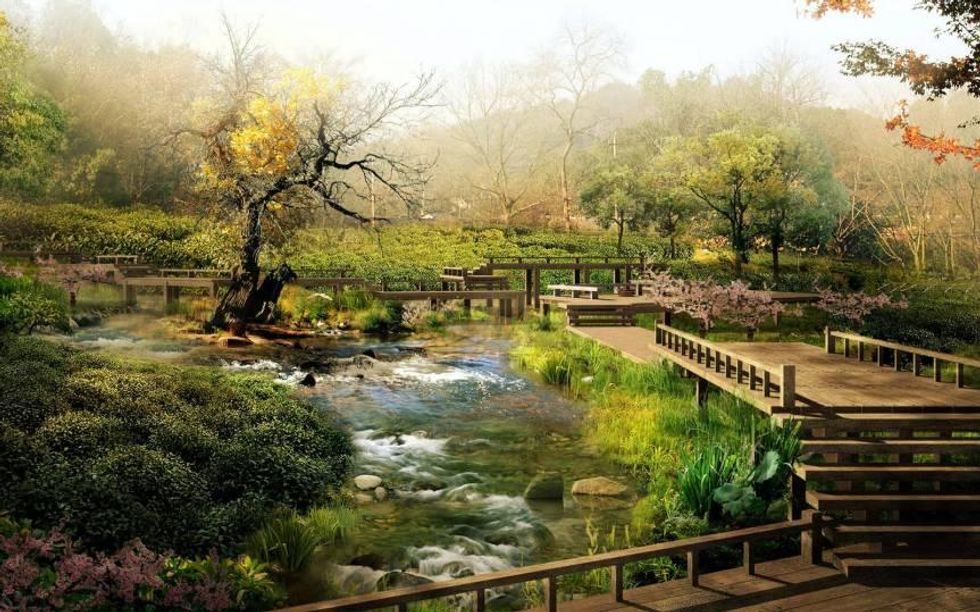
In practice, transitioning to an ecological civilization would mean restructuring some of the fundamental institutions driving our current civilization to destruction. In place of an economy based on perpetual growth in GDP, it would institute one that emphasized quality of life, using alternative measures such as a Genuine Progress Indicator to gauge success. Economic systems would be based on respect for individual dignity and fairly rewarding each person's contribution to the greater good, while ensuring that nutritional, housing, healthcare, and educational needs were fully met for everyone. Transnational corporations would be fundamentally reorganized and made accountable to the communities they purportedly serve, to optimize human and environmental wellbeing rather than shareholder profits. Locally owned cooperatives would become the default organizational structure. Food systems would be designed to emphasize local production using state-of-the-art agroecology practices in place of fossil fuel-based fertilizer and pesticides, while manufacturing would prioritize circular flows where efficient re-use of waste products is built into the process from the outset.
In an ecological civilization, the local community would be the basic building block of society. Face-to-face interaction would regain ascendance as a crucial part of human flourishing, and each community's relationship with others would be based on principles of mutual respect, learning, and reciprocity. Technological innovation would still be encouraged, but would be prized for its effectiveness in enhancing the vitality of living systems rather than minting billionaires. The driving principle of enterprise would be that we are all interconnected in the web of life--and long-term human prosperity is therefore founded on a healthy Earth.
While this vision may seem a distant dream to those who are transfixed by the daily frenzy of current events, innumerable pioneering organizations around the world are already planting the seeds for this cultural metamorphosis.
In China, President Xi Jinping has declared an ecological civilization to be a central part of his long-term vision for the country. In Bolivia and Ecuador, the related values of buen vivir and sumak kawsay ("good living') are written into the constitution, and in Africa the concept of ubuntu ("I am because we are") is a widely-discussed principle of human relations. In Europe, hundreds of scientists, politicians, and policy-makers recently co-authored a call for the EU to plan for a sustainable future in which human and ecological wellbeing is prioritized over GDP.
Examples of large-scale thriving cooperatives, such as Mondragon in Spain, demonstrate that it's possible for companies to provide effectively for human needs without utilizing a shareholder-based profit model. Think tanks such as The Next System Project, The Global Citizens Initiative, and the P2P Foundation are laying down parameters for the political, economic, and social organization of an ecological civilization. Meanwhile, visionary authors such as Kate Raworth and David Korten have written extensively on how to reframe the way we think about our economic and political path forward.
As the mainstream juggernaut drives our current civilization inexorably toward breaking point, it's easy to dismiss these steps toward a new form of civilization as too insignificant to make a difference. However, as the current system begins to break down in the coming years, increasing numbers of people around the world will come to realize that a fundamentally different alternative is needed. Whether they turn to movements based on prejudice and fear or join in a vision for a better future for humanity depends, to a large extent, on the ideas available to them.
One way or another, humanity is headed for the third great transformation in its history: either in the form of global collapse or a metamorphosis to a new foundation for sustainable flourishing. An ecological civilization offers a path forward that may be the only true hope for our descendants to thrive on Earth into the distant future.
We the people of the United States find ourselves in a political crisis and resurgent tribalism that pits left against right, hard-left against moderate-left, and extreme-right against everyone else. The result is a political impasse that leaves us unable to address our own needs domestically and has stripped us of credibility globally.
The crisis has a simple explanation, and it didn't start with the current occupant of the Oval Office. Irrespective of where we fall on the political spectrum, a great many of us don't trust our own political system. Nor should we: It represents power that is captive to interests quite at odds with our own.
Two recent news stories brought this home to me in a way that might help us find common cause across the political spectrum.
The first story was about a meeting of the World Health Organization. Ecuador introduced a resolution calling on governments to "protect, promote and support breast-feeding" and to restrict promotion of food products found to have deleterious effects on young children. Now what could be more unassailable than that?
Breastfeeding is a wholly natural process and scientific studies confirm that breast milk is the best food source for infants. While most all the national representatives rallied behind the initiative, the United States' representatives stood firmly in opposition. They even threatened Ecuador with trade sanctions and a cutback in military aid.
Their stance surely did not represent the interests or preferences of the American people. The U.S. representatives left those present with no doubt that they were representing the interest of transnational corporations that sell infant formula.
Within days of the breastfeeding incident, President Trump was attacking the U.S.'s NATO allies in Europe for spending too little on their militaries. At first mention his argument seemed reasonable. Surely our allies should pay their fair share for our common defense.
But then a deeper reality hit home for me. Collapsing environmental and social systems are the greatest current threat to U.S. and world security. The more of Earth's resources we use preparing for and conducting wars, the less we attend to the needs of our own people and the greater a burden humanity bears. That means we deprive more people of a means of living, more places on Earth become rendered uninhabitable, and a greater the number of people are forced to flee their homes as desperate refugees, or are turned in fear and hatred to terrorism against real and imagined enemies.
The biggest share of U.S. military expenditure goes to preparing for war with another world power--specifically, Russia or China. Russia may tamper with our elections and China is beating our socks off as a global economic competitor, but both have much to lose and nothing to gain from starting a 20th century-style conventional war with the United States that would be fought with 21st century weapons. They are aware such a war would have devastating consequences for all--worst of all if it involved nuclear weapons.
Since the disintegration of the Soviet Union, Russia has not threatened us and our interests nearly so much as we have threatened Russia's interests. We've integrated former members of the Soviet Union into NATO right up to the borders of Russia. China's economic expansion is simply following the U.S. example, but doing so far more competently.
The political establishment's sellout to corporate interests is reflected in every aspect of policy from military, to health care, to financial regulation, to education, the environment and much else.Our military, however, has not been idle. We have wasted many lives and caused much damage to people, infrastructure, and nature pursuing pointless wars in Vietnam, Iraq, and Afghanistan. Our drone strikes inflict further pain and terror on helpless innocents in more countries than we know.
Our problem is not that we and our allies are spending too little on war, but that we are spending far too much. The parallel to the U.S. stance on breastfeeding is clear. The interests served by bloated military budgets and endless wars against sometimes wholly imagined enemies are corporations that profit from defense contracts.
The misguided corporatist loyalty of the U.S. political establishment did not begin with the Trump presidency. Defense contractors and infant formula corporations are just two examples of the abuse of unaccountable institutional power in which both Republican and Democratic parties have been complicit for decades. Not all Republican and Democratic politicians are willing corporate shills, but the dynamics of the political process force most of them to fall into line with corporate interests--especially at the national level.
The political establishment's sellout to corporate interests is reflected in every aspect of policy from military, to health care, to financial regulation, to education, the environment and much else. And the sellout is not exclusive to the Republican Party. We experienced it as well with the Clinton and Obama administrations--which explains why so many didn't trust Hillary Clinton in the 2016 election.
When two corrupt parties control the political system, debating which is the more corrupt simply diverts attention away from addressing the source of the corruption. In this case, the source is extreme inequality combined with a system of law that allows for a virtually unlimited concentration of corporate power. At the same time, corporations are granted more rights than people are, and are exempted from accountability to the communities in which they do business and from liability for the harm they cause.
The corporate establishment has been winning this battle for decades by keeping us divided between those who place the blame on business and the market and those who place the blame on government.
Responsible businesses and accountable governments are essential institutions, as are fair and ethical markets. All could be corrupted if the electorate allows for concentrations of unaccountable monopoly power. All institutions require an ethical frame and a clear order of accountability.
Government must be accountable to the electorate. Businesses must be accountable to accountable governments. And markets must function within an ethical framework and agreed rules that are fairly enforced by those accountable governments.
Unaccountable corporations protected from public accountability by unaccountable governments leads to certain disaster. And yet, here we are.
President Trump's unintended gift to the nation and the world may be to awaken us to the reality that, far from being the global model for democracy and a community-centric market economy, the United States' political system is fundamentally corrupt and destructive to the common good.
Our future depends on bridging the artificially cultivated political divide that serves only interests fundamentally contrary to our common well-being. In the short-term, only the richest of the rich are served by the concentration of wealth and power that in the long term serves none of us. We must all, including the principled wealthy, work to dismantle the institutional instruments of monopoly power while creating truly democratically accountable institutions and markets that advance the equitable redistribution of wealth.
United we stand, divided we fall is a rallying cry for our time. We must do this together.
Some ideas hit us in a way that is hard to shake. Last year that happened to me. I was in a public conversation with my friend and colleague, theologian Matthew Fox, when he made this observation: "Humans might be the first species to knowingly choose self-extinction."
Most people recognize that our situation is serious, and many realize it is a choice, not a foreordained destiny. Yet the clarity and finality of Matt's observation keep it ringing in my ears, along with the profound questions it raises.
Are we an inherently flawed species? Have we for some reason suppressed the higher potentials of our nature? If we have the means to choose our future, why are we on the path to a disastrous one? Might we have choices that would lead not only to survival, but as well to truly joyful lives for all? How might Earth's 7.6 billion people come to agree on those choices?
This set of questions led me to the following thought experiment, based on three key assumptions:
These assumptions provide us with a natural incentive to join in common cause to create a world in which everyone, regardless of the circumstances of their birth, can look forward to a full and satisfying life now and in future rebirths. This contrasts starkly with our current situation, where, given our current trajectory, a future life might be anticipated only with dread.
The next step in the thought experiment is to examine three questions:
What is striking to me is how obvious the answers are. Yet we are far from engaging--or even seriously discussing--the kinds of changes that would create a world into which we might hope to be reborn.
So why does the current system deprive so many of opportunity? Our prevailing cultural choices favor extreme individualistic competition for material goods. Our institutional choices reward the destruction of Earth's capacity to support life and concentrate control by fewer and fewer people over what remains of that capacity. The many are thus pressed into lives of desperate servitude to the few.
The obvious alternative begins with the recognition that individually and collectively, we survive and thrive only as interdependent, sharing, and mutually contributing members of Earth's community of life. We are better served by working together to create a world that works for all, rather than competing for what remains of a shrinking pool of real wealth.
Transformation begins with clarity on the nature of the choice and its cultural and institutional implications. Our defining cultural value must become cooperation. And we must transfer power from institutions that reward predatory competition to ones that facilitate and reward cooperation in service to the common good.
I'd love to see interested groups begin conversations based on these assumptions and questions. Such conversations are essential to the deep transformations so needed at this time.