

SUBSCRIBE TO OUR FREE NEWSLETTER
Daily news & progressive opinion—funded by the people, not the corporations—delivered straight to your inbox.
5
#000000
#FFFFFF
To donate by check, phone, or other method, see our More Ways to Give page.
Daily news & progressive opinion—funded by the people, not the corporations—delivered straight to your inbox.
President Barack Obama is widely expected to announce proposed changes to cybersecurity legislation in next week's State of the Union address, urging Congress to expand the definition of what makes a hacker a hacker--and to increase prison terms for them.
At issue is the Computer Fraud and Abuse Act (CFAA), which protects computers and cell phones from unauthorized access. The law gained notoriety in 2011 when it was used to prosecute the late activist Aaron Swartz for downloading academic articles from the digital library JSTOR, which charges for subscriptions. Swartz committed suicide in 2013 while under investigation.
The proposed changes (pdf) would increase the maximum penalty for hacking into a computer "in furtherance of a state or federal crime" to 10 years in prison, twice the length of the current maximum penalty; moreover, the law would categorize "whoever... intentionally exceeds authorized access to a computer" as a hacker.
"We want cybercriminals to feel the full force of American justice, because they are doing as much damage--if not more, these days--as folks who are involved in more conventional crime," Obama said Tuesday while visiting the National Cybersecurity and Communications Integration Center in Arlington, Virginia.
The proposal comes as a response to this week's cyber attack on the U.S. Central Command's Twitter account, as well as last year's hack into Sony Pictures' computer systems, which released thousands of private files and documents from the company's email servers and which the White House and the Federal Bureau of Investigation blamed on North Korea, despite little evidence.
"It just goes to show how much more work we need to do, both public and private sector, to strengthen our cybersecurity to make sure that families' bank accounts are safe, to make sure that our public infrastructure is safe," Obama said on Wednesday.
But cybersecurity experts say the changes are phrased to prioritize the desires of a computer's owner rather than the actions of the individual using the computer--a "dangerous idea," according to George Washington University law professor and digital crime expert Orin Kerr.
"The expansion of 'exceeding authorized access' would seem to allow lots of prosecutions under a 'you knew the computer owner wouldn't like that' theory," Kerr writes in Washington Post. "And that strikes me as a dangerous idea, as it focuses on the subjective wishes of the computer owner instead of the individual's actual conduct."
Much of the administration's language in the new proposal is worrisome, Kerr continues. Because every state already has its own unauthorized access laws that are similar to the CFAA, the proposal raises a question, Kerr says: "If Congress makes it a crime to commit an act 'in furtherance of' a different crime, does the existence of overlapping crimes mean that a person's conduct violates the first crime because it was 'in furtherance of' the second?"
"One wonders what the point is: Why not just punish the underlying felony?" Kerr says.
The Electronic Frontier Foundation similarly analyzed the president's proposals, calling them "troubling."
EFF legislative analyst Mark Jaycox and senior staff attorney Lee Tien wrote in a blog post on Tuesday:
"[T]he past two years of surveillance disclosures has shown law enforcement certainly doesn't need more legal authorities to conduct digital surveillance or prosecute criminals. As former White House Chief Counselor for Privacy Peter Swire said in 2011, "today [is] a golden age for surveillance. And when it comes to increased criminalization, we've often noted the already excessive--and redundant--penalties for crimes performed with computers.
Swartz's case, Jaycox wrote in an earlier post, "was only of one of many instances where the CFAA has been used to threaten draconian penalties against defendants in situations where little or no economic harm had occurred."
This week marks the eighth annual Open Access Week, which champions scholarly work being made part of the "knowledge commons" for the benefit of all.
Many scholarly articles, though they may be publicly funded, remain restricted as a result of paywalls or copyright restrictions.
These barriers, critics charge, thwart the advancement and sharing of knowledge--and that hurts everyone, not just those in academic fields.
As the Open Access Week website states:
Open Access to information - the free, immediate, online access to the results of scholarly research, and the right to use and re-use those results as you need - has the power to transform the way research and scientific inquiry are conducted. It has direct and widespread implications for academia, medicine, science, industry, and for society as a whole.
Open Access (OA) has the potential to maximize research investments, increase the exposure and use of published research, facilitate the ability to conduct research across available literature, and enhance the overall advancement of scholarship.
Among the supporters of OA is digital rights group Electronic Frontier Foundation (EFF). Maira Sutton, Global Policy Analyst at EFF, participated in a reddit Ask Me Anything (AMA) session Thursday and stressed how
[t]here's no way of knowing the untapped potential of billions of people unless they have access to the same information and research that privileged people do. In fact, having many people with diverse background and experiences think about our cutting edge scientific and academic problems means these topics are approached in new ways and that's sure to lead to some big advances in our understanding.
Responding to the same theme, Nick Shockey, Director of Programs and Engagement at the Scholarly Publishing and Academic Resources Coalition, added on the AMA that
we have to address the fact that the vast majority of the world's population is completely locked out of the scientific and scholarly research literature by high prices. When you consider that there are more than 15 entire academic disciplines in which the average ISI-indexed journal is more than $1,000 per institutional subscription per year (see https://lj.libraryjournal.com/2014/04/publishing/steps-down-the-evolutionary-road-periodicals-price-survey-2014/), it's easy to see how access quickly becomes limited to only the wealthiest institutions in the world. This doesn't just mean developing countries--it also means less wealthy institutions, such as community colleges, are locked out as well.
Also among the supporters of OA was the late cyber-rights activist Aaron Swartz. In his "Guerrilla Open Access Manifesto," he concludes:
With enough of us, around the world, we'll not just send a strong message opposing the privatization of knowledge -- we'll make it a thing of the past. Will you join us?
It is 3 am. Something in me is unsettled and I cannot sleep. Earlier today, the Israeli military intensified its assault on Gaza Strip as a kind of collective punishment of the Palestinians; those vulnerable and marginalized who have been locked up and denied their humanity. After more than 440 air strikes since the beginning of the week, I saw photos of injured and dead men, women and children by the dozens.
I hear a man walking on the street outside my window shouting loudly; "you are a liar, a liar". In this explosion of anger, I feel his pain. Life does not have to be this way. We can live with dignity and treat each other with respect and kindness. We can do much better.
When we see suffering of others, it upsets and saddens and keeps many of us awake at night. This reminds me of the words of Chelsea Manning and what she said about the scenes of the Collateral Murder video she witnessed; "we're human . . . and we're killing ourselves . . . and no-one seems to see that . . . and it bothers me".
Why did our indifference bother her so much? Because she remembered our inherent ties to one another. She once spoke of this deep connection to all people in the world; "i cant separate myself from others. . . i feel connected to everybody . . . like they were distant family ... i care?" This allowed her to empathize with others, even those who have been made into an enemy. She was able to see the usual scenery of modern war, not from the perspective of the U.S. military but from the perspectives of the Iraq people. She was able to put herself into the shoes of those who are made victims of this war of terror.
WikiLeaks editor and journalist Sarah Harrison, who assisted the safe passage of NSA whistleblower Edward Snowden, pointed to empathy as one reason behind her courageous act. She said, "someone had done something so brave, and they should be supported ....I felt an empathy, a natural human empathy, and wished to support". Julian Assange, who was also involved in this effort noted empathy as a reason to support his bid for asylum. He described how he personally sympathized with his situation, especially after watching what Manning had gone through.
Empathy is a primary evolutionary force of mankind. It is part of our common universal language. We need to nurture and pass it on to the next generation as a heritage of a human culture. The survival of the species depends on our capacity to feel the pain of others as if it is our own.This ability to empathize with others brings hope because this makes us human. Empathy has been defined as "an affective response more appropriate to someone else's situation than to one's own" (Hoffman, 1987, p. 48). It is our deep attachment to one another that binds us together. We learn this through our connection to our mother as a representative of mother earth, that sustains our life unconditionally.
All life began with a mother's vulnerable love, her courage to risk her life for another human being. Our attachment makes us vulnerable. It can at times make one look pathetic, weak and naive, yet it is what allows one to act selflessly for others, even risking one's own life. This is conscience, the recognition of our inescapable obligation to one another. We are all bound by it. This makes people do extraordinary deeds, which at times are seen as almost crazy in others eyes.
The late activist Aaron Swartz was a child prodigy. At 14, he helped write the RSS specifications and at 16 he helped found Creative Commons, making it easier technically and legally for people to freely share online. In his short life of 26 years, he had accomplished much more than most of us could in a full lifetime. With his rare talents, he could have had a wide choice of careers. Yet, he took a hard path, one that was not for self-gain or status but was in opposition to the corporate culture of ownership and control. He stood up for our inherent right to information and fought to keep the Internet free and open.
Jeremy Hammond also showed exceptional intelligence and talent at a young age. He took a lonely road to follow his idealism. All his life he fought for fellowship, exposing the inner workings of the pervasive surveillance state. He never betrayed himself even after he was wrongly put into prison.
Snowden had a life that many could be envious of, an American dream in Hawaii with his beautiful girlfriend and high paying job. What made him leave all this behind, risking his personal freedom and safety to challenge the U.S. National Security State apparatus? It was because he saw the horrendous level of mass surveillance destroying the fundamental principles of the Constitution and the idea of consent of the governed. He saw our rights being violated. He empathized with humanity as a whole and acted out of his obligation to all people.
Now he is completely at peace and has no regrets about making this hard decision. In an interview with NBC News, Snowden said: "I may have lost my ability to travel, but I've gained the ability to go to sleep at night and to put my head on the pillow and feel comfortable that I've done the right thing even when it was the hard thing". He is not alone. Others who came before Snowden, like Thomas Drake, William Binney, J. Kirk Wiebe and Edward Loomis, acted out of this innate concern for others.
Why did these intelligent people do such things that do not lead to any benefit for themselves? Because they care. When the truth confronted them, something bothered them, made them not able to sleep at night. These acts of conscience are a threat to the dominant power structures.
The corporate state is built on a denial of the intrinsic bond we have to one another. Its pathological logic of profit at any cost rewards callousness and those who pursue self-interests with impunity. We are conditioned to compete against one other, learn bias and hatred and see each other as separate. We are constantly divided by class, religion, politics or ideology and no longer remember our deep connection as a species.
Our society punishes those who empathize and act on feelings that are innately human. This happened to Ethan McCord, the U.S. soldier in the Collateral Murder video who rescued the wounded children. When he spoke with his sergeant about how much the scene of wanton carnage and the wounded children bothered him, he was berated and told that he needed to suck it up.
Manning was put into a cage, given a show trial and made an example with a sentence of 35 years in prison for revealing war crimes. Snowden has become a traitor in the eyes of U.S. government and charged with violating the espionage act, a law that is intrinsically unconstitutional. Assange is treated as an enemy of the state, detained without charge for almost 4 years. U.S. government intimidation and prosecutorial overreach drove Swartz to his death. Hammond has been sentenced to 10 years in prison. Ecuador's Consul, Fidel Narvaez who helped Snowden to safe passage lost his job. Harrison, Laura Poitras, Jacob Appelbaum, are now all in effective exile in Berlin and Glenn Greenwald's lawyer advised him not to return to his home country.
They all did what they thought was right and suffered the consequences. Their actions showed their empathic connection to other human beings, affirming our humanity that there is someone who cares. In describing what led her to release the biggest document leak in human history, Manning expressed how she felt it was important for it to get it out and that she believed that it would change something, hopefully leading to worldwide discussion, debates and reforms. She said if not, then "we're doomed as a species". She called for our affective response, for each of us to trust and follow our own feelings that lead us to the other. This is the source of our power that has repeatedly fueled the Ethernet, creating waves of contagious courage.
Manning said, "Apathy is far worse than the active participation." Our apathy and indifference magnifies the darkness, misery and suffering in the world. Those who can feel are obliged to act, to have courage to meet hatred with love, to meet ugliness with beauty and ignorance with understanding and to solve human conflicts with compassion rather than violence.
Empathy is a primary evolutionary force of mankind. It is part of our common universal language. We need to nurture and pass it on to the next generation as a heritage of a human culture. The survival of the species depends on our capacity to feel the pain of others as if it is our own. For this I say Chelsea Manning did a great service to humanity. She taught us all that it is this vulnerable love for our fellow human beings that can overcome the darkness in the world.
Reference:
Hoffman, M.L. (1987). The contribution of empathy to justice and moral judgment. In N. Eisenberg & J. Strayer (eds.), Empathy and its Development (pp. 47-80). Cambridge: Cambridge University Press.
Three weeks after Christmas, the American judiciary gave telecommunications corporations a huge present. On January 14 a federal appeals court decided to weaken the Federal Communications Commission (FCC) Internet Neutrality policy by striking down the rules it adopted in 2010 to regulate Internet service providers (ISPs). Without these guidelines, corporations like Verizon,
The decision by the US Court of Appeals for the District of Columbia in favor of Verizon Communications is a major blow to people's freedom to access an open, free, and uncensored Internet. Given that the Internet is now the primary medium for streaming content and applications used by billions of people on a daily basis, this ruling sets a dangerous precedent that will allow the telecommunications industry to dictate what we can and cannot see online. It will make it incredibly hard for ordinary people to democratically mount resistance to corporate rule.
The FCC's Open Internet Order established the main tenets of net neutrality, effectively preventing ISPs from content discrimination. In fact, the current guidelines on net neutrality came about after a related ruling by the same court backing similar efforts by Comcast Corporation to prevent the FCC from enforcing net neutrality standards. Without these standards, ISPs are free to make "pay to play" deals with corporations like Netflix and Amazon for Internet "express lanes" that leave ordinary content providers in the dust.
News channels on both radio and television inundate Americans. Yet, on any given day, the political narrative on every TV and radio station seems to follow the same narrow topics. Where are the stories about the Trans-Pacific Partnership, China's investments in Africa, the persecution and death of Aaron Swartz, the continuing fallout from Fukishima, and dozens of other under-reported or ignored stories?
When six corporations control more than 90% of media communications, the media does not inform, it indoctrinates. Corporate media provides selective information, often unreliable, for the express purpose of controlling public opinion, rather than informing it. The mainstream corporate media giants cannot be trusted to accurately report political corruption or collusion.
Now that ISPs are allowed to obstruct Internet traffic, these six media corporations can decide what type of traffic is "permissible" based on their commercial interests. AT&T Corporation already filed a patenton technology allowing the corporation to restrict users from "consuming an excessive amount of channel bandwidth," allowing the corporation to spy on our data usage and charge us a fee to access Internet content that would otherwise be free.
Now more than ever, Americans are responsible for finding their own sources of fact-based information. These sources are available via independent websites and blogs. These alternative sources provide non-corporate written news, podcasts, and videocasts. The Internet is their basic transport.
People's movements are dependent on the Internet and social networks, using video and audio communication tools like Skype and Maestro. They transmit live feeds via tools like Ustream. The world was provided video in real time from Occupy Wall Street, the Iranian Green Movement, and the Arab Spring.
The tenets of net neutrality are vital. All data packets are treated equally throughout the Internet. Specific services like streaming, file transfers, etc. cannot be restricted. Websites cannot be blocked by ISPs. The FCC will try again to rewrite regulations and Congress will debate a billto restore net neutrality standards. But these efforts will be futile unless the Internet is recognized for the utility it is and places ISPs under the same scrutiny as telecommunication utilities.
It is evident that absent net neutrality every American citizen will be at the behest of corporate ISPs, either directly or indirectly inculcated with the corporate line. Websites exposing wrongdoing by corporations or the state could be silenced. Livecasting protest could be silenced. Podcasts, videos, and news from alternative news sources could be throttled down or simply made inaccessible.
We all share ownership of the Internet equally and we all have a right to the same access. Just because corporations have made investments in the Internet (which have resulted in huge profits for them) does not mean they have the right to dictate the access to or speed in which we use the Internet we already own. To ensure that the interests of We the People are served, we would do well to abolish corporate personhood rights and campaign spending as protected political speech, thereby removing their power to indoctrinate and control us on the Internet and in every other aspect of our lives.
The Internet is the last bridge left between democracy and the populace. If the Internet becomes shackled by corporate interests and corporate profits as traditional media has, democracy is not only in peril. It is unattainable.
For more information about the implications of this decision check out Move to Amend Report's radio interview with Joseph Torres, Senior External Affairs Director for Free Press.
The idea that the Internet is a space where all voices have the same right to be heard is common sense to millions. The principle that we should be free to access information online--and in private--without the interference of companies or governments resonates across the political spectrum.
But in the last two years, telecom companies, content providers, and politicians have worked together to say that their voices matter most. They've pushed regressive policy after regressive policy to try to turn the Internet from a vibrant global square into a pay-to-play walled garden.
But the belief that everyone deserves safe, affordable, and private access to the Internet--that this is, in fact, a human right--is resonating with more and more people.
In the last two years, we've moved from one-off displays of grassroots power to more sustained bottom-up activism.
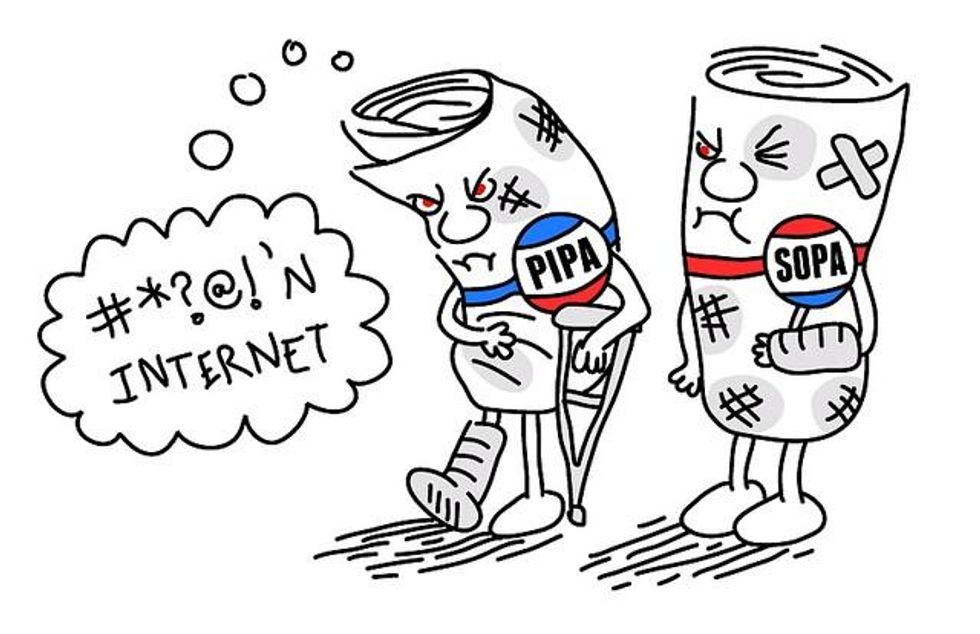
The 2012 fight to stop the SOPA/PIPA Web-censorship bills was just the beginning. Since then, we've seen collaborations connecting Internet freedom advocates of all political stripes (see the Declaration of Internet Freedom), an international campaign to cast light on destructive global trade pacts (see the push to stop the Trans-Pacific Partnership) and the building of the Stop Watching Us coalition and the broader movement to end government surveillance.
It may seem that each issue features a different opponent: Internet service providers like Comcast and Verizon, federal agencies like the NSA, multinational corporations and their government friends. But when it comes to Internet freedom, big companies are in cahoots with government actors like never before.
Take Verizon: Before it was the company that got rid of the Net Neutrality rules, it was the company that voluntarily gave the NSA data about the who, where and when of our phone calls. This is the same company that, thanks to weak rules that didn't hold up in a federal court, is now free to turn the Internet into a private fiefdom where it can charge us extra for every site, app, and device we use. And it's the same company that remained silent as we reacted to news about its involvement in the biggest privacy scandal in decades.
Meanwhile, Congress continues to do the bidding of giant corporations--valuing entertainment conglomerates' protection of copyrights over collateral damage to their own constituents and shielding the NSA as companies collecting our private data create the greatest mechanism for surveillance ever known.
But now, millions of Internet users are coordinating to build political, legal, and tech solutions to take the Internet back. While Congress considers bills to ratify NSA surveillance, fast-track a draconian trade agreement, or kill Net Neutrality for good, it should remember what happened when it tried to railroad the SOPA/PIPA legislation through.
Two years ago this winter, those twin bills fell apart in 24 hours thanks to the organic uprising of millions of Internet users across the country.
This will--and must--happen again. Only next time there will be much more at stake, and many millions more at the ready.
_____________________
Josh Levy and Hannah Sassaman wrote this article for Education Uprising: The New Rebels Taking Back Our Public Schools, the Spring 2014 issue of YES! Magazine. J
Today--Tuesday, February 11th, 2014--is the day the people across the world are "fighting back" against mass, unwarranted surveillance.
With an online campaign designed to galvanize supporters of privacy and the open internet against the troublesome trend of government spying, more than 600 hundred organizations from around the globe--including Access, Demand Progress, the Electronic Frontier Foundation, Fight for the Future, Free Press, BoingBoing, Reddit, Mozilla, ThoughtWorks, and others--are participating by posting banners on their websites and urging their members to endorse a set of 13 Principles for privacy protections.
"Surveillance can and does threaten human rights. Even laws intended to protect national security or combat crime will inevitably lead to abuse if left unchecked and kept secret." --Katitza Rodriguez, Electronic Frontier Foundation
According to the campaign's website, the day of activism, in addition to championing the broader goal of internet freedom, is meant to commemorate the tragic passing of activist and technologist Aaron Swartz. "The protest is both in his honor and in celebration of the victory over the Stop Online Piracy Act two years ago this month, which he helped spur," said organizers.
David Segal, executive director of Demand Progress, which he co-founded with Swartz, said: "Today the greatest threat to a free Internet, and broader free society, is the National Security Agency's mass spying regime. If Aaron were alive he'd be on the front lines, fighting back against these practices that undermine our ability to engage with each other as genuinely free human beings."
Those participating in the campaign are demanding an end to the kind of mass surveillance exemplified by the NSA programs revealed in more than eight months of reporting based on documents leaked by whistleblower Edward Snowden.
Condensed, those 13 'Necessary and Proportionate Principles' around which people are gathering make clear that:
According to Katitza Rodriguez at the Electronic Frontier Foundation, one of the lead groups organizing the campaign, the 'Day We Fight Back' hopes to show that NSA-style spying is a universal assault on the people and democracy that goes beyond the simple invasion of privacy.
"Surveillance can and does threaten human rights," says Rodriguez. "Even laws intended to protect national security or combat crime will inevitably lead to abuse if left unchecked and kept secret."
Danny O'Brien, EFF's international director, adds: "This isn't just a battle for reining back the NSA, or GCHQ, or any other intelligence agency. This is about drawing a line in the sand. If you create a secret apparatus that has carte blanche to collect data on every innocent user of the Net, you create an apparatus that can control politicians, detect and silence dissent, and dismantle any democratic check or balance. Mass surveillance is poison to the modern open society. We need to fight back, and we need to win."
And Rainey Reitman, a third EFF staff member who directs the group's activism, appeared on Democracy Now! to discuss the digital protest:
All over the world, actions are taking place and campaigners are joining forces with a common cause.
The campaigners also released this video:
Stop Watching Us: The VideoStopWatching.us is a coalition of more than 100 public advocacy organizations and companies from across the political spectrum.
There won't be a website blackout next Tuesday, 11 February, but there will be another virtual call to arms. In the US the primary goal this time is to help reverse America's retreat from liberty by telling lawmakers we can't abide a surveillance state - and by insisting they vote for a measure, called the USA Freedom Act, that would begin to restore the civil liberties we've lost in recent times. (For people outside the US the goal will be similar, to push authorities toward policies favoring liberty and privacy.)
Next week's protest organizers are calling it "The Day We Fight Back Against Mass Surveillance". They've lined up an array of backers of various political persuasions. You don't often see the American Civil Liberties Union on the same side of an issue as the very conservative FreedomWorks, but they are this time.
The cynics will say, "Why bother?" They'll note that the NSA and other security agencies in the US and abroad, urged on by a series of American presidents and other leaders, have ignored and broken laws with impunity. They'll point out politicians' epic hypocrisy; for example, members of Congress have supported the shredding of the Bill of Rights when presidents of their own party were in power, only protesting when the other party captured the White House. And they'll assure us, even as public opinion turns against dragnet surveillance, that the next terrorist attack will swing the public mood back to the "keep me safe no matter what it takes" camp.
They'll have a point. The relentlessness of the surveillance forces and their enablers in the technology industry, and the fecklessness of the politicians who are supposed to honor their oaths of office, make it hard to be optimistic. But realism doesn't mean we should to give up.
The organizers of Fight Back are realistic. David Segal, a main organizer, is a former Rhode Island state representative and head of Demand Progress, an advocacy group founded by the late activist Aaron Swartz, who in turn was a key organizer of the fight against SOPA and, a year later, took his own life after being hounded by federal prosecutors on outrageously trumped-up charges. No one can doubt that Swartz would have been on the front lines of a day when we fight back, and it is dedicated in part to his memory.
Segal calls the 11 February event one step among many more we need to take - but an important one if it galvanizes enough people to do something at a key juncture.
"Right now we do think we have enough votes in the House to move the USA Freedom Act forward," he told me this week. The main sponsor of the legislation, Jim Sensenbrenner, a Republican, is an author of the odious Bush-era Patriot Act that has been at the heart of the worst behavior by the NSA et al; he says it's all gone too far, and more than 200 representatives have signed on.
At the Senate, it's a different story. It's controlled by Democrats who, for the most part, have been reluctant to challenge the Obama adminstration or who - like California's Dianne Feinstein - have been ardent advocates for civil liberties abuses by administrations of both parties. So the Fight Back organizers are hoping Americans will call and write their senators first. Calls and letters from Americans whose senators are on the Judiciary Committee, which will decide whether the legislation gets a genuine hearing, will be especially vital.
Even passage of this bill would be just a start. Another upcoming milestone will arrive next year when the Patriot Act is up for reauthorization, and the coalition that is gathering for the Fight Back effort will be essential then as well.
By the time you read this, you'll be able to find some interactive images on the homepage of the Fight Back website - and code that you can use to embed them on your own website to help this campaign. It will be on my site. How about yours?
Fighting back will be a long, difficult process, and will take more than contacting members of Congress. But this is one useful activity, among many others we'll need to try. Let's not allow realism to turn to despair, meanwhile. The stakes are too high.
The Snowden revelations have confirmed our worst fears about online spying.

We aren't going to let the NSA and its allies ruin the Internet. Inspired by the memory of Aaron Swartz, fueled by our victory against SOPA and ACTA, the global digital rights community are uniting to fight back.
On February 11, on the Day We Fight Back, the world will demand an end to mass surveillance in every country, by every state, regardless of boundaries or politics. The SOPA and ACTA protests were successful because we all took part, as a community. As Aaron Swartz put it, everybody "made themselves the hero of their own story." We can set a date, but we need everyone, all the users of the Global Internet, to make this a movement.
Here's part of our plan (but it's just the beginning). Last year, before Ed Snowden had spoken to the world, digital rights activists united on 13 Principles. The Principles spelled out just why mass surveillance was a violation of human rights, and gave sympathetic lawmakers and judges a list of fixes they could apply to the lawless Internet spooks. On the day we fight back, we want the world to sign onto those principles. We want politicians to pledge to uphold them. We want the world to see we care.
Here's how you can join the effort:
The organizers of the Day We Fight Back are:
The organizers of the international action center are:
The Internet's spies have spent too long listening on our most private thoughts and fears. Now it's time they really heard us. If you share our anger, share the principles: and fight back.
Staging what they have dubbed "the New Hampshire Rebellion," a group lead by Harvard intellectual and activist Lawrence Lessig set out for a 185 mile journey across the "live free or die" state on Saturday, calling attention to what they see as one of the most important issues in U.S. politics today--the dire need for campaign finance reform.
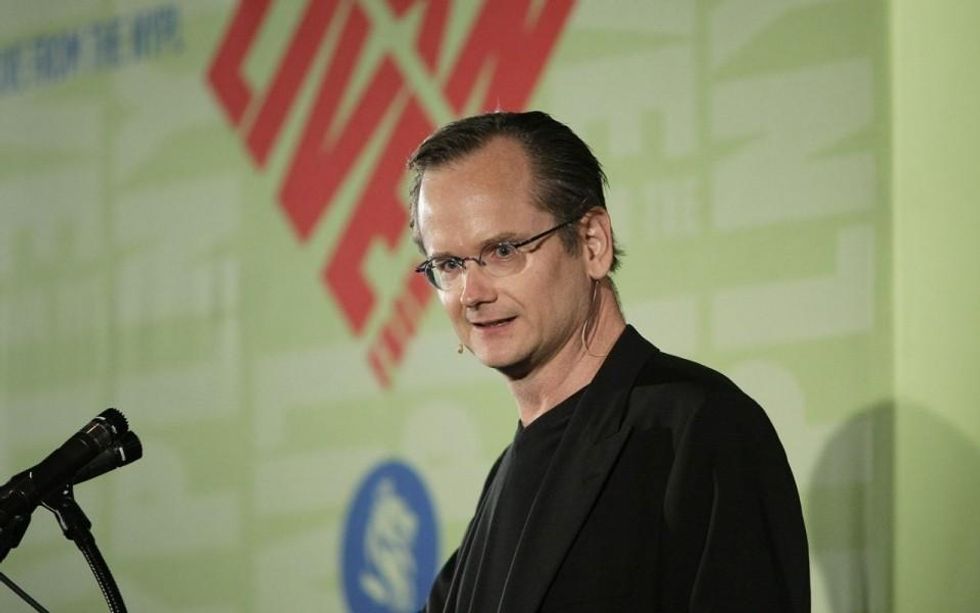
"On Saturday, we begin a walk across the state of New Hampshire, to launch a campaign to bring about an end to the system of corruption that we believe infects DC. This is the New Hampshire Rebellion," states Lessig in a recent op-ed.
The march will pay homage to a similar attempt by famed activist Dorris Haddock, or "Granny D," who, fifteen years ago at the age of 88, marched across the United States from Los Angeles to Washington DC with a sign reading "Campaign Finance Reform" across her chest.
"Haddock is credited with helping to galvanize public will around the McCain-Feingold Campaign Finance Reform Act," Al Jazeera America reports, "which was signed into law in 2002." However, two months after Haddock passed away at the age of 100, the Supreme Court ruled in favor of big donors, and the politicians who use them, in Citizens United vs. Federal Election Commission, "which undid many of the limits put in place on campaign finance and heralded a new era in unprecedented spending by special interests and corporations."
Lessig said he expects over 100 people to join him along the way as they stop in over a dozen towns over the course of two weeks. The group will hold events and public discussions centered around the issues of big money in politics--and how to cleanse such influence from the democratic process.
Citing the importance of New Hampshire in U.S. presidential elections, being the site of the first presidential primary, the goal of the walk will be to convince voters to pressure candidates on the issue of campaign finance reform.
"Along the way, we will recruit everyone we can to do one thing: We want them to ask every presidential candidate at every event between now and January 2016, this one question: 'How will YOU end the system of corruption in DC?'" Lessig writes.
Lessig continues:
A system of corruption, not particular crimes. Our focus is not Rod Blagojevich; it is the system of campaign funding in which fundraising is key, and the funders represent the tiniest fraction of the 1%. That system, we believe, corrupts this democracy. (We, and 71% of Americans according to a recent poll.) And until that system changes, no sensible reform on the right or the left is possible. Politicians may continue to play this fundraising game. We believe that New Hampshire can change it.
As this question gets asked, we will record the responses. Literally. And post them. And through allied campaigns, we will put pressure on the candidates to surface this issue -- and if we're lucky -- make it central to their campaigns.
The walk begins in Dixville Notch, NH, the place the first 2016 presidential ballots will be cast and will end in Nashua, NH, on the day Granny D was born.
The activists embark Saturday January 11th, exactly one year after the the suicide of internet activist Aaron Swartz, a close friend and colleague of Lessig's.
"I wanted to find a way to mark this day," Lessig writes. "I wanted to feel it, as physically painful as it was emotionally painful one year ago, and every moment since. So I am marking it with the cause that he convinced me to take up seven years ago and which I am certain he wanted to make his legacy too."
Lessig is asking anyone who can to join the walk and sign an online petition to pressure candidates to take on the issue.
Lessig talks about the New Hampshire Rebellion:
Lawrence Lessig talks about the New Hampshire Rebellion (Animated)Prof. Lawrence Lessig, Director of the Edmond J. Safra Center for Ethics at Harvard University, and founder of the Rootstrikers, ...
A year ago tomorrow, Aaron Swartz left. He had wound us all up, pointed us in a million directions, we were all working as hard as we could, moving things forward. And then he was gone.

Forever, all of us close to him will wonder whether there was more we could have done to keep him. We hadn't worked hard enough to help him. He was alone, surrounded by a million friends. And now, even now, forever it will be this now, a million friends are forever alone, having lost him.
I wanted to find a way to mark this day. I wanted to feel it, as physically painful as it was emotionally painful one year ago, and every moment since. So I am marking it with the cause that he convinced me to take up seven years ago and which I am certain he wanted to make his legacy too.
On Saturday, we begin a walk across the state of New Hampshire, to launch a campaign to bring about an end to the system of corruption that we believe infects DC. This is the New Hampshire Rebellion.
Fifteen years after New Hampshire's Doris Haddock (aka, "Granny D"), at 88, began her famous walk from LA to DC with the sign "CAMPAIGN FINANCE REFORM" on her chest, a dozen or so of us will start to walk in Dixville Notch, NH, the place the first 2016 presidential ballots will be cast. For two weeks, with more than 100 joining us along the way, we will walk south across New Hampshire, ending up in Nashua, NH, on the day Granny D was born.
Along the way, we will recruit everyone we can to do one thing: We want them to ask every presidential candidate at every event between now and January 2016, this one question: "How will YOU end the system of corruption in DC?"
A system of corruption, not particular crimes. Our focus is not Rod Blagojevich; it is the system of campaign funding in which fundraising is key, and the funders represent the tiniest fraction of the 1%. That system, we believe, corrupts this democracy. (We, and 71% of Americans according to a recent poll.) And until that system changes, no sensible reform on the right or the left is possible. Politicians may continue to play this fundraising game. We believe that New Hampshire can change it.
As this question gets asked, we will record the responses. Literally. And post them. And through allied campaigns, we will put pressure on the candidates to surface this issue -- and if we're lucky -- make it central to their campaigns.
This campaign will only work if the citizens of New Hampshire care about this issue. Really care. And the citizens of New Hampshire will really care only if we can find a way to convince them that there's something that can be done about it.
Because here's the really incredible fact about we, the People:
Ninety-six percent of America believe it is "important" "that the influence of money in politics be reduced" -- 68 percent believing it "very important," 28 percent, just "important."
Yet:
91 percent of America believes it is "not likely" that the influence will be reduced.
This gap is an incredibly opportunity. If we can, as Harvey Milk used to say, "give'm hope" -- hope that that there's a real chance this system of corruption might change -- then this latent energy for reform might be released. And then this, the only real hope for real reform, might be realized: an end to this system of corruption.
Since Aaron convinced me to take up this cause, I've written three books and given more than three hundred lectures about the problem. But the walk across New Hampshire is not a lecture tour. It is a chance for all of us to talk about this issue, person to person, one citizen at a time. Most politicos believe it is not possible to convince ordinary voters to care about this issue. I believe these experts are wrong. Over the next two weeks, and twice more before the 2016 primary, as we walk across the state, we'll see. And I will report back.
You can help. Please help. You can still join the walk. You can spread the word of the walk (tweet #NHRWalk linked to nhrebellion.org). You can sign a petition from wherever you are to push the candidates to answer this one question. Or, with just a few clicks, you can send support that will help this movement grow.
It will always be my penance to believe that I didn't do enough for my friend. I will do more. This is the start. If we're lucky, we'll mark the third anniversary of that terrible day with the real hope that the New Hampshire primary will turn upon this issue. And if we're super lucky, we'll mark the fourth with the anticipation of a president who made it her or his is-sue. And won.