

SUBSCRIBE TO OUR FREE NEWSLETTER
Daily news & progressive opinion—funded by the people, not the corporations—delivered straight to your inbox.
5
#000000
#FFFFFF
To donate by check, phone, or other method, see our More Ways to Give page.
Daily news & progressive opinion—funded by the people, not the corporations—delivered straight to your inbox.
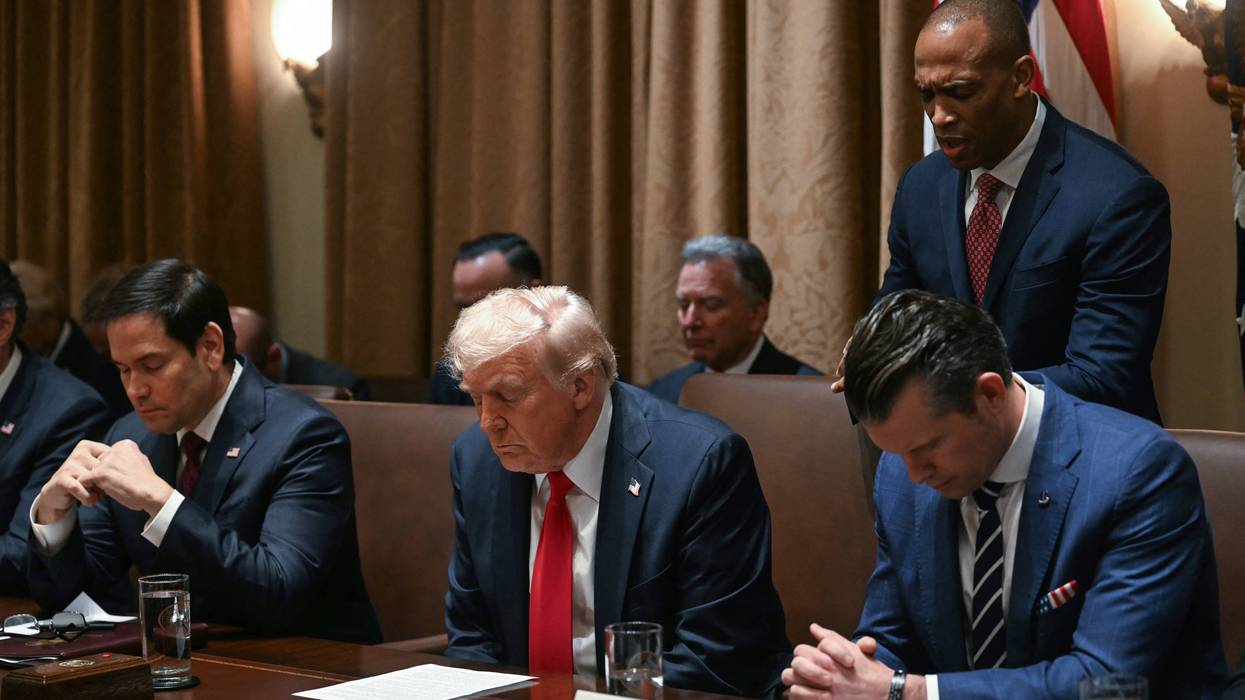
Christian nationalism is reshaping the moral language of US foreign policy and endangering pluralist democracy.
Less than a week after American bombs started to drop on Iran in late February, evangelical pastors famously gathered in the Oval Office to lay hands on a president unilaterally executing a war. It remains an emblematic moment, one of the more clarifying silhouettes of our political mood now sweeping through digital spaces.
That image and many more like it circulated instantly around the country and the world lifting the veil of a bigger story that's gone under-reported: Christian nationalism reshaping the moral language of US foreign policy and endangering pluralist democracy, as the Oval Office is transformed into a quasi-liturgical space in which war is cast as divine sanction, one that is specifically hostile to American Muslims in important ways.
The consecration of a president by a covey of clergy (eyes closed and heads bowed) in the heart of a secular and multicultural democracy illuminates a political culture in which narrow religious narratives are permitted to exert greater influence on how foreign conflicts are imagined and justified in the American public sphere. In our current context, Iran is cast not simply as a strategic adversary but as an apocalyptic antagonist that must be defeated because it is God’s plan. In other words, a major geopolitical event is refashioned into a scriptural caricature that prefigures war in the presumed theater of Armageddon.
What is hardly considered in our context at home is the domestic consequence of that caricature. The United States is not an evangelical nation, despite the bloated conceits of mega-churches, maudlin politicians, and rock star preachers. It is a pluralistic one—home to millions of Catholics, mainline Protestants, Muslims, Jews, Sikhs, Buddhists, Hindus, and nonbelievers. When a specific strand of evangelical eschatology is invited to run the theological grammar of American foreign policy, it shapes how Washington thinks about Iran, a Muslim country; and it also messages how Washington may think about the millions of American Muslims who share a religious tradition with the country being bombed and caricatured. The revival of Crusade-like language among those at the apex of American political and military authority thickens the margins of already marginalized and vulnerable communities. The San Diego mosque shooting, undoubtedly horrific, was one of several indicators of the rise of Islamophobia since the start of the US-Israeli war on Iran.
An administration that reaches any agreement or capitulation with Iran must contend with a powerful domestic constituency for whom any settlement carries the implicit suggestion that the prophetic script was wrong.
These observations are not a call to police theological conviction. But those steering American power toward a militant democracy owe the public transparency about how directly end-times rhetoric about the Muslim world is shaping the foreign policy of a government that still boasts about its pluralism. It should also reckon with the domestic costs of the language of demonization, which places at great risk on the mosques and neighborhoods of American cities and towns.
This dynamic is precarious not merely because of the literalist theology itself but because of its digital velocity. Christian Zionist eschatology has interpreted Middle Eastern events through biblical end-times prophecy for decades; spread through pews, big tents, publishing houses, radio ministries, and cable television. What has changed is the infrastructure of mediation. Images that are dense with symbolism, such as those of evangelical pastors pressing their hands on a president whom they know is irreligious, traverse the globe, crossing denominational boundaries and reaching international audiences instantly.
Free of the guardrails of moral premises, algorithms now act as transnational religious authorities made not of flesh and intellect but of unseen codes, engineered to decide which images and voices are amplified and which are left behind. Algorithmic power does not operate with corrections—no scholarly review or denominational pushback. Its only function is to maximize attention. The meta-platform effect reinforces the frame that American power and divine providence are aligned, and that Iran and the larger Muslim world stand in opposition to both.
Evangelical militancy circulating through algorithmic feeds that reaches tens of millions is structural in a precise sense: Digital scale generates not merely larger audiences but a self-righteous zealotry that feeds on an epistemic apparition—rationales for war and self-defense narratives that present themselves as a well-reasoned, evidence-based mandate.
An administration that reaches any agreement or capitulation with Iran must contend with a powerful domestic constituency for whom any settlement carries the implicit suggestion that the prophetic script was wrong and that the prayers of the pastors who laid hands on the president spectacularly failed—an extraordinary sacred cost with no secular equivalent.
That cost is borne not only by strategists calculating political survival, but by every American citizen whose religious identity, ancestry, and moral convictions place them outside the religious consensus that currently holds the room and exposes their communities and institutions to the kinetic costs of pernicious public discourses.
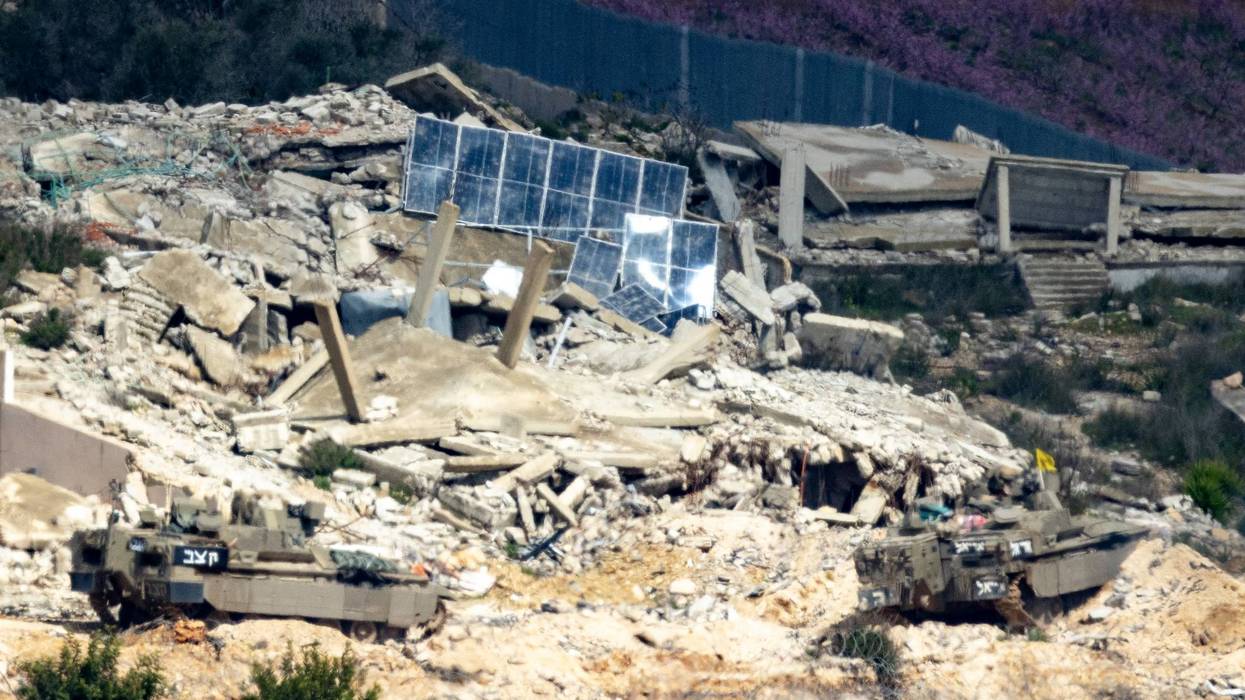
Israel’s use of much US intelligence is apt to be contrary to US interests and the interest of peace and security in the Middle East, and for many of the same reasons underlying the reduced popularity of Israel among the US public.
Buried deep inside a 192-page intelligence authorization bill is Section 622, titled “United States-Israel Intelligence Sharing Enhancement.” It would require the president, acting through the director of national intelligence and as necessary the secretary of defense, to “expand and enhance intelligence sharing with the Government of Israel” on a list of subjects that encompasses almost every topic of intelligence interest in the Middle East.
The bill, put forward by Sen. Tom Cotton (R-Ark.), the chairman of the Senate Intelligence Committee, would prohibit any suspension, reduction, or limitation of such sharing “except on the basis of a specific and identifiable national security concern determined by the President.” Any such exception would require a report to Congress within 15 days detailing not only the reason for the change but also the categories of information involved. The same report would require an assessment of the anticipated impact on regional security and various other matters.
This proposal is one of several recent moves by those in Washington who carry the Israeli government’s water to keep the United States tied to Israel despite plummeting support for the country among the American public. The most salient form of US support to Israel has been more than $300 billion in economic and especially military assistance. Israeli Prime Minister Benjamin Netanyahu has tried to get ahead of the declining public support and avoid embarrassing losses by suggesting it would be fine with him to phase out the military aid.
Israel’s strategy and that of its US supporters is now to rely on ties with, and support from, the United States that are not as salient as the military aid with its prominent price tag. The strategy includes forms of military integration that are less visible than congressionally appropriated grant aid and therefore less publicly accountable. Section 224 of a defense authorization bill currently in the House of Representatives embodies this form of integration.
Attacks that sabotage diplomacy are among the Israeli operations that might use shared US intelligence.
The mandating of intelligence sharing carries this strategy further by moving it into the shadowy world of relations between intelligence agencies. That world is even farther removed from public visibility and accountability than the defense integration, and even less likely to stimulate thoughts about American taxpayers’ money going to a foreign country. So far, Section 622 of the intelligence bill has received less attention than Section 224 of the defense bill.
The notion of legislating an intelligence liaison relationship in this way, with any foreign country, is bizarre. Liaison with counterpart foreign services, including exchanges of information, is an important but complex part of the intelligence business. The nature of a liaison relationship depends partly on the temperature of the overall political relationship with the country in question but also on other factors known mostly to intelligence officers. These include the collection requirements levied on them, their ability or inability to meet those requirements with national resources, their assessment of the foreign service’s ability and willingness to fill collection gaps, the role that any trading of information plays as quid pro quos in operational cooperation, and the risks of compromising intelligence sources and methods.
Moreover, no single liaison relationship exists in isolation. The US intelligence services need to consider possible implications for their other foreign relationships. For example, one generally does not share with country A information about country B if the United States has a relationship with B that is about at the same level as it has with A. Intelligence liaison involves a hierarchy of relationships, ranging from extensive cooperation with close allies to carefully limited ad hoc exchanges with adversaries. The intelligence community has a staff with the full-time job of monitoring and managing this set of relationships to prevent crossed wires. A congressional mandate regarding a single relationship increases the chance of crossed wires.
An irony is that the Congress considering this mandate is the same Congress that has in effect surrendered to the president its powers under Article I of the Constitution to set tariff rates and to decide whether to wage war. And yet, Section 622 would involve congressional micromanagement of a matter that by its nature needs to be the business of the executive branch and especially the intelligence agencies.
In intelligence, Israel is more of an adversary than an ally. Being an adversary in intelligence means indulging in the hostile act of espionage. Israel has a long record of conducting that type of hostile act against the United States. The best-known case involves the spy Jonathan Pollard, who stole such an overwhelming volume of US secrets that then-Secretary of Defense Caspar Weinberger stated to the court that sentenced Pollard that it was difficult “ to conceive of a greater harm to national security than that caused by the defendant in view of the breadth, the critical importance to the US, and the high sensitivity of the information he sold to Israel.”
When Pollard completed his prison sentence and parole in 2020, he was given a hero's welcome, led by Netanyahu himself, on his arrival at Ben Gurion Airport in Israel. There was nothing noble in Pollard’s actions. Although he liked to say he was motivated by concern about Israel’s security, before selling his espionage services to Israel he offered to sell US secrets to three other countries and made the same offer to a fourth country even when spying for Israel.
The Israeli espionage threat to the United States has only intensified. Last week, NBC News reported that the Defense Intelligence Agency raised the threat level for such espionage, evidently a reflection mostly of US-Israeli differences over the Iran war. The New York Times quotes an official saying that Israeli intelligence operations aimed at senior US officials during the second Trump administration have become so aggressive as to be “unhinged.”
Any sensitive information, including intelligence secrets, shared with Israel entails a high risk of Israel passing it to other countries, including US adversaries. Israel has a long record of that, too, and not just because Israel probably passed some of the secrets Pollard purloined to the USSR, in exchange for Moscow allowing Soviet Jews to emigrate. Israel’s sharing of US-origin military technology with China has been an issue. That the partner may be a rogue state has not stopped Israel from military and technical cooperation, as demonstrated by its relationship with apartheid-era South Africa, which extended even to the development of nuclear weapons.
The risk of Israel passing sensitive US information to other states continues partly because Israel is hungry for cordial relationships—and especially establishment of new formal diplomatic relations—with any country willing to have such relations despite Israel’s continued subjugation of the Palestinians. Secrets from US intelligence would be very attractive to some of Israel’s partners or potential partners, and thus attractive to Israel as trading material. Those other countries may include China, with which Israel continues to have extensive technical cooperation, and Russia.
Even without any passing to third countries, Israel’s own use of much US intelligence is apt to be contrary to US interests and the interest of peace and security in the Middle East, and for many of the same reasons underlying the reduced popularity of Israel among the US public. Israel has started more wars and attacked more nations than any other country in the Middle East. In recent years it has inflicted more death and destruction on civilians through military operations than any other Middle Eastern state. It uses violence to seek regional hegemony and destroy Palestinian nationhood in ways that are inconsistent with US interests.
The current ill-advised war with Iran demonstrates the sharp divergence of US and Israeli interests. After being the principal influence on President Donald Trump’s decision to launch the war, Netanyahu’s government has been sabotaging efforts to end it. It currently is doing so mainly with relentless attacks in Lebanon that have killed thousands and displaced over a million people. The divergence of objectives was reflected in an expletive-laden phone call last week between Trump and Netanyahu that was mainly about those attacks.
Attacks that sabotage diplomacy are among the Israeli operations that might use shared US intelligence. The United States also will be blamed for aiding other violent Israeli operations because of the “enhanced” intelligence sharing, even if it were no longer paying for Israeli arms.
The supposed escape clause in Section 622 of the intelligence bill would in practice be so cumbersome as to be useless. The required report to Congress would dump the issue on Capitol Hill, where the Israel lobby would quickly depict it as a question of being for or against the security of Israel. The mandated intelligence sharing in the bill thus would tie the president’s hands and prevent any administration from using management of the intelligence liaison relationship as leverage to deter destructive conduct by Israel.
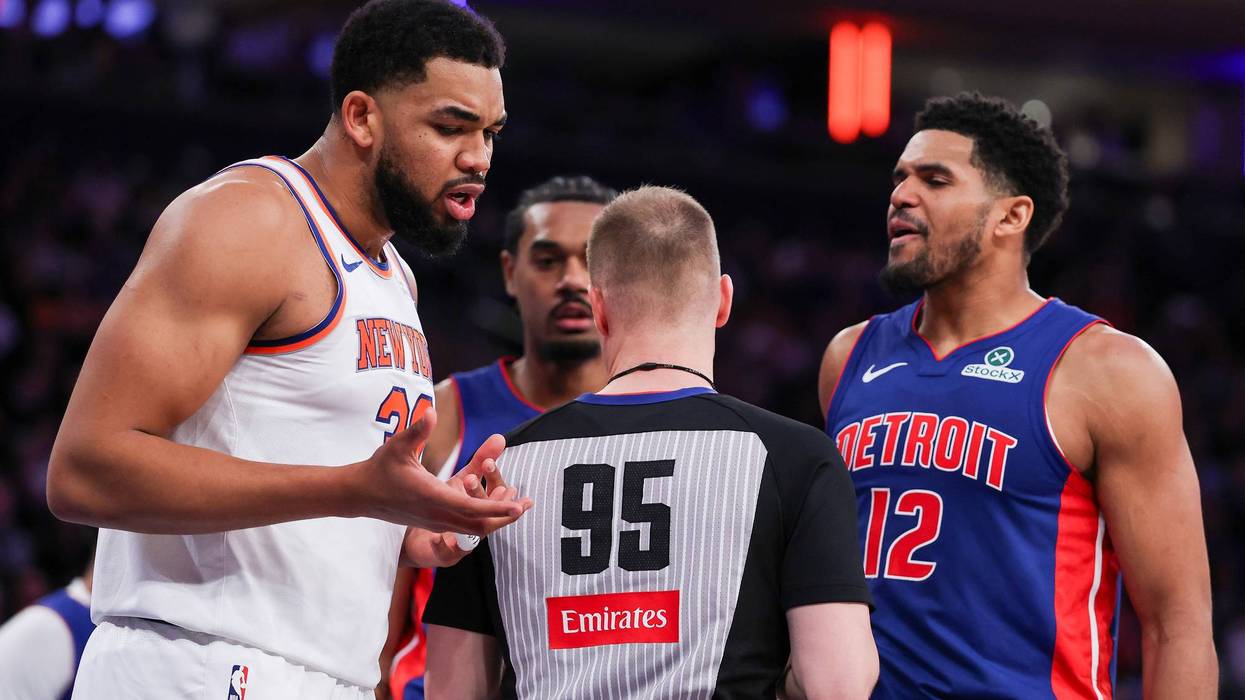
Companies, sports teams, and elected officials should stop partnering with the UAE or wearing Emeriates-emblazoned swag until the country stops arming genocide in Sudan.
While little is reported about the role of the United Arab Emirates in provoking and supporting genocide in Sudan, the sheikdom is being celebrated at major sporting events here and abroad. I was reminded of this watching an interview with New York City Mayor Zohran Mamdani about the Knicks in the Athletic The New York Times sports website. During the interview I was alarmed to see he was wearing a sweater emblazoned with “Fly Emirates.”
I'm rooting for the Knicks and am a huge Mamdani fan, not only of the mayor but of his parents for many decades before Zohran caught my attention. It turns out that the sweater he was wearing is one a several outfits he wears in support of Arsenal, his favorite English Premier soccer team. During an Eid al-Adha celebration in the Bronx, he wore a kurta in the team’s blue and black colors. On it inscribed in large letters was “ Emirates—Fly Better.”
Emirates, the airline of the United Arab Emirates (UAE), has its major hub in Dubai linking a vast network of connections to Asia and Africa from Europe and the USA. The NBA and Emirates entered into a multiyear global marketing agreement. It is the official airline and a major sponsor of the NBA. The league’s annual in-season tournament is now called the Emirates NBA Cup and referees at NBA games wear EMIRATES on the back of their uniforms.
Numerous international organizations and media have identified the UAE (aka The Emirates) as a major supplier of arms, training, mercenaries, and material support for the Rapid Support Forces. The New York Times stated that, “under the guise of saving refugees, the United Arab Emirates is running an elaborate covert operation to back one side in Sudan’s spiraling war—supplying powerful weapons and drones, treating injured fighters, and airlifting the most serious cases to one of its military hospitals, according to a dozen current and former officials from the United States, Europe and several African countries.”
Refugees International wants prominent companies and organizations like the NBA, Disney, and Warner Brothers to suspend their partnerships with the UAE until it has ended its armed support for the RSF.
Mayor Mandani while condemning Israeli genocide in Palestine wears apparel endorsing the foremost sponsor of genocide in Darfur. The UAE supplies arms, equipment, and finances for the Rapid Support Forces who have committed countless acts of brutality including genocide and systematic rape. United Nations’ Secretary General António Guterres described the Sudan civil war as a “crisis of staggering scale and brutality.” He told world leaders that “the external support and flow of weapons must end.”
US-based Refugees International “calls for immediate accountability for the United Arab Emirates as new evidence emerges that it continues to fuel genocide in Sudan.” The Conflict Insights Group (CIG) report, “BLOOD MONEY: How UAE Support and Foreign Mercenaries Enabled the Fall of El Fasher,” uncovers the extent of Emirati operational involvement in the war.
The investigation documented “how a UAE-backed network of Colombian mercenaries provided critical military support to Sudan’s Rapid Support Forces (RSF), enabling the October 2025 capture of El Fasher, North Darfur. Colombian mercenaries flew drones, trained soldiers, and were present during the RSF’s takeover of El Fasher, where the Prosecutor of the International Criminal Court has concluded that war crimes and crimes against humanity took place.” The report states that these mercenaries were associated with Global Security Services Group, a UAE company with documented ties to senior Emirati government officials, including links to Sheikh Tahnoon bin Zayed Al Nahyan.
Donald Trump hosted a dinner for Sheikh Tahnoon on March 18, 2025. The sheikh met with the head of the CIA, various cabinet members, and CEOs including Jeff Bezos. The New York Times reported that leaked information indicated that Tahnoon sought Trump’s support “to shield the UAE from potential international sanctions and an ICJ (International Court of Justice) investigation into its alleged support for the RSF militia in Sudan.”
Ironically, on November 14, 2025, the BBC reported that “US Secretary of State Marco Rubio has called for international action to cut off the supply of weapons to Sudan's paramilitary Rapid Support Forces (RSF), who are accused of mass killings in el-Fasher. At the end of a G7 foreign ministers meeting in Canada, Rubio said the RSF had committed systematic atrocities, including murder, rape and sexual violence against civilians.”
Refugees International wants prominent companies and organizations like the NBA, Disney, and Warner Brothers to suspend their partnerships with the UAE until it has ended its armed support for the RSF. Hopefully, in that spirit, Mayor Mandani will denounce the UAE and offer a mea culpa for wearing genocidal swag.
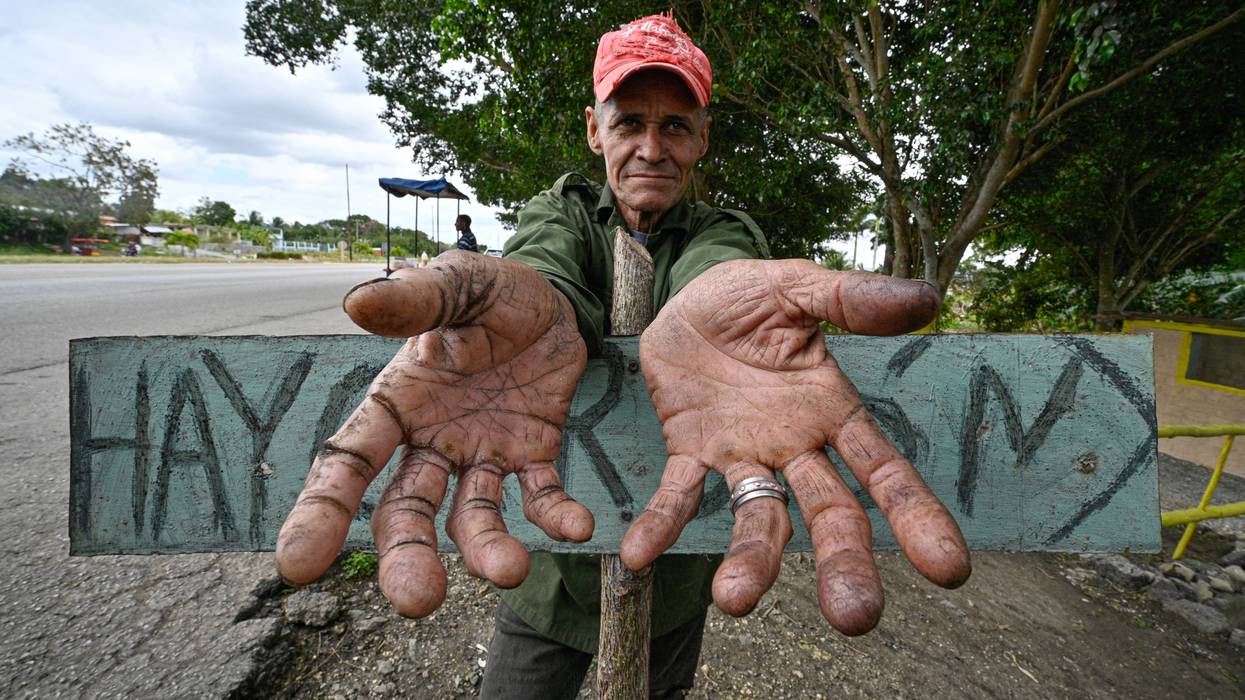
In an interview, scholar Danny Shaw discusses President Donald Trump’s policy of strangling Cuba and offers an anatomy of the impact of the economic embargo on its people after having witnessed firsthand the existing conditions on the island.
Cuba has been under a US trade embargo since the Eisenhower administration, although it was President John F. Kennedy who implemented a comprehensive embargo on all trade with Cuba. And while every subsequent administration has tried since to cause pain and suffering to the Cuban people for its support of a revolutionary government, it is the Trump administration that has made the collapse of the communist regime on the island a top priority by expanding sanctions against the island, blocking fuel deliveries, and threatening Cuba with military action.
Cuba is indeed on the brink and unlikely to survive since the inhumane and criminal actions of the second Trump administration have plunged the island into a deep humanitarian crisis.
In the interview that follows, Danny Shaw discusses President Donald Trump’s policy of strangling Cuba and offers an anatomy of the impact of the economic embargo on its people after having witnessed firsthand the existing conditions on the island. Danny Shaw is a scholar of Latin American and Caribbean studies and a longtime supporter of the Cuban revolution. He recently traveled across Cuba, where he documented for The Grayzone the harrowing conditions following the Trump administration's imposition of an energy blockade.
C. J. Polychroniou: US President Donald Trump has revived the Monroe Doctrine with a series of forceful actions in the Western Hemisphere, such as the attack on Venezuela, which resulted in the kidnapping of Venezuelan President Nicolas Maduro, and conducting military strikes against fishing boats in the Caribbean. It may not be totally clear what’s driving the Trump administration’s gunboat diplomacy, but Cuba, which has endured perhaps the longest economic embargo in modern history, is next on the wannabe dictator’s hit list.
Danny, can you talk about the policy methods the second Trump administration has used in order to further isolate Cuba and, in the process, strangle its economy and its people?
Danny Shaw: On January 29, the Trump administration—the true spokesman of the billionaire class with global reach, as we’ve seen from Caracas to Tehran—took actions to completely shut down the Cuban economy. Threatening any country that sold oil to Cuba or continued to trade with them tightened the screws on an already long-existing, illegal, unilateral Economic War. Washington and their right-wing minions across the hemisphere also went after Cuban medical missions from Honduras to Jamaica, which brought much-needed foreign reserves for Cuba and most importantly afforded medical attention throughout the Americas and the world to marginalized populations. Ecuador and Costa Rica kicked out the Cuban embassies. The Trump administration has made it clear to the world: Any attempt to support the Cuban government will be severely criminalized. Concretely, this means Cuba is more isolated and desperate than it has ever been.
The US method of stoking “hunger” and “desperation” has completely crushed this fascinating, historical experiment in resistance and a people’s government.
We must see Trump’s energy blockade in the context of an economic blockade which has left Cuba on life support since 1991, the year the Soviet Union and the Socialist Block countries fell. Overnight, these measures cut Cubans’ average caloric intake in half. Periodically, under both Democratic and Republican presidencies, the US government has taken a scalpel to the Cuban economy. With a Gazaesque strategy of surgical precision, the State Department has cut off remittances, wiped out tourism, and penalized any foreign company that did business with Cuba. January 29 was yet another inflection point of what has truthfully been an ongoing “special period” and is now proving to be a death sentence for many Cuban families. Now the FBI and Homeland Security are going after those of us who have brought humanitarian aid to Cuba.
Every word I share, including my quotation of hungry and dispirited Cubans, has to be seen within the context of a 67-year-old war on a country that has sought to be sovereign from empire. As an ethnographer, an international affairs analyst for Cuban and Venezuelan television since 2014, and someone building fluency in Cuban Spanish for over three decades, I have had a lot of intimate contact with Cubans, their opinions, and their struggles. We have to go back to the original State Department memorandum as laid out by Deputy Assistant Secretary of State for Inter-American Affairs Lester Mallory on April 6, 1960:
..it follows that every possible means should be undertaken promptly to weaken the economic life of Cuba. If such a policy is adopted, it should be the result of a positive decision which would call forth a line of action which, while as adroit and inconspicuous as possible, makes the greatest inroads in denying money and supplies to Cuba, to decrease monetary and real wages, to bring about hunger, desperation and overthrow of government.”
I quoted the ruling class’s thinking at length because that is precisely what has been happening in Cuba now since at least 1991. The US method of stoking “hunger” and “desperation” has completely crushed this fascinating, historical experiment in resistance and a people’s government. What I witnessed in Cuba in February, March, and April of this year was apocalyptic.
C. J. Polychroniou: The Trump administration forced a leadership change in Venezuela, but it is debatable whether there has also been a regime change. However, the plan for Cuba seems to be regime change even though its government is not doing anything to threaten the United States. Why is Trump after regime change in Cuba and to what end? Whose interests is he really serving?
Danny Shaw: Trump is the ultimate distraction. Like all billionaire bubble boys, there are no consequences for his lies, threats, and general clownishness. But behind the bombastic, arrogant billionaire are the true global power brokers, a small group of 2,800 billionaires who seek to preside over humanity’s destiny. They use Trump as their spokesman to carry out a fascist global agenda that was thought to be impossible prior to 2016 when he first came into power.
The War on Cuba and all states who represent any type of resistance—China, Nicaragua, Venezuela, Zimbabwe, Palestine, Russia etc.—is designed to convince us again and again of “the end of history.” The idea that cowing to the billionaires and soon-to-be trillionaires is inevitable.
The corporate media has long presented “Cuba” as a “failed socialist state.” This serves the empire’s ideological interests. They can showcase this “miserable island,” stripped of all contexts, and show this horrible place on CNN and Fox hemorrhaging their own people. Millions of Cubans are dying and migrating. Even before this crisis, the most extreme ever, the Cuban population shrank by 1.4 million between 2020 and 2024. The capitalist media can then propagandistically contrast this reality with a mirage of extreme abundance and excess that they parade in front of our faces through their ideological apparatuses. Think social media, Hollywood, the mainstream media etc.
We are all focused on US drones, bombs, and boots on the ground, but the invasion has already arrived.
The other interest the US has in Cuba is of course economic. The Cuban state has been the ultimate arbiter of questions of foreign trade and investment and an obstacle to unfettered penetration by private capital. Trump, his business partners, and cronies will cash in on land grabs, mineral deals, and the buying of shorefront hotels. Cuba has long had a big tourist economy that they can cash in on.
So these are some of their motivations. But I think your question is an interesting one that I have sat with for decades.
Truthfully, the Empire would only have to blow and the Cuban government would fall. In terms of being able to provide for and defend the Cuban people, the Cuban government fell long ago, arguably in 1991.
Private property is now ascendant in Cuba and has been arguably since 1991. Whatever leadership that is there now, though they put out daily patriotic statements, is not the leadership of Fidel, Che, and Camilo that we in the Western left came to love and defend since 1959. What I have seen over the past 31 years was a people left to fend for themselves. The ethos and general mindset in Cuba is not “Patria o Muerte” and “Venceremos,” (“Homeland or Death” and “We Shall Overcome”), the historic slogans of the Revolution; it is the “Law of the Jungle” and “Every Man For Himself.”
While leftist tourists maintain a glorified, outdated image of this museum of socialism, another mentality already reigns over Cuba, especially among the two generations born into the special period. For example, in the province of Sancti Spiritus I stayed with a family that was relatively stable. The father was a retired track coach and the mother a retired physical therapist. The son plays professional basketball in Brazil and, at 6 feet 9 inches, is one of the tallest Cubans in the country. They have given a plate of food to two elderly neighbors, Sonia and Francisco, for years now. They can no longer afford to do so as they can barely feed themselves and their immediate family. Sonia and Francisco are now hungry and malnourished. They will soon die, two more anonymous victims of this macabre US foreign policy. But who will record their deaths? Who will know their names? The local officials will just record that they died of old age.
And this happens everyday now in Cuba. Generalized hunger has become mass malnutrition, and everyday that passes there is more death. Many Cubans say there is already starvation in the most historically neglected areas like Guantanamo and Las Tunas.
So I think being able to point a finger and enact laws in Florida about "commemorating the victims of communism” serves the billionaires' interests. This begins to explain why they have sadistically sought to cause so much suffering in Cuba.
C. J. Polychroniou: As you already pointed out, you were recently in Cuba and traveled throughout the island. Describe the actual conditions that you encountered.
Danny Shaw: Let me take you deeper into the class contradictions that have long been surfacing in Cuba.
One of the first things a visitor to Cuba will notice is that as the people are dehydrated and starved, the private sector is growing. It is important to clarify that Marco Rubio, Trump, and the architects of the intensification of the economic war on Cuba are at the same time bolstering the private sector. So the owners of private businesses, the MIPYMES, are allowed to import gas, generators, food, etc. It is the Cuban masses that are completely cut off, as an emerging business sector continues to consolidate its economic power on the island functioning as Miami and Washington’s beachheads. But to access these private shops one has to have dollars, or big stacks of Cuban pesos. The 99% of Cubans have neither. The private MYPIMES also have more quality food, but they are private peninsulas of privilege, or Little Miamis, that very few Cubans can afford.
Four days after the guerrillas took power in Havana on January 1 1959, Fidel Castro asked a crowd of tens of thousands in Camaguey, “How can we call this our homeland, if the homeland gives us nothing?” Today, the children, grandchildren and great-grandchildren of that generation of Cubans circulate this heroic speech that grew out of their anti-imperialist and anti-dictatorship struggle and ask, “Why are we being shut out of our own country?”
Collectively, right now, Cuban children have less access to toys and food than what I have seen across Haiti since I first went there in 1998. Some of my friends in Cuba have asked me if there is any way for them to escape to Haiti. Haitian medical students I knew in Santiago and other Haitians were forced to flee Cuba and return to their besieged homeland because of how bad Cuba is. When Haiti is a reference for relative abundance, that is the ultimate indicator of how blockaded and dire Cuba is.
My responsibility is not to parrot Cuban government speeches and positions as the left does here in the West, but to give a voice to a population captured in a looming Economic Genocide, trapped between two bureaucracies,
Agricultural products cannot get from the countryside into the city. Every day there is more hunger, malnutrition, and encroaching starvation. The Cuban people say they have no voice. The most vulnerable, the elderly, children and prisoners, are already dying. There is a stark sense of generalized hopelessness. There are no functioning means of transportation. Yet as one waits for buses that never arrive, imported cars from Miami speed down the highways. The people say those are rich Cubans or government officials. The people do not trust their government and see them as a central ingredient in the genocidal campaign they are facing.
Let’s break down the math of starvation, CJ. Because we are all focused on US drones, bombs, and boots on the ground, but the invasion has already arrived. What will play out in the upcoming days and months is the consolidation of the umpteenth US intervention in the affairs of the people of the Caribbean, South America, and the world. And it will continue to exterminate a lot of lives. When Cubans say that today Cuba is the equivalent of Gaza without bombs, they are not exaggerating.
A liter of gasoline in Cuba costs more than 6,000 pesos ($10 US dollars), meaning a gallon of gas costs $40. The average Cubans’ salary or pension is 2,400 pesos ($4 dollars) monthly. A bottle of Turkish sunflower oil to cook costs 1,500 ($2.50), a pound of rice costs 350 ($0.60), and the electricity bill, regardless of whether there is any, is 400-500 pesos (less than $1 per month), meaning that alone consumes a Cuban’s money for the month.
In Cuba, no matter how much money you have in the bank, you can only take out $2 or $3 dollars. That is why you see long lines across Cuba of retirees and heads of family waiting all day in front of banks, trying to get their money out. Cuba is a country of lines, long lines.
Infant mortality rates have increased by 148% in Cuba. Center for Economic and Policy Research’s director of international policy Alexander Main: explains: “The Trump policy of 'maximum pressure' on Cuba has killed a lot of babies… it’s highly likely that more babies are dying now, and at an even higher rate than last year as a result of the current US fuel blockade targeting Cuba.”
Many families have to get up in the middle of the night because that is the only time they have access to a few hours of electricity. Measures of insomnia, depression, and all mental health indicators are skyrocketing. US terrorism comes in many different forms.
By the time we publish, the hyperinflation and devaluation of the Cuban peso will be even more extreme. Everyday, the peso is worth a fraction less than the dollar, damaging Cubans’ earning power even more. What Cubans have whispered to me since 1995 is that if they film their reality or try to speak out against the economic disparities, the authorities will arrest them immediately.
What if you have children? How do you feed them? Cuban families are weary of having children because they cannot feed them. The War on Cuba is a Demographic War, a War of Depopulation. From the perspective of capital, Cuba’s population is excessive and expendable, especially old people who are generally more loyal to the revolution because they can remember what it once was prior to 1991. Similar to Palestine and Haiti, masses of people can be displaced and exterminated. Why would capital care? And why would a Western public care, if they have never heard one positive word about these “sh^thole countries,” to quote the ever-eloquent Trump again.
Religion, alcohol and drug addiction all find a foothold among a population who cannot see beyond this bleak material reality. All of the ingredients for an Economic Genocide are in place. Cubans I met and hung out with in Las Tunas, Holguin, or Granma were not worried about imperialist drones or bombs. They said the bombs of thirst and hunger have long been their number one enemy. Colonial death comes in many different forms.
C. J. Polychroniou: Cuban government officials have said that the country will fight to death in the event of a US invasion. But is it realistic to expect a starving nation fight back in the event of a full-scale invasion of the island by the world’s most powerful and advanced military?
Danny Shaw: Minister of Foreign Affairs, Bruno Rodriguez, himself explained: “It seems that the US government has chosen a dangerous path, a path that could lead to unimaginable consequences, to humanitarian catastrophe, to a genocide.” He then says what every leader has to say but it is tough to take seriously: "Cuba will exercise its right for its legitimate defense to the very last consequences with massive, mass support of the people." These militant government statements are out of touch with mass sentiment.
Observing our movement of activists, Marxists, the left, or whatever we call ourselves, we pretend like it is 1959 or 1989 and Fidel and well-trained, honest revolutionaries are still at the helm of the state. If we cannot honestly reflect on this question of leadership, the Cuban state and the masses, aren’t we complicit in the ongoing strangling and starvation of today’s mambisado (the masses who fought for Cuba’s independence against Spain)? Do we judge a revolution by the objective and subjective conditions the people confront, or by the latest interview or speech of Diaz-Canel? Have any of these activists who defend Cuba ever gotten outside of the Hotel Nacional and outside of the government-guided tours? If we mischaracterize the objective and subjective conditions in Cuba, aren't we complicit in our own way in the war on Cuba, which Cubans say comes from both an internal and external blockade?
Capitalism is the accumulation of misery in one pole, and luxury in the other.
To think Cuba can resist in any way is ridiculous. How can a half-starved, unarmed people resist the largest military with the largest budget, $1.5 trillion, in the history of the world? Cubans overwhelmingly told me they are so sick of “resolving," “surviving," and “resisting." Besides some elderly veterans of the heroic war of liberation in Angola and that generation of fighters, I met almost no Cubans with any enthusiasm for the idea of fighting back against the United States. There’s a complete state of demoralization across Cuba. Hyperbolic leftist comparisons to “People’s War” in Vietnam under the direction of Ho Chi Minh and General Nygun Vo Giap are goofy and dishonest. Cubans see their government and police as complicit in everything that is happening. Why would they die for a process they long stopped believing in? The Western “left movement” is clueless about the objective and subjective conditions in Cuba because we uncritically take our cues from the Cuban government. The private sector could not be ascendant in Cuba if there was not collusion with high-level officials. The Cuban masses perceive that government officials are saying one thing publicly but behind the scenes are looking out for themselves. And if you listen to the statements on CNN by this generation of Castros, that is exactly what they say. They praise capitalism and position themselves to adapt to the inevitable reconquering of the island.
Cuban officialdom and their leftist counterparts have engaged in what we can call “high politics.” Spanish researcher of communes in Venezuela, Cira Pascual Marquina, explains that we often base our conclusion on “institutional declarations, negotiations, geopolitical responses—while overlooking the dense fabric of everyday political practice that sustains the process.” Look at the Venezuela General Vladimir Padrino and all of his rhetoric before January 3 about a “people's war” in Venezuela that would resist any efforts by the Trump administration. What resistance has there been in Venezuela? Today, six months after the US
occupation of Venezuela, Padrino is an agricultural minister.
All of these triumphant-sounding speeches mask the reality of the Cuban masses, and arguably do more damage than good. As a supporter of the Cuban Revolution, I waited years if not decades to say some of these things publicly. Because again, I am with David, not Goliath. But scholars and supporters of Cuba need to be vocal about the whole truth. My responsibility is not to parrot Cuban government speeches and positions as the left does here in the West, but to give a voice to a population captured in a looming Economic Genocide, trapped between two bureaucracies. Here is an essay by a Cuban student in Ireland which brilliantly captures how the Cuban people feel they are stuck between two competing rhetorics, which both ignore their interests.
C. J. Polychroniou: US imperialism never went away but has gone totally berserk under the second Trump administration. Can the beast be reformed?
Danny Shaw: In Cuba, the closest place to get Cuban food is Miami.
It’s surreal. After navigating dehydration and hunger across Cuba for one month, I returned, like other activists and friends of Cuba, to be detained and interrogated by the FBI in Miami. When I was released, after my third detention and interrogation in less than two years, I walked through an airport full of every last type of food and consumer good. Capitalism is the accumulation of misery in one pole, and luxury in the other. The Donroe Doctrine means US imperialism cuts off any attempt by China, Russia, Iran, etc., at building multipolarity in the hemisphere and recolonizes any bad example or “maroon state" that has escaped their hegemony. There is no reforming US imperialism. Only the unity of oppressed peoples as expressed through multipolar projects like the BRICS+ nations could ever defeat empire. That is the only hope right now for defeating this beast which will continue to starve, bomb, and genocide resistant populations until a knife is plunged into its neck.
Like the War on Haiti, first through the use of paramilitary gangs beginning in 2018, and now through Erik Prince and his private security companies to displace the once resistant population of Port-au-Prince and Latibonit (another department or province of Haiti), this constitutes the latest and most intense chapter of war on the Cuban people. Cubans are dying in silence as US government officials talk about bringing “freedom” to Cuba and Cuban government officials give speeches about Cuba’s “historic resistance.” What I have lived and witnessed in Cuba since 1995 constitutes an ongoing Economic Genocide against a defenseless, muzzled population.