SUBSCRIBE TO OUR FREE NEWSLETTER
Daily news & progressive opinion—funded by the people, not the corporations—delivered straight to your inbox.
5
#000000
#FFFFFF
To donate by check, phone, or other method, see our More Ways to Give page.
Daily news & progressive opinion—funded by the people, not the corporations—delivered straight to your inbox.
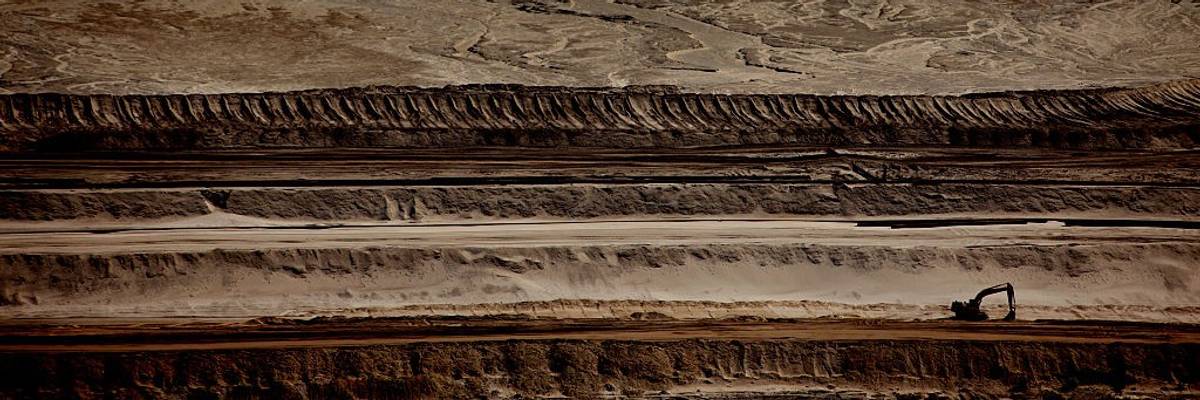
An excavator is working at a tailing pond at the Syncrude open pit oil excavation mine in Fort McMurray; the top soil is removed to give access to the controversial tar sands.
There is a bad guy in this discussion, and that is Big Oil.
With outright climate denialism largely behind us, we keep moving on through more sophisticated stages of climate inaction.
Currently, even as large swaths of North America became engulfed in wildfire smoke last week, we seem lodged in a new stage of inaction based on the notion “we’re all to blame.”
Or, as Majid Al Suwaidi put it: “There’s no simple bad guy, good guy in this discussion.”
Framed this way—that it’s up to all of us to reduce emissions—climate action takes on the feel of a communal effort with us all rooting for the same team.
A fascinating study by the corporate mapping project of the Canadian Centre for Policy Alternatives documents that the oil industry lobbied government officials 11,452 times—with a heavy focus on lobbying senior officials responsible for climate policies—during a seven-year period spanning the governments of Stephen Harper’s Conservatives and Justin Trudeau’s Liberals.
Of course, there’s nothing wrong with communal effort. But this framing prevents us from seeing what’s really going on: Yes, we all behave in ways that emit carbon (although some of us emit way more than others).
But—and this is the nub of it—we’re not all actively blocking climate action.
Rather, most of us are trying in small ways to reduce our carbon footprint. The problem is that there are immensely powerful forces out there using their clout to block the world from taking the urgent action needed to avert ever-worsening climate chaos.
So, sorry Mr. Al Suwaidi, but there is a bad guy in this discussion and that is Big Oil.
It’s not surprising that Al Suwaidi would avoid acknowledging this. After all, he’s an aide to Sultan al-Jaber, who heads up the national oil company of the United Arab Emirates, as well as heading up the U.N. climate negotiations to be held there next November. The fact that the sultan is heading up both is a perfect example of the sort of communal effort on climate change that feels good, but has gotten us nowhere.
To get somewhere, we have to start center-staging the truly immoral role played by Big Oil. Otherwise, we end up duped into believing that what holds us back is the refusal of ordinary Canadians to give up their fossil-fuel-guzzling cars.
True, some Canadians would refuse, and they would be goaded on by the oil lobby and the Freedom Convoy crowd. But the majority of Canadians are sufficiently freaked out by wildfires, heat domes, and flooding to be ready to transition to clean energy (especially since it wouldn’t have to impact their lifestyles that much)—if only there was some serious government leadership.
But there isn’t. Justin Trudeau, knowing the public fears climate change, fashions himself a climate warrior. But he largely succumbs to oil industry demands, revealing his warrior posture to be more fashion accessory than commitment.
It’s easy to see how this happens; Big Oil is relentless in its opposition to climate action.
A fascinating study by the corporate mapping project of the Canadian Centre for Policy Alternatives documents that the oil industry lobbied government officials 11,452 times—with a heavy focus on lobbying senior officials responsible for climate policies—during a seven-year period spanning the governments of Stephen Harper’s Conservatives and Justin Trudeau’s Liberals.
Both governments appear to have responded to this constant pressure by giving Big Oil a say in our climate policies, leaving Canada with a terrible record on reducing emissions—far worse than many comparable nations.
As climate journalist Barry Saxifrage has documented, key nations—including Germany, France, the U.K., Sweden, and Norway—have significantly reduced vehicle emissions, largely by raising taxes on gas-guzzlers and cutting taxes on battery-electric vehicles.
In case you’re tempted to excuse Canada’s dismal performance because we’re economically reliant on oil, Saxifrage notes that oil is also central to Norway’s economy, yet Norway has dramatically reduced emissions. (Last year, 78% of new vehicles purchased in Norway were battery-electric, compared to just 6%—and 1% in Alberta.)
Canadians are just as reasonable as Norwegians. If only we had a government willing to stand up to the menace of Big Oil.
Dear Common Dreams reader, It’s been nearly 30 years since I co-founded Common Dreams with my late wife, Lina Newhouser. We had the radical notion that journalism should serve the public good, not corporate profits. It was clear to us from the outset what it would take to build such a project. No paid advertisements. No corporate sponsors. No millionaire publisher telling us what to think or do. Many people said we wouldn't last a year, but we proved those doubters wrong. Together with a tremendous team of journalists and dedicated staff, we built an independent media outlet free from the constraints of profits and corporate control. Our mission has always been simple: To inform. To inspire. To ignite change for the common good. Building Common Dreams was not easy. Our survival was never guaranteed. When you take on the most powerful forces—Wall Street greed, fossil fuel industry destruction, Big Tech lobbyists, and uber-rich oligarchs who have spent billions upon billions rigging the economy and democracy in their favor—the only bulwark you have is supporters who believe in your work. But here’s the urgent message from me today. It's never been this bad out there. And it's never been this hard to keep us going. At the very moment Common Dreams is most needed, the threats we face are intensifying. We need your support now more than ever. We don't accept corporate advertising and never will. We don't have a paywall because we don't think people should be blocked from critical news based on their ability to pay. Everything we do is funded by the donations of readers like you. When everyone does the little they can afford, we are strong. But if that support retreats or dries up, so do we. Will you donate now to make sure Common Dreams not only survives but thrives? —Craig Brown, Co-founder |
With outright climate denialism largely behind us, we keep moving on through more sophisticated stages of climate inaction.
Currently, even as large swaths of North America became engulfed in wildfire smoke last week, we seem lodged in a new stage of inaction based on the notion “we’re all to blame.”
Or, as Majid Al Suwaidi put it: “There’s no simple bad guy, good guy in this discussion.”
Framed this way—that it’s up to all of us to reduce emissions—climate action takes on the feel of a communal effort with us all rooting for the same team.
A fascinating study by the corporate mapping project of the Canadian Centre for Policy Alternatives documents that the oil industry lobbied government officials 11,452 times—with a heavy focus on lobbying senior officials responsible for climate policies—during a seven-year period spanning the governments of Stephen Harper’s Conservatives and Justin Trudeau’s Liberals.
Of course, there’s nothing wrong with communal effort. But this framing prevents us from seeing what’s really going on: Yes, we all behave in ways that emit carbon (although some of us emit way more than others).
But—and this is the nub of it—we’re not all actively blocking climate action.
Rather, most of us are trying in small ways to reduce our carbon footprint. The problem is that there are immensely powerful forces out there using their clout to block the world from taking the urgent action needed to avert ever-worsening climate chaos.
So, sorry Mr. Al Suwaidi, but there is a bad guy in this discussion and that is Big Oil.
It’s not surprising that Al Suwaidi would avoid acknowledging this. After all, he’s an aide to Sultan al-Jaber, who heads up the national oil company of the United Arab Emirates, as well as heading up the U.N. climate negotiations to be held there next November. The fact that the sultan is heading up both is a perfect example of the sort of communal effort on climate change that feels good, but has gotten us nowhere.
To get somewhere, we have to start center-staging the truly immoral role played by Big Oil. Otherwise, we end up duped into believing that what holds us back is the refusal of ordinary Canadians to give up their fossil-fuel-guzzling cars.
True, some Canadians would refuse, and they would be goaded on by the oil lobby and the Freedom Convoy crowd. But the majority of Canadians are sufficiently freaked out by wildfires, heat domes, and flooding to be ready to transition to clean energy (especially since it wouldn’t have to impact their lifestyles that much)—if only there was some serious government leadership.
But there isn’t. Justin Trudeau, knowing the public fears climate change, fashions himself a climate warrior. But he largely succumbs to oil industry demands, revealing his warrior posture to be more fashion accessory than commitment.
It’s easy to see how this happens; Big Oil is relentless in its opposition to climate action.
A fascinating study by the corporate mapping project of the Canadian Centre for Policy Alternatives documents that the oil industry lobbied government officials 11,452 times—with a heavy focus on lobbying senior officials responsible for climate policies—during a seven-year period spanning the governments of Stephen Harper’s Conservatives and Justin Trudeau’s Liberals.
Both governments appear to have responded to this constant pressure by giving Big Oil a say in our climate policies, leaving Canada with a terrible record on reducing emissions—far worse than many comparable nations.
As climate journalist Barry Saxifrage has documented, key nations—including Germany, France, the U.K., Sweden, and Norway—have significantly reduced vehicle emissions, largely by raising taxes on gas-guzzlers and cutting taxes on battery-electric vehicles.
In case you’re tempted to excuse Canada’s dismal performance because we’re economically reliant on oil, Saxifrage notes that oil is also central to Norway’s economy, yet Norway has dramatically reduced emissions. (Last year, 78% of new vehicles purchased in Norway were battery-electric, compared to just 6%—and 1% in Alberta.)
Canadians are just as reasonable as Norwegians. If only we had a government willing to stand up to the menace of Big Oil.
With outright climate denialism largely behind us, we keep moving on through more sophisticated stages of climate inaction.
Currently, even as large swaths of North America became engulfed in wildfire smoke last week, we seem lodged in a new stage of inaction based on the notion “we’re all to blame.”
Or, as Majid Al Suwaidi put it: “There’s no simple bad guy, good guy in this discussion.”
Framed this way—that it’s up to all of us to reduce emissions—climate action takes on the feel of a communal effort with us all rooting for the same team.
A fascinating study by the corporate mapping project of the Canadian Centre for Policy Alternatives documents that the oil industry lobbied government officials 11,452 times—with a heavy focus on lobbying senior officials responsible for climate policies—during a seven-year period spanning the governments of Stephen Harper’s Conservatives and Justin Trudeau’s Liberals.
Of course, there’s nothing wrong with communal effort. But this framing prevents us from seeing what’s really going on: Yes, we all behave in ways that emit carbon (although some of us emit way more than others).
But—and this is the nub of it—we’re not all actively blocking climate action.
Rather, most of us are trying in small ways to reduce our carbon footprint. The problem is that there are immensely powerful forces out there using their clout to block the world from taking the urgent action needed to avert ever-worsening climate chaos.
So, sorry Mr. Al Suwaidi, but there is a bad guy in this discussion and that is Big Oil.
It’s not surprising that Al Suwaidi would avoid acknowledging this. After all, he’s an aide to Sultan al-Jaber, who heads up the national oil company of the United Arab Emirates, as well as heading up the U.N. climate negotiations to be held there next November. The fact that the sultan is heading up both is a perfect example of the sort of communal effort on climate change that feels good, but has gotten us nowhere.
To get somewhere, we have to start center-staging the truly immoral role played by Big Oil. Otherwise, we end up duped into believing that what holds us back is the refusal of ordinary Canadians to give up their fossil-fuel-guzzling cars.
True, some Canadians would refuse, and they would be goaded on by the oil lobby and the Freedom Convoy crowd. But the majority of Canadians are sufficiently freaked out by wildfires, heat domes, and flooding to be ready to transition to clean energy (especially since it wouldn’t have to impact their lifestyles that much)—if only there was some serious government leadership.
But there isn’t. Justin Trudeau, knowing the public fears climate change, fashions himself a climate warrior. But he largely succumbs to oil industry demands, revealing his warrior posture to be more fashion accessory than commitment.
It’s easy to see how this happens; Big Oil is relentless in its opposition to climate action.
A fascinating study by the corporate mapping project of the Canadian Centre for Policy Alternatives documents that the oil industry lobbied government officials 11,452 times—with a heavy focus on lobbying senior officials responsible for climate policies—during a seven-year period spanning the governments of Stephen Harper’s Conservatives and Justin Trudeau’s Liberals.
Both governments appear to have responded to this constant pressure by giving Big Oil a say in our climate policies, leaving Canada with a terrible record on reducing emissions—far worse than many comparable nations.
As climate journalist Barry Saxifrage has documented, key nations—including Germany, France, the U.K., Sweden, and Norway—have significantly reduced vehicle emissions, largely by raising taxes on gas-guzzlers and cutting taxes on battery-electric vehicles.
In case you’re tempted to excuse Canada’s dismal performance because we’re economically reliant on oil, Saxifrage notes that oil is also central to Norway’s economy, yet Norway has dramatically reduced emissions. (Last year, 78% of new vehicles purchased in Norway were battery-electric, compared to just 6%—and 1% in Alberta.)
Canadians are just as reasonable as Norwegians. If only we had a government willing to stand up to the menace of Big Oil.