
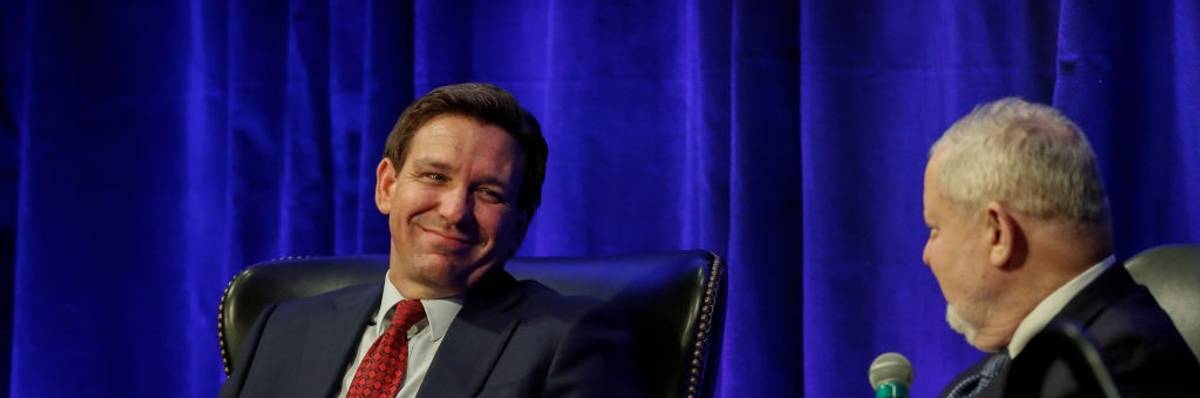
Florida Gov. Ron DeSantis (R-FL) listens to a question from Hillsdale College President Dr. Larry Arnn at Hillsdale College on April 6, 2023 in Hillsdale, Michigan.
Ron DeSantis: Yet Another Cog in Guantanamo's Torture Machine
The Florida governor and White House hopeful reminds us of how the prisoners at the offshore prison became defenseless victims of state vengeance run amok and how the perpetrators of torture and abuse—and their masters—have eluded any form of accountability.
Recently, there have been troubling revelations about Florida Governor Ron DeSantis — a leading 2024 GOP presidential aspirant — concerning his conduct as a Navy JAG officer at Guantanamo Bay. His responsibilities at the detention facility apparently included responding to claims of mistreatment from the war-on-terror prisoners there. Relatively few of these detainees had any connection with al Qaeda, and many had simply been handed over to US forces in exchange for bounty payments. But DeSantis seemingly viewed them all as wily and unrepentant terrorists.
Of particular note, DeSantis was at Guantanamo in 2006 during the brutal forced-feeding of prisoners engaged in a mass hunger strike. Years later, DeSantis acknowledged that, as a legal advisor, he had suggested this intervention as a countermeasure to what he described as the detainees’ “waging jihad” — by refusing to eat. When interviewed last month, DeSantis emphasized that he “didn’t have authority to authorize anything” and that Guantanamo was “a professionally-run prison.” His first claim — sidestepping personal responsibility — may contain elements of truth; his second is outrageously absurd.
As a general matter, the forced-feeding of mentally competent individuals violates international standards of medical ethics and constitutes inhuman and degrading treatment. This was especially so in the case of the Department of Defense, which opted to employ extreme, punitive measures — even described as torture by United Nations investigators — when force-feeding the prisoners at Guantanamo. These measures included a restraint chair that immobilized the detainee’s entire body for hours at a time, and the use of tubing that was inserted through the nose into the stomach and then removed and reinserted multiple times each day, often causing sharp pain and bleeding. A defense attorney for Guantanamo prisoners subjected to forced-feeding has written, “Only a sadist could impose and witness such treatment without grave concern and soul-sickness.” It’s hard to argue with that blunt assessment. But there are also two larger truths we shouldn’t overlook.
First, even though DeSantis has disingenuously characterized the detainees as master manipulators who all claimed to be “Koran salesmen,” the hunger strikers were actually protesting an unconscionable system of indefinite detention and ruthless interrogation that relied on daily abuse — solitary confinement, physical beatings, sexual humiliation, and more. This routinized cruelty didn’t solely involve guards and interrogators. It also depended upon guidance from health professionals, who seemingly abandoned their fundamental “Do No Harm” principles to accommodate a White House insistent that the prisoners had no entitlement to humane treatment.
These abusive conditions and techniques have left many Guantanamo prisoners —past and present — with deep psychic wounds. Survivors of torture often experience overwhelming feelings of shame, helplessness, and disconnection as a result of having been subjected to mistreatment at the hands of another human being. Frequently, the victims of such traumas are also haunted by depression, anxiety, and PTSD; by nightmares and flashbacks; and by a lasting sense that safety and solace will never be achieved. Viewed from this perspective, the hunger strikes that DeSantis witnessed — and apparently dismissed as terrorist tactics — are better understood as the prisoners’ desperate and despairing attempts to regain some semblance of control over their lives and circumstances, even at the risk of starvation.
The second larger truth is this: accountability for Guantanamo’s horrors has never been a priority for our country’s elected leaders. No US president has ever taken meaningful steps on this front. George W. Bush, of course, never sought to discipline those responsible for the torturous policies his own administration authorized. Barrack Obama took action to end torture — but when it came to accountability, he decided “we need to look forward as opposed to looking backwards.” Donald Trump clearly had no interest in such matters, promising instead to bring back waterboarding and “a hell of a lot worse.” And although Joe Biden has expressed a desire to close Guantanamo, he’s now building a second, multi-million-dollar courtroom there for military commission prosecutions in which detainees have limited due process rights.
So then how does Ron DeSantis’s alleged up-close-and-personal connections to prisoner abuse years ago really matter? It would be naïve to think that his political prospects will suffer. Indeed, he may even gain in popularity among voters who embrace his authoritarian mindset, share his disdain for protecting the rights of the vulnerable, and believe his misleading characterizations of the prison and the prisoners at Guantanamo.
But the attention DeSantis’s story has brought to Guantanamo can still do some good. Ideally, it can spark broader public interest in an examination of the facility’s shameful 21-year history: how its detention and interrogation operations have dishonored the values this country has long professed to hold dear; how the prisoners there became defenseless victims of state vengeance run amok; how the perpetrators of torture and abuse — and their masters — have eluded any form of accountability; and how essential it is to close Guantanamo and throw away the key.
We are at a crossroads
This country and this world are at a monumental crossroads. US voters have an opportunity to beat back the forces of fascism and confront the billionaires who are rigging the economy, our media system, and our democracy, making it increasingly impossible for ordinary people to get by. We’re not just talking about the election. We’re talking about what must be done once these fascist elements are vanquished from power. We need a bolder set of solutions than what either major party has so far been willing to offer and a working-class movement ready to fight like hell for it. Trump didn't emerge from nowhere. The conditions that fueled MAGA authoritarianism were created by decades of radical neoliberal economic policies and a corrupt political system dominated by corporate interests. They slashed taxes on the super-rich, promising that the benefits would trickle down. They said giveaways to the corporate titans would make life more affordable for the rest of us. It was all bullshit. And when a bitter, betrayed populace searches for someone to blame, right-wing demagogues have little trouble finding scapegoats. People know when they're being lied to, but you won't hear any of this from the corporate media. Only independent journalism—powered and funded by people who believe in building a better world—can deliver truly trustworthy daily news. Our Fall Campaign is underway, and we need your help. To power our newsroom through the rest of the year, we need to raise $125,000 by midnight on October 31. So if you share our vision, please contribute whatever you can to sustain our work. |
Roy Eidelson, PhD, is a member of the Coalition for an Ethical Psychology, a past president of Psychologists for Social Responsibility, and the author of Doing Harm: How the World’s Largest Psychological Association Lost Its Way in the War on Terror (McGill-Queen’s University Press).
Recently, there have been troubling revelations about Florida Governor Ron DeSantis — a leading 2024 GOP presidential aspirant — concerning his conduct as a Navy JAG officer at Guantanamo Bay. His responsibilities at the detention facility apparently included responding to claims of mistreatment from the war-on-terror prisoners there. Relatively few of these detainees had any connection with al Qaeda, and many had simply been handed over to US forces in exchange for bounty payments. But DeSantis seemingly viewed them all as wily and unrepentant terrorists.
Of particular note, DeSantis was at Guantanamo in 2006 during the brutal forced-feeding of prisoners engaged in a mass hunger strike. Years later, DeSantis acknowledged that, as a legal advisor, he had suggested this intervention as a countermeasure to what he described as the detainees’ “waging jihad” — by refusing to eat. When interviewed last month, DeSantis emphasized that he “didn’t have authority to authorize anything” and that Guantanamo was “a professionally-run prison.” His first claim — sidestepping personal responsibility — may contain elements of truth; his second is outrageously absurd.
As a general matter, the forced-feeding of mentally competent individuals violates international standards of medical ethics and constitutes inhuman and degrading treatment. This was especially so in the case of the Department of Defense, which opted to employ extreme, punitive measures — even described as torture by United Nations investigators — when force-feeding the prisoners at Guantanamo. These measures included a restraint chair that immobilized the detainee’s entire body for hours at a time, and the use of tubing that was inserted through the nose into the stomach and then removed and reinserted multiple times each day, often causing sharp pain and bleeding. A defense attorney for Guantanamo prisoners subjected to forced-feeding has written, “Only a sadist could impose and witness such treatment without grave concern and soul-sickness.” It’s hard to argue with that blunt assessment. But there are also two larger truths we shouldn’t overlook.
First, even though DeSantis has disingenuously characterized the detainees as master manipulators who all claimed to be “Koran salesmen,” the hunger strikers were actually protesting an unconscionable system of indefinite detention and ruthless interrogation that relied on daily abuse — solitary confinement, physical beatings, sexual humiliation, and more. This routinized cruelty didn’t solely involve guards and interrogators. It also depended upon guidance from health professionals, who seemingly abandoned their fundamental “Do No Harm” principles to accommodate a White House insistent that the prisoners had no entitlement to humane treatment.
These abusive conditions and techniques have left many Guantanamo prisoners —past and present — with deep psychic wounds. Survivors of torture often experience overwhelming feelings of shame, helplessness, and disconnection as a result of having been subjected to mistreatment at the hands of another human being. Frequently, the victims of such traumas are also haunted by depression, anxiety, and PTSD; by nightmares and flashbacks; and by a lasting sense that safety and solace will never be achieved. Viewed from this perspective, the hunger strikes that DeSantis witnessed — and apparently dismissed as terrorist tactics — are better understood as the prisoners’ desperate and despairing attempts to regain some semblance of control over their lives and circumstances, even at the risk of starvation.
The second larger truth is this: accountability for Guantanamo’s horrors has never been a priority for our country’s elected leaders. No US president has ever taken meaningful steps on this front. George W. Bush, of course, never sought to discipline those responsible for the torturous policies his own administration authorized. Barrack Obama took action to end torture — but when it came to accountability, he decided “we need to look forward as opposed to looking backwards.” Donald Trump clearly had no interest in such matters, promising instead to bring back waterboarding and “a hell of a lot worse.” And although Joe Biden has expressed a desire to close Guantanamo, he’s now building a second, multi-million-dollar courtroom there for military commission prosecutions in which detainees have limited due process rights.
So then how does Ron DeSantis’s alleged up-close-and-personal connections to prisoner abuse years ago really matter? It would be naïve to think that his political prospects will suffer. Indeed, he may even gain in popularity among voters who embrace his authoritarian mindset, share his disdain for protecting the rights of the vulnerable, and believe his misleading characterizations of the prison and the prisoners at Guantanamo.
But the attention DeSantis’s story has brought to Guantanamo can still do some good. Ideally, it can spark broader public interest in an examination of the facility’s shameful 21-year history: how its detention and interrogation operations have dishonored the values this country has long professed to hold dear; how the prisoners there became defenseless victims of state vengeance run amok; how the perpetrators of torture and abuse — and their masters — have eluded any form of accountability; and how essential it is to close Guantanamo and throw away the key.
- I'll Never Forget That Smiling Face of Ron DeSantis... As I Was Being Tortured at Guantanamo ›
- Opinion | Unveiling Shadows: Guantánamo Prisoners and the International Day of the Victims of Enforced Disappearances | Common Dreams ›
- Opinion | I'm Totally Here for the DeSantis Jokes—But Let's Not Forget the Vicious Cruelty He Imposed | Common Dreams ›
- Opinion | The Disappearance Machine | Common Dreams ›