SUBSCRIBE TO OUR FREE NEWSLETTER
Daily news & progressive opinion—funded by the people, not the corporations—delivered straight to your inbox.
5
#000000
#FFFFFF
To donate by check, phone, or other method, see our More Ways to Give page.
Daily news & progressive opinion—funded by the people, not the corporations—delivered straight to your inbox.
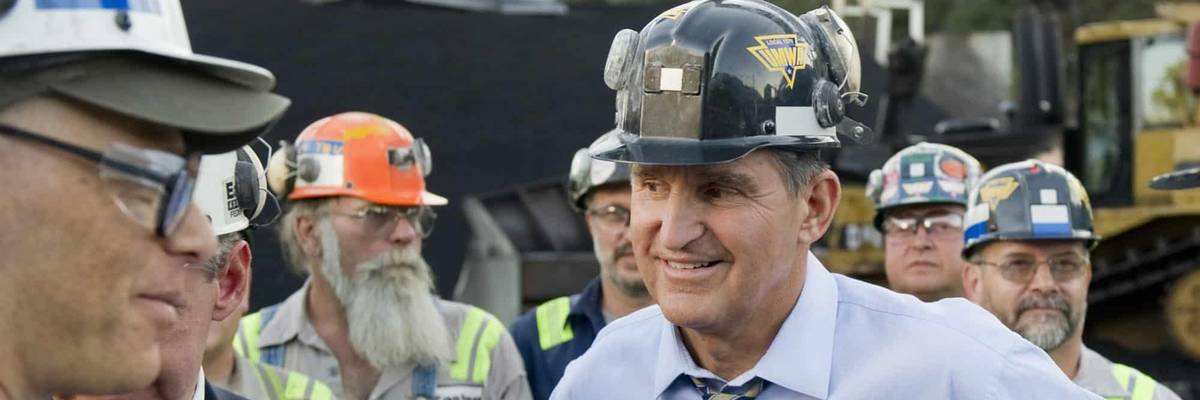
U.S. Sen Joe Manchin, who introduced the Energy Permitting Reform Act, speaks with West Virginia coal miners.
Though the EPRA alleges to improve energy projects’ approval processes, it does so through fossil fuel racism, with giveaways to big oil and gas while hurting vulnerable communities and the environment.
To achieve a “clean energy revolution,” we cannot replicate the injustices of our current and past energy systems. As the next administration promises massive increases for fossil fuel projects and near total removals of environmental protections and agency functions, we must hold the line and set a standard for the future we need and deserve.
The Energy Permitting Reform Act of 2024 (EPRA) (S. 4753) introduced by Sen. Joe Manchin (I-W.Va.) and Sen. John Barrasso (R-Wyo.), is being sold as a “necessary” and bipartisan path. But why does it feel so dirty, and so familiar?
We’ve seen this before. There have been multiple attempts to advance legislation that weakens environmental protections and sacrifices vulnerable communities to fast-track energy projects driven by fossil fuel interests. As foreshadowed during previous attempts in 2022, “The industry will keep trying these secretive, last minute efforts to push forward dirty deals.”
Unjust energy policies being marketed as for the “common good” is an age-old practice—as old as redlining, the industrial revolution, and earlier. Our energy systems have long been controlled by extractive, industry-driven forces, resulting in what is known as “fossil fuel racism.” Fossil fuel racism creates disproportionate impacts on people of color from the fossil fuel cycle and requires:
So what’s different about EPRA? Nothing. Not only does it contain goals straight out of Project 2025, the American Petroleum Institute and “two dozen energy companies and trade groups’” lobbying reports mention EPRA by name. Though the bill alleges to improve energy projects’ approval processes, it does so through fossil fuel racism, with giveaways to big oil and gas while hurting vulnerable communities and the environment. Here’s how:
1) Sacrifice Zones and Fossil Fuel Expansion
The Energy Permitting Reform Act continues to exploit environmental justice communities by reinforcing sacrifice zones, which include predominantly people of color and low income, by greenlighting fossil fuel projects. EPRA would undo the Biden administration’s pause on approving Liquefied Natural Gas (LNG) export projects, overwhelmingly situated in these communities. EPRA would also dramatically shorten time for the Department of Energy (DOE) to perform environmental reviews and mandates automatic project approvals after 90 days, regardless of potential negative impacts. Additionally, modeled emissions reductions used to justify support for EPRA rely on continued use of environmental justice communities as sacrifice zones.
2) Climate Crisis and Public Health
People of color and low income disproportionately experience the worst climate crisis impacts. The modeling that claims the transmission pieces of EPRA would reduce greenhouse gas emissions are cherry-picked scenarios and assumptions, according to and underscored by over 100 scientists. Modeling also ignores localized pollution contributing to increasing health crises. The models’ reliance on greenhouse gas calculations overlooks realities for communities on the ground.
3) Industry Control and Democracy Broken
The bill undermines the ability of communities burdened by pollution to have a say regarding projects that threaten their health and environments. EPRA would reduce the time communities and Tribes have to challenge projects in court from six years to 150 days. It goes further to weaken the National Environmental Policy Act by voiding essential environmental impact assessments for fossil fuel projects.
EPRA sets a dangerous precedent and has serious implications for frontline communities. Zulene Mayfield, of Chester Residents Concerned for Quality Living (CRCQL) in Chester, Pennsylvania, is fighting a proposed LNG facility in her backyard. Chester—a majority working class, Black neighborhood—is already dealing with a health crisis from trash incinerators and sewage treatment facilities. Community members received no public notice about the project and were locked out of public hearings. With EPRA’s extreme project approval timeline coupled with an intentional lack of transparency, safeguards from hazardous projects are gone.
Hilton Kelley of Community In-Power and Development Association Incorporated (CIDA Inc.) in Port Arthur, Texas has also been fighting to free his community from fossil fuel racism. As a resident of the “cancer belt,” he is now dealing with two new LNG facilities in his neighborhood.
Voices against EPRA are rising with over 680 organizations opposing the bill. Environmental Justice leaders have spoken out including Richard Moore of Los Jardines Institute: “It [EPRA] is a stark reminder of the priorities of those who continue to put corporate profits above the health and well-being of our communities.”
EPRA is built on a false policy dichotomy. We don't have to sacrifice environmental protections and communities to fast-track clean energy projects. There are other legislative proposals that are designed to protect communities with significant support, such as the A. Donald McEachin Environmental Justice for All Act, which was written in partnership with environmental justice communities. This bill would cement key protections including cumulative impacts analysis; first, early, and ongoing engagement models; and civil rights and NEPA requirements. The Clean Electricity and Transmission Acceleration Act (CETA) similarly strengthens engagement through environmental justice liaisons facilitating relationships between project sponsors and communities.
Our communities are opportunity centers full of vision, solutions, and wisdom—not sacrifice zones. Our communities are worth investing in to achieve a just, sustainable energy future and address the climate crisis now, if decision-makers would only open their eyes.
Dear Common Dreams reader, It’s been nearly 30 years since I co-founded Common Dreams with my late wife, Lina Newhouser. We had the radical notion that journalism should serve the public good, not corporate profits. It was clear to us from the outset what it would take to build such a project. No paid advertisements. No corporate sponsors. No millionaire publisher telling us what to think or do. Many people said we wouldn't last a year, but we proved those doubters wrong. Together with a tremendous team of journalists and dedicated staff, we built an independent media outlet free from the constraints of profits and corporate control. Our mission has always been simple: To inform. To inspire. To ignite change for the common good. Building Common Dreams was not easy. Our survival was never guaranteed. When you take on the most powerful forces—Wall Street greed, fossil fuel industry destruction, Big Tech lobbyists, and uber-rich oligarchs who have spent billions upon billions rigging the economy and democracy in their favor—the only bulwark you have is supporters who believe in your work. But here’s the urgent message from me today. It's never been this bad out there. And it's never been this hard to keep us going. At the very moment Common Dreams is most needed, the threats we face are intensifying. We need your support now more than ever. We don't accept corporate advertising and never will. We don't have a paywall because we don't think people should be blocked from critical news based on their ability to pay. Everything we do is funded by the donations of readers like you. When everyone does the little they can afford, we are strong. But if that support retreats or dries up, so do we. Will you donate now to make sure Common Dreams not only survives but thrives? —Craig Brown, Co-founder |
To achieve a “clean energy revolution,” we cannot replicate the injustices of our current and past energy systems. As the next administration promises massive increases for fossil fuel projects and near total removals of environmental protections and agency functions, we must hold the line and set a standard for the future we need and deserve.
The Energy Permitting Reform Act of 2024 (EPRA) (S. 4753) introduced by Sen. Joe Manchin (I-W.Va.) and Sen. John Barrasso (R-Wyo.), is being sold as a “necessary” and bipartisan path. But why does it feel so dirty, and so familiar?
We’ve seen this before. There have been multiple attempts to advance legislation that weakens environmental protections and sacrifices vulnerable communities to fast-track energy projects driven by fossil fuel interests. As foreshadowed during previous attempts in 2022, “The industry will keep trying these secretive, last minute efforts to push forward dirty deals.”
Unjust energy policies being marketed as for the “common good” is an age-old practice—as old as redlining, the industrial revolution, and earlier. Our energy systems have long been controlled by extractive, industry-driven forces, resulting in what is known as “fossil fuel racism.” Fossil fuel racism creates disproportionate impacts on people of color from the fossil fuel cycle and requires:
So what’s different about EPRA? Nothing. Not only does it contain goals straight out of Project 2025, the American Petroleum Institute and “two dozen energy companies and trade groups’” lobbying reports mention EPRA by name. Though the bill alleges to improve energy projects’ approval processes, it does so through fossil fuel racism, with giveaways to big oil and gas while hurting vulnerable communities and the environment. Here’s how:
1) Sacrifice Zones and Fossil Fuel Expansion
The Energy Permitting Reform Act continues to exploit environmental justice communities by reinforcing sacrifice zones, which include predominantly people of color and low income, by greenlighting fossil fuel projects. EPRA would undo the Biden administration’s pause on approving Liquefied Natural Gas (LNG) export projects, overwhelmingly situated in these communities. EPRA would also dramatically shorten time for the Department of Energy (DOE) to perform environmental reviews and mandates automatic project approvals after 90 days, regardless of potential negative impacts. Additionally, modeled emissions reductions used to justify support for EPRA rely on continued use of environmental justice communities as sacrifice zones.
2) Climate Crisis and Public Health
People of color and low income disproportionately experience the worst climate crisis impacts. The modeling that claims the transmission pieces of EPRA would reduce greenhouse gas emissions are cherry-picked scenarios and assumptions, according to and underscored by over 100 scientists. Modeling also ignores localized pollution contributing to increasing health crises. The models’ reliance on greenhouse gas calculations overlooks realities for communities on the ground.
3) Industry Control and Democracy Broken
The bill undermines the ability of communities burdened by pollution to have a say regarding projects that threaten their health and environments. EPRA would reduce the time communities and Tribes have to challenge projects in court from six years to 150 days. It goes further to weaken the National Environmental Policy Act by voiding essential environmental impact assessments for fossil fuel projects.
EPRA sets a dangerous precedent and has serious implications for frontline communities. Zulene Mayfield, of Chester Residents Concerned for Quality Living (CRCQL) in Chester, Pennsylvania, is fighting a proposed LNG facility in her backyard. Chester—a majority working class, Black neighborhood—is already dealing with a health crisis from trash incinerators and sewage treatment facilities. Community members received no public notice about the project and were locked out of public hearings. With EPRA’s extreme project approval timeline coupled with an intentional lack of transparency, safeguards from hazardous projects are gone.
Hilton Kelley of Community In-Power and Development Association Incorporated (CIDA Inc.) in Port Arthur, Texas has also been fighting to free his community from fossil fuel racism. As a resident of the “cancer belt,” he is now dealing with two new LNG facilities in his neighborhood.
Voices against EPRA are rising with over 680 organizations opposing the bill. Environmental Justice leaders have spoken out including Richard Moore of Los Jardines Institute: “It [EPRA] is a stark reminder of the priorities of those who continue to put corporate profits above the health and well-being of our communities.”
EPRA is built on a false policy dichotomy. We don't have to sacrifice environmental protections and communities to fast-track clean energy projects. There are other legislative proposals that are designed to protect communities with significant support, such as the A. Donald McEachin Environmental Justice for All Act, which was written in partnership with environmental justice communities. This bill would cement key protections including cumulative impacts analysis; first, early, and ongoing engagement models; and civil rights and NEPA requirements. The Clean Electricity and Transmission Acceleration Act (CETA) similarly strengthens engagement through environmental justice liaisons facilitating relationships between project sponsors and communities.
Our communities are opportunity centers full of vision, solutions, and wisdom—not sacrifice zones. Our communities are worth investing in to achieve a just, sustainable energy future and address the climate crisis now, if decision-makers would only open their eyes.
To achieve a “clean energy revolution,” we cannot replicate the injustices of our current and past energy systems. As the next administration promises massive increases for fossil fuel projects and near total removals of environmental protections and agency functions, we must hold the line and set a standard for the future we need and deserve.
The Energy Permitting Reform Act of 2024 (EPRA) (S. 4753) introduced by Sen. Joe Manchin (I-W.Va.) and Sen. John Barrasso (R-Wyo.), is being sold as a “necessary” and bipartisan path. But why does it feel so dirty, and so familiar?
We’ve seen this before. There have been multiple attempts to advance legislation that weakens environmental protections and sacrifices vulnerable communities to fast-track energy projects driven by fossil fuel interests. As foreshadowed during previous attempts in 2022, “The industry will keep trying these secretive, last minute efforts to push forward dirty deals.”
Unjust energy policies being marketed as for the “common good” is an age-old practice—as old as redlining, the industrial revolution, and earlier. Our energy systems have long been controlled by extractive, industry-driven forces, resulting in what is known as “fossil fuel racism.” Fossil fuel racism creates disproportionate impacts on people of color from the fossil fuel cycle and requires:
So what’s different about EPRA? Nothing. Not only does it contain goals straight out of Project 2025, the American Petroleum Institute and “two dozen energy companies and trade groups’” lobbying reports mention EPRA by name. Though the bill alleges to improve energy projects’ approval processes, it does so through fossil fuel racism, with giveaways to big oil and gas while hurting vulnerable communities and the environment. Here’s how:
1) Sacrifice Zones and Fossil Fuel Expansion
The Energy Permitting Reform Act continues to exploit environmental justice communities by reinforcing sacrifice zones, which include predominantly people of color and low income, by greenlighting fossil fuel projects. EPRA would undo the Biden administration’s pause on approving Liquefied Natural Gas (LNG) export projects, overwhelmingly situated in these communities. EPRA would also dramatically shorten time for the Department of Energy (DOE) to perform environmental reviews and mandates automatic project approvals after 90 days, regardless of potential negative impacts. Additionally, modeled emissions reductions used to justify support for EPRA rely on continued use of environmental justice communities as sacrifice zones.
2) Climate Crisis and Public Health
People of color and low income disproportionately experience the worst climate crisis impacts. The modeling that claims the transmission pieces of EPRA would reduce greenhouse gas emissions are cherry-picked scenarios and assumptions, according to and underscored by over 100 scientists. Modeling also ignores localized pollution contributing to increasing health crises. The models’ reliance on greenhouse gas calculations overlooks realities for communities on the ground.
3) Industry Control and Democracy Broken
The bill undermines the ability of communities burdened by pollution to have a say regarding projects that threaten their health and environments. EPRA would reduce the time communities and Tribes have to challenge projects in court from six years to 150 days. It goes further to weaken the National Environmental Policy Act by voiding essential environmental impact assessments for fossil fuel projects.
EPRA sets a dangerous precedent and has serious implications for frontline communities. Zulene Mayfield, of Chester Residents Concerned for Quality Living (CRCQL) in Chester, Pennsylvania, is fighting a proposed LNG facility in her backyard. Chester—a majority working class, Black neighborhood—is already dealing with a health crisis from trash incinerators and sewage treatment facilities. Community members received no public notice about the project and were locked out of public hearings. With EPRA’s extreme project approval timeline coupled with an intentional lack of transparency, safeguards from hazardous projects are gone.
Hilton Kelley of Community In-Power and Development Association Incorporated (CIDA Inc.) in Port Arthur, Texas has also been fighting to free his community from fossil fuel racism. As a resident of the “cancer belt,” he is now dealing with two new LNG facilities in his neighborhood.
Voices against EPRA are rising with over 680 organizations opposing the bill. Environmental Justice leaders have spoken out including Richard Moore of Los Jardines Institute: “It [EPRA] is a stark reminder of the priorities of those who continue to put corporate profits above the health and well-being of our communities.”
EPRA is built on a false policy dichotomy. We don't have to sacrifice environmental protections and communities to fast-track clean energy projects. There are other legislative proposals that are designed to protect communities with significant support, such as the A. Donald McEachin Environmental Justice for All Act, which was written in partnership with environmental justice communities. This bill would cement key protections including cumulative impacts analysis; first, early, and ongoing engagement models; and civil rights and NEPA requirements. The Clean Electricity and Transmission Acceleration Act (CETA) similarly strengthens engagement through environmental justice liaisons facilitating relationships between project sponsors and communities.
Our communities are opportunity centers full of vision, solutions, and wisdom—not sacrifice zones. Our communities are worth investing in to achieve a just, sustainable energy future and address the climate crisis now, if decision-makers would only open their eyes.