SUBSCRIBE TO OUR FREE NEWSLETTER
Daily news & progressive opinion—funded by the people, not the corporations—delivered straight to your inbox.
5
#000000
#FFFFFF
To donate by check, phone, or other method, see our More Ways to Give page.
Daily news & progressive opinion—funded by the people, not the corporations—delivered straight to your inbox.
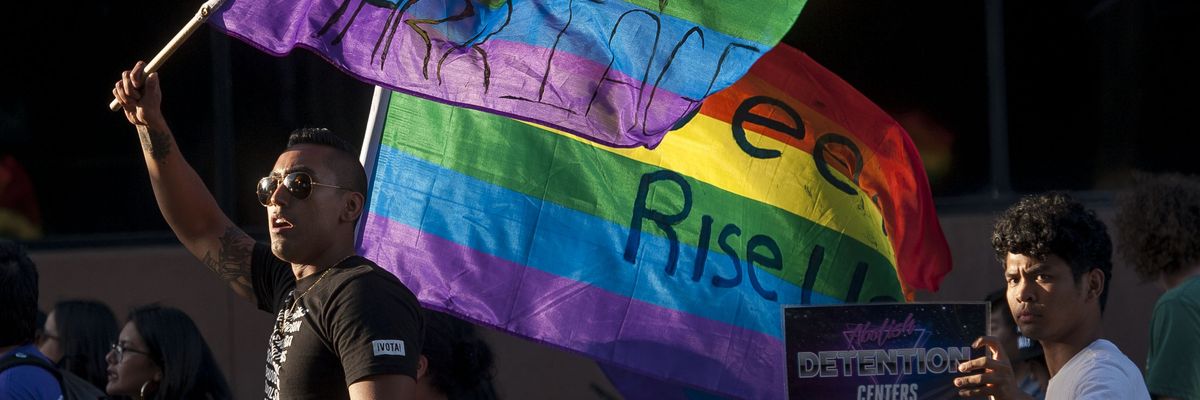
Ignacio Rios, left, of Santa Ana marches with fellow protesters against the detention of transgender women in Santa Ana on Thursday, May 4, 2017.
Pride should be a time to focus on pushing forth progress for all LGBTQ+ individuals, including our LGBTQ+ community incarcerated in our nation’s carceral system.
It’s official—we’re less than a month away from the beginning of Pride. And the anticipation is building. Disney recently announced its first ever Pride event, “Disneyland After Dark: Pride Nite.” Meanwhile, cities around the country have been announcing their Pride themes. San Francisco will focus on “Looking Back and Moving Forward.” D.C. Capital Pride’s theme will be “Peace, Love, Revolution;” and New York City’s is “Strength in Solidarity.”
But if we really want to show solidarity across our community, we must remember how many within our community aren’t truly free.
Pride represents a time to celebrate and honor the progress that has been made for LGBTQ+ rights, especially during a time where anti- LGBTQ+ laws are being introduced nearly daily. But it’s also a time to reflect on how many within our community are exposed to violence and trauma because of their identities. That’s why I believe while we celebrate the progress made for LGBTQ+ rights, Pride should also be a time to focus on pushing forth progress for all LGBTQ+ individuals, including our LGBTQ+ community incarcerated in our nation’s carceral system.
Today, lesbian, gay, and bisexual individuals are incarcerated at a rate three times greater than that of their heterosexual counterparts.
This year marks the 50th anniversary of mass incarceration in the U.S., a system of policies and practices that increased the prison population and have continued to disproportionately targeted LGBTQ+ people. Today, lesbian, gay, and bisexual individuals are incarcerated at a rate three times greater than that of their heterosexual counterparts. Approximately one in six transgender individuals have been incarcerated at some point in their lives. Overrepresentation of LGBTQ+ within our criminal justice system is no accident, but rather a reflection of a system that polices and criminalizes queer and trans lives—particularly queer and trans people of color.
Incarceration isn’t easy for anyone, and LGBTQ+ folks have an unusually harsh experience while incarcerated in an already cruel environment. In California, nearly 60% of trans individuals incarcerated have been sexually assaulted during their incarcerations, which is well higher than the average incarcerated population reports. Lesbian and bisexual women are almost five times more likely than heterosexual women to have a sentence length of over 20 years. Nationwide, over 70% of gay and bisexual men incarcerated have experienced solitary confinement, which is nearly twice the odds for heterosexual incarcerated men.
Pride, despite its intentions, has not always been aligned with the needs of those most marginalized within the LGBTQ+ community. Rather, the increased commercialism of Pride has resulted in corporations like Walmart actively marketing the month for profits while doing little to support the most urgent social problems faced by the community throughout the year, such as mass incarceration. This year, amidst unparalleled attacks on LGBTQ+ rights and transphobia, Pride should reflect its origins of community organizing for our most vulnerable members and achieving structural change.
To be sure, Pride is an important time of celebration and rejoicing over the progress we’ve made, and some may feel that a focus on those within a violent system of incarceration detracts from that moment of celebration. But I argue we can both celebrate the accomplishments that have been achieved over the last decade, from the passage of same-sex marriage to unprecedented representation of LGBTQ+ individuals in state and federal administrations, while demanding more. Pride should never become a time solely for anger or mourning, but we cannot rightfully celebrate these accomplishments that benefit us without pushing for additional ones for others in our community.
More so, what we yearn for as a community are systematic societal changes to protect and promote our well-being, including that of our most marginalized. While reforms to improve prisons and jails as well as the reentry process for LGBTQ+ incarcerated individuals are needed, we must also prevent LGBTQ+ people from being incarcerated in the first place. Abolishing HIV criminalization laws would be one place to start—an archaic notion of HIV risk transmission that allows 35 states to funnel their homophobia and transphobia. Anti-profiling laws from police that include protections for LGBTQ+ could be a start to reduce the overrepresentation of queer and trans people inside. Policies that prevent poverty and homelessness—which disproportionately impact LGBTQ+ people—could reduce scenarios that lead to incarceration in the first place.
The urgency of mass incarceration and its lasting harm on the LGBTQ+ community cannot be emphasized enough. We must not allow for another 50 years of mass incarceration as an ineffective solution to the ills of society, including poverty and inadequate health access. This Pride, we—as the queer and trans community—should live up to slogans praising solidarity, strength, or revolution by advocating and fighting for our incarcerated siblings.
Dear Common Dreams reader, It’s been nearly 30 years since I co-founded Common Dreams with my late wife, Lina Newhouser. We had the radical notion that journalism should serve the public good, not corporate profits. It was clear to us from the outset what it would take to build such a project. No paid advertisements. No corporate sponsors. No millionaire publisher telling us what to think or do. Many people said we wouldn't last a year, but we proved those doubters wrong. Together with a tremendous team of journalists and dedicated staff, we built an independent media outlet free from the constraints of profits and corporate control. Our mission has always been simple: To inform. To inspire. To ignite change for the common good. Building Common Dreams was not easy. Our survival was never guaranteed. When you take on the most powerful forces—Wall Street greed, fossil fuel industry destruction, Big Tech lobbyists, and uber-rich oligarchs who have spent billions upon billions rigging the economy and democracy in their favor—the only bulwark you have is supporters who believe in your work. But here’s the urgent message from me today. It's never been this bad out there. And it's never been this hard to keep us going. At the very moment Common Dreams is most needed, the threats we face are intensifying. We need your support now more than ever. We don't accept corporate advertising and never will. We don't have a paywall because we don't think people should be blocked from critical news based on their ability to pay. Everything we do is funded by the donations of readers like you. When everyone does the little they can afford, we are strong. But if that support retreats or dries up, so do we. Will you donate now to make sure Common Dreams not only survives but thrives? —Craig Brown, Co-founder |
It’s official—we’re less than a month away from the beginning of Pride. And the anticipation is building. Disney recently announced its first ever Pride event, “Disneyland After Dark: Pride Nite.” Meanwhile, cities around the country have been announcing their Pride themes. San Francisco will focus on “Looking Back and Moving Forward.” D.C. Capital Pride’s theme will be “Peace, Love, Revolution;” and New York City’s is “Strength in Solidarity.”
But if we really want to show solidarity across our community, we must remember how many within our community aren’t truly free.
Pride represents a time to celebrate and honor the progress that has been made for LGBTQ+ rights, especially during a time where anti- LGBTQ+ laws are being introduced nearly daily. But it’s also a time to reflect on how many within our community are exposed to violence and trauma because of their identities. That’s why I believe while we celebrate the progress made for LGBTQ+ rights, Pride should also be a time to focus on pushing forth progress for all LGBTQ+ individuals, including our LGBTQ+ community incarcerated in our nation’s carceral system.
Today, lesbian, gay, and bisexual individuals are incarcerated at a rate three times greater than that of their heterosexual counterparts.
This year marks the 50th anniversary of mass incarceration in the U.S., a system of policies and practices that increased the prison population and have continued to disproportionately targeted LGBTQ+ people. Today, lesbian, gay, and bisexual individuals are incarcerated at a rate three times greater than that of their heterosexual counterparts. Approximately one in six transgender individuals have been incarcerated at some point in their lives. Overrepresentation of LGBTQ+ within our criminal justice system is no accident, but rather a reflection of a system that polices and criminalizes queer and trans lives—particularly queer and trans people of color.
Incarceration isn’t easy for anyone, and LGBTQ+ folks have an unusually harsh experience while incarcerated in an already cruel environment. In California, nearly 60% of trans individuals incarcerated have been sexually assaulted during their incarcerations, which is well higher than the average incarcerated population reports. Lesbian and bisexual women are almost five times more likely than heterosexual women to have a sentence length of over 20 years. Nationwide, over 70% of gay and bisexual men incarcerated have experienced solitary confinement, which is nearly twice the odds for heterosexual incarcerated men.
Pride, despite its intentions, has not always been aligned with the needs of those most marginalized within the LGBTQ+ community. Rather, the increased commercialism of Pride has resulted in corporations like Walmart actively marketing the month for profits while doing little to support the most urgent social problems faced by the community throughout the year, such as mass incarceration. This year, amidst unparalleled attacks on LGBTQ+ rights and transphobia, Pride should reflect its origins of community organizing for our most vulnerable members and achieving structural change.
To be sure, Pride is an important time of celebration and rejoicing over the progress we’ve made, and some may feel that a focus on those within a violent system of incarceration detracts from that moment of celebration. But I argue we can both celebrate the accomplishments that have been achieved over the last decade, from the passage of same-sex marriage to unprecedented representation of LGBTQ+ individuals in state and federal administrations, while demanding more. Pride should never become a time solely for anger or mourning, but we cannot rightfully celebrate these accomplishments that benefit us without pushing for additional ones for others in our community.
More so, what we yearn for as a community are systematic societal changes to protect and promote our well-being, including that of our most marginalized. While reforms to improve prisons and jails as well as the reentry process for LGBTQ+ incarcerated individuals are needed, we must also prevent LGBTQ+ people from being incarcerated in the first place. Abolishing HIV criminalization laws would be one place to start—an archaic notion of HIV risk transmission that allows 35 states to funnel their homophobia and transphobia. Anti-profiling laws from police that include protections for LGBTQ+ could be a start to reduce the overrepresentation of queer and trans people inside. Policies that prevent poverty and homelessness—which disproportionately impact LGBTQ+ people—could reduce scenarios that lead to incarceration in the first place.
The urgency of mass incarceration and its lasting harm on the LGBTQ+ community cannot be emphasized enough. We must not allow for another 50 years of mass incarceration as an ineffective solution to the ills of society, including poverty and inadequate health access. This Pride, we—as the queer and trans community—should live up to slogans praising solidarity, strength, or revolution by advocating and fighting for our incarcerated siblings.
It’s official—we’re less than a month away from the beginning of Pride. And the anticipation is building. Disney recently announced its first ever Pride event, “Disneyland After Dark: Pride Nite.” Meanwhile, cities around the country have been announcing their Pride themes. San Francisco will focus on “Looking Back and Moving Forward.” D.C. Capital Pride’s theme will be “Peace, Love, Revolution;” and New York City’s is “Strength in Solidarity.”
But if we really want to show solidarity across our community, we must remember how many within our community aren’t truly free.
Pride represents a time to celebrate and honor the progress that has been made for LGBTQ+ rights, especially during a time where anti- LGBTQ+ laws are being introduced nearly daily. But it’s also a time to reflect on how many within our community are exposed to violence and trauma because of their identities. That’s why I believe while we celebrate the progress made for LGBTQ+ rights, Pride should also be a time to focus on pushing forth progress for all LGBTQ+ individuals, including our LGBTQ+ community incarcerated in our nation’s carceral system.
Today, lesbian, gay, and bisexual individuals are incarcerated at a rate three times greater than that of their heterosexual counterparts.
This year marks the 50th anniversary of mass incarceration in the U.S., a system of policies and practices that increased the prison population and have continued to disproportionately targeted LGBTQ+ people. Today, lesbian, gay, and bisexual individuals are incarcerated at a rate three times greater than that of their heterosexual counterparts. Approximately one in six transgender individuals have been incarcerated at some point in their lives. Overrepresentation of LGBTQ+ within our criminal justice system is no accident, but rather a reflection of a system that polices and criminalizes queer and trans lives—particularly queer and trans people of color.
Incarceration isn’t easy for anyone, and LGBTQ+ folks have an unusually harsh experience while incarcerated in an already cruel environment. In California, nearly 60% of trans individuals incarcerated have been sexually assaulted during their incarcerations, which is well higher than the average incarcerated population reports. Lesbian and bisexual women are almost five times more likely than heterosexual women to have a sentence length of over 20 years. Nationwide, over 70% of gay and bisexual men incarcerated have experienced solitary confinement, which is nearly twice the odds for heterosexual incarcerated men.
Pride, despite its intentions, has not always been aligned with the needs of those most marginalized within the LGBTQ+ community. Rather, the increased commercialism of Pride has resulted in corporations like Walmart actively marketing the month for profits while doing little to support the most urgent social problems faced by the community throughout the year, such as mass incarceration. This year, amidst unparalleled attacks on LGBTQ+ rights and transphobia, Pride should reflect its origins of community organizing for our most vulnerable members and achieving structural change.
To be sure, Pride is an important time of celebration and rejoicing over the progress we’ve made, and some may feel that a focus on those within a violent system of incarceration detracts from that moment of celebration. But I argue we can both celebrate the accomplishments that have been achieved over the last decade, from the passage of same-sex marriage to unprecedented representation of LGBTQ+ individuals in state and federal administrations, while demanding more. Pride should never become a time solely for anger or mourning, but we cannot rightfully celebrate these accomplishments that benefit us without pushing for additional ones for others in our community.
More so, what we yearn for as a community are systematic societal changes to protect and promote our well-being, including that of our most marginalized. While reforms to improve prisons and jails as well as the reentry process for LGBTQ+ incarcerated individuals are needed, we must also prevent LGBTQ+ people from being incarcerated in the first place. Abolishing HIV criminalization laws would be one place to start—an archaic notion of HIV risk transmission that allows 35 states to funnel their homophobia and transphobia. Anti-profiling laws from police that include protections for LGBTQ+ could be a start to reduce the overrepresentation of queer and trans people inside. Policies that prevent poverty and homelessness—which disproportionately impact LGBTQ+ people—could reduce scenarios that lead to incarceration in the first place.
The urgency of mass incarceration and its lasting harm on the LGBTQ+ community cannot be emphasized enough. We must not allow for another 50 years of mass incarceration as an ineffective solution to the ills of society, including poverty and inadequate health access. This Pride, we—as the queer and trans community—should live up to slogans praising solidarity, strength, or revolution by advocating and fighting for our incarcerated siblings.