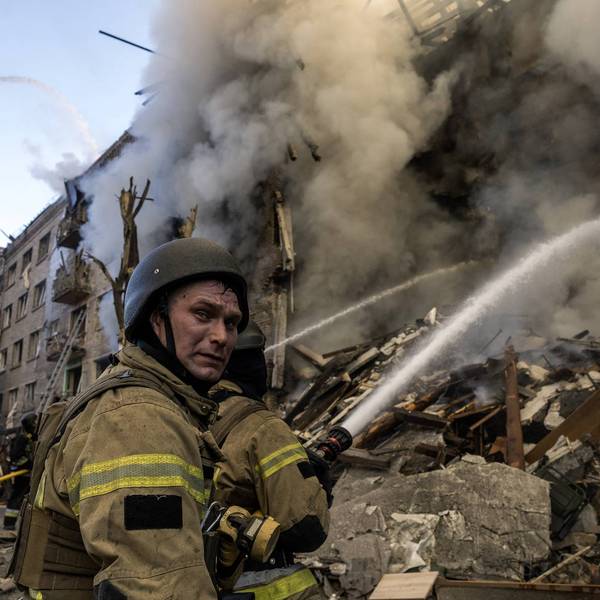
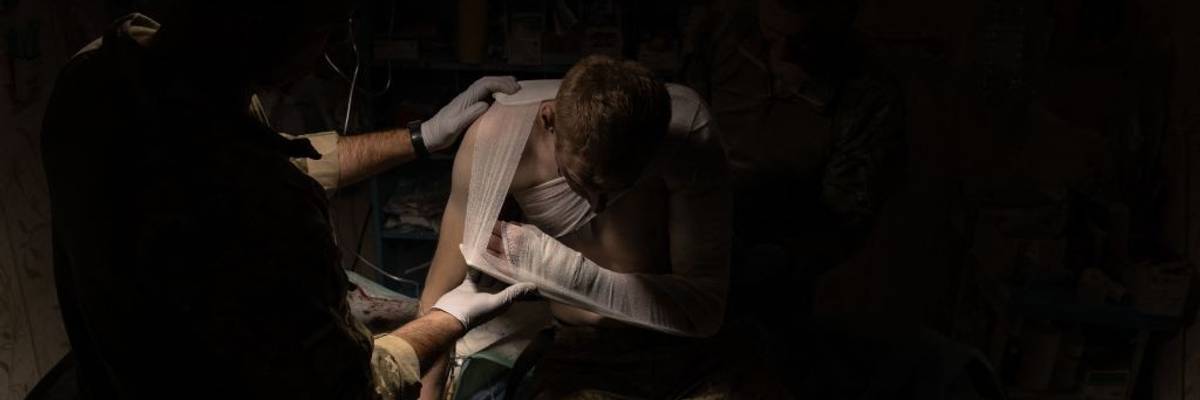
Ukrainian military medics treat a wounded Ukrainian soldier in a Ukrainian stabilization point in an undisclosed location near Bakhmut in Ukraine, on September 23, 2023, amid the Russian invasion of Ukraine.
Beyond the Neocon Debacle and Towards Peace in Ukraine
Ukraine is at risk of economic, demographic, and military collapse. What should the U.S. government do to face this potential disaster?
The second is the collapsing support in Europe for the U.S. neocon strategy. Poland no longer speaks with Ukraine. Hungary has long opposed the neocons. Slovakia has elected an anti-neocon government. E.U. leaders—including Macron, Meloni, Sanchez, Scholz, Sunak, and others—have disapproval ratings far higher than approvals.
The third is the cut in U.S. financial support for Ukraine. The grassroots of the Republican Party, several GOP Presidential candidates, and a growing number of Republican members of Congress, oppose more spending on Ukraine. In the stop-gap bill to keep the government running, Republicans stripped away new financial support for Ukraine. The White House has called for new aid legislation, but this will be an uphill fight.
The fourth, and most urgent from Ukraine’s point of view, is the likelihood of a Russian offensive. Ukraine’s casualties are in the hundreds of thousands, and Ukraine has burned through its artillery, air defenses, tanks, and others heavy weapons. Russia is likely to follow with a massive offensive.
Biden foolishly refused to negotiate with Putin in December 2021. It’s time to negotiate now.
The neocons have created utter disasters in Afghanistan, Iraq, Syria, Libya, and now Ukraine. The U.S. political system has not yet held the neocons to account, since foreign policy is carried out with little public or congressional scrutiny to date. Mainstream media have sided with the slogans of the neocons.
Ukraine is at risk of economic, demographic, and military collapse. What should the U.S. government do to face this potential disaster?
Urgently, it should change course. Britain advises the U.S. to escalate, as Britain is stuck with 19th-century imperial reveries. U.S. neocons are stuck with imperial bravado. Cooler heads urgently need to prevail.
President Joe Biden should immediately inform President Vladimir Putin that the U.S. will end NATO enlargement eastward if the U.S. and Russia reach a new agreement on security arrangements. By ending NATO expansion, the U.S. can still save Ukraine from the policy debacles of the past 30 years.
Biden should agree to negotiate a security arrangement of the kind, though not precise details, of Putin’s proposals of December 17, 2021. Biden foolishly refused to negotiate with Putin in December 2021. It’s time to negotiate now.
There are four keys to an agreement. First, as part of an overall agreement, Biden should agree that NATO will not enlarge eastward, but not reverse the past NATO enlargement. NATO would of course not tolerate Russian encroachments in existing NATO states. Both Russia and the U.S. would pledge to avoid provocations near Russia’s borders, including provocative missile placement, military exercises, and the like.
Second, the new U.S.-Russia security agreement should cover nuclear weapons. The U.S. unilateral withdrawal from the Anti-Ballistic Missile Treaty in 2002, followed by the placement of Aegis missiles in Poland and Romania, gravely inflamed tensions, which were further exacerbated by the U.S. withdrawal from the Intermediate Nuclear Force (INF) Agreement in 2019 and Russia’s suspension of the New Start Treaty in 2023. Russian leaders have repeatedly pointed to U.S. missiles near Russia, unconstrained by the abandoned ABM Treaty, as a dire threat to Russia’s national security.
Third, Russia and Ukraine would agree on new borders, in which the overwhelmingly ethnic Russian Crimea and heavily ethnic Russian districts of eastern Ukraine would remain part of Russia. The border changes would be accompanied by security guarantees for Ukraine backed unanimously by the UN Security Council and other states such as Germany, Turkey, and India.
Fourth, as part of a settlement, the U.S., Russia, and the E.U. would re-establish trade, finance, cultural exchange, and tourist relations. It’s certainly time once again to hear Rachmaninoff and Tchaikovsky in U.S. and European concert halls.
Border changes are a last resort, and should be made only under auspices of the UN Security Council. They must never be an invitation to further territorial demands, such as by Russia regarding ethnic Russians in other countries. Yet borders change, and the U.S. has recently backed two border changes. NATO bombed Serbia for 78 days until it relinquished the Albanian-majority region of Kosovo. In 2008, the U.S. recognized Kosovo as a sovereign nation. The U.S. government similarly backed South Sudan’s insurgency to break away from Sudan.
If Russia, Ukraine, or the U.S. subsequently violated the new agreement, they would be challenging the rest of the world. As President John F. Kennedy Jr. once observed, “even the most hostile nations can be relied upon to accept and keep those treaty obligations, and only those treaty obligations, which are in their own interest.”
The U.S. neocons carry much blame for undermining Ukraine’s 1991 borders. Russia did not claim Crimea until after the U.S.-backed overthrow of Ukraine’s President Viktor Yanukovych in 2014. Nor did Russia annex the Donbas after 2014, instead calling on Ukraine to honor the UN-backed Minsk II agreement, based on autonomy for the Donbas. The neocons preferred to arm Ukraine to retake the Donbas by force rather than grant the Donbas autonomy.
The long-term key to peace in Europe is collective security as called for by the Organization for Security and Co-operation in Europe (OSCE). According to OSCE agreements, OSCE member states “will not strengthen their security at the expense of the security of other States.” Neocon unilateralism undermined Europe’s collective security by pushing NATO enlargement without regard to third parties, notably Russia. Europe—including the E.U., Russia, and Ukraine—needs more OSCE and less neocon unilateralism as key to lasting peace in Europe.
Correction: This article has been updated to more accurately reflect the number of days Kosovo faced bombardment.
We are at a crossroads
This country and this world are at a monumental crossroads. In a few short weeks, US voters will have an opportunity to beat back the forces of fascism and confront the billionaires who are rigging the economy, our media system, and our democracy, making it increasingly impossible for ordinary people to get by. We’re not just talking about the election. We’re talking about what must be done once these fascist elements are vanquished from power. We need a bolder set of solutions than what either major party has so far been willing to offer and a working-class movement ready to fight like hell for it. Trump didn't emerge from nowhere. The conditions that fueled MAGA authoritarianism were created by decades of radical neoliberal economic policies and a corrupt political system dominated by corporate interests. They slashed taxes on the super-rich, promising that the benefits would trickle down. They said giveaways to the corporate titans would make life more affordable for the rest of us. It was all bullshit. And when a bitter, betrayed populace searches for someone to blame, right-wing demagogues have little trouble finding scapegoats. People know when they're being lied to, but you won't hear any of this from the corporate media. Only independent journalism—powered and funded by people who believe in building a better world—can deliver truly trustworthy daily news. Our Fall Campaign is underway, and we need your help. To power our newsroom through the rest of the year, we need to raise $125,000 by midnight on October 31. So if you share our vision, please contribute whatever you can to sustain our work. |
The second is the collapsing support in Europe for the U.S. neocon strategy. Poland no longer speaks with Ukraine. Hungary has long opposed the neocons. Slovakia has elected an anti-neocon government. E.U. leaders—including Macron, Meloni, Sanchez, Scholz, Sunak, and others—have disapproval ratings far higher than approvals.
The third is the cut in U.S. financial support for Ukraine. The grassroots of the Republican Party, several GOP Presidential candidates, and a growing number of Republican members of Congress, oppose more spending on Ukraine. In the stop-gap bill to keep the government running, Republicans stripped away new financial support for Ukraine. The White House has called for new aid legislation, but this will be an uphill fight.
The fourth, and most urgent from Ukraine’s point of view, is the likelihood of a Russian offensive. Ukraine’s casualties are in the hundreds of thousands, and Ukraine has burned through its artillery, air defenses, tanks, and others heavy weapons. Russia is likely to follow with a massive offensive.
Biden foolishly refused to negotiate with Putin in December 2021. It’s time to negotiate now.
The neocons have created utter disasters in Afghanistan, Iraq, Syria, Libya, and now Ukraine. The U.S. political system has not yet held the neocons to account, since foreign policy is carried out with little public or congressional scrutiny to date. Mainstream media have sided with the slogans of the neocons.
Ukraine is at risk of economic, demographic, and military collapse. What should the U.S. government do to face this potential disaster?
Urgently, it should change course. Britain advises the U.S. to escalate, as Britain is stuck with 19th-century imperial reveries. U.S. neocons are stuck with imperial bravado. Cooler heads urgently need to prevail.
President Joe Biden should immediately inform President Vladimir Putin that the U.S. will end NATO enlargement eastward if the U.S. and Russia reach a new agreement on security arrangements. By ending NATO expansion, the U.S. can still save Ukraine from the policy debacles of the past 30 years.
Biden should agree to negotiate a security arrangement of the kind, though not precise details, of Putin’s proposals of December 17, 2021. Biden foolishly refused to negotiate with Putin in December 2021. It’s time to negotiate now.
There are four keys to an agreement. First, as part of an overall agreement, Biden should agree that NATO will not enlarge eastward, but not reverse the past NATO enlargement. NATO would of course not tolerate Russian encroachments in existing NATO states. Both Russia and the U.S. would pledge to avoid provocations near Russia’s borders, including provocative missile placement, military exercises, and the like.
Second, the new U.S.-Russia security agreement should cover nuclear weapons. The U.S. unilateral withdrawal from the Anti-Ballistic Missile Treaty in 2002, followed by the placement of Aegis missiles in Poland and Romania, gravely inflamed tensions, which were further exacerbated by the U.S. withdrawal from the Intermediate Nuclear Force (INF) Agreement in 2019 and Russia’s suspension of the New Start Treaty in 2023. Russian leaders have repeatedly pointed to U.S. missiles near Russia, unconstrained by the abandoned ABM Treaty, as a dire threat to Russia’s national security.
Third, Russia and Ukraine would agree on new borders, in which the overwhelmingly ethnic Russian Crimea and heavily ethnic Russian districts of eastern Ukraine would remain part of Russia. The border changes would be accompanied by security guarantees for Ukraine backed unanimously by the UN Security Council and other states such as Germany, Turkey, and India.
Fourth, as part of a settlement, the U.S., Russia, and the E.U. would re-establish trade, finance, cultural exchange, and tourist relations. It’s certainly time once again to hear Rachmaninoff and Tchaikovsky in U.S. and European concert halls.
Border changes are a last resort, and should be made only under auspices of the UN Security Council. They must never be an invitation to further territorial demands, such as by Russia regarding ethnic Russians in other countries. Yet borders change, and the U.S. has recently backed two border changes. NATO bombed Serbia for 78 days until it relinquished the Albanian-majority region of Kosovo. In 2008, the U.S. recognized Kosovo as a sovereign nation. The U.S. government similarly backed South Sudan’s insurgency to break away from Sudan.
If Russia, Ukraine, or the U.S. subsequently violated the new agreement, they would be challenging the rest of the world. As President John F. Kennedy Jr. once observed, “even the most hostile nations can be relied upon to accept and keep those treaty obligations, and only those treaty obligations, which are in their own interest.”
The U.S. neocons carry much blame for undermining Ukraine’s 1991 borders. Russia did not claim Crimea until after the U.S.-backed overthrow of Ukraine’s President Viktor Yanukovych in 2014. Nor did Russia annex the Donbas after 2014, instead calling on Ukraine to honor the UN-backed Minsk II agreement, based on autonomy for the Donbas. The neocons preferred to arm Ukraine to retake the Donbas by force rather than grant the Donbas autonomy.
The long-term key to peace in Europe is collective security as called for by the Organization for Security and Co-operation in Europe (OSCE). According to OSCE agreements, OSCE member states “will not strengthen their security at the expense of the security of other States.” Neocon unilateralism undermined Europe’s collective security by pushing NATO enlargement without regard to third parties, notably Russia. Europe—including the E.U., Russia, and Ukraine—needs more OSCE and less neocon unilateralism as key to lasting peace in Europe.
Correction: This article has been updated to more accurately reflect the number of days Kosovo faced bombardment.
- The US Corporate Media Must Start Asking Tougher Questions About Ukraine ›
- A Three-Step Plan For Ending War in Ukraine and Building a Global Peace Movement ›
- Peace in Ukraine Will Only Happen at a Negotiating Table, Not on the Battlefield ›
- Biden Urged to Ignore War Hawks and Pursue 'Real Path to Peace' in Ukraine ›
The second is the collapsing support in Europe for the U.S. neocon strategy. Poland no longer speaks with Ukraine. Hungary has long opposed the neocons. Slovakia has elected an anti-neocon government. E.U. leaders—including Macron, Meloni, Sanchez, Scholz, Sunak, and others—have disapproval ratings far higher than approvals.
The third is the cut in U.S. financial support for Ukraine. The grassroots of the Republican Party, several GOP Presidential candidates, and a growing number of Republican members of Congress, oppose more spending on Ukraine. In the stop-gap bill to keep the government running, Republicans stripped away new financial support for Ukraine. The White House has called for new aid legislation, but this will be an uphill fight.
The fourth, and most urgent from Ukraine’s point of view, is the likelihood of a Russian offensive. Ukraine’s casualties are in the hundreds of thousands, and Ukraine has burned through its artillery, air defenses, tanks, and others heavy weapons. Russia is likely to follow with a massive offensive.
Biden foolishly refused to negotiate with Putin in December 2021. It’s time to negotiate now.
The neocons have created utter disasters in Afghanistan, Iraq, Syria, Libya, and now Ukraine. The U.S. political system has not yet held the neocons to account, since foreign policy is carried out with little public or congressional scrutiny to date. Mainstream media have sided with the slogans of the neocons.
Ukraine is at risk of economic, demographic, and military collapse. What should the U.S. government do to face this potential disaster?
Urgently, it should change course. Britain advises the U.S. to escalate, as Britain is stuck with 19th-century imperial reveries. U.S. neocons are stuck with imperial bravado. Cooler heads urgently need to prevail.
President Joe Biden should immediately inform President Vladimir Putin that the U.S. will end NATO enlargement eastward if the U.S. and Russia reach a new agreement on security arrangements. By ending NATO expansion, the U.S. can still save Ukraine from the policy debacles of the past 30 years.
Biden should agree to negotiate a security arrangement of the kind, though not precise details, of Putin’s proposals of December 17, 2021. Biden foolishly refused to negotiate with Putin in December 2021. It’s time to negotiate now.
There are four keys to an agreement. First, as part of an overall agreement, Biden should agree that NATO will not enlarge eastward, but not reverse the past NATO enlargement. NATO would of course not tolerate Russian encroachments in existing NATO states. Both Russia and the U.S. would pledge to avoid provocations near Russia’s borders, including provocative missile placement, military exercises, and the like.
Second, the new U.S.-Russia security agreement should cover nuclear weapons. The U.S. unilateral withdrawal from the Anti-Ballistic Missile Treaty in 2002, followed by the placement of Aegis missiles in Poland and Romania, gravely inflamed tensions, which were further exacerbated by the U.S. withdrawal from the Intermediate Nuclear Force (INF) Agreement in 2019 and Russia’s suspension of the New Start Treaty in 2023. Russian leaders have repeatedly pointed to U.S. missiles near Russia, unconstrained by the abandoned ABM Treaty, as a dire threat to Russia’s national security.
Third, Russia and Ukraine would agree on new borders, in which the overwhelmingly ethnic Russian Crimea and heavily ethnic Russian districts of eastern Ukraine would remain part of Russia. The border changes would be accompanied by security guarantees for Ukraine backed unanimously by the UN Security Council and other states such as Germany, Turkey, and India.
Fourth, as part of a settlement, the U.S., Russia, and the E.U. would re-establish trade, finance, cultural exchange, and tourist relations. It’s certainly time once again to hear Rachmaninoff and Tchaikovsky in U.S. and European concert halls.
Border changes are a last resort, and should be made only under auspices of the UN Security Council. They must never be an invitation to further territorial demands, such as by Russia regarding ethnic Russians in other countries. Yet borders change, and the U.S. has recently backed two border changes. NATO bombed Serbia for 78 days until it relinquished the Albanian-majority region of Kosovo. In 2008, the U.S. recognized Kosovo as a sovereign nation. The U.S. government similarly backed South Sudan’s insurgency to break away from Sudan.
If Russia, Ukraine, or the U.S. subsequently violated the new agreement, they would be challenging the rest of the world. As President John F. Kennedy Jr. once observed, “even the most hostile nations can be relied upon to accept and keep those treaty obligations, and only those treaty obligations, which are in their own interest.”
The U.S. neocons carry much blame for undermining Ukraine’s 1991 borders. Russia did not claim Crimea until after the U.S.-backed overthrow of Ukraine’s President Viktor Yanukovych in 2014. Nor did Russia annex the Donbas after 2014, instead calling on Ukraine to honor the UN-backed Minsk II agreement, based on autonomy for the Donbas. The neocons preferred to arm Ukraine to retake the Donbas by force rather than grant the Donbas autonomy.
The long-term key to peace in Europe is collective security as called for by the Organization for Security and Co-operation in Europe (OSCE). According to OSCE agreements, OSCE member states “will not strengthen their security at the expense of the security of other States.” Neocon unilateralism undermined Europe’s collective security by pushing NATO enlargement without regard to third parties, notably Russia. Europe—including the E.U., Russia, and Ukraine—needs more OSCE and less neocon unilateralism as key to lasting peace in Europe.
Correction: This article has been updated to more accurately reflect the number of days Kosovo faced bombardment.
- The US Corporate Media Must Start Asking Tougher Questions About Ukraine ›
- A Three-Step Plan For Ending War in Ukraine and Building a Global Peace Movement ›
- Peace in Ukraine Will Only Happen at a Negotiating Table, Not on the Battlefield ›
- Biden Urged to Ignore War Hawks and Pursue 'Real Path to Peace' in Ukraine ›