

SUBSCRIBE TO OUR FREE NEWSLETTER
Daily news & progressive opinion—funded by the people, not the corporations—delivered straight to your inbox.
5
#000000
#FFFFFF
To donate by check, phone, or other method, see our More Ways to Give page.
Daily news & progressive opinion—funded by the people, not the corporations—delivered straight to your inbox.
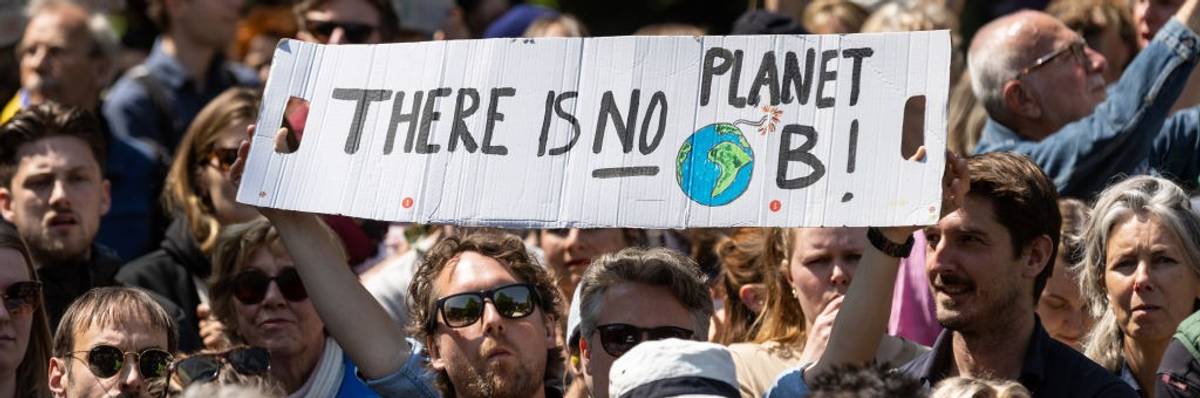
An activist holds a sign reading, “There is No Planet B” while blocking the A12 motorway during an Extinction Rebellion led protest on May 27, 2023 in The Hague, Netherlands.
Before we can begin “doing everything we can,” we have to transcend our limited sense of who we are and what matters.
“We need to do everything we can to keep (global) warming as low as possible.”
When it comes to climate change, one two-letter word has me totally perplexed: “we.” There’s an implication of global unity—a transcendent “we,” marching as to war (so to speak)—facing humanity’s greatest crisis, undoing the exploitative, Earth-destroying aspects of our social structure and grabbing control over the planet’s rising temperature. We need to do everything we can!
Yeah, sure. And then it turns out “we” aren’t doing nearly enough. The blame gets passed around—to the rich countries of the Global North, to the world’s largest fossil fuel companies. And the ice keeps melting, the wildfires rage, average temperatures keep setting records. Scientists grow ever more distraught. The cry repeats itself: We need to do everything we can!
There is a “we” that most Americans embrace and feel a part of, but it has nothing to do with the warming planet and collapsing ecosystem.
I don’t disagree with this. I just don’t know who “we” are, and hardly feel like a participant in the process, except in small ways: when I recycle stuff or argue with a climate-change denier or walk rather than drive wherever (achy legs, balance issues—I mostly drive). This isn’t enough, of course. It’s change from the social margins. The global warming—the global “weirding”—continues unabated, as do the warnings from the science community. National promises to change remain minimal, and are ultimately bypassed and ignored.
What I’m trying to say is this: There is a “we” that most Americans embrace and feel a part of, but it has nothing to do with the warming planet and collapsing ecosystem. Before we can begin “doing everything we can,” we have to transcend our limited sense of who we are and what matters.
The New York Times’ Brad Plumer, for instance, writing about a report recently released by the Intergovernmental Panel on Climate Change, a body of experts convened by the United Nations, noted:
“Governments and companies would need to invest three to six times the roughly $600 billion they now spend annually on encouraging clean energy in order to hold global warming at 1.5 or 2°C, the report says. While there is currently enough global capital to do so, much of it is difficult for developing countries to acquire. The question of what wealthy, industrialized nations owe to poor, developing countries has been divisive at global climate negotiations.”
These words quietly scream for a fundamental shift in the planet’s political infrastructure. “Encouraging clean energy” isn’t really any nation’s first priority, especially if it’s rich and powerful. As I read that paragraph, what popped into my head is this: The planet’s annual military budget is about $2.2 trillion (with the United States accounting for nearly half of that). War is hell, but that’s OK. It’s the primary manifestation of nationalism, the primary expression of power. We have treaties and such—some nations are allies—but the essence of the situation is this: We live in an us-vs.-them world. We have to be continually cautions and, if necessary, aggressive. This is a divided world. Any questions?
The problem, of course, is that the divisions are mostly arbitrary, not to mention pragmatic. There’s nothing like a good enemy to help a country maintain its unity, to help a government assert control over the population. (Careful, he may be a commie.) But these arbitrary divisions are also distinct and specific; they’re called borders.
Borders have nothing to do with reality, but “we” pretend that they matter—often to the detriment of people who need to cross them. And as climate change continues to create chaos, it makes certain regions uninhabitable. More and more human beings will find themselves being pushed out of the “human climate niche,” which means they’ll have to go somewhere else.
As Anju Anna John and Stefano Balbi write at Common Dreams, regarding a study called Quantifying the Human Cost of Global Warming: “In the worst-case future scenario—where the world reverts to fossil-fueled development and has a population of 9.5 billion at the end of the century—the study found that 5.3 billion people would be left behind. We would be looking at a world where about half the world’s population would no longer be able to live in regions they once considered home.”
So they’d have to move. They’d have to become climate refugees, which probably means confronting a foreign bureaucracy at some border or other. Uh oh. That could be a problem, even though, according to The Guardian:
“The richest 1% of the world’s population is responsible for twice the amount of greenhouse gases as the world’s poorest 50%, who suffer the brunt of the harms.
“So far, the rich countries of the global north are regarded as having promised too little—and delivered even less—for climate adaptation efforts in poorer countries.”
We need to do everything we can—to minimize global warming, to deal with its inevitable effects on some. But this will only happen minimally in the context of the present moment, in which the wealthy and powerful are motivated primarily to protect and expand their wealth and power, and will casually dehumanize those who are in the way or who attempt to cross a sacred border.
This is not the “we” that’s going to do everything it can to save the planet, but it’s the “we” we’re stuck with, at least for now. Truly dealing with climate change—doing everything we can—means transforming who we are and reorganizing ourselves as one world.
Dear Common Dreams reader, It’s been nearly 30 years since I co-founded Common Dreams with my late wife, Lina Newhouser. We had the radical notion that journalism should serve the public good, not corporate profits. It was clear to us from the outset what it would take to build such a project. No paid advertisements. No corporate sponsors. No millionaire publisher telling us what to think or do. Many people said we wouldn't last a year, but we proved those doubters wrong. Together with a tremendous team of journalists and dedicated staff, we built an independent media outlet free from the constraints of profits and corporate control. Our mission has always been simple: To inform. To inspire. To ignite change for the common good. Building Common Dreams was not easy. Our survival was never guaranteed. When you take on the most powerful forces—Wall Street greed, fossil fuel industry destruction, Big Tech lobbyists, and uber-rich oligarchs who have spent billions upon billions rigging the economy and democracy in their favor—the only bulwark you have is supporters who believe in your work. But here’s the urgent message from me today. It's never been this bad out there. And it's never been this hard to keep us going. At the very moment Common Dreams is most needed, the threats we face are intensifying. We need your support now more than ever. We don't accept corporate advertising and never will. We don't have a paywall because we don't think people should be blocked from critical news based on their ability to pay. Everything we do is funded by the donations of readers like you. When everyone does the little they can afford, we are strong. But if that support retreats or dries up, so do we. Will you donate now to make sure Common Dreams not only survives but thrives? —Craig Brown, Co-founder |
“We need to do everything we can to keep (global) warming as low as possible.”
When it comes to climate change, one two-letter word has me totally perplexed: “we.” There’s an implication of global unity—a transcendent “we,” marching as to war (so to speak)—facing humanity’s greatest crisis, undoing the exploitative, Earth-destroying aspects of our social structure and grabbing control over the planet’s rising temperature. We need to do everything we can!
Yeah, sure. And then it turns out “we” aren’t doing nearly enough. The blame gets passed around—to the rich countries of the Global North, to the world’s largest fossil fuel companies. And the ice keeps melting, the wildfires rage, average temperatures keep setting records. Scientists grow ever more distraught. The cry repeats itself: We need to do everything we can!
There is a “we” that most Americans embrace and feel a part of, but it has nothing to do with the warming planet and collapsing ecosystem.
I don’t disagree with this. I just don’t know who “we” are, and hardly feel like a participant in the process, except in small ways: when I recycle stuff or argue with a climate-change denier or walk rather than drive wherever (achy legs, balance issues—I mostly drive). This isn’t enough, of course. It’s change from the social margins. The global warming—the global “weirding”—continues unabated, as do the warnings from the science community. National promises to change remain minimal, and are ultimately bypassed and ignored.
What I’m trying to say is this: There is a “we” that most Americans embrace and feel a part of, but it has nothing to do with the warming planet and collapsing ecosystem. Before we can begin “doing everything we can,” we have to transcend our limited sense of who we are and what matters.
The New York Times’ Brad Plumer, for instance, writing about a report recently released by the Intergovernmental Panel on Climate Change, a body of experts convened by the United Nations, noted:
“Governments and companies would need to invest three to six times the roughly $600 billion they now spend annually on encouraging clean energy in order to hold global warming at 1.5 or 2°C, the report says. While there is currently enough global capital to do so, much of it is difficult for developing countries to acquire. The question of what wealthy, industrialized nations owe to poor, developing countries has been divisive at global climate negotiations.”
These words quietly scream for a fundamental shift in the planet’s political infrastructure. “Encouraging clean energy” isn’t really any nation’s first priority, especially if it’s rich and powerful. As I read that paragraph, what popped into my head is this: The planet’s annual military budget is about $2.2 trillion (with the United States accounting for nearly half of that). War is hell, but that’s OK. It’s the primary manifestation of nationalism, the primary expression of power. We have treaties and such—some nations are allies—but the essence of the situation is this: We live in an us-vs.-them world. We have to be continually cautions and, if necessary, aggressive. This is a divided world. Any questions?
The problem, of course, is that the divisions are mostly arbitrary, not to mention pragmatic. There’s nothing like a good enemy to help a country maintain its unity, to help a government assert control over the population. (Careful, he may be a commie.) But these arbitrary divisions are also distinct and specific; they’re called borders.
Borders have nothing to do with reality, but “we” pretend that they matter—often to the detriment of people who need to cross them. And as climate change continues to create chaos, it makes certain regions uninhabitable. More and more human beings will find themselves being pushed out of the “human climate niche,” which means they’ll have to go somewhere else.
As Anju Anna John and Stefano Balbi write at Common Dreams, regarding a study called Quantifying the Human Cost of Global Warming: “In the worst-case future scenario—where the world reverts to fossil-fueled development and has a population of 9.5 billion at the end of the century—the study found that 5.3 billion people would be left behind. We would be looking at a world where about half the world’s population would no longer be able to live in regions they once considered home.”
So they’d have to move. They’d have to become climate refugees, which probably means confronting a foreign bureaucracy at some border or other. Uh oh. That could be a problem, even though, according to The Guardian:
“The richest 1% of the world’s population is responsible for twice the amount of greenhouse gases as the world’s poorest 50%, who suffer the brunt of the harms.
“So far, the rich countries of the global north are regarded as having promised too little—and delivered even less—for climate adaptation efforts in poorer countries.”
We need to do everything we can—to minimize global warming, to deal with its inevitable effects on some. But this will only happen minimally in the context of the present moment, in which the wealthy and powerful are motivated primarily to protect and expand their wealth and power, and will casually dehumanize those who are in the way or who attempt to cross a sacred border.
This is not the “we” that’s going to do everything it can to save the planet, but it’s the “we” we’re stuck with, at least for now. Truly dealing with climate change—doing everything we can—means transforming who we are and reorganizing ourselves as one world.
“We need to do everything we can to keep (global) warming as low as possible.”
When it comes to climate change, one two-letter word has me totally perplexed: “we.” There’s an implication of global unity—a transcendent “we,” marching as to war (so to speak)—facing humanity’s greatest crisis, undoing the exploitative, Earth-destroying aspects of our social structure and grabbing control over the planet’s rising temperature. We need to do everything we can!
Yeah, sure. And then it turns out “we” aren’t doing nearly enough. The blame gets passed around—to the rich countries of the Global North, to the world’s largest fossil fuel companies. And the ice keeps melting, the wildfires rage, average temperatures keep setting records. Scientists grow ever more distraught. The cry repeats itself: We need to do everything we can!
There is a “we” that most Americans embrace and feel a part of, but it has nothing to do with the warming planet and collapsing ecosystem.
I don’t disagree with this. I just don’t know who “we” are, and hardly feel like a participant in the process, except in small ways: when I recycle stuff or argue with a climate-change denier or walk rather than drive wherever (achy legs, balance issues—I mostly drive). This isn’t enough, of course. It’s change from the social margins. The global warming—the global “weirding”—continues unabated, as do the warnings from the science community. National promises to change remain minimal, and are ultimately bypassed and ignored.
What I’m trying to say is this: There is a “we” that most Americans embrace and feel a part of, but it has nothing to do with the warming planet and collapsing ecosystem. Before we can begin “doing everything we can,” we have to transcend our limited sense of who we are and what matters.
The New York Times’ Brad Plumer, for instance, writing about a report recently released by the Intergovernmental Panel on Climate Change, a body of experts convened by the United Nations, noted:
“Governments and companies would need to invest three to six times the roughly $600 billion they now spend annually on encouraging clean energy in order to hold global warming at 1.5 or 2°C, the report says. While there is currently enough global capital to do so, much of it is difficult for developing countries to acquire. The question of what wealthy, industrialized nations owe to poor, developing countries has been divisive at global climate negotiations.”
These words quietly scream for a fundamental shift in the planet’s political infrastructure. “Encouraging clean energy” isn’t really any nation’s first priority, especially if it’s rich and powerful. As I read that paragraph, what popped into my head is this: The planet’s annual military budget is about $2.2 trillion (with the United States accounting for nearly half of that). War is hell, but that’s OK. It’s the primary manifestation of nationalism, the primary expression of power. We have treaties and such—some nations are allies—but the essence of the situation is this: We live in an us-vs.-them world. We have to be continually cautions and, if necessary, aggressive. This is a divided world. Any questions?
The problem, of course, is that the divisions are mostly arbitrary, not to mention pragmatic. There’s nothing like a good enemy to help a country maintain its unity, to help a government assert control over the population. (Careful, he may be a commie.) But these arbitrary divisions are also distinct and specific; they’re called borders.
Borders have nothing to do with reality, but “we” pretend that they matter—often to the detriment of people who need to cross them. And as climate change continues to create chaos, it makes certain regions uninhabitable. More and more human beings will find themselves being pushed out of the “human climate niche,” which means they’ll have to go somewhere else.
As Anju Anna John and Stefano Balbi write at Common Dreams, regarding a study called Quantifying the Human Cost of Global Warming: “In the worst-case future scenario—where the world reverts to fossil-fueled development and has a population of 9.5 billion at the end of the century—the study found that 5.3 billion people would be left behind. We would be looking at a world where about half the world’s population would no longer be able to live in regions they once considered home.”
So they’d have to move. They’d have to become climate refugees, which probably means confronting a foreign bureaucracy at some border or other. Uh oh. That could be a problem, even though, according to The Guardian:
“The richest 1% of the world’s population is responsible for twice the amount of greenhouse gases as the world’s poorest 50%, who suffer the brunt of the harms.
“So far, the rich countries of the global north are regarded as having promised too little—and delivered even less—for climate adaptation efforts in poorer countries.”
We need to do everything we can—to minimize global warming, to deal with its inevitable effects on some. But this will only happen minimally in the context of the present moment, in which the wealthy and powerful are motivated primarily to protect and expand their wealth and power, and will casually dehumanize those who are in the way or who attempt to cross a sacred border.
This is not the “we” that’s going to do everything it can to save the planet, but it’s the “we” we’re stuck with, at least for now. Truly dealing with climate change—doing everything we can—means transforming who we are and reorganizing ourselves as one world.

