SUBSCRIBE TO OUR FREE NEWSLETTER
Daily news & progressive opinion—funded by the people, not the corporations—delivered straight to your inbox.
5
#000000
#FFFFFF
To donate by check, phone, or other method, see our More Ways to Give page.
Daily news & progressive opinion—funded by the people, not the corporations—delivered straight to your inbox.

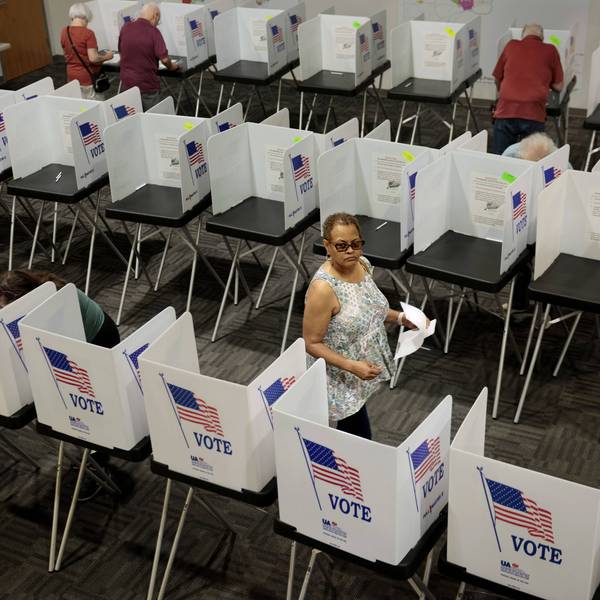
A voter casts a ballot as others check in to cast theirs in Georgia's primary election at a polling location on May 21, 2024 in Atlanta, Georgia. Among the races on the ballot in Fulton County is Scott McAfee, the Fulton County Superior Court Judge overseeing former president Donald Trump's election interference criminal trial.
National Voter Registration Day, the fourth Tuesday of September, is an opportunity to reclaim our power.
As we approach National Voter Registration Day this September, it's crucial to reflect on the significance of the right to vote—a fundamental pillar of democracy that many fought tirelessly to secure. Voting is more than a civic duty; it is an expression of your voice, your values, and your vision for the future. The fight continues to this day.
For centuries, the right to vote was restricted to a privileged few. In Early America, voting rights were reserved for white, land-owning men, excluding entire populations who were deemed unworthy of having a say in the government of their country. Women, Black Americans, Indigenous peoples, and other marginalized groups were systematically excluded from the political process, their voices stifled by laws and practices designed to maintain the status quo and preserve chattel slavery.
The fight for suffrage was long and arduous. Countless individuals marched, protested, and even risked their lives to demand a seat at the table. The 15th Amendment in 1870 granted Black men the right to vote, but their full participation as citizens with a say in their communities was short-lived. White supremacists enacted barriers to voting and enforced them with gang violence. The struggle continued, culminating in the Civil Rights Movement of the 1960s and the passage of the Voting Rights Act of 1965—a landmark piece of legislation designed to eliminate the racial barriers to voting.
Registration is just the beginning. Voting requires commitment, especially in a system that can seem hostile.
Similarly, the road to women's suffrage was a century-long battle that finally resulted in the 19th Amendment in 1920. Even then, many women of color were still denied access to the polls due to discriminatory practices that persisted long after the amendment’s passage. The right to vote, once so fiercely sought, is now something many of us take for granted, to our own peril.
If voting didn’t matter, we would not be witnessing modern-day voter suppression by way of closing poll locations, limiting early and mail-in voting, and photo ID and proof of citizenship requirements. However, since 2013, when the Supreme Court gutted the Voting Rights Act, 29 states have enacted nearly 100 laws to limit adult citizens’ access to the vote. Rights and freedoms, unfortunately, have not moved in a steady and forward direction in America.
Voter participation in the United States remains alarmingly low. According to the U.S. Census Bureau, only about 66% of eligible voters cast a ballot in the 2020 presidential election. While this was a significant increase from previous years, it still means that one-third of eligible voters did not participate. In non-presidential election years, less than half of eligible citizens vote. When only a small number of Americans exercise their right to vote, the outcome of elections is unlikely to represent the true will and wellbeing of our vast and diverse country.
National Voter Registration Day, the fourth Tuesday of September, is an opportunity to reclaim our power. Whether you’re registering for the first time, updating your information, or helping others get registered, taking this first step is crucial to making sure your voice is heard.
But registration is just the beginning. Voting requires commitment, especially in a system that can seem hostile. That’s why we must educate ourselves about the issues, understand the stakes, and recognize the impact our votes can have. It’s easy to feel like one vote doesn’t matter, but history has shown us that collective action can lead to transformative change. That is why those who resist change continue to suppress the vote, more than 150 years after the 15th Amendment. When we all show up, the power of our voices combined can create a force that is impossible to ignore.
In 2024, we have the chance to continue shaping the future of our country. Voting is the most powerful nonviolent tool we have to shape our communities and our nation. It is a means of holding our leaders accountable and ensuring that our government reflects the will of the people. When we vote, we join the chorus that determines the direction of our country.
This September, commit to register or check your registration status, and help others register. Prepare to make your voice heard.
This op-ed was produced by American Forum.
Dear Common Dreams reader, It’s been nearly 30 years since I co-founded Common Dreams with my late wife, Lina Newhouser. We had the radical notion that journalism should serve the public good, not corporate profits. It was clear to us from the outset what it would take to build such a project. No paid advertisements. No corporate sponsors. No millionaire publisher telling us what to think or do. Many people said we wouldn't last a year, but we proved those doubters wrong. Together with a tremendous team of journalists and dedicated staff, we built an independent media outlet free from the constraints of profits and corporate control. Our mission has always been simple: To inform. To inspire. To ignite change for the common good. Building Common Dreams was not easy. Our survival was never guaranteed. When you take on the most powerful forces—Wall Street greed, fossil fuel industry destruction, Big Tech lobbyists, and uber-rich oligarchs who have spent billions upon billions rigging the economy and democracy in their favor—the only bulwark you have is supporters who believe in your work. But here’s the urgent message from me today. It's never been this bad out there. And it's never been this hard to keep us going. At the very moment Common Dreams is most needed, the threats we face are intensifying. We need your support now more than ever. We don't accept corporate advertising and never will. We don't have a paywall because we don't think people should be blocked from critical news based on their ability to pay. Everything we do is funded by the donations of readers like you. When everyone does the little they can afford, we are strong. But if that support retreats or dries up, so do we. Will you donate now to make sure Common Dreams not only survives but thrives? —Craig Brown, Co-founder |
As we approach National Voter Registration Day this September, it's crucial to reflect on the significance of the right to vote—a fundamental pillar of democracy that many fought tirelessly to secure. Voting is more than a civic duty; it is an expression of your voice, your values, and your vision for the future. The fight continues to this day.
For centuries, the right to vote was restricted to a privileged few. In Early America, voting rights were reserved for white, land-owning men, excluding entire populations who were deemed unworthy of having a say in the government of their country. Women, Black Americans, Indigenous peoples, and other marginalized groups were systematically excluded from the political process, their voices stifled by laws and practices designed to maintain the status quo and preserve chattel slavery.
The fight for suffrage was long and arduous. Countless individuals marched, protested, and even risked their lives to demand a seat at the table. The 15th Amendment in 1870 granted Black men the right to vote, but their full participation as citizens with a say in their communities was short-lived. White supremacists enacted barriers to voting and enforced them with gang violence. The struggle continued, culminating in the Civil Rights Movement of the 1960s and the passage of the Voting Rights Act of 1965—a landmark piece of legislation designed to eliminate the racial barriers to voting.
Registration is just the beginning. Voting requires commitment, especially in a system that can seem hostile.
Similarly, the road to women's suffrage was a century-long battle that finally resulted in the 19th Amendment in 1920. Even then, many women of color were still denied access to the polls due to discriminatory practices that persisted long after the amendment’s passage. The right to vote, once so fiercely sought, is now something many of us take for granted, to our own peril.
If voting didn’t matter, we would not be witnessing modern-day voter suppression by way of closing poll locations, limiting early and mail-in voting, and photo ID and proof of citizenship requirements. However, since 2013, when the Supreme Court gutted the Voting Rights Act, 29 states have enacted nearly 100 laws to limit adult citizens’ access to the vote. Rights and freedoms, unfortunately, have not moved in a steady and forward direction in America.
Voter participation in the United States remains alarmingly low. According to the U.S. Census Bureau, only about 66% of eligible voters cast a ballot in the 2020 presidential election. While this was a significant increase from previous years, it still means that one-third of eligible voters did not participate. In non-presidential election years, less than half of eligible citizens vote. When only a small number of Americans exercise their right to vote, the outcome of elections is unlikely to represent the true will and wellbeing of our vast and diverse country.
National Voter Registration Day, the fourth Tuesday of September, is an opportunity to reclaim our power. Whether you’re registering for the first time, updating your information, or helping others get registered, taking this first step is crucial to making sure your voice is heard.
But registration is just the beginning. Voting requires commitment, especially in a system that can seem hostile. That’s why we must educate ourselves about the issues, understand the stakes, and recognize the impact our votes can have. It’s easy to feel like one vote doesn’t matter, but history has shown us that collective action can lead to transformative change. That is why those who resist change continue to suppress the vote, more than 150 years after the 15th Amendment. When we all show up, the power of our voices combined can create a force that is impossible to ignore.
In 2024, we have the chance to continue shaping the future of our country. Voting is the most powerful nonviolent tool we have to shape our communities and our nation. It is a means of holding our leaders accountable and ensuring that our government reflects the will of the people. When we vote, we join the chorus that determines the direction of our country.
This September, commit to register or check your registration status, and help others register. Prepare to make your voice heard.
This op-ed was produced by American Forum.
As we approach National Voter Registration Day this September, it's crucial to reflect on the significance of the right to vote—a fundamental pillar of democracy that many fought tirelessly to secure. Voting is more than a civic duty; it is an expression of your voice, your values, and your vision for the future. The fight continues to this day.
For centuries, the right to vote was restricted to a privileged few. In Early America, voting rights were reserved for white, land-owning men, excluding entire populations who were deemed unworthy of having a say in the government of their country. Women, Black Americans, Indigenous peoples, and other marginalized groups were systematically excluded from the political process, their voices stifled by laws and practices designed to maintain the status quo and preserve chattel slavery.
The fight for suffrage was long and arduous. Countless individuals marched, protested, and even risked their lives to demand a seat at the table. The 15th Amendment in 1870 granted Black men the right to vote, but their full participation as citizens with a say in their communities was short-lived. White supremacists enacted barriers to voting and enforced them with gang violence. The struggle continued, culminating in the Civil Rights Movement of the 1960s and the passage of the Voting Rights Act of 1965—a landmark piece of legislation designed to eliminate the racial barriers to voting.
Registration is just the beginning. Voting requires commitment, especially in a system that can seem hostile.
Similarly, the road to women's suffrage was a century-long battle that finally resulted in the 19th Amendment in 1920. Even then, many women of color were still denied access to the polls due to discriminatory practices that persisted long after the amendment’s passage. The right to vote, once so fiercely sought, is now something many of us take for granted, to our own peril.
If voting didn’t matter, we would not be witnessing modern-day voter suppression by way of closing poll locations, limiting early and mail-in voting, and photo ID and proof of citizenship requirements. However, since 2013, when the Supreme Court gutted the Voting Rights Act, 29 states have enacted nearly 100 laws to limit adult citizens’ access to the vote. Rights and freedoms, unfortunately, have not moved in a steady and forward direction in America.
Voter participation in the United States remains alarmingly low. According to the U.S. Census Bureau, only about 66% of eligible voters cast a ballot in the 2020 presidential election. While this was a significant increase from previous years, it still means that one-third of eligible voters did not participate. In non-presidential election years, less than half of eligible citizens vote. When only a small number of Americans exercise their right to vote, the outcome of elections is unlikely to represent the true will and wellbeing of our vast and diverse country.
National Voter Registration Day, the fourth Tuesday of September, is an opportunity to reclaim our power. Whether you’re registering for the first time, updating your information, or helping others get registered, taking this first step is crucial to making sure your voice is heard.
But registration is just the beginning. Voting requires commitment, especially in a system that can seem hostile. That’s why we must educate ourselves about the issues, understand the stakes, and recognize the impact our votes can have. It’s easy to feel like one vote doesn’t matter, but history has shown us that collective action can lead to transformative change. That is why those who resist change continue to suppress the vote, more than 150 years after the 15th Amendment. When we all show up, the power of our voices combined can create a force that is impossible to ignore.
In 2024, we have the chance to continue shaping the future of our country. Voting is the most powerful nonviolent tool we have to shape our communities and our nation. It is a means of holding our leaders accountable and ensuring that our government reflects the will of the people. When we vote, we join the chorus that determines the direction of our country.
This September, commit to register or check your registration status, and help others register. Prepare to make your voice heard.
This op-ed was produced by American Forum.