SUBSCRIBE TO OUR FREE NEWSLETTER
Daily news & progressive opinion—funded by the people, not the corporations—delivered straight to your inbox.
5
#000000
#FFFFFF
To donate by check, phone, or other method, see our More Ways to Give page.
Daily news & progressive opinion—funded by the people, not the corporations—delivered straight to your inbox.
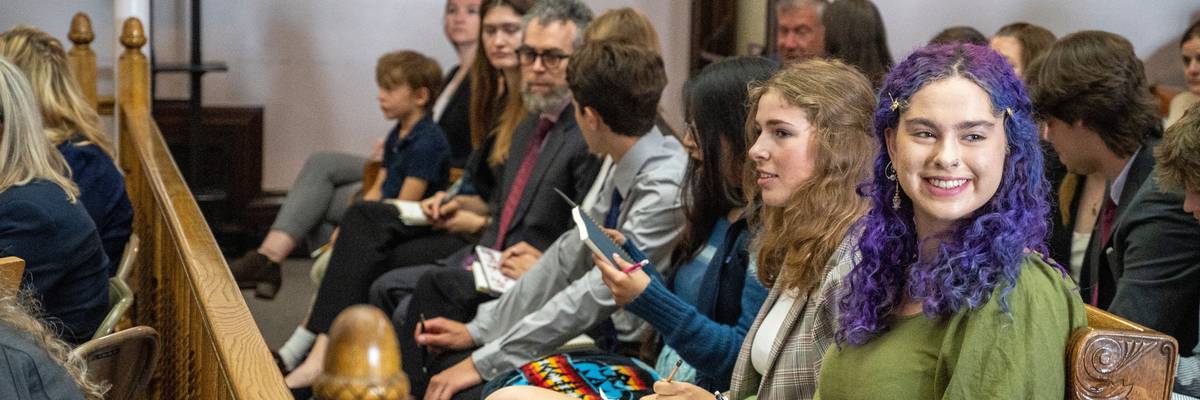
Plaintiffs await the start of the nation's first youth climate trial at Montana's 1st Judicial District Court in Helena on June 12, 2023.
These young people are quite literally fighting for the future—but also their health and wellbeing in the here and now.
It got…somewhat less coverage than the imploded sub, but for me the titanic story of the last week was the truly remarkable trial held in Montana over the last ten days—one of the first times that the climate story has played out in an American courtroom.
The plaintiffs were 16 Montana youth, who charged that by continuing to issue permits for oil and gas production, the state was violating its constitution, which was amended decades ago to include this phrase: “The state and each person shall maintain and improve a clean and healthful environment in Montana for present and future generations.”
The plaintiffs presented their case over the first week, and it was a doozy. (You can read the daily summaries here). Some of it was testimony from experts on climate and energy—Steven Running, say, emeritus professor at the University of Montana and a team member of NASA’s Earth Observing System, who explained the earth’s rapidly worsening energy imbalance and the need to reduce co2 in the atmosphere to 350 parts per million, or Stanford’s Mark Jacobson, who “described the technological and economical feasibility to transition Montana off of fossil fuels by 2050 and supply its energy needs via water, wind, and solar. The primary barrier, he stated, was the lack of government direction to move energy policy towards renewables, as well as current government policies that continue to favor a fossil fuel-based energy system.”
But much of the testimony came from experts on being kids.
Grace talked about playing soccer in high school, including how “a lot of practices were smoked out.” Eva shared her experience filling sandbags for seven hours during severe flooding of the Yellowstone River near her home. Mica K. spoke of his love for outdoor activities, especially running. He was recently diagnosed with asthma and is especially vulnerable to wildfire smoke. “I hope people try to make a difference and I hope the state of Montana can change its ways on fossil fuels,” he said.
Sariel, a member of the Confederated Salish and Kootenai Tribes, testified the she learned about the science behind climate change in high school, including how greenhouse gases are breaking down the ozone layer, and then had her education expanded when she experienced firsthand the effects of wildfire and wildfire smoke. "It is really scary seeing what you love disappear before your eyes,” she said. Georgi, a competitive Nordic skier, who trains year-round, testified that wildfire smoke was so bad in the summer of 2021, she was forced to train indoors. “She recounted looking out the window and barely seeing the buildings across the street for all the smoke.”
Or maybe you’d like to hear from Kian T.,18, who described trying to play soccer outdoors in excessive heat. "I have had many, many soccer practices canceled for smoke and heat," he said. "Playing soccer on turf in the heat is miserable. Imagine your feet are boiling in your cleats, burning every single step you take on the field. It burns you out."
On the last day of testimony from the plaintiffs, the renowned psychologist Lise van Susteren described how children are more susceptible to the impacts of climate change due to unique characteristics like their dependency on adults, their brains and bodies still not being fully developed, and an increased exposure and cumulative toll of trauma. “The kids have told you this week very compellingly how their world is different,” she said. “They are very aware of something called intergenerational injustices. Their world is spinning out of their control and they have first-hand experience.”
This week was supposed to feature the rebuttal from the state—but it didn’t last long. A couple of state environmental bureaucrats (one of whom said he’d never heard of the Intergovernmental Panel on Climate Change, which would be like the state treasurer announcing she’d never heard of the Fed) said state law forced them to grant permits, and a senior economist from the Hoover Institute at Stanford was confronted with the fact he’d made a series of math errors in his presentation. The state then decided not to call its long roster of expert witnesses, including well-known climate minimizer Dr Judith Curry. I have no idea her reasons for not appearing, but it strikes me as wise: what are you going to say to the kid who can’t breathe?
We’ll wait a few weeks for the verdict in the case, and—given Montana—perhaps one shouldn’t hold one’s breath (except in the case of wildfire). But no matter the outcome, it was a moment of very high drama—and a reminder that we have a chance to see precisely the same remarkable scenes play out on a national level.
As you may recall, Our Children’s Trust filed suit on behalf of 21 young Americans in 2015 (they’re not so young any more). That case, Juliana v. U.S., was resuscitated on June 1, when federal district judge Ann Aiken ruled in favor of the plaintiffs, putting “their case back on the path to trial where the evidence of their federal government’s conduct that is causing the climate crisis and violating their constitutional rights will be heard in open court.”
But here’s the thing: the US Department of Justice may try and stop that trial from happening. Under President Trump, it invoked the little used legal tactic of a writ of mandamus six times—apparently a record—in an effort to keep the case out of court. Now attorney general Merrick Garland—and the Biden administration—must decide whether to mimic the former guy, or whether to give the kids a fair shot at judgment. Two hundred and fifty different environmental groups have called on the administration to do the right thing.
And if you want in, the good folks at People vs Fossil Fuels have provided a handy form to let you email the DOJ and tell them to give our young people their moment in court. (Look for the little orange box on the right). If we’re going to damage their lives this profoundly, that seems the absolute least we can do.
Dear Common Dreams reader, It’s been nearly 30 years since I co-founded Common Dreams with my late wife, Lina Newhouser. We had the radical notion that journalism should serve the public good, not corporate profits. It was clear to us from the outset what it would take to build such a project. No paid advertisements. No corporate sponsors. No millionaire publisher telling us what to think or do. Many people said we wouldn't last a year, but we proved those doubters wrong. Together with a tremendous team of journalists and dedicated staff, we built an independent media outlet free from the constraints of profits and corporate control. Our mission has always been simple: To inform. To inspire. To ignite change for the common good. Building Common Dreams was not easy. Our survival was never guaranteed. When you take on the most powerful forces—Wall Street greed, fossil fuel industry destruction, Big Tech lobbyists, and uber-rich oligarchs who have spent billions upon billions rigging the economy and democracy in their favor—the only bulwark you have is supporters who believe in your work. But here’s the urgent message from me today. It's never been this bad out there. And it's never been this hard to keep us going. At the very moment Common Dreams is most needed, the threats we face are intensifying. We need your support now more than ever. We don't accept corporate advertising and never will. We don't have a paywall because we don't think people should be blocked from critical news based on their ability to pay. Everything we do is funded by the donations of readers like you. When everyone does the little they can afford, we are strong. But if that support retreats or dries up, so do we. Will you donate now to make sure Common Dreams not only survives but thrives? —Craig Brown, Co-founder |
It got…somewhat less coverage than the imploded sub, but for me the titanic story of the last week was the truly remarkable trial held in Montana over the last ten days—one of the first times that the climate story has played out in an American courtroom.
The plaintiffs were 16 Montana youth, who charged that by continuing to issue permits for oil and gas production, the state was violating its constitution, which was amended decades ago to include this phrase: “The state and each person shall maintain and improve a clean and healthful environment in Montana for present and future generations.”
The plaintiffs presented their case over the first week, and it was a doozy. (You can read the daily summaries here). Some of it was testimony from experts on climate and energy—Steven Running, say, emeritus professor at the University of Montana and a team member of NASA’s Earth Observing System, who explained the earth’s rapidly worsening energy imbalance and the need to reduce co2 in the atmosphere to 350 parts per million, or Stanford’s Mark Jacobson, who “described the technological and economical feasibility to transition Montana off of fossil fuels by 2050 and supply its energy needs via water, wind, and solar. The primary barrier, he stated, was the lack of government direction to move energy policy towards renewables, as well as current government policies that continue to favor a fossil fuel-based energy system.”
But much of the testimony came from experts on being kids.
Grace talked about playing soccer in high school, including how “a lot of practices were smoked out.” Eva shared her experience filling sandbags for seven hours during severe flooding of the Yellowstone River near her home. Mica K. spoke of his love for outdoor activities, especially running. He was recently diagnosed with asthma and is especially vulnerable to wildfire smoke. “I hope people try to make a difference and I hope the state of Montana can change its ways on fossil fuels,” he said.
Sariel, a member of the Confederated Salish and Kootenai Tribes, testified the she learned about the science behind climate change in high school, including how greenhouse gases are breaking down the ozone layer, and then had her education expanded when she experienced firsthand the effects of wildfire and wildfire smoke. "It is really scary seeing what you love disappear before your eyes,” she said. Georgi, a competitive Nordic skier, who trains year-round, testified that wildfire smoke was so bad in the summer of 2021, she was forced to train indoors. “She recounted looking out the window and barely seeing the buildings across the street for all the smoke.”
Or maybe you’d like to hear from Kian T.,18, who described trying to play soccer outdoors in excessive heat. "I have had many, many soccer practices canceled for smoke and heat," he said. "Playing soccer on turf in the heat is miserable. Imagine your feet are boiling in your cleats, burning every single step you take on the field. It burns you out."
On the last day of testimony from the plaintiffs, the renowned psychologist Lise van Susteren described how children are more susceptible to the impacts of climate change due to unique characteristics like their dependency on adults, their brains and bodies still not being fully developed, and an increased exposure and cumulative toll of trauma. “The kids have told you this week very compellingly how their world is different,” she said. “They are very aware of something called intergenerational injustices. Their world is spinning out of their control and they have first-hand experience.”
This week was supposed to feature the rebuttal from the state—but it didn’t last long. A couple of state environmental bureaucrats (one of whom said he’d never heard of the Intergovernmental Panel on Climate Change, which would be like the state treasurer announcing she’d never heard of the Fed) said state law forced them to grant permits, and a senior economist from the Hoover Institute at Stanford was confronted with the fact he’d made a series of math errors in his presentation. The state then decided not to call its long roster of expert witnesses, including well-known climate minimizer Dr Judith Curry. I have no idea her reasons for not appearing, but it strikes me as wise: what are you going to say to the kid who can’t breathe?
We’ll wait a few weeks for the verdict in the case, and—given Montana—perhaps one shouldn’t hold one’s breath (except in the case of wildfire). But no matter the outcome, it was a moment of very high drama—and a reminder that we have a chance to see precisely the same remarkable scenes play out on a national level.
As you may recall, Our Children’s Trust filed suit on behalf of 21 young Americans in 2015 (they’re not so young any more). That case, Juliana v. U.S., was resuscitated on June 1, when federal district judge Ann Aiken ruled in favor of the plaintiffs, putting “their case back on the path to trial where the evidence of their federal government’s conduct that is causing the climate crisis and violating their constitutional rights will be heard in open court.”
But here’s the thing: the US Department of Justice may try and stop that trial from happening. Under President Trump, it invoked the little used legal tactic of a writ of mandamus six times—apparently a record—in an effort to keep the case out of court. Now attorney general Merrick Garland—and the Biden administration—must decide whether to mimic the former guy, or whether to give the kids a fair shot at judgment. Two hundred and fifty different environmental groups have called on the administration to do the right thing.
And if you want in, the good folks at People vs Fossil Fuels have provided a handy form to let you email the DOJ and tell them to give our young people their moment in court. (Look for the little orange box on the right). If we’re going to damage their lives this profoundly, that seems the absolute least we can do.
It got…somewhat less coverage than the imploded sub, but for me the titanic story of the last week was the truly remarkable trial held in Montana over the last ten days—one of the first times that the climate story has played out in an American courtroom.
The plaintiffs were 16 Montana youth, who charged that by continuing to issue permits for oil and gas production, the state was violating its constitution, which was amended decades ago to include this phrase: “The state and each person shall maintain and improve a clean and healthful environment in Montana for present and future generations.”
The plaintiffs presented their case over the first week, and it was a doozy. (You can read the daily summaries here). Some of it was testimony from experts on climate and energy—Steven Running, say, emeritus professor at the University of Montana and a team member of NASA’s Earth Observing System, who explained the earth’s rapidly worsening energy imbalance and the need to reduce co2 in the atmosphere to 350 parts per million, or Stanford’s Mark Jacobson, who “described the technological and economical feasibility to transition Montana off of fossil fuels by 2050 and supply its energy needs via water, wind, and solar. The primary barrier, he stated, was the lack of government direction to move energy policy towards renewables, as well as current government policies that continue to favor a fossil fuel-based energy system.”
But much of the testimony came from experts on being kids.
Grace talked about playing soccer in high school, including how “a lot of practices were smoked out.” Eva shared her experience filling sandbags for seven hours during severe flooding of the Yellowstone River near her home. Mica K. spoke of his love for outdoor activities, especially running. He was recently diagnosed with asthma and is especially vulnerable to wildfire smoke. “I hope people try to make a difference and I hope the state of Montana can change its ways on fossil fuels,” he said.
Sariel, a member of the Confederated Salish and Kootenai Tribes, testified the she learned about the science behind climate change in high school, including how greenhouse gases are breaking down the ozone layer, and then had her education expanded when she experienced firsthand the effects of wildfire and wildfire smoke. "It is really scary seeing what you love disappear before your eyes,” she said. Georgi, a competitive Nordic skier, who trains year-round, testified that wildfire smoke was so bad in the summer of 2021, she was forced to train indoors. “She recounted looking out the window and barely seeing the buildings across the street for all the smoke.”
Or maybe you’d like to hear from Kian T.,18, who described trying to play soccer outdoors in excessive heat. "I have had many, many soccer practices canceled for smoke and heat," he said. "Playing soccer on turf in the heat is miserable. Imagine your feet are boiling in your cleats, burning every single step you take on the field. It burns you out."
On the last day of testimony from the plaintiffs, the renowned psychologist Lise van Susteren described how children are more susceptible to the impacts of climate change due to unique characteristics like their dependency on adults, their brains and bodies still not being fully developed, and an increased exposure and cumulative toll of trauma. “The kids have told you this week very compellingly how their world is different,” she said. “They are very aware of something called intergenerational injustices. Their world is spinning out of their control and they have first-hand experience.”
This week was supposed to feature the rebuttal from the state—but it didn’t last long. A couple of state environmental bureaucrats (one of whom said he’d never heard of the Intergovernmental Panel on Climate Change, which would be like the state treasurer announcing she’d never heard of the Fed) said state law forced them to grant permits, and a senior economist from the Hoover Institute at Stanford was confronted with the fact he’d made a series of math errors in his presentation. The state then decided not to call its long roster of expert witnesses, including well-known climate minimizer Dr Judith Curry. I have no idea her reasons for not appearing, but it strikes me as wise: what are you going to say to the kid who can’t breathe?
We’ll wait a few weeks for the verdict in the case, and—given Montana—perhaps one shouldn’t hold one’s breath (except in the case of wildfire). But no matter the outcome, it was a moment of very high drama—and a reminder that we have a chance to see precisely the same remarkable scenes play out on a national level.
As you may recall, Our Children’s Trust filed suit on behalf of 21 young Americans in 2015 (they’re not so young any more). That case, Juliana v. U.S., was resuscitated on June 1, when federal district judge Ann Aiken ruled in favor of the plaintiffs, putting “their case back on the path to trial where the evidence of their federal government’s conduct that is causing the climate crisis and violating their constitutional rights will be heard in open court.”
But here’s the thing: the US Department of Justice may try and stop that trial from happening. Under President Trump, it invoked the little used legal tactic of a writ of mandamus six times—apparently a record—in an effort to keep the case out of court. Now attorney general Merrick Garland—and the Biden administration—must decide whether to mimic the former guy, or whether to give the kids a fair shot at judgment. Two hundred and fifty different environmental groups have called on the administration to do the right thing.
And if you want in, the good folks at People vs Fossil Fuels have provided a handy form to let you email the DOJ and tell them to give our young people their moment in court. (Look for the little orange box on the right). If we’re going to damage their lives this profoundly, that seems the absolute least we can do.