

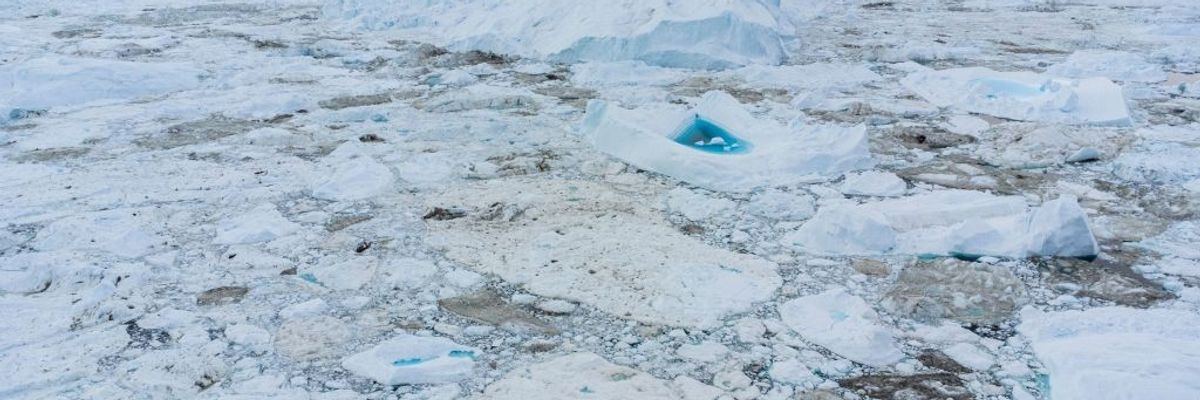
Picture taken on June 29, 2022 with a drone shows turquoise water in a large melt hole (C) on the top of an iceberg in the Disko Bay, Ilulissat, western Greenland.
The Corporate Media's Shocking Silence on Latest Tipping Points Study
When what should be top "headline news," gets nearly no major coverage at all.
On the heels of the latest Intergovernmental Panel on Climate Change (IPCC) report (3/20/23), which featured scientists running out of ways to emphasize how urgently deep cuts in fossil fuel use are needed, a troubling new climate study has emerged. Published in the prominent peer-reviewed science journal Nature (3/29/23), the study found that a little-studied deep ocean circulation system is slowing dramatically, and could collapse this century. One IPCC author not involved in the study declared it "headline news." Unfortunately, science doesn't guide US corporate media, which were virtually silent on the landmark study.
The authors modeled the effects of Antarctic meltwater on deep ocean currents crucial to marine ecosystems. Similar to the more well-studied Atlantic Meridional Overturning Circulation (AMOC) that the Gulf Stream is a part of, and which is also known to be dangerously weakening, the Antarctic overturning circulation has major planetary impacts. It pushes nutrient-dense water from the ocean floor up toward the surface, where those nutrients support marine life. The Nature study, which also refers to the current as the Antarctic Bottom Water, found that this circulation system is projected to slow down 42% by 2050, with a total collapse "this century," according to study co-author Matthew England (CNN.com, 3/29/23).
Toronto-based wire service Reuters (3/29/23), the London Guardian (3/29/23) and BBC (3/30/23) also published articles.
Climate activist Bill McKibben (Crucial Years, 4/2/23) argued that Donald Trump's arrest, which dominated headlines the day the Nature study came out, was far less remarkable as news goes. "Him ending up in trouble for tax evasion to cover up an affair with a porn star seems unlikely only in its details," McKibben wrote, while the Antarctic story was "one of the most important installments in the most important saga of our time, the rapid decline of the planet's physical health."
Last year, FAIR (4/21/22) found that after paying brief lip service to that year's IPCC report, TV news networks virtually ignored the climate crisis for the next six weeks—when they had a chance to pay lip service to the crisis again on Earth Day. Perhaps the Nature study came too soon after the IPCC report, and corporate media had had their fill of news requiring viewers to question the grip the fossil fuel industry—a major news advertiser—has on politics. In any case, the shocking lack of coverage of Nature's devastating study demonstrates, once again, that corporate media's commitment to a livable planet comes nowhere close to matching the urgency of the situation.
We are at a crossroads
This country and this world are at a monumental crossroads. In a few short weeks, US voters will have an opportunity to beat back the forces of fascism and confront the billionaires who are rigging the economy, our media system, and our democracy, making it increasingly impossible for ordinary people to get by. We’re not just talking about the election. We’re talking about what must be done once these fascist elements are vanquished from power. We need a bolder set of solutions than what either major party has so far been willing to offer and a working-class movement ready to fight like hell for it. Trump didn't emerge from nowhere. The conditions that fueled MAGA authoritarianism were created by decades of radical neoliberal economic policies and a corrupt political system dominated by corporate interests. They slashed taxes on the super-rich, promising that the benefits would trickle down. They said giveaways to the corporate titans would make life more affordable for the rest of us. It was all bullshit. And when a bitter, betrayed populace searches for someone to blame, right-wing demagogues have little trouble finding scapegoats. People know when they're being lied to, but you won't hear any of this from the corporate media. Only independent journalism—powered and funded by people who believe in building a better world—can deliver truly trustworthy daily news. Our Fall Campaign is underway, and we need your help. To power our newsroom through the rest of the year, we need to raise $125,000 by midnight on October 31. So if you share our vision, please contribute whatever you can to sustain our work. |
On the heels of the latest Intergovernmental Panel on Climate Change (IPCC) report (3/20/23), which featured scientists running out of ways to emphasize how urgently deep cuts in fossil fuel use are needed, a troubling new climate study has emerged. Published in the prominent peer-reviewed science journal Nature (3/29/23), the study found that a little-studied deep ocean circulation system is slowing dramatically, and could collapse this century. One IPCC author not involved in the study declared it "headline news." Unfortunately, science doesn't guide US corporate media, which were virtually silent on the landmark study.
The authors modeled the effects of Antarctic meltwater on deep ocean currents crucial to marine ecosystems. Similar to the more well-studied Atlantic Meridional Overturning Circulation (AMOC) that the Gulf Stream is a part of, and which is also known to be dangerously weakening, the Antarctic overturning circulation has major planetary impacts. It pushes nutrient-dense water from the ocean floor up toward the surface, where those nutrients support marine life. The Nature study, which also refers to the current as the Antarctic Bottom Water, found that this circulation system is projected to slow down 42% by 2050, with a total collapse "this century," according to study co-author Matthew England (CNN.com, 3/29/23).
Toronto-based wire service Reuters (3/29/23), the London Guardian (3/29/23) and BBC (3/30/23) also published articles.
Climate activist Bill McKibben (Crucial Years, 4/2/23) argued that Donald Trump's arrest, which dominated headlines the day the Nature study came out, was far less remarkable as news goes. "Him ending up in trouble for tax evasion to cover up an affair with a porn star seems unlikely only in its details," McKibben wrote, while the Antarctic story was "one of the most important installments in the most important saga of our time, the rapid decline of the planet's physical health."
Last year, FAIR (4/21/22) found that after paying brief lip service to that year's IPCC report, TV news networks virtually ignored the climate crisis for the next six weeks—when they had a chance to pay lip service to the crisis again on Earth Day. Perhaps the Nature study came too soon after the IPCC report, and corporate media had had their fill of news requiring viewers to question the grip the fossil fuel industry—a major news advertiser—has on politics. In any case, the shocking lack of coverage of Nature's devastating study demonstrates, once again, that corporate media's commitment to a livable planet comes nowhere close to matching the urgency of the situation.
On the heels of the latest Intergovernmental Panel on Climate Change (IPCC) report (3/20/23), which featured scientists running out of ways to emphasize how urgently deep cuts in fossil fuel use are needed, a troubling new climate study has emerged. Published in the prominent peer-reviewed science journal Nature (3/29/23), the study found that a little-studied deep ocean circulation system is slowing dramatically, and could collapse this century. One IPCC author not involved in the study declared it "headline news." Unfortunately, science doesn't guide US corporate media, which were virtually silent on the landmark study.
The authors modeled the effects of Antarctic meltwater on deep ocean currents crucial to marine ecosystems. Similar to the more well-studied Atlantic Meridional Overturning Circulation (AMOC) that the Gulf Stream is a part of, and which is also known to be dangerously weakening, the Antarctic overturning circulation has major planetary impacts. It pushes nutrient-dense water from the ocean floor up toward the surface, where those nutrients support marine life. The Nature study, which also refers to the current as the Antarctic Bottom Water, found that this circulation system is projected to slow down 42% by 2050, with a total collapse "this century," according to study co-author Matthew England (CNN.com, 3/29/23).
Toronto-based wire service Reuters (3/29/23), the London Guardian (3/29/23) and BBC (3/30/23) also published articles.
Climate activist Bill McKibben (Crucial Years, 4/2/23) argued that Donald Trump's arrest, which dominated headlines the day the Nature study came out, was far less remarkable as news goes. "Him ending up in trouble for tax evasion to cover up an affair with a porn star seems unlikely only in its details," McKibben wrote, while the Antarctic story was "one of the most important installments in the most important saga of our time, the rapid decline of the planet's physical health."
Last year, FAIR (4/21/22) found that after paying brief lip service to that year's IPCC report, TV news networks virtually ignored the climate crisis for the next six weeks—when they had a chance to pay lip service to the crisis again on Earth Day. Perhaps the Nature study came too soon after the IPCC report, and corporate media had had their fill of news requiring viewers to question the grip the fossil fuel industry—a major news advertiser—has on politics. In any case, the shocking lack of coverage of Nature's devastating study demonstrates, once again, that corporate media's commitment to a livable planet comes nowhere close to matching the urgency of the situation.