SUBSCRIBE TO OUR FREE NEWSLETTER
Daily news & progressive opinion—funded by the people, not the corporations—delivered straight to your inbox.
5
#000000
#FFFFFF
To donate by check, phone, or other method, see our More Ways to Give page.
Daily news & progressive opinion—funded by the people, not the corporations—delivered straight to your inbox.
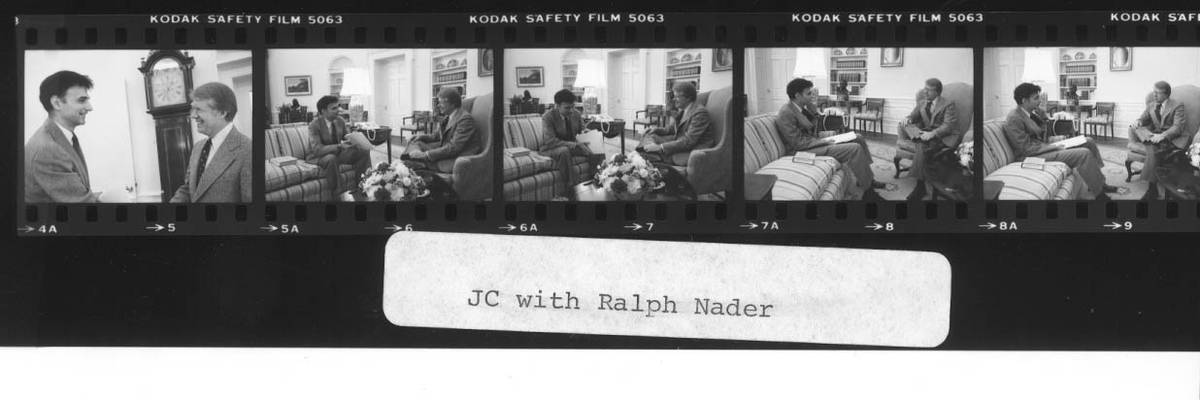
A collection of photographs shows former U.S. President Jimmy Carter with Ralph Nader.
He nourished the norms of personal and civic decency, dialogue, truth-telling, and working for a just society, expressing his Christian faith in action.
Jimmy Carter was the last president to actively open the government for engagement by citizen groups. Right after his November 1976 election, he agreed to address a huge hotel ballroom in D.C. full of local and national citizen advocates. It was a great success never again repeated by succeeding president-elects.
Mr. Carter then chose civic leaders and other solid progressives to head regulatory agencies such as National Highway Traffic Safety Administration, Environmental Protection Agency, Occupational Safety and Health Administration, Federal Trade Commission, and for other high positions in government. He chose the formidable longtime consumer-labor advocate Esther Peterson to be his consumer protection special assistant in the White House. He also supported an independent consumer protection agency which Congress, after a fierce struggle between corporate lobbies and consumer groups, narrowly defeated in 1978. Starting in 1981, Ronald Reagan undermined many Carter Administration health and safety initiatives.
Compare Jimmy Carter’s life with the rancid, corrupt, cowardly politicians spoiling today’s Washington landscapes.
Mr. Carter was also the last president to authentically recognize Palestinian rights and charge the Israeli government with imposing a system of apartheid (“worse than in South Africa,” he said) over Palestine. However, he failed to get Israel to agree to a comprehensive peace settlement, including the creation of a Palestinian state, and had to settle for a peace treaty between Egypt and Israel.
Citizen Carter was easily our greatest former president. For over 40 years his indefatigable work ethic was applied to advancing peace efforts, initiating health programs in developing countries, supervising fair elections overseas and, with Rosalynn, joining Habitat for Humanity as a manual laborer (he was an expert woodworker, among his many skills) to build houses around the country for needy families.
The range of interests expressed through his 32 books and conferences revealed a practical, results-oriented, humble Renaissance man. His compassion and honesty infuse the Carter Center to this day.
He nourished the norms of personal and civic decency, dialogue, truth-telling, and working for a just society, expressing his Christian faith in action.
Compare Jimmy Carter’s life with the rancid, corrupt, cowardly politicians spoiling today’s Washington landscapes.
There are legitimate criticisms of Carter’s foreign and domestic policies that others will examine. But overall, his legacy will live on to inspire future generations of Americans to elevate their expectations and strive toward them with civic dedication and commitment.
I was always in awe of how efficiently he used his time every day—and truly amazed by his relentless productivity. This alone would have been a worthy book by Mr. Carter were it not for his genuine humility.
Dear Common Dreams reader, It’s been nearly 30 years since I co-founded Common Dreams with my late wife, Lina Newhouser. We had the radical notion that journalism should serve the public good, not corporate profits. It was clear to us from the outset what it would take to build such a project. No paid advertisements. No corporate sponsors. No millionaire publisher telling us what to think or do. Many people said we wouldn't last a year, but we proved those doubters wrong. Together with a tremendous team of journalists and dedicated staff, we built an independent media outlet free from the constraints of profits and corporate control. Our mission has always been simple: To inform. To inspire. To ignite change for the common good. Building Common Dreams was not easy. Our survival was never guaranteed. When you take on the most powerful forces—Wall Street greed, fossil fuel industry destruction, Big Tech lobbyists, and uber-rich oligarchs who have spent billions upon billions rigging the economy and democracy in their favor—the only bulwark you have is supporters who believe in your work. But here’s the urgent message from me today. It's never been this bad out there. And it's never been this hard to keep us going. At the very moment Common Dreams is most needed, the threats we face are intensifying. We need your support now more than ever. We don't accept corporate advertising and never will. We don't have a paywall because we don't think people should be blocked from critical news based on their ability to pay. Everything we do is funded by the donations of readers like you. When everyone does the little they can afford, we are strong. But if that support retreats or dries up, so do we. Will you donate now to make sure Common Dreams not only survives but thrives? —Craig Brown, Co-founder |
Jimmy Carter was the last president to actively open the government for engagement by citizen groups. Right after his November 1976 election, he agreed to address a huge hotel ballroom in D.C. full of local and national citizen advocates. It was a great success never again repeated by succeeding president-elects.
Mr. Carter then chose civic leaders and other solid progressives to head regulatory agencies such as National Highway Traffic Safety Administration, Environmental Protection Agency, Occupational Safety and Health Administration, Federal Trade Commission, and for other high positions in government. He chose the formidable longtime consumer-labor advocate Esther Peterson to be his consumer protection special assistant in the White House. He also supported an independent consumer protection agency which Congress, after a fierce struggle between corporate lobbies and consumer groups, narrowly defeated in 1978. Starting in 1981, Ronald Reagan undermined many Carter Administration health and safety initiatives.
Compare Jimmy Carter’s life with the rancid, corrupt, cowardly politicians spoiling today’s Washington landscapes.
Mr. Carter was also the last president to authentically recognize Palestinian rights and charge the Israeli government with imposing a system of apartheid (“worse than in South Africa,” he said) over Palestine. However, he failed to get Israel to agree to a comprehensive peace settlement, including the creation of a Palestinian state, and had to settle for a peace treaty between Egypt and Israel.
Citizen Carter was easily our greatest former president. For over 40 years his indefatigable work ethic was applied to advancing peace efforts, initiating health programs in developing countries, supervising fair elections overseas and, with Rosalynn, joining Habitat for Humanity as a manual laborer (he was an expert woodworker, among his many skills) to build houses around the country for needy families.
The range of interests expressed through his 32 books and conferences revealed a practical, results-oriented, humble Renaissance man. His compassion and honesty infuse the Carter Center to this day.
He nourished the norms of personal and civic decency, dialogue, truth-telling, and working for a just society, expressing his Christian faith in action.
Compare Jimmy Carter’s life with the rancid, corrupt, cowardly politicians spoiling today’s Washington landscapes.
There are legitimate criticisms of Carter’s foreign and domestic policies that others will examine. But overall, his legacy will live on to inspire future generations of Americans to elevate their expectations and strive toward them with civic dedication and commitment.
I was always in awe of how efficiently he used his time every day—and truly amazed by his relentless productivity. This alone would have been a worthy book by Mr. Carter were it not for his genuine humility.
Jimmy Carter was the last president to actively open the government for engagement by citizen groups. Right after his November 1976 election, he agreed to address a huge hotel ballroom in D.C. full of local and national citizen advocates. It was a great success never again repeated by succeeding president-elects.
Mr. Carter then chose civic leaders and other solid progressives to head regulatory agencies such as National Highway Traffic Safety Administration, Environmental Protection Agency, Occupational Safety and Health Administration, Federal Trade Commission, and for other high positions in government. He chose the formidable longtime consumer-labor advocate Esther Peterson to be his consumer protection special assistant in the White House. He also supported an independent consumer protection agency which Congress, after a fierce struggle between corporate lobbies and consumer groups, narrowly defeated in 1978. Starting in 1981, Ronald Reagan undermined many Carter Administration health and safety initiatives.
Compare Jimmy Carter’s life with the rancid, corrupt, cowardly politicians spoiling today’s Washington landscapes.
Mr. Carter was also the last president to authentically recognize Palestinian rights and charge the Israeli government with imposing a system of apartheid (“worse than in South Africa,” he said) over Palestine. However, he failed to get Israel to agree to a comprehensive peace settlement, including the creation of a Palestinian state, and had to settle for a peace treaty between Egypt and Israel.
Citizen Carter was easily our greatest former president. For over 40 years his indefatigable work ethic was applied to advancing peace efforts, initiating health programs in developing countries, supervising fair elections overseas and, with Rosalynn, joining Habitat for Humanity as a manual laborer (he was an expert woodworker, among his many skills) to build houses around the country for needy families.
The range of interests expressed through his 32 books and conferences revealed a practical, results-oriented, humble Renaissance man. His compassion and honesty infuse the Carter Center to this day.
He nourished the norms of personal and civic decency, dialogue, truth-telling, and working for a just society, expressing his Christian faith in action.
Compare Jimmy Carter’s life with the rancid, corrupt, cowardly politicians spoiling today’s Washington landscapes.
There are legitimate criticisms of Carter’s foreign and domestic policies that others will examine. But overall, his legacy will live on to inspire future generations of Americans to elevate their expectations and strive toward them with civic dedication and commitment.
I was always in awe of how efficiently he used his time every day—and truly amazed by his relentless productivity. This alone would have been a worthy book by Mr. Carter were it not for his genuine humility.