

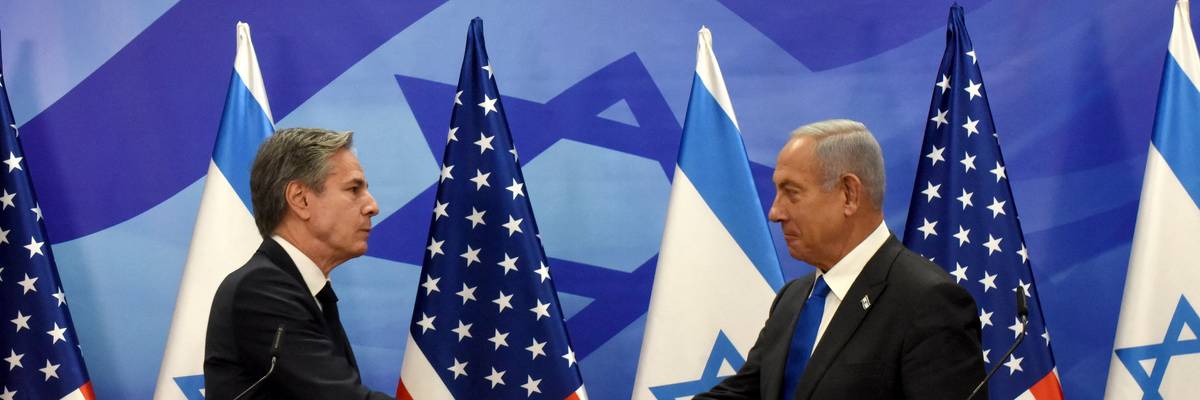
U.S. Secretary of State Antony Blinken shakes hands with Israeli Prime Minister Benjamin Netanyahu following a joint press conference on January 30, 2023 in Jerusalem.
By Caving to Israel, Biden Opens the Door to War With Iran
Biden administration officials have recently defended and justified Israel's military attacks on Iran.
As all eyes were on Ukraine and Chinese balloons in the sky, the Biden administration seemingly shifted America’s longstanding opposition to Israel starting a disastrous war with Iran.
U.S. Ambassador to Israel Tom Nides told the Conference of Presidents of Major American Jewish Organizations Sunday that “Israel can and should do whatever they need to deal with [in regards to Iran] and we’ve got their back” — a thinly veiled reference to military action.
These comments do not appear to be outliers. After Israel struck a defense compound in Iran on January 29, the Biden administration uncharacteristically hinted to reporters that the Israeli operation was part of a new joint effort by the U.S. and Israel to contain Tehran’s nuclear and military ambitions. When Secretary of State Tony Blinken was asked about it a day later, he offered no criticism and no concern for the destabilizing potential of the strikes, let alone a condemnation. Instead, he offered what amounts to a defense and justification of the Israeli strike: “[It is] very important that we continue to deal with and work against as necessary the various actions that Iran has engaged in throughout the region and beyond that threaten peace and security.”
A senior Biden administration official tells me that this does not signify a major shift in policy, but, without a public walk-back, such assurances leave much to be desired. From George W. Bush to Barack Obama to even Donald Trump, the U.S. government has sought to prevent Israel from bombing Iran since Washington risked getting sucked into that war — and the end result would most likely be a severely destabilized Middle East and an Iran with a nuclear weapon.
Bush Jr. refused to sell Israel specialized bunker-busting bombs and denied giving Israeli leaders a green light to bomb Iran in 2008, effectively blocking the Israeli plan. President Obama made his opposition to an Israeli strike public, telling CNN in 2009 that he is “absolutely not” giving Israel a green light to attack Iran. The fear of a surprise Israeli attack was so significant during the Obama years that a senior Pentagon official asked to have the moon cycle included in his daily intelligence brief since a unilateraln Israeli attack was deemed more likely to occur during particular moon phases. At one point, Secretary of State Hillary Clinton took the unusual step of going to the podium in 2012 to condemn Israel’s assassination of an Iranian scientist due to its potentially destabilizing consequences.
And when the Israelis pushed American presidents to take military action, various elements of the U.S. government pushed back — even under Donald Trump. According to Mark Milley, the chairman of the U.S. Joint Chiefs of Staff, Israeli prime minister Benjamin Netanyahu urged Trump to strike against Iran after he had lost the 2020 election. Milley resisted, telling Trump at one point that “If you do this, you’re gonna have a fucking war.”
A lot has clearly changed in the past years and months. Trump pulled out of the Iran nuclear agreement, and, while Biden promised to return to it, the deal is still in limbo. Power in Iran, in turn, shifted back to the conservative hardliners, who fumbled the nuclear talks while increasing the regime’s repression of the Iranian people. This then led to widespread protests and the most significant challenge to the clerical regime in more than a decade.
One thing hasn’t changed, however: War with Iran will be disastrous for the region, for the United States — and for the Iranian people’s struggle for freedom and dignity.
Yet, this appears to be the direction in which the Biden team is going — perhaps inadvertently — by caving to Israel’s longstanding position to deal with Iran’s nuclear program militarily rather than diplomatically. (Incidentally, Netanyahu has been caught on tape boasting that it was he who convinced Trump to quit the Iran nuclear deal.)
This does fit a pattern, however, in which the one area where Biden has most consistently followed Trump’s Middle East policy has been on Israel. Biden has refused to reverse almost all major policy shifts in favor of Israel that Trump put in place – from moving the U.S. embassy to Jerusalem, to recognizing Israel’s annexation of the Golan Heights (which exposes the blatant double standard in Biden asserting that Russia’s illegal annexation of Ukrainian territory threatens the “rules-based order”), to embracing and seeking to expand the Abraham Accords, a measure that put the final nail in the coffin of the two-state solution by explicitly “moving beyond” the Israeli-Palestinian conflict rather than seeking to resolve it.
Despite this Trump-like deference to Israel — or perhaps precisely because of it — Israel’s Minister of Diaspora affairs did not mince his words slamming the United States when U.S. Ambassador Nides issued a benign criticism of ongoing plans to weaken Israel’s justice system. “Mind your own business,” Amichai Chikli told the U.S. representative via Israeli radio. He later tweeted it as well, just to make sure the message was received by Washington.
Ironically, that is good advice. An America that minds its own business — and by extension prioritizes its own interests — would not only stop undermining its own credibility by condemning Russian illegal annexations while enabling Israeli ones, but it would also block any Israeli attempt to drag America into a disastrous war in the Middle East.
The United States already has its hands full with international crises. Between seeking to defeat Russia in Ukraine and battling China by strangling its high-tech industries, America simply doesn’t have the bandwidth for an Israeli-initiated war with Iran. As Harvard professor and Quincy Institute Distinguished Fellow Stephen Walt told me in an email, “This is lunacy.”
Perhaps Biden should take to heart the true meaning of Minister Chikli’s dismissive advice.
We are at a crossroads
This country and this world are at a monumental crossroads. In a few short weeks, US voters will have an opportunity to beat back the forces of fascism and confront the billionaires who are rigging the economy, our media system, and our democracy, making it increasingly impossible for ordinary people to get by. We’re not just talking about the election. We’re talking about what must be done once these fascist elements are vanquished from power. We need a bolder set of solutions than what either major party has so far been willing to offer and a working-class movement ready to fight like hell for it. Trump didn't emerge from nowhere. The conditions that fueled MAGA authoritarianism were created by decades of radical neoliberal economic policies and a corrupt political system dominated by corporate interests. They slashed taxes on the super-rich, promising that the benefits would trickle down. They said giveaways to the corporate titans would make life more affordable for the rest of us. It was all bullshit. And when a bitter, betrayed populace searches for someone to blame, right-wing demagogues have little trouble finding scapegoats. People know when they're being lied to, but you won't hear any of this from the corporate media. Only independent journalism—powered and funded by people who believe in building a better world—can deliver truly trustworthy daily news. Our Fall Campaign is underway, and we need your help. To power our newsroom through the rest of the year, we need to raise $125,000 by midnight on October 31. So if you share our vision, please contribute whatever you can to sustain our work. |
As all eyes were on Ukraine and Chinese balloons in the sky, the Biden administration seemingly shifted America’s longstanding opposition to Israel starting a disastrous war with Iran.
U.S. Ambassador to Israel Tom Nides told the Conference of Presidents of Major American Jewish Organizations Sunday that “Israel can and should do whatever they need to deal with [in regards to Iran] and we’ve got their back” — a thinly veiled reference to military action.
These comments do not appear to be outliers. After Israel struck a defense compound in Iran on January 29, the Biden administration uncharacteristically hinted to reporters that the Israeli operation was part of a new joint effort by the U.S. and Israel to contain Tehran’s nuclear and military ambitions. When Secretary of State Tony Blinken was asked about it a day later, he offered no criticism and no concern for the destabilizing potential of the strikes, let alone a condemnation. Instead, he offered what amounts to a defense and justification of the Israeli strike: “[It is] very important that we continue to deal with and work against as necessary the various actions that Iran has engaged in throughout the region and beyond that threaten peace and security.”
A senior Biden administration official tells me that this does not signify a major shift in policy, but, without a public walk-back, such assurances leave much to be desired. From George W. Bush to Barack Obama to even Donald Trump, the U.S. government has sought to prevent Israel from bombing Iran since Washington risked getting sucked into that war — and the end result would most likely be a severely destabilized Middle East and an Iran with a nuclear weapon.
Bush Jr. refused to sell Israel specialized bunker-busting bombs and denied giving Israeli leaders a green light to bomb Iran in 2008, effectively blocking the Israeli plan. President Obama made his opposition to an Israeli strike public, telling CNN in 2009 that he is “absolutely not” giving Israel a green light to attack Iran. The fear of a surprise Israeli attack was so significant during the Obama years that a senior Pentagon official asked to have the moon cycle included in his daily intelligence brief since a unilateraln Israeli attack was deemed more likely to occur during particular moon phases. At one point, Secretary of State Hillary Clinton took the unusual step of going to the podium in 2012 to condemn Israel’s assassination of an Iranian scientist due to its potentially destabilizing consequences.
And when the Israelis pushed American presidents to take military action, various elements of the U.S. government pushed back — even under Donald Trump. According to Mark Milley, the chairman of the U.S. Joint Chiefs of Staff, Israeli prime minister Benjamin Netanyahu urged Trump to strike against Iran after he had lost the 2020 election. Milley resisted, telling Trump at one point that “If you do this, you’re gonna have a fucking war.”
A lot has clearly changed in the past years and months. Trump pulled out of the Iran nuclear agreement, and, while Biden promised to return to it, the deal is still in limbo. Power in Iran, in turn, shifted back to the conservative hardliners, who fumbled the nuclear talks while increasing the regime’s repression of the Iranian people. This then led to widespread protests and the most significant challenge to the clerical regime in more than a decade.
One thing hasn’t changed, however: War with Iran will be disastrous for the region, for the United States — and for the Iranian people’s struggle for freedom and dignity.
Yet, this appears to be the direction in which the Biden team is going — perhaps inadvertently — by caving to Israel’s longstanding position to deal with Iran’s nuclear program militarily rather than diplomatically. (Incidentally, Netanyahu has been caught on tape boasting that it was he who convinced Trump to quit the Iran nuclear deal.)
This does fit a pattern, however, in which the one area where Biden has most consistently followed Trump’s Middle East policy has been on Israel. Biden has refused to reverse almost all major policy shifts in favor of Israel that Trump put in place – from moving the U.S. embassy to Jerusalem, to recognizing Israel’s annexation of the Golan Heights (which exposes the blatant double standard in Biden asserting that Russia’s illegal annexation of Ukrainian territory threatens the “rules-based order”), to embracing and seeking to expand the Abraham Accords, a measure that put the final nail in the coffin of the two-state solution by explicitly “moving beyond” the Israeli-Palestinian conflict rather than seeking to resolve it.
Despite this Trump-like deference to Israel — or perhaps precisely because of it — Israel’s Minister of Diaspora affairs did not mince his words slamming the United States when U.S. Ambassador Nides issued a benign criticism of ongoing plans to weaken Israel’s justice system. “Mind your own business,” Amichai Chikli told the U.S. representative via Israeli radio. He later tweeted it as well, just to make sure the message was received by Washington.
Ironically, that is good advice. An America that minds its own business — and by extension prioritizes its own interests — would not only stop undermining its own credibility by condemning Russian illegal annexations while enabling Israeli ones, but it would also block any Israeli attempt to drag America into a disastrous war in the Middle East.
The United States already has its hands full with international crises. Between seeking to defeat Russia in Ukraine and battling China by strangling its high-tech industries, America simply doesn’t have the bandwidth for an Israeli-initiated war with Iran. As Harvard professor and Quincy Institute Distinguished Fellow Stephen Walt told me in an email, “This is lunacy.”
Perhaps Biden should take to heart the true meaning of Minister Chikli’s dismissive advice.
- Opinion | Hamas Attack a Response to Netanyahu’s and Biden’s Choices | Common Dreams ›
- Delayed But Not Denied: 2nd Hamas-Israeli Prisoner Swap Goes Through ›
- Opinion | Can US Threats Prevent a Wider War in the Middle East? | Common Dreams ›
- Opinion | Biden Should Just Say ‘No’ to Israel | Common Dreams ›
- Opinion | US Bombs Won’t Stop the Houthis | Common Dreams ›
- Opinion | From Ukraine to Gaza, Turning War Rhetoric on Its Head | Common Dreams ›
- Opinion | As Palestinians Bleed, US Policy Towards Iran Proves Disastrous | Common Dreams ›
- 'A Declaration of War': Israel Accused of Bombing Iranian Consulate in Syria ›
- Calls for De-Escalation Mount as Israel Plans to 'Exact a Price From Iran' | Common Dreams ›
- Opinion | The Biden Administration's THAAD Deployment and the Path to War | Common Dreams ›
- Opinion | Is Trump Attack on Iran Hinging on Looming Retirement of This Hawkish Pro-Israel US General? | Common Dreams ›
- Opinion | Trump (and Biden) Could Have Forestalled War With Iran If They Wanted | Common Dreams ›
As all eyes were on Ukraine and Chinese balloons in the sky, the Biden administration seemingly shifted America’s longstanding opposition to Israel starting a disastrous war with Iran.
U.S. Ambassador to Israel Tom Nides told the Conference of Presidents of Major American Jewish Organizations Sunday that “Israel can and should do whatever they need to deal with [in regards to Iran] and we’ve got their back” — a thinly veiled reference to military action.
These comments do not appear to be outliers. After Israel struck a defense compound in Iran on January 29, the Biden administration uncharacteristically hinted to reporters that the Israeli operation was part of a new joint effort by the U.S. and Israel to contain Tehran’s nuclear and military ambitions. When Secretary of State Tony Blinken was asked about it a day later, he offered no criticism and no concern for the destabilizing potential of the strikes, let alone a condemnation. Instead, he offered what amounts to a defense and justification of the Israeli strike: “[It is] very important that we continue to deal with and work against as necessary the various actions that Iran has engaged in throughout the region and beyond that threaten peace and security.”
A senior Biden administration official tells me that this does not signify a major shift in policy, but, without a public walk-back, such assurances leave much to be desired. From George W. Bush to Barack Obama to even Donald Trump, the U.S. government has sought to prevent Israel from bombing Iran since Washington risked getting sucked into that war — and the end result would most likely be a severely destabilized Middle East and an Iran with a nuclear weapon.
Bush Jr. refused to sell Israel specialized bunker-busting bombs and denied giving Israeli leaders a green light to bomb Iran in 2008, effectively blocking the Israeli plan. President Obama made his opposition to an Israeli strike public, telling CNN in 2009 that he is “absolutely not” giving Israel a green light to attack Iran. The fear of a surprise Israeli attack was so significant during the Obama years that a senior Pentagon official asked to have the moon cycle included in his daily intelligence brief since a unilateraln Israeli attack was deemed more likely to occur during particular moon phases. At one point, Secretary of State Hillary Clinton took the unusual step of going to the podium in 2012 to condemn Israel’s assassination of an Iranian scientist due to its potentially destabilizing consequences.
And when the Israelis pushed American presidents to take military action, various elements of the U.S. government pushed back — even under Donald Trump. According to Mark Milley, the chairman of the U.S. Joint Chiefs of Staff, Israeli prime minister Benjamin Netanyahu urged Trump to strike against Iran after he had lost the 2020 election. Milley resisted, telling Trump at one point that “If you do this, you’re gonna have a fucking war.”
A lot has clearly changed in the past years and months. Trump pulled out of the Iran nuclear agreement, and, while Biden promised to return to it, the deal is still in limbo. Power in Iran, in turn, shifted back to the conservative hardliners, who fumbled the nuclear talks while increasing the regime’s repression of the Iranian people. This then led to widespread protests and the most significant challenge to the clerical regime in more than a decade.
One thing hasn’t changed, however: War with Iran will be disastrous for the region, for the United States — and for the Iranian people’s struggle for freedom and dignity.
Yet, this appears to be the direction in which the Biden team is going — perhaps inadvertently — by caving to Israel’s longstanding position to deal with Iran’s nuclear program militarily rather than diplomatically. (Incidentally, Netanyahu has been caught on tape boasting that it was he who convinced Trump to quit the Iran nuclear deal.)
This does fit a pattern, however, in which the one area where Biden has most consistently followed Trump’s Middle East policy has been on Israel. Biden has refused to reverse almost all major policy shifts in favor of Israel that Trump put in place – from moving the U.S. embassy to Jerusalem, to recognizing Israel’s annexation of the Golan Heights (which exposes the blatant double standard in Biden asserting that Russia’s illegal annexation of Ukrainian territory threatens the “rules-based order”), to embracing and seeking to expand the Abraham Accords, a measure that put the final nail in the coffin of the two-state solution by explicitly “moving beyond” the Israeli-Palestinian conflict rather than seeking to resolve it.
Despite this Trump-like deference to Israel — or perhaps precisely because of it — Israel’s Minister of Diaspora affairs did not mince his words slamming the United States when U.S. Ambassador Nides issued a benign criticism of ongoing plans to weaken Israel’s justice system. “Mind your own business,” Amichai Chikli told the U.S. representative via Israeli radio. He later tweeted it as well, just to make sure the message was received by Washington.
Ironically, that is good advice. An America that minds its own business — and by extension prioritizes its own interests — would not only stop undermining its own credibility by condemning Russian illegal annexations while enabling Israeli ones, but it would also block any Israeli attempt to drag America into a disastrous war in the Middle East.
The United States already has its hands full with international crises. Between seeking to defeat Russia in Ukraine and battling China by strangling its high-tech industries, America simply doesn’t have the bandwidth for an Israeli-initiated war with Iran. As Harvard professor and Quincy Institute Distinguished Fellow Stephen Walt told me in an email, “This is lunacy.”
Perhaps Biden should take to heart the true meaning of Minister Chikli’s dismissive advice.
- Opinion | Hamas Attack a Response to Netanyahu’s and Biden’s Choices | Common Dreams ›
- Delayed But Not Denied: 2nd Hamas-Israeli Prisoner Swap Goes Through ›
- Opinion | Can US Threats Prevent a Wider War in the Middle East? | Common Dreams ›
- Opinion | Biden Should Just Say ‘No’ to Israel | Common Dreams ›
- Opinion | US Bombs Won’t Stop the Houthis | Common Dreams ›
- Opinion | From Ukraine to Gaza, Turning War Rhetoric on Its Head | Common Dreams ›
- Opinion | As Palestinians Bleed, US Policy Towards Iran Proves Disastrous | Common Dreams ›
- 'A Declaration of War': Israel Accused of Bombing Iranian Consulate in Syria ›
- Calls for De-Escalation Mount as Israel Plans to 'Exact a Price From Iran' | Common Dreams ›
- Opinion | The Biden Administration's THAAD Deployment and the Path to War | Common Dreams ›
- Opinion | Is Trump Attack on Iran Hinging on Looming Retirement of This Hawkish Pro-Israel US General? | Common Dreams ›
- Opinion | Trump (and Biden) Could Have Forestalled War With Iran If They Wanted | Common Dreams ›