SUBSCRIBE TO OUR FREE NEWSLETTER
Daily news & progressive opinion—funded by the people, not the corporations—delivered straight to your inbox.
5
#000000
#FFFFFF
To donate by check, phone, or other method, see our More Ways to Give page.
Daily news & progressive opinion—funded by the people, not the corporations—delivered straight to your inbox.
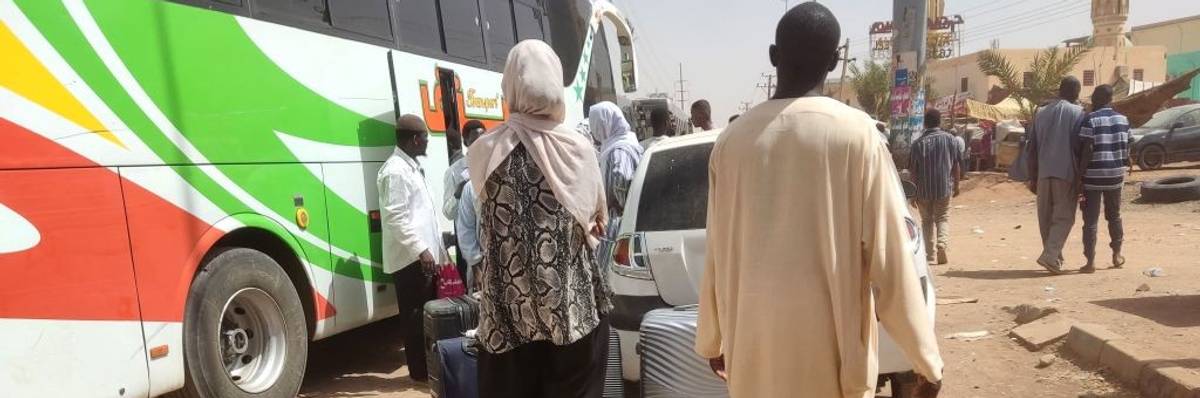
People gather at a bus station in southern Khartoum to leave the Sudanese capital to safer areas, on May 19, 2023, as battles continue between the army and paramilitary forces led by rival generals.
The situation in Sudan should demand our attention not only for the sake of international stability, but because so many lives are at stake.
In Sudan, the conflict between the Sudanese Army and the paramilitary Rapid Support Forces (RSF) continues. There are more than 100,000 people fleeing Sudan to neighbouring countries and more than 300,000 currently internally displaced. If a lasting truce is not in place soon, these numbers will only continue to increase. Humanitarian and religious organizations globally must step up their efforts to support the Sudanese people and bring a peaceful resolution to this conflict.
As thousands of Sudanese people flee hundreds of miles from Khartoum to reach the eastern port, hoping to ride a ship which will take them to safety, while others take treacherous journeys towards Chad, Southern Sudan, Ethiopia, and Libya, many are still trapped in the conflict area. Continuous shelling combined with shortages of food, drinking water, and medicine among other essential materials have left the people of the Republic of Sudan in a state of complete disarray.
Ms. Ahmed, a peace builder who works in a civil society organization that American Friends Service Committee (AFSC) partners with in Sudan said that she is heartbroken that the conflict has destroyed everything that the people of Sudan have been building for years.
“Who is going to save us from this situation?”
“Chaos and loss have been a daily aspect of our lives. My family and I are internally displaced like many other Sudanese people. We had to leave Khartoum and move to a different city to find safety. Many families are now living in one room with other families as there is shortage of space to live,” said Ms. Ahmed. She and her family were forced to pack their entire lives into few small bags which they could carry on foot and by bus in the areas where buses were still running. She is just one of many in this situation.
An earlier three-day cease-fire allowed thousands of foreign nationals to evacuate. However, the people of Sudan are left to fend for themselves. Ms. Kura, a Sudanese woman who works with another of AFSC’s partners in Sudan, is stuck in her house in Khartoum. She is afraid of even sleeping or going out to seek medical care. “Who is going to save us from this situation?” she asks.
The people of Sudan deserve to live in a peaceful environment which is free of conflict and where their rights are respected. The situation calls for negotiations involving all parties. For negotiations to work, international cooperation and attention is necessary. The United Nations, the African Union, and the Intergovernmental Authority on Development (IGAD) in Eastern Africa can play a key role in creating conditions for ending the conflict and ensuring that refugees and internally displaced people can meet their basic human needs. There is need for a permanent ceasefire agreement between the parties involved.
AFSC is raising money to provide food, medical supplies, hygiene kits, and other necessities for those displaced by violence. It is critical that religious and humanitarian organizations like ours step up our efforts to support the Sudanese people and to insist on a humanitarian corridor to provide necessary supplies and psychosocial support. We need to speak in unity for respecting human rights, including civic participation, and an end to all hostilities. Only with a united effort will peace be attained—and sustainable.
The impact of this mass exodus from Sudan will have lasting effects in the country, and in the greater Horn of Africa and other neighbouring countries. Some of these countries, including Chad, South Sudan, and Ethiopia, remain high on the Fragile states Index. However, should the violence and displacement in Sudan be stopped, the conflict resolution will have positive ripple effects for the region.
The situation in Sudan should demand our attention not only for the sake of international stability, but because so many lives are at stake. The world has shown in our reaction to conflict in Ukraine that we can sustain interest in the well-being of people who live far away from us. The Sudanese deserve the same sustained attention. The words of our friend Ahmed are ringing in my ears:
“I have evacuated my family to a different state. We have absolutely nothing. We left with small bags and what we could manage to carry in our journey out of Khartoum on foot and bus. We need medicines, food, shelter, but the world seems to have forgotten us.”
We need to invest in peace for Sudan and the greater Horn of Africa, to show Ahmed and all the others in the country that the rest of the world has not forgotten them.
Dear Common Dreams reader, It’s been nearly 30 years since I co-founded Common Dreams with my late wife, Lina Newhouser. We had the radical notion that journalism should serve the public good, not corporate profits. It was clear to us from the outset what it would take to build such a project. No paid advertisements. No corporate sponsors. No millionaire publisher telling us what to think or do. Many people said we wouldn't last a year, but we proved those doubters wrong. Together with a tremendous team of journalists and dedicated staff, we built an independent media outlet free from the constraints of profits and corporate control. Our mission has always been simple: To inform. To inspire. To ignite change for the common good. Building Common Dreams was not easy. Our survival was never guaranteed. When you take on the most powerful forces—Wall Street greed, fossil fuel industry destruction, Big Tech lobbyists, and uber-rich oligarchs who have spent billions upon billions rigging the economy and democracy in their favor—the only bulwark you have is supporters who believe in your work. But here’s the urgent message from me today. It's never been this bad out there. And it's never been this hard to keep us going. At the very moment Common Dreams is most needed, the threats we face are intensifying. We need your support now more than ever. We don't accept corporate advertising and never will. We don't have a paywall because we don't think people should be blocked from critical news based on their ability to pay. Everything we do is funded by the donations of readers like you. When everyone does the little they can afford, we are strong. But if that support retreats or dries up, so do we. Will you donate now to make sure Common Dreams not only survives but thrives? —Craig Brown, Co-founder |
In Sudan, the conflict between the Sudanese Army and the paramilitary Rapid Support Forces (RSF) continues. There are more than 100,000 people fleeing Sudan to neighbouring countries and more than 300,000 currently internally displaced. If a lasting truce is not in place soon, these numbers will only continue to increase. Humanitarian and religious organizations globally must step up their efforts to support the Sudanese people and bring a peaceful resolution to this conflict.
As thousands of Sudanese people flee hundreds of miles from Khartoum to reach the eastern port, hoping to ride a ship which will take them to safety, while others take treacherous journeys towards Chad, Southern Sudan, Ethiopia, and Libya, many are still trapped in the conflict area. Continuous shelling combined with shortages of food, drinking water, and medicine among other essential materials have left the people of the Republic of Sudan in a state of complete disarray.
Ms. Ahmed, a peace builder who works in a civil society organization that American Friends Service Committee (AFSC) partners with in Sudan said that she is heartbroken that the conflict has destroyed everything that the people of Sudan have been building for years.
“Who is going to save us from this situation?”
“Chaos and loss have been a daily aspect of our lives. My family and I are internally displaced like many other Sudanese people. We had to leave Khartoum and move to a different city to find safety. Many families are now living in one room with other families as there is shortage of space to live,” said Ms. Ahmed. She and her family were forced to pack their entire lives into few small bags which they could carry on foot and by bus in the areas where buses were still running. She is just one of many in this situation.
An earlier three-day cease-fire allowed thousands of foreign nationals to evacuate. However, the people of Sudan are left to fend for themselves. Ms. Kura, a Sudanese woman who works with another of AFSC’s partners in Sudan, is stuck in her house in Khartoum. She is afraid of even sleeping or going out to seek medical care. “Who is going to save us from this situation?” she asks.
The people of Sudan deserve to live in a peaceful environment which is free of conflict and where their rights are respected. The situation calls for negotiations involving all parties. For negotiations to work, international cooperation and attention is necessary. The United Nations, the African Union, and the Intergovernmental Authority on Development (IGAD) in Eastern Africa can play a key role in creating conditions for ending the conflict and ensuring that refugees and internally displaced people can meet their basic human needs. There is need for a permanent ceasefire agreement between the parties involved.
AFSC is raising money to provide food, medical supplies, hygiene kits, and other necessities for those displaced by violence. It is critical that religious and humanitarian organizations like ours step up our efforts to support the Sudanese people and to insist on a humanitarian corridor to provide necessary supplies and psychosocial support. We need to speak in unity for respecting human rights, including civic participation, and an end to all hostilities. Only with a united effort will peace be attained—and sustainable.
The impact of this mass exodus from Sudan will have lasting effects in the country, and in the greater Horn of Africa and other neighbouring countries. Some of these countries, including Chad, South Sudan, and Ethiopia, remain high on the Fragile states Index. However, should the violence and displacement in Sudan be stopped, the conflict resolution will have positive ripple effects for the region.
The situation in Sudan should demand our attention not only for the sake of international stability, but because so many lives are at stake. The world has shown in our reaction to conflict in Ukraine that we can sustain interest in the well-being of people who live far away from us. The Sudanese deserve the same sustained attention. The words of our friend Ahmed are ringing in my ears:
“I have evacuated my family to a different state. We have absolutely nothing. We left with small bags and what we could manage to carry in our journey out of Khartoum on foot and bus. We need medicines, food, shelter, but the world seems to have forgotten us.”
We need to invest in peace for Sudan and the greater Horn of Africa, to show Ahmed and all the others in the country that the rest of the world has not forgotten them.
In Sudan, the conflict between the Sudanese Army and the paramilitary Rapid Support Forces (RSF) continues. There are more than 100,000 people fleeing Sudan to neighbouring countries and more than 300,000 currently internally displaced. If a lasting truce is not in place soon, these numbers will only continue to increase. Humanitarian and religious organizations globally must step up their efforts to support the Sudanese people and bring a peaceful resolution to this conflict.
As thousands of Sudanese people flee hundreds of miles from Khartoum to reach the eastern port, hoping to ride a ship which will take them to safety, while others take treacherous journeys towards Chad, Southern Sudan, Ethiopia, and Libya, many are still trapped in the conflict area. Continuous shelling combined with shortages of food, drinking water, and medicine among other essential materials have left the people of the Republic of Sudan in a state of complete disarray.
Ms. Ahmed, a peace builder who works in a civil society organization that American Friends Service Committee (AFSC) partners with in Sudan said that she is heartbroken that the conflict has destroyed everything that the people of Sudan have been building for years.
“Who is going to save us from this situation?”
“Chaos and loss have been a daily aspect of our lives. My family and I are internally displaced like many other Sudanese people. We had to leave Khartoum and move to a different city to find safety. Many families are now living in one room with other families as there is shortage of space to live,” said Ms. Ahmed. She and her family were forced to pack their entire lives into few small bags which they could carry on foot and by bus in the areas where buses were still running. She is just one of many in this situation.
An earlier three-day cease-fire allowed thousands of foreign nationals to evacuate. However, the people of Sudan are left to fend for themselves. Ms. Kura, a Sudanese woman who works with another of AFSC’s partners in Sudan, is stuck in her house in Khartoum. She is afraid of even sleeping or going out to seek medical care. “Who is going to save us from this situation?” she asks.
The people of Sudan deserve to live in a peaceful environment which is free of conflict and where their rights are respected. The situation calls for negotiations involving all parties. For negotiations to work, international cooperation and attention is necessary. The United Nations, the African Union, and the Intergovernmental Authority on Development (IGAD) in Eastern Africa can play a key role in creating conditions for ending the conflict and ensuring that refugees and internally displaced people can meet their basic human needs. There is need for a permanent ceasefire agreement between the parties involved.
AFSC is raising money to provide food, medical supplies, hygiene kits, and other necessities for those displaced by violence. It is critical that religious and humanitarian organizations like ours step up our efforts to support the Sudanese people and to insist on a humanitarian corridor to provide necessary supplies and psychosocial support. We need to speak in unity for respecting human rights, including civic participation, and an end to all hostilities. Only with a united effort will peace be attained—and sustainable.
The impact of this mass exodus from Sudan will have lasting effects in the country, and in the greater Horn of Africa and other neighbouring countries. Some of these countries, including Chad, South Sudan, and Ethiopia, remain high on the Fragile states Index. However, should the violence and displacement in Sudan be stopped, the conflict resolution will have positive ripple effects for the region.
The situation in Sudan should demand our attention not only for the sake of international stability, but because so many lives are at stake. The world has shown in our reaction to conflict in Ukraine that we can sustain interest in the well-being of people who live far away from us. The Sudanese deserve the same sustained attention. The words of our friend Ahmed are ringing in my ears:
“I have evacuated my family to a different state. We have absolutely nothing. We left with small bags and what we could manage to carry in our journey out of Khartoum on foot and bus. We need medicines, food, shelter, but the world seems to have forgotten us.”
We need to invest in peace for Sudan and the greater Horn of Africa, to show Ahmed and all the others in the country that the rest of the world has not forgotten them.