

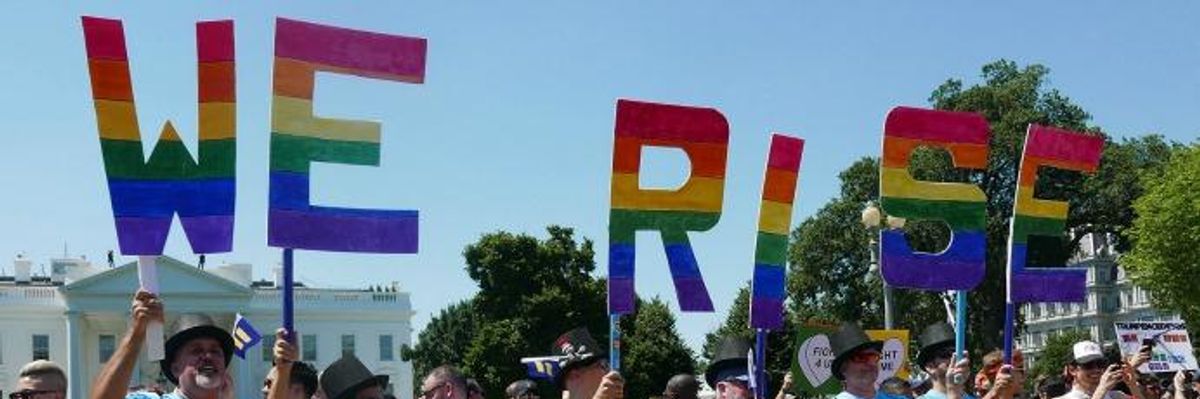
Equal rights advocates march in front of the White House in 2017.
Can Americans Come Out if Corporations Have Shut the Door? A Call for Courage
We have been seeing a concerning trend of companies, both large and small, scaling back or eliminating their DEI commitments out of fear. Instead, corporate leaders should stand up for their LGBTQIA+ employees.
Today, our nation celebrates National Coming Out Day. This October 11, you may see a wave of brave stories from your friends or family members, right along with messages of support from corporations touting their inclusive environments. It is a day when many of us in the LGBTQIA+ community choose to share our true selves with our loved ones, our community, our co-workers, and the world. And it serves as a reminder of the progress that has been made and how fortunate we are that so many can now feel comfortable to live openly and out loud.
After centuries of battles, whether that be on the streets outside Stonewall or in the courtrooms across our country, it is comforting to know that the efforts of our elders have helped to create a society where more people feel comfortable enough to live as their authentic selves.
Yet, the progress that we see today can, if we are not paying careful attention, belie the reality that our communities—and the progress we've made—continue to be under attack. Coming out is a deeply personal choice—a choice that becomes more difficult without cultural acceptance, and without the promises of security and protection we have increasingly begun to expect. But these hard-fought protections are, sadly, now being stripped away by the anti-DEI (Diversity, Equity, and Inclusion) movement and its pressure campaign pushing employers to backtrack on their commitment to inclusivity.
Now is the time to prove you respect your LGBTQIA+ employees as people, and that their personhood is not a fad that can be easily discarded when there is pushback.
Across the country we have been seeing a concerning trend of companies, both large and small, scaling back or eliminating their DEI commitments out of fear. One key measure of that is the number of companies withdrawing from participation in the Human Rights Campaign (HRC) Corporate Equality Index, a long-time and widely used measure of companies' commitment to respecting the rights of their LGBTQIA+ employees. To maintain the progress we've made, it is important that we recognize and push back on these attacks.
National Coming Out Day was created in 1988 to commemorate the first anniversary of the 1987 National March on Washington for Lesbian and Gay Rights. Inspired by the visibility of that event, the day was meant to encourage individuals to live openly and make themselves visible at home, at work, and in their local communities—demonstrating the strength of the LGBT movement and promoting acceptance. By 1993, the National Coming Out Day organization had merged with the Human Rights Campaign Fund. HRC's Corporate Equality Index later grew from this sentiment and was developed to push for a world where gay, lesbian, bisexual, transgender, and queer employees could be out at work without facing discrimination in hiring or on the job. This was a crucial tool for LGBTQIA+ employees at the time of its creation, and it still stands as an important resource for the community to this day.
When companies like Ford, Harley-Davidson, and Lowe's —all targeted by ultra-conservatives to sow division and fear—withdraw from participating in the Corporate Equality Index, they undermine a tool that has driven substantial progress for LGBTQIA+ employees over the past two decades.Today, the index is as crucial as ever. It's not just about acceptance or branded pride parade swag; it's about creating an environment where everyone—regardless of sexual orientation or gender identity—can thrive. And thriving requires that our laws and institutions guarantee that one's livelihood, healthcare, and chance for financial security are not put at risk by choosing to live openly and freely. LGBTQIA+ employees in many states are already feeling their human rights come under attack through hateful and discriminatory state laws. The last thing they need is to have their places of employment also turning their backs on them. How can individuals feel safe coming out when the very systems designed to protect them are under attack?
The rollback of DEI programs isn't just a moral issue; it's increasingly a legal one. Lawsuits have been filed against employers claiming that DEI initiatives that work to welcome and include people of color and LGBTQIA+ folks discriminate against white people and straight cisgender people. While these suits exploit existing tensions, they overlook an important fact—legal protections exist to support inclusive workplaces.
Under Title VII of the Civil Rights Act of 1964, employment discrimination in the United States on the basis of sexual orientation or gender identity is illegal. This was made clear in 2020 with the Supreme Court's decision in Bostock v. Clayton County. This legal framework provides a foundation for companies committed to true inclusivity and is the starting point for them to showcase an authentic commitment to equality.
To the corporate leaders reading this, now is the time to stand firm and hold strong in your values. It's easy to support diversity in times of peace, but it's during times of challenge that true commitment is tested. Companies who were early allies in the fight for equality are still remembered and respected to this day. Now is the time to prove you respect your LGBTQIA+ employees as people, and that their personhood is not a fad that can be easily discarded when there is pushback.There are legal protections to ensure your commitment to the principles of equality and inclusion are bolstered against this wave of divisive political agendas. And it is your duty to ensure DEI is cemented into your institution's core values.
National Coming Out Day is a celebration of courage. It is a reminder of the progress that has been made possible by that courage, and that every person deserves the right to live openly without fear of retribution or exclusion. But this can only happen in an environment where safety and acceptance are firmly rooted in our laws and our institutions. This October 11, let's reaffirm our commitment to equality and stand up to this hateful and divisive anti-DEI rhetoric.
We are at a crossroads
This country and this world are at a monumental crossroads. In a few short weeks, US voters will have an opportunity to beat back the forces of fascism and confront the billionaires who are rigging the economy, our media system, and our democracy, making it increasingly impossible for ordinary people to get by. We’re not just talking about the election. We’re talking about what must be done once these fascist elements are vanquished from power. We need a bolder set of solutions than what either major party has so far been willing to offer and a working-class movement ready to fight like hell for it. Trump didn't emerge from nowhere. The conditions that fueled MAGA authoritarianism were created by decades of radical neoliberal economic policies and a corrupt political system dominated by corporate interests. They slashed taxes on the super-rich, promising that the benefits would trickle down. They said giveaways to the corporate titans would make life more affordable for the rest of us. It was all bullshit. And when a bitter, betrayed populace searches for someone to blame, right-wing demagogues have little trouble finding scapegoats. People know when they're being lied to, but you won't hear any of this from the corporate media. Only independent journalism—powered and funded by people who believe in building a better world—can deliver truly trustworthy daily news. Our Fall Campaign is underway, and we need your help. To power our newsroom through the rest of the year, we need to raise $125,000 by midnight on October 31. So if you share our vision, please contribute whatever you can to sustain our work. |
Today, our nation celebrates National Coming Out Day. This October 11, you may see a wave of brave stories from your friends or family members, right along with messages of support from corporations touting their inclusive environments. It is a day when many of us in the LGBTQIA+ community choose to share our true selves with our loved ones, our community, our co-workers, and the world. And it serves as a reminder of the progress that has been made and how fortunate we are that so many can now feel comfortable to live openly and out loud.
After centuries of battles, whether that be on the streets outside Stonewall or in the courtrooms across our country, it is comforting to know that the efforts of our elders have helped to create a society where more people feel comfortable enough to live as their authentic selves.
Yet, the progress that we see today can, if we are not paying careful attention, belie the reality that our communities—and the progress we've made—continue to be under attack. Coming out is a deeply personal choice—a choice that becomes more difficult without cultural acceptance, and without the promises of security and protection we have increasingly begun to expect. But these hard-fought protections are, sadly, now being stripped away by the anti-DEI (Diversity, Equity, and Inclusion) movement and its pressure campaign pushing employers to backtrack on their commitment to inclusivity.
Now is the time to prove you respect your LGBTQIA+ employees as people, and that their personhood is not a fad that can be easily discarded when there is pushback.
Across the country we have been seeing a concerning trend of companies, both large and small, scaling back or eliminating their DEI commitments out of fear. One key measure of that is the number of companies withdrawing from participation in the Human Rights Campaign (HRC) Corporate Equality Index, a long-time and widely used measure of companies' commitment to respecting the rights of their LGBTQIA+ employees. To maintain the progress we've made, it is important that we recognize and push back on these attacks.
National Coming Out Day was created in 1988 to commemorate the first anniversary of the 1987 National March on Washington for Lesbian and Gay Rights. Inspired by the visibility of that event, the day was meant to encourage individuals to live openly and make themselves visible at home, at work, and in their local communities—demonstrating the strength of the LGBT movement and promoting acceptance. By 1993, the National Coming Out Day organization had merged with the Human Rights Campaign Fund. HRC's Corporate Equality Index later grew from this sentiment and was developed to push for a world where gay, lesbian, bisexual, transgender, and queer employees could be out at work without facing discrimination in hiring or on the job. This was a crucial tool for LGBTQIA+ employees at the time of its creation, and it still stands as an important resource for the community to this day.
When companies like Ford, Harley-Davidson, and Lowe's —all targeted by ultra-conservatives to sow division and fear—withdraw from participating in the Corporate Equality Index, they undermine a tool that has driven substantial progress for LGBTQIA+ employees over the past two decades.Today, the index is as crucial as ever. It's not just about acceptance or branded pride parade swag; it's about creating an environment where everyone—regardless of sexual orientation or gender identity—can thrive. And thriving requires that our laws and institutions guarantee that one's livelihood, healthcare, and chance for financial security are not put at risk by choosing to live openly and freely. LGBTQIA+ employees in many states are already feeling their human rights come under attack through hateful and discriminatory state laws. The last thing they need is to have their places of employment also turning their backs on them. How can individuals feel safe coming out when the very systems designed to protect them are under attack?
The rollback of DEI programs isn't just a moral issue; it's increasingly a legal one. Lawsuits have been filed against employers claiming that DEI initiatives that work to welcome and include people of color and LGBTQIA+ folks discriminate against white people and straight cisgender people. While these suits exploit existing tensions, they overlook an important fact—legal protections exist to support inclusive workplaces.
Under Title VII of the Civil Rights Act of 1964, employment discrimination in the United States on the basis of sexual orientation or gender identity is illegal. This was made clear in 2020 with the Supreme Court's decision in Bostock v. Clayton County. This legal framework provides a foundation for companies committed to true inclusivity and is the starting point for them to showcase an authentic commitment to equality.
To the corporate leaders reading this, now is the time to stand firm and hold strong in your values. It's easy to support diversity in times of peace, but it's during times of challenge that true commitment is tested. Companies who were early allies in the fight for equality are still remembered and respected to this day. Now is the time to prove you respect your LGBTQIA+ employees as people, and that their personhood is not a fad that can be easily discarded when there is pushback.There are legal protections to ensure your commitment to the principles of equality and inclusion are bolstered against this wave of divisive political agendas. And it is your duty to ensure DEI is cemented into your institution's core values.
National Coming Out Day is a celebration of courage. It is a reminder of the progress that has been made possible by that courage, and that every person deserves the right to live openly without fear of retribution or exclusion. But this can only happen in an environment where safety and acceptance are firmly rooted in our laws and our institutions. This October 11, let's reaffirm our commitment to equality and stand up to this hateful and divisive anti-DEI rhetoric.
Today, our nation celebrates National Coming Out Day. This October 11, you may see a wave of brave stories from your friends or family members, right along with messages of support from corporations touting their inclusive environments. It is a day when many of us in the LGBTQIA+ community choose to share our true selves with our loved ones, our community, our co-workers, and the world. And it serves as a reminder of the progress that has been made and how fortunate we are that so many can now feel comfortable to live openly and out loud.
After centuries of battles, whether that be on the streets outside Stonewall or in the courtrooms across our country, it is comforting to know that the efforts of our elders have helped to create a society where more people feel comfortable enough to live as their authentic selves.
Yet, the progress that we see today can, if we are not paying careful attention, belie the reality that our communities—and the progress we've made—continue to be under attack. Coming out is a deeply personal choice—a choice that becomes more difficult without cultural acceptance, and without the promises of security and protection we have increasingly begun to expect. But these hard-fought protections are, sadly, now being stripped away by the anti-DEI (Diversity, Equity, and Inclusion) movement and its pressure campaign pushing employers to backtrack on their commitment to inclusivity.
Now is the time to prove you respect your LGBTQIA+ employees as people, and that their personhood is not a fad that can be easily discarded when there is pushback.
Across the country we have been seeing a concerning trend of companies, both large and small, scaling back or eliminating their DEI commitments out of fear. One key measure of that is the number of companies withdrawing from participation in the Human Rights Campaign (HRC) Corporate Equality Index, a long-time and widely used measure of companies' commitment to respecting the rights of their LGBTQIA+ employees. To maintain the progress we've made, it is important that we recognize and push back on these attacks.
National Coming Out Day was created in 1988 to commemorate the first anniversary of the 1987 National March on Washington for Lesbian and Gay Rights. Inspired by the visibility of that event, the day was meant to encourage individuals to live openly and make themselves visible at home, at work, and in their local communities—demonstrating the strength of the LGBT movement and promoting acceptance. By 1993, the National Coming Out Day organization had merged with the Human Rights Campaign Fund. HRC's Corporate Equality Index later grew from this sentiment and was developed to push for a world where gay, lesbian, bisexual, transgender, and queer employees could be out at work without facing discrimination in hiring or on the job. This was a crucial tool for LGBTQIA+ employees at the time of its creation, and it still stands as an important resource for the community to this day.
When companies like Ford, Harley-Davidson, and Lowe's —all targeted by ultra-conservatives to sow division and fear—withdraw from participating in the Corporate Equality Index, they undermine a tool that has driven substantial progress for LGBTQIA+ employees over the past two decades.Today, the index is as crucial as ever. It's not just about acceptance or branded pride parade swag; it's about creating an environment where everyone—regardless of sexual orientation or gender identity—can thrive. And thriving requires that our laws and institutions guarantee that one's livelihood, healthcare, and chance for financial security are not put at risk by choosing to live openly and freely. LGBTQIA+ employees in many states are already feeling their human rights come under attack through hateful and discriminatory state laws. The last thing they need is to have their places of employment also turning their backs on them. How can individuals feel safe coming out when the very systems designed to protect them are under attack?
The rollback of DEI programs isn't just a moral issue; it's increasingly a legal one. Lawsuits have been filed against employers claiming that DEI initiatives that work to welcome and include people of color and LGBTQIA+ folks discriminate against white people and straight cisgender people. While these suits exploit existing tensions, they overlook an important fact—legal protections exist to support inclusive workplaces.
Under Title VII of the Civil Rights Act of 1964, employment discrimination in the United States on the basis of sexual orientation or gender identity is illegal. This was made clear in 2020 with the Supreme Court's decision in Bostock v. Clayton County. This legal framework provides a foundation for companies committed to true inclusivity and is the starting point for them to showcase an authentic commitment to equality.
To the corporate leaders reading this, now is the time to stand firm and hold strong in your values. It's easy to support diversity in times of peace, but it's during times of challenge that true commitment is tested. Companies who were early allies in the fight for equality are still remembered and respected to this day. Now is the time to prove you respect your LGBTQIA+ employees as people, and that their personhood is not a fad that can be easily discarded when there is pushback.There are legal protections to ensure your commitment to the principles of equality and inclusion are bolstered against this wave of divisive political agendas. And it is your duty to ensure DEI is cemented into your institution's core values.
National Coming Out Day is a celebration of courage. It is a reminder of the progress that has been made possible by that courage, and that every person deserves the right to live openly without fear of retribution or exclusion. But this can only happen in an environment where safety and acceptance are firmly rooted in our laws and our institutions. This October 11, let's reaffirm our commitment to equality and stand up to this hateful and divisive anti-DEI rhetoric.