

SUBSCRIBE TO OUR FREE NEWSLETTER
Daily news & progressive opinion—funded by the people, not the corporations—delivered straight to your inbox.
5
#000000
#FFFFFF
To donate by check, phone, or other method, see our More Ways to Give page.
Daily news & progressive opinion—funded by the people, not the corporations—delivered straight to your inbox.
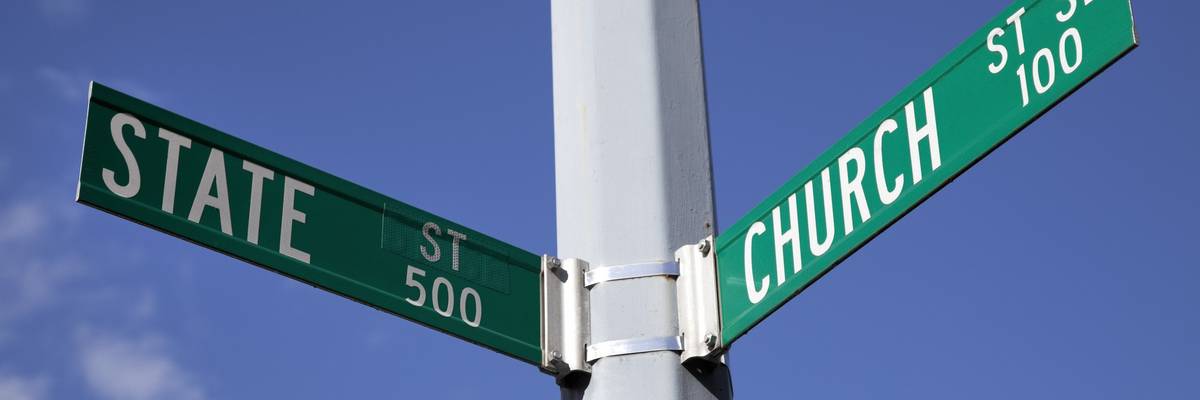
The intersection of Church and State Street in the town of Salem, Oregon.
Religious schools funded by U.S. taxpayer dollars provoke serious concerns.
“One nation, under God . . .”
Interesting addition to the Pledge, considering, you know, the separation of church and state. I actually remember it — it was 1954. I was in third grade, and had been reciting the Pledge with my classmates every morning for several years by then. I thought it was kind of cool, getting to say “God” without swearing.
“The push to add ‘under God’ to the pledge,” according to the History Channel, “gained momentum during the second Red Scare, a period when U.S. politicians were keen to assert the moral superiority of U.S. capitalism over Soviet communism, which many conservatives regarded as ‘godless.’”
The separation of church and state — what a paradox. It makes total sense, of course, considering the hell a state-empowered religion can inflict on “non-believers.” Power corrupts, especially when you stir in a little absolute certainty about the nature of the universe, and who’s boss. The nation’s founders made a good call, pushing religion out of the state houses and into the private domain. One problem: What about values? You know, the deep ones, that give us love and honesty and sacrifice? They’re crucial to a functioning state; they’re crucial to sanity.
And, uh . . . as Ike declared, we’re better than the commies.
A New York Times story got me thinking about all this the other day, seemingly opening up that infamous box Zeus gave Pandora (speaking of religion). Apparently, the state of Oklahoma has crossed the line, approving “what would be the nation’s first religious charter school on Monday, handing a victory to Christian conservatives but opening the door to a constitutional battle over whether taxpayer dollars can directly fund religious schools.”
This now-public school is an online Catholic school, “with religious teachings embedded in the curriculum.”
Is this a bad thing? I am choosing to publicly ponder this, if for no other reason than to open the enormous paradox that is religion and peek inside. Let me start with a personal story. I was 16 years old when I abandoned the Lutheran church, the Protestant faith I was being brought up in. I had recently read Exodus, Leon Uris’s novel about the creation of the state of Israel, and deeply identified with the characters. One problem. They were Jews. Jews aren’t Christians, so they’re going to hell. That’s just the way it is, or at least the way it was then — it’s what I was told in Sunday School.
At the time, no big deal. I didn’t know any Jews, so it was just an abstraction. But the Uris novel changed that. And then, a short while later, I was at my local library and wound up checking out Thomas Paine’s The Age of Reason, which went after Christian certainty with a Deist rationality. I spent all day Saturday in my room, absorbing his words. And on Sunday morning I told my mom: “I’m not going to church today. I’m not a Christian anymore.”
Now comes the hard part. Mom was devastated. She was a loving mom whose own faith — so I learned, many years later — had rescued her from near-psychological collapse during a difficult time in her life. We spent the next year stubbornly at odds with each other, and I deeply upset her again when, on my college application I wrote as my religion: agnostic.
But Mom never stopped loving me and we also went on living our normal lives. I graduated from high school. That summer, the four of us (mom, dad, brother and sister) went on an extended family vacation to Yellowstone National Park — wow! We were, by and large, still a happy family. On the way back to Michigan, we were driving along the Chicago Skyway when — yikes! — radio weather alert. Tornado warning!
There was no tornado; we made it home, went on with our lives. But Mom, who was an English teacher and a writer, sometime later penned an essay about the religious standoff with her son, which wound up being published in a Lutheran publication. I only remember the essay’s final words, but they summarized what I would call a stunning breakthrough about what matters in life. Referencing the tornado warning, she wrote: “Three Christians and one agnostic prayed.”
I believe these words transcend everything that is small and petulant about religion and connect us in all directions. This is not about proper belief but hope and longing in the moment, as we face the unknown. And it implies, in my reading of these words, that we all have a reverence deep within, or what I might call: a soul. And this is what matters.
Can church and state be rejoined, as were mother and son? Perhaps, but only in a state of groping oneness. Consider the civil rights movement, which was empowered by a large religious base but was in no way limited to that base. The value it advanced — trans-racial oneness, full human equality — was a value emerging in the moment, in defiance of a settled, one might say religious, status quo, which had set strict rules about who mattered and who didn’t. The movement expanded our collective awareness. By embracing it, we evolved.
There’s no simple conclusion for me to reach here. Let me merely note: This is not a matter of church vs. state, but of value vs. power. The lust for power may be religious, but it’s not spiritual. Was God added to the Pledge of Allegiance in 1954 to help the United States defeat communism? “One nation, under a nuclear armed God . . .”? If so, God help us.
Dear Common Dreams reader, It’s been nearly 30 years since I co-founded Common Dreams with my late wife, Lina Newhouser. We had the radical notion that journalism should serve the public good, not corporate profits. It was clear to us from the outset what it would take to build such a project. No paid advertisements. No corporate sponsors. No millionaire publisher telling us what to think or do. Many people said we wouldn't last a year, but we proved those doubters wrong. Together with a tremendous team of journalists and dedicated staff, we built an independent media outlet free from the constraints of profits and corporate control. Our mission has always been simple: To inform. To inspire. To ignite change for the common good. Building Common Dreams was not easy. Our survival was never guaranteed. When you take on the most powerful forces—Wall Street greed, fossil fuel industry destruction, Big Tech lobbyists, and uber-rich oligarchs who have spent billions upon billions rigging the economy and democracy in their favor—the only bulwark you have is supporters who believe in your work. But here’s the urgent message from me today. It's never been this bad out there. And it's never been this hard to keep us going. At the very moment Common Dreams is most needed, the threats we face are intensifying. We need your support now more than ever. We don't accept corporate advertising and never will. We don't have a paywall because we don't think people should be blocked from critical news based on their ability to pay. Everything we do is funded by the donations of readers like you. When everyone does the little they can afford, we are strong. But if that support retreats or dries up, so do we. Will you donate now to make sure Common Dreams not only survives but thrives? —Craig Brown, Co-founder |
“One nation, under God . . .”
Interesting addition to the Pledge, considering, you know, the separation of church and state. I actually remember it — it was 1954. I was in third grade, and had been reciting the Pledge with my classmates every morning for several years by then. I thought it was kind of cool, getting to say “God” without swearing.
“The push to add ‘under God’ to the pledge,” according to the History Channel, “gained momentum during the second Red Scare, a period when U.S. politicians were keen to assert the moral superiority of U.S. capitalism over Soviet communism, which many conservatives regarded as ‘godless.’”
The separation of church and state — what a paradox. It makes total sense, of course, considering the hell a state-empowered religion can inflict on “non-believers.” Power corrupts, especially when you stir in a little absolute certainty about the nature of the universe, and who’s boss. The nation’s founders made a good call, pushing religion out of the state houses and into the private domain. One problem: What about values? You know, the deep ones, that give us love and honesty and sacrifice? They’re crucial to a functioning state; they’re crucial to sanity.
And, uh . . . as Ike declared, we’re better than the commies.
A New York Times story got me thinking about all this the other day, seemingly opening up that infamous box Zeus gave Pandora (speaking of religion). Apparently, the state of Oklahoma has crossed the line, approving “what would be the nation’s first religious charter school on Monday, handing a victory to Christian conservatives but opening the door to a constitutional battle over whether taxpayer dollars can directly fund religious schools.”
This now-public school is an online Catholic school, “with religious teachings embedded in the curriculum.”
Is this a bad thing? I am choosing to publicly ponder this, if for no other reason than to open the enormous paradox that is religion and peek inside. Let me start with a personal story. I was 16 years old when I abandoned the Lutheran church, the Protestant faith I was being brought up in. I had recently read Exodus, Leon Uris’s novel about the creation of the state of Israel, and deeply identified with the characters. One problem. They were Jews. Jews aren’t Christians, so they’re going to hell. That’s just the way it is, or at least the way it was then — it’s what I was told in Sunday School.
At the time, no big deal. I didn’t know any Jews, so it was just an abstraction. But the Uris novel changed that. And then, a short while later, I was at my local library and wound up checking out Thomas Paine’s The Age of Reason, which went after Christian certainty with a Deist rationality. I spent all day Saturday in my room, absorbing his words. And on Sunday morning I told my mom: “I’m not going to church today. I’m not a Christian anymore.”
Now comes the hard part. Mom was devastated. She was a loving mom whose own faith — so I learned, many years later — had rescued her from near-psychological collapse during a difficult time in her life. We spent the next year stubbornly at odds with each other, and I deeply upset her again when, on my college application I wrote as my religion: agnostic.
But Mom never stopped loving me and we also went on living our normal lives. I graduated from high school. That summer, the four of us (mom, dad, brother and sister) went on an extended family vacation to Yellowstone National Park — wow! We were, by and large, still a happy family. On the way back to Michigan, we were driving along the Chicago Skyway when — yikes! — radio weather alert. Tornado warning!
There was no tornado; we made it home, went on with our lives. But Mom, who was an English teacher and a writer, sometime later penned an essay about the religious standoff with her son, which wound up being published in a Lutheran publication. I only remember the essay’s final words, but they summarized what I would call a stunning breakthrough about what matters in life. Referencing the tornado warning, she wrote: “Three Christians and one agnostic prayed.”
I believe these words transcend everything that is small and petulant about religion and connect us in all directions. This is not about proper belief but hope and longing in the moment, as we face the unknown. And it implies, in my reading of these words, that we all have a reverence deep within, or what I might call: a soul. And this is what matters.
Can church and state be rejoined, as were mother and son? Perhaps, but only in a state of groping oneness. Consider the civil rights movement, which was empowered by a large religious base but was in no way limited to that base. The value it advanced — trans-racial oneness, full human equality — was a value emerging in the moment, in defiance of a settled, one might say religious, status quo, which had set strict rules about who mattered and who didn’t. The movement expanded our collective awareness. By embracing it, we evolved.
There’s no simple conclusion for me to reach here. Let me merely note: This is not a matter of church vs. state, but of value vs. power. The lust for power may be religious, but it’s not spiritual. Was God added to the Pledge of Allegiance in 1954 to help the United States defeat communism? “One nation, under a nuclear armed God . . .”? If so, God help us.
“One nation, under God . . .”
Interesting addition to the Pledge, considering, you know, the separation of church and state. I actually remember it — it was 1954. I was in third grade, and had been reciting the Pledge with my classmates every morning for several years by then. I thought it was kind of cool, getting to say “God” without swearing.
“The push to add ‘under God’ to the pledge,” according to the History Channel, “gained momentum during the second Red Scare, a period when U.S. politicians were keen to assert the moral superiority of U.S. capitalism over Soviet communism, which many conservatives regarded as ‘godless.’”
The separation of church and state — what a paradox. It makes total sense, of course, considering the hell a state-empowered religion can inflict on “non-believers.” Power corrupts, especially when you stir in a little absolute certainty about the nature of the universe, and who’s boss. The nation’s founders made a good call, pushing religion out of the state houses and into the private domain. One problem: What about values? You know, the deep ones, that give us love and honesty and sacrifice? They’re crucial to a functioning state; they’re crucial to sanity.
And, uh . . . as Ike declared, we’re better than the commies.
A New York Times story got me thinking about all this the other day, seemingly opening up that infamous box Zeus gave Pandora (speaking of religion). Apparently, the state of Oklahoma has crossed the line, approving “what would be the nation’s first religious charter school on Monday, handing a victory to Christian conservatives but opening the door to a constitutional battle over whether taxpayer dollars can directly fund religious schools.”
This now-public school is an online Catholic school, “with religious teachings embedded in the curriculum.”
Is this a bad thing? I am choosing to publicly ponder this, if for no other reason than to open the enormous paradox that is religion and peek inside. Let me start with a personal story. I was 16 years old when I abandoned the Lutheran church, the Protestant faith I was being brought up in. I had recently read Exodus, Leon Uris’s novel about the creation of the state of Israel, and deeply identified with the characters. One problem. They were Jews. Jews aren’t Christians, so they’re going to hell. That’s just the way it is, or at least the way it was then — it’s what I was told in Sunday School.
At the time, no big deal. I didn’t know any Jews, so it was just an abstraction. But the Uris novel changed that. And then, a short while later, I was at my local library and wound up checking out Thomas Paine’s The Age of Reason, which went after Christian certainty with a Deist rationality. I spent all day Saturday in my room, absorbing his words. And on Sunday morning I told my mom: “I’m not going to church today. I’m not a Christian anymore.”
Now comes the hard part. Mom was devastated. She was a loving mom whose own faith — so I learned, many years later — had rescued her from near-psychological collapse during a difficult time in her life. We spent the next year stubbornly at odds with each other, and I deeply upset her again when, on my college application I wrote as my religion: agnostic.
But Mom never stopped loving me and we also went on living our normal lives. I graduated from high school. That summer, the four of us (mom, dad, brother and sister) went on an extended family vacation to Yellowstone National Park — wow! We were, by and large, still a happy family. On the way back to Michigan, we were driving along the Chicago Skyway when — yikes! — radio weather alert. Tornado warning!
There was no tornado; we made it home, went on with our lives. But Mom, who was an English teacher and a writer, sometime later penned an essay about the religious standoff with her son, which wound up being published in a Lutheran publication. I only remember the essay’s final words, but they summarized what I would call a stunning breakthrough about what matters in life. Referencing the tornado warning, she wrote: “Three Christians and one agnostic prayed.”
I believe these words transcend everything that is small and petulant about religion and connect us in all directions. This is not about proper belief but hope and longing in the moment, as we face the unknown. And it implies, in my reading of these words, that we all have a reverence deep within, or what I might call: a soul. And this is what matters.
Can church and state be rejoined, as were mother and son? Perhaps, but only in a state of groping oneness. Consider the civil rights movement, which was empowered by a large religious base but was in no way limited to that base. The value it advanced — trans-racial oneness, full human equality — was a value emerging in the moment, in defiance of a settled, one might say religious, status quo, which had set strict rules about who mattered and who didn’t. The movement expanded our collective awareness. By embracing it, we evolved.
There’s no simple conclusion for me to reach here. Let me merely note: This is not a matter of church vs. state, but of value vs. power. The lust for power may be religious, but it’s not spiritual. Was God added to the Pledge of Allegiance in 1954 to help the United States defeat communism? “One nation, under a nuclear armed God . . .”? If so, God help us.

