SUBSCRIBE TO OUR FREE NEWSLETTER
Daily news & progressive opinion—funded by the people, not the corporations—delivered straight to your inbox.
5
#000000
#FFFFFF
To donate by check, phone, or other method, see our More Ways to Give page.
Daily news & progressive opinion—funded by the people, not the corporations—delivered straight to your inbox.
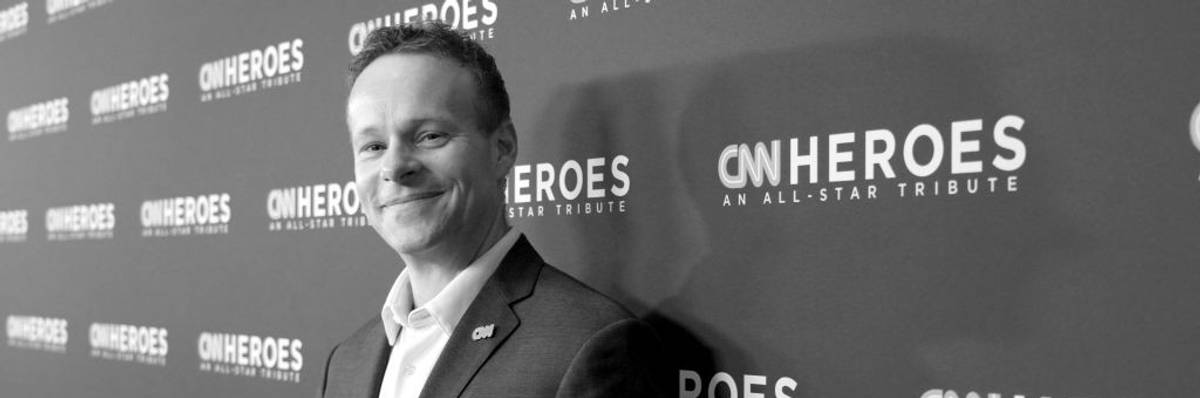
Chris Licht, Chairman and Chief Executive Officer, CNN Worldwide, attends the 16th annual CNN Heroes: An All-Star Tribute at the American Museum of Natural History on December 11, 2022 in New York City.
It's important to understand that Licht’s journalistic perspective is hardly a disqualifier for corporate news leadership; it’s closer to a job requirement.
After less than a year, Warner Bros Discovery has ousted CNN chair and CEO Chris Licht. The move comes after the network has suffered dismal ratings, layoffs, an embarrassing town hall with Donald Trump and, most recently, a withering 15,000-word profile of Licht in the Atlantic (6/2/23).
But don’t hold your breath hoping for a better CNN with Licht’s departure.
Licht was recruited by Warner Bros Discovery CEO David Zaslav after Warner Media merged with Discovery Inc in 2022 to create a new parent company for the network. As FAIR wrote at the time of the merger (2/17/22), libertarian billionaire John Malone, an influential board member and stakeholder at Discovery, had been vocal about his desire to see CNN become more like Fox News. And Zaslav had said he wanted to distinguish CNN from cable news “advocacy networks” (Wall Street Journal, 4/14/22).
After Licht took the helm, he quickly axed the network’s most outspoken Trump critics, including longtime media reporter Brian Stelter—who had also pushed back forcefully and publicly (CNN, 2/7/22) against Malone’s characterizations of CNN as a place that did not “actually have journalists.”
Don’t hold your breath hoping for a better CNN with Licht’s departure.
FAIR (8/25/22) called Licht’s ouster of Stelter and cancellation of his long-running show, Reliable Sources, “the first evidence of a shift away from critical journalism at CNN, at a critical time.”
When Chris Licht told his boss, Stephen Colbert, the host of the CBS program Late Show With Stephen Colbert, in February that he had been offered the chief executive job at CNN, Mr. Colbert was blunt: “Definitely don’t go do that.”
But for Mr. Licht, nothing less than democracy itself was at stake. He argued he could make CNN a news channel that people trusted, as opposed to one that monetized partisan combat.
Licht complained to the Times:
The uninformed vitriol, especially from the left, has been stunning…. Which proves my point: so much of what passes for news is name-calling, half-truths and desperation.
It’s not clear exactly what Licht was referring to, but “name-calling, half-truths and desperation” certainly would seem to be appropriate characterizations of the May event he orchestrated that marked the beginning of the end for his tenure.
With “democracy itself” at stake, Licht decided to give Donald Trump a town hall event stocked with supporters, in which little effort was made to rein in the presidential candidate’s lies and insults. The outcome? As the Atlantic‘s Tim Alberta put it, “The only one who wasn’t angry, it seemed, was Trump, most likely because he’d succeeded in disgracing the network on its own airwaves.”
On the contrary, Licht’s approach to journalism aligns neatly with too many other news execs (and reporters) who see themselves as non-ideological truth-tellers, pushing back against left and right in the service of democracy. (“Democracy Dies in Darkness,” anyone?) Yet they bend over backwards to both-sides every issue and avoid any appearance of anti-Republican bias, while forcefully rejecting what they see as a creeping “wokeism” on the left.
From the Atlantic:
Licht insisted that his media critiques were not ideological; that he was rebuking not a liberal slant on the news, per se, but rather a bias toward elite cultural sensibility, a reporting covenant in which affluent urban-dwelling journalists avoid speaking hard truths that would alienate members of their tribe. When we returned to the question of covering transgender issues—specifically, the science around prepubescent hormone treatments and life-altering surgeries—he suggested that the media was less interested in finding answers and more worried about not offending perceived allies.
“We’ve got to ask tough questions without being shouted down for having the temerity to even ask,” Licht said. “There is a truth in there, and it may not serve one side or the other. But let’s get to the truth. Some of this is right, some of this is wrong; some of this is wrong, some of this is right.”
If Licht’s take sounds familiar, it’s because it’s quite similar to the New York Times publisher A.G. Sulzberger’s defense of his paper’s misleading trans coverage. Sulzberger suggested (CJR, 5/15/23) that the paper’s high-profile articles that boosted misleading anti-trans narratives were likewise getting at what is “true” and “important,” and that “suppressing” unsupported anti-trans viewpoints would make the paper “overtly political.”
He paused. “And I will add, this is where words matter. You immediately force some people to tune out when you use, like, ‘person capable of giving birth.’ People tune out and you lose that trust.” He took another pause. “Do not virtue signal. Tell the truth. Ask questions getting at the truth—not collecting facts for one side or collecting facts for another side. Ask the tough questions. It’s an incredibly sensitive, divisive issue of which there is a Venn diagram that this country can agree on, if we get there with facts.”
Again, Licht echoes Sulzberger. A “greater journalistic risk” than both-sidesing, Sulzberger asserted (CJR, 5/15/23), is “to actively embrace a journalistic one-sideism to signal that they are on the side of the righteous.” Better to include bigoted, false and/or conspiratorial viewpoints, these brave leaders suggest, than to “signal” that you’re taking the other side by excluding them.
Both men seem to believe that, while gaining trust is vital for news outlets, the trust they need to gain is from a sector of the public that supports election lies and conspiracy theories—not the sector deeply skeptical of a corporate media system that found a Trump candidacy “damn good” for their bottom line. And the people with ultimate power in our media system seem more concerned about bigoted victims of criticism than about victims of bigotry.
Licht’s journalistic perspective is hardly a disqualifier for corporate news leadership; it’s closer to a job requirement. As long as corporate media continue to emphasize appearing unbiased against an increasingly radical right, and on being “tough” on the left rather than holding the powerful to account, their purported goals of saving democracy and gaining public trust will both be equally out of reach.
Dear Common Dreams reader, It’s been nearly 30 years since I co-founded Common Dreams with my late wife, Lina Newhouser. We had the radical notion that journalism should serve the public good, not corporate profits. It was clear to us from the outset what it would take to build such a project. No paid advertisements. No corporate sponsors. No millionaire publisher telling us what to think or do. Many people said we wouldn't last a year, but we proved those doubters wrong. Together with a tremendous team of journalists and dedicated staff, we built an independent media outlet free from the constraints of profits and corporate control. Our mission has always been simple: To inform. To inspire. To ignite change for the common good. Building Common Dreams was not easy. Our survival was never guaranteed. When you take on the most powerful forces—Wall Street greed, fossil fuel industry destruction, Big Tech lobbyists, and uber-rich oligarchs who have spent billions upon billions rigging the economy and democracy in their favor—the only bulwark you have is supporters who believe in your work. But here’s the urgent message from me today. It's never been this bad out there. And it's never been this hard to keep us going. At the very moment Common Dreams is most needed, the threats we face are intensifying. We need your support now more than ever. We don't accept corporate advertising and never will. We don't have a paywall because we don't think people should be blocked from critical news based on their ability to pay. Everything we do is funded by the donations of readers like you. When everyone does the little they can afford, we are strong. But if that support retreats or dries up, so do we. Will you donate now to make sure Common Dreams not only survives but thrives? —Craig Brown, Co-founder |
After less than a year, Warner Bros Discovery has ousted CNN chair and CEO Chris Licht. The move comes after the network has suffered dismal ratings, layoffs, an embarrassing town hall with Donald Trump and, most recently, a withering 15,000-word profile of Licht in the Atlantic (6/2/23).
But don’t hold your breath hoping for a better CNN with Licht’s departure.
Licht was recruited by Warner Bros Discovery CEO David Zaslav after Warner Media merged with Discovery Inc in 2022 to create a new parent company for the network. As FAIR wrote at the time of the merger (2/17/22), libertarian billionaire John Malone, an influential board member and stakeholder at Discovery, had been vocal about his desire to see CNN become more like Fox News. And Zaslav had said he wanted to distinguish CNN from cable news “advocacy networks” (Wall Street Journal, 4/14/22).
After Licht took the helm, he quickly axed the network’s most outspoken Trump critics, including longtime media reporter Brian Stelter—who had also pushed back forcefully and publicly (CNN, 2/7/22) against Malone’s characterizations of CNN as a place that did not “actually have journalists.”
Don’t hold your breath hoping for a better CNN with Licht’s departure.
FAIR (8/25/22) called Licht’s ouster of Stelter and cancellation of his long-running show, Reliable Sources, “the first evidence of a shift away from critical journalism at CNN, at a critical time.”
When Chris Licht told his boss, Stephen Colbert, the host of the CBS program Late Show With Stephen Colbert, in February that he had been offered the chief executive job at CNN, Mr. Colbert was blunt: “Definitely don’t go do that.”
But for Mr. Licht, nothing less than democracy itself was at stake. He argued he could make CNN a news channel that people trusted, as opposed to one that monetized partisan combat.
Licht complained to the Times:
The uninformed vitriol, especially from the left, has been stunning…. Which proves my point: so much of what passes for news is name-calling, half-truths and desperation.
It’s not clear exactly what Licht was referring to, but “name-calling, half-truths and desperation” certainly would seem to be appropriate characterizations of the May event he orchestrated that marked the beginning of the end for his tenure.
With “democracy itself” at stake, Licht decided to give Donald Trump a town hall event stocked with supporters, in which little effort was made to rein in the presidential candidate’s lies and insults. The outcome? As the Atlantic‘s Tim Alberta put it, “The only one who wasn’t angry, it seemed, was Trump, most likely because he’d succeeded in disgracing the network on its own airwaves.”
On the contrary, Licht’s approach to journalism aligns neatly with too many other news execs (and reporters) who see themselves as non-ideological truth-tellers, pushing back against left and right in the service of democracy. (“Democracy Dies in Darkness,” anyone?) Yet they bend over backwards to both-sides every issue and avoid any appearance of anti-Republican bias, while forcefully rejecting what they see as a creeping “wokeism” on the left.
From the Atlantic:
Licht insisted that his media critiques were not ideological; that he was rebuking not a liberal slant on the news, per se, but rather a bias toward elite cultural sensibility, a reporting covenant in which affluent urban-dwelling journalists avoid speaking hard truths that would alienate members of their tribe. When we returned to the question of covering transgender issues—specifically, the science around prepubescent hormone treatments and life-altering surgeries—he suggested that the media was less interested in finding answers and more worried about not offending perceived allies.
“We’ve got to ask tough questions without being shouted down for having the temerity to even ask,” Licht said. “There is a truth in there, and it may not serve one side or the other. But let’s get to the truth. Some of this is right, some of this is wrong; some of this is wrong, some of this is right.”
If Licht’s take sounds familiar, it’s because it’s quite similar to the New York Times publisher A.G. Sulzberger’s defense of his paper’s misleading trans coverage. Sulzberger suggested (CJR, 5/15/23) that the paper’s high-profile articles that boosted misleading anti-trans narratives were likewise getting at what is “true” and “important,” and that “suppressing” unsupported anti-trans viewpoints would make the paper “overtly political.”
He paused. “And I will add, this is where words matter. You immediately force some people to tune out when you use, like, ‘person capable of giving birth.’ People tune out and you lose that trust.” He took another pause. “Do not virtue signal. Tell the truth. Ask questions getting at the truth—not collecting facts for one side or collecting facts for another side. Ask the tough questions. It’s an incredibly sensitive, divisive issue of which there is a Venn diagram that this country can agree on, if we get there with facts.”
Again, Licht echoes Sulzberger. A “greater journalistic risk” than both-sidesing, Sulzberger asserted (CJR, 5/15/23), is “to actively embrace a journalistic one-sideism to signal that they are on the side of the righteous.” Better to include bigoted, false and/or conspiratorial viewpoints, these brave leaders suggest, than to “signal” that you’re taking the other side by excluding them.
Both men seem to believe that, while gaining trust is vital for news outlets, the trust they need to gain is from a sector of the public that supports election lies and conspiracy theories—not the sector deeply skeptical of a corporate media system that found a Trump candidacy “damn good” for their bottom line. And the people with ultimate power in our media system seem more concerned about bigoted victims of criticism than about victims of bigotry.
Licht’s journalistic perspective is hardly a disqualifier for corporate news leadership; it’s closer to a job requirement. As long as corporate media continue to emphasize appearing unbiased against an increasingly radical right, and on being “tough” on the left rather than holding the powerful to account, their purported goals of saving democracy and gaining public trust will both be equally out of reach.
After less than a year, Warner Bros Discovery has ousted CNN chair and CEO Chris Licht. The move comes after the network has suffered dismal ratings, layoffs, an embarrassing town hall with Donald Trump and, most recently, a withering 15,000-word profile of Licht in the Atlantic (6/2/23).
But don’t hold your breath hoping for a better CNN with Licht’s departure.
Licht was recruited by Warner Bros Discovery CEO David Zaslav after Warner Media merged with Discovery Inc in 2022 to create a new parent company for the network. As FAIR wrote at the time of the merger (2/17/22), libertarian billionaire John Malone, an influential board member and stakeholder at Discovery, had been vocal about his desire to see CNN become more like Fox News. And Zaslav had said he wanted to distinguish CNN from cable news “advocacy networks” (Wall Street Journal, 4/14/22).
After Licht took the helm, he quickly axed the network’s most outspoken Trump critics, including longtime media reporter Brian Stelter—who had also pushed back forcefully and publicly (CNN, 2/7/22) against Malone’s characterizations of CNN as a place that did not “actually have journalists.”
Don’t hold your breath hoping for a better CNN with Licht’s departure.
FAIR (8/25/22) called Licht’s ouster of Stelter and cancellation of his long-running show, Reliable Sources, “the first evidence of a shift away from critical journalism at CNN, at a critical time.”
When Chris Licht told his boss, Stephen Colbert, the host of the CBS program Late Show With Stephen Colbert, in February that he had been offered the chief executive job at CNN, Mr. Colbert was blunt: “Definitely don’t go do that.”
But for Mr. Licht, nothing less than democracy itself was at stake. He argued he could make CNN a news channel that people trusted, as opposed to one that monetized partisan combat.
Licht complained to the Times:
The uninformed vitriol, especially from the left, has been stunning…. Which proves my point: so much of what passes for news is name-calling, half-truths and desperation.
It’s not clear exactly what Licht was referring to, but “name-calling, half-truths and desperation” certainly would seem to be appropriate characterizations of the May event he orchestrated that marked the beginning of the end for his tenure.
With “democracy itself” at stake, Licht decided to give Donald Trump a town hall event stocked with supporters, in which little effort was made to rein in the presidential candidate’s lies and insults. The outcome? As the Atlantic‘s Tim Alberta put it, “The only one who wasn’t angry, it seemed, was Trump, most likely because he’d succeeded in disgracing the network on its own airwaves.”
On the contrary, Licht’s approach to journalism aligns neatly with too many other news execs (and reporters) who see themselves as non-ideological truth-tellers, pushing back against left and right in the service of democracy. (“Democracy Dies in Darkness,” anyone?) Yet they bend over backwards to both-sides every issue and avoid any appearance of anti-Republican bias, while forcefully rejecting what they see as a creeping “wokeism” on the left.
From the Atlantic:
Licht insisted that his media critiques were not ideological; that he was rebuking not a liberal slant on the news, per se, but rather a bias toward elite cultural sensibility, a reporting covenant in which affluent urban-dwelling journalists avoid speaking hard truths that would alienate members of their tribe. When we returned to the question of covering transgender issues—specifically, the science around prepubescent hormone treatments and life-altering surgeries—he suggested that the media was less interested in finding answers and more worried about not offending perceived allies.
“We’ve got to ask tough questions without being shouted down for having the temerity to even ask,” Licht said. “There is a truth in there, and it may not serve one side or the other. But let’s get to the truth. Some of this is right, some of this is wrong; some of this is wrong, some of this is right.”
If Licht’s take sounds familiar, it’s because it’s quite similar to the New York Times publisher A.G. Sulzberger’s defense of his paper’s misleading trans coverage. Sulzberger suggested (CJR, 5/15/23) that the paper’s high-profile articles that boosted misleading anti-trans narratives were likewise getting at what is “true” and “important,” and that “suppressing” unsupported anti-trans viewpoints would make the paper “overtly political.”
He paused. “And I will add, this is where words matter. You immediately force some people to tune out when you use, like, ‘person capable of giving birth.’ People tune out and you lose that trust.” He took another pause. “Do not virtue signal. Tell the truth. Ask questions getting at the truth—not collecting facts for one side or collecting facts for another side. Ask the tough questions. It’s an incredibly sensitive, divisive issue of which there is a Venn diagram that this country can agree on, if we get there with facts.”
Again, Licht echoes Sulzberger. A “greater journalistic risk” than both-sidesing, Sulzberger asserted (CJR, 5/15/23), is “to actively embrace a journalistic one-sideism to signal that they are on the side of the righteous.” Better to include bigoted, false and/or conspiratorial viewpoints, these brave leaders suggest, than to “signal” that you’re taking the other side by excluding them.
Both men seem to believe that, while gaining trust is vital for news outlets, the trust they need to gain is from a sector of the public that supports election lies and conspiracy theories—not the sector deeply skeptical of a corporate media system that found a Trump candidacy “damn good” for their bottom line. And the people with ultimate power in our media system seem more concerned about bigoted victims of criticism than about victims of bigotry.
Licht’s journalistic perspective is hardly a disqualifier for corporate news leadership; it’s closer to a job requirement. As long as corporate media continue to emphasize appearing unbiased against an increasingly radical right, and on being “tough” on the left rather than holding the powerful to account, their purported goals of saving democracy and gaining public trust will both be equally out of reach.