SUBSCRIBE TO OUR FREE NEWSLETTER
Daily news & progressive opinion—funded by the people, not the corporations—delivered straight to your inbox.
5
#000000
#FFFFFF
To donate by check, phone, or other method, see our More Ways to Give page.
Daily news & progressive opinion—funded by the people, not the corporations—delivered straight to your inbox.
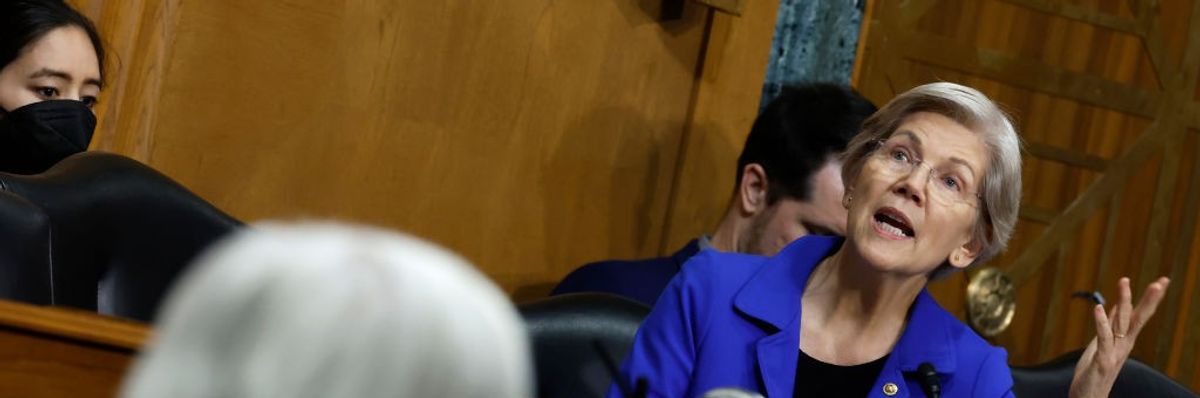
Senate Finance Committee member Sen. Elizabeth Warren (D-MA) questions U.S. Treasury Secretary Janet Yellen during a hearing about the Biden Administration's FY2024 federal budget proposal before the committee in the Dirksen Senate Office Building on Capitol Hill on March 16, 2023 in Washington, DC.
As the song goes, 'Something's got to give.' What will it be?
I hadn't intended to spend so much time this week on the banking crisis. I'm old enough to remember a time when banking was boring. But since the 1980s, banking has become hugely profitable for bankers and wildly dangerous for the rest of the economy. This week shows why.
At this moment, the Federal Reserve Bank is sitting on the horns of a dilemma.
On one horn are legitimate fears that smaller banks won't have enough capital to meet their depositors' needs if the Fed continues to raise interest rates when it meets next week.
Raising rates will slow the economy and possibly imperil banks—especially those that used depositors' money to purchase long-term bonds when interest rates were lower, as did Silicon Valley Bank.
In other words, raising interest rates next week could cause an even bigger run on the banks.
Besides, inflation is receding, albeit slowly. So why take the risk?
But on the other horn are the Fed's legitimate fears about inflation becoming entrenched in the economy, requiring more interest rate hikes.
But the two objectives—avoiding a bank run and raising rates—are in conflict. As the song goes, Something's got to give. What will it be?
On top of this, 11 of America's biggest banks yesterday agreed to contribute a total of $30 billion to prop up First Republic Bank, another smaller bank caught in the turmoil. This "show of support" (as it was billed, without irony) elicited a cheer from the Fed's Jerome Powell and Treasury Secretary Janet Yellen, who called it "most welcome." (Of course it was welcome. They probably organized it.)
But consumers and depositors are still worried.
Meanwhile, on the other side of the Atlantic, the European Central Bank has raised interest rates by half a percentage point, saying it's as committed as ever to fighting inflation.
Yet rising interest rates are shaking banks in Europe as well. Just hours before the European Central Bank's announcement, the banking giant Credit Suisse got a $54 billion lifeline from Switzerland's central bank.
The financial system is facing a crisis of confidence. Finance ultimately depends on confidence—confidence that prices are under control, and confidence that banks are sound.
But ever since the near meltdown of Wall Street in 2008, followed by the milquetoast Dodd-Frank regulation of 2010 and the awful 2018 law exempting smaller banks, confidence in America's banks has been shaky.
November's revelation that the bitcoin giant FTX was nothing but a Ponzi scheme has contributed to the fears. Where were the regulators? Last Friday's revelation that Silicon Valley Bank didn't have enough capital to pay its depositors has added to the anxieties. Where were the regulators?
Credit Suisse has been battered by years of mistakes and controversies. It is now on its third CEO in three years. Why? Swiss banking regulations are notoriously lax, but American bankers have also pushed Europeans to relax their financial regulations, setting off a race to the bottom where the only winners are the bankers. As Lloyd Blankfein, then CEO of Goldman Sachs, warned Europeans, "operations can be moved globally and capital can be accessed globally."
One advantage of being a bank (whether headquartered in Silicon Valley or Switzerland) is you get bailed out when you make dumb bets. Another is you can choose where around the world to make dumb bets. Which is why central banks and bank regulators around the world must coordinate with each other to ensure that instead of a race to the bottom, it's a race to protect the public.
**
Banking is a confidence game. If the public loses confidence in banks, the financial system can't function.
In the Panic of 1907, when major New York banks were heading toward bankruptcy, Secretary of the Treasury George B. Cortelyou deposited $35 million of federal money in the banks. It was one of the earliest bank bailouts, designed to restore confidence.
But it wasn't enough. J.P. Morgan (the man who founded the bank) organized the nation's leading financiers to devise a private bailout of the banks, analogous to yesterday's. They redirected money between banks, secured further international lines of credit, and bought up the plummeting stocks of healthy corporations.
Confidence was restored, but the underlying weaknesses of the financial system remained. Those weaknesses became painfully and irrevocably apparent in the Great Crash of 1929.
Dear Common Dreams reader, It’s been nearly 30 years since I co-founded Common Dreams with my late wife, Lina Newhouser. We had the radical notion that journalism should serve the public good, not corporate profits. It was clear to us from the outset what it would take to build such a project. No paid advertisements. No corporate sponsors. No millionaire publisher telling us what to think or do. Many people said we wouldn't last a year, but we proved those doubters wrong. Together with a tremendous team of journalists and dedicated staff, we built an independent media outlet free from the constraints of profits and corporate control. Our mission has always been simple: To inform. To inspire. To ignite change for the common good. Building Common Dreams was not easy. Our survival was never guaranteed. When you take on the most powerful forces—Wall Street greed, fossil fuel industry destruction, Big Tech lobbyists, and uber-rich oligarchs who have spent billions upon billions rigging the economy and democracy in their favor—the only bulwark you have is supporters who believe in your work. But here’s the urgent message from me today. It's never been this bad out there. And it's never been this hard to keep us going. At the very moment Common Dreams is most needed, the threats we face are intensifying. We need your support now more than ever. We don't accept corporate advertising and never will. We don't have a paywall because we don't think people should be blocked from critical news based on their ability to pay. Everything we do is funded by the donations of readers like you. When everyone does the little they can afford, we are strong. But if that support retreats or dries up, so do we. Will you donate now to make sure Common Dreams not only survives but thrives? —Craig Brown, Co-founder |
I hadn't intended to spend so much time this week on the banking crisis. I'm old enough to remember a time when banking was boring. But since the 1980s, banking has become hugely profitable for bankers and wildly dangerous for the rest of the economy. This week shows why.
At this moment, the Federal Reserve Bank is sitting on the horns of a dilemma.
On one horn are legitimate fears that smaller banks won't have enough capital to meet their depositors' needs if the Fed continues to raise interest rates when it meets next week.
Raising rates will slow the economy and possibly imperil banks—especially those that used depositors' money to purchase long-term bonds when interest rates were lower, as did Silicon Valley Bank.
In other words, raising interest rates next week could cause an even bigger run on the banks.
Besides, inflation is receding, albeit slowly. So why take the risk?
But on the other horn are the Fed's legitimate fears about inflation becoming entrenched in the economy, requiring more interest rate hikes.
But the two objectives—avoiding a bank run and raising rates—are in conflict. As the song goes, Something's got to give. What will it be?
On top of this, 11 of America's biggest banks yesterday agreed to contribute a total of $30 billion to prop up First Republic Bank, another smaller bank caught in the turmoil. This "show of support" (as it was billed, without irony) elicited a cheer from the Fed's Jerome Powell and Treasury Secretary Janet Yellen, who called it "most welcome." (Of course it was welcome. They probably organized it.)
But consumers and depositors are still worried.
Meanwhile, on the other side of the Atlantic, the European Central Bank has raised interest rates by half a percentage point, saying it's as committed as ever to fighting inflation.
Yet rising interest rates are shaking banks in Europe as well. Just hours before the European Central Bank's announcement, the banking giant Credit Suisse got a $54 billion lifeline from Switzerland's central bank.
The financial system is facing a crisis of confidence. Finance ultimately depends on confidence—confidence that prices are under control, and confidence that banks are sound.
But ever since the near meltdown of Wall Street in 2008, followed by the milquetoast Dodd-Frank regulation of 2010 and the awful 2018 law exempting smaller banks, confidence in America's banks has been shaky.
November's revelation that the bitcoin giant FTX was nothing but a Ponzi scheme has contributed to the fears. Where were the regulators? Last Friday's revelation that Silicon Valley Bank didn't have enough capital to pay its depositors has added to the anxieties. Where were the regulators?
Credit Suisse has been battered by years of mistakes and controversies. It is now on its third CEO in three years. Why? Swiss banking regulations are notoriously lax, but American bankers have also pushed Europeans to relax their financial regulations, setting off a race to the bottom where the only winners are the bankers. As Lloyd Blankfein, then CEO of Goldman Sachs, warned Europeans, "operations can be moved globally and capital can be accessed globally."
One advantage of being a bank (whether headquartered in Silicon Valley or Switzerland) is you get bailed out when you make dumb bets. Another is you can choose where around the world to make dumb bets. Which is why central banks and bank regulators around the world must coordinate with each other to ensure that instead of a race to the bottom, it's a race to protect the public.
**
Banking is a confidence game. If the public loses confidence in banks, the financial system can't function.
In the Panic of 1907, when major New York banks were heading toward bankruptcy, Secretary of the Treasury George B. Cortelyou deposited $35 million of federal money in the banks. It was one of the earliest bank bailouts, designed to restore confidence.
But it wasn't enough. J.P. Morgan (the man who founded the bank) organized the nation's leading financiers to devise a private bailout of the banks, analogous to yesterday's. They redirected money between banks, secured further international lines of credit, and bought up the plummeting stocks of healthy corporations.
Confidence was restored, but the underlying weaknesses of the financial system remained. Those weaknesses became painfully and irrevocably apparent in the Great Crash of 1929.
I hadn't intended to spend so much time this week on the banking crisis. I'm old enough to remember a time when banking was boring. But since the 1980s, banking has become hugely profitable for bankers and wildly dangerous for the rest of the economy. This week shows why.
At this moment, the Federal Reserve Bank is sitting on the horns of a dilemma.
On one horn are legitimate fears that smaller banks won't have enough capital to meet their depositors' needs if the Fed continues to raise interest rates when it meets next week.
Raising rates will slow the economy and possibly imperil banks—especially those that used depositors' money to purchase long-term bonds when interest rates were lower, as did Silicon Valley Bank.
In other words, raising interest rates next week could cause an even bigger run on the banks.
Besides, inflation is receding, albeit slowly. So why take the risk?
But on the other horn are the Fed's legitimate fears about inflation becoming entrenched in the economy, requiring more interest rate hikes.
But the two objectives—avoiding a bank run and raising rates—are in conflict. As the song goes, Something's got to give. What will it be?
On top of this, 11 of America's biggest banks yesterday agreed to contribute a total of $30 billion to prop up First Republic Bank, another smaller bank caught in the turmoil. This "show of support" (as it was billed, without irony) elicited a cheer from the Fed's Jerome Powell and Treasury Secretary Janet Yellen, who called it "most welcome." (Of course it was welcome. They probably organized it.)
But consumers and depositors are still worried.
Meanwhile, on the other side of the Atlantic, the European Central Bank has raised interest rates by half a percentage point, saying it's as committed as ever to fighting inflation.
Yet rising interest rates are shaking banks in Europe as well. Just hours before the European Central Bank's announcement, the banking giant Credit Suisse got a $54 billion lifeline from Switzerland's central bank.
The financial system is facing a crisis of confidence. Finance ultimately depends on confidence—confidence that prices are under control, and confidence that banks are sound.
But ever since the near meltdown of Wall Street in 2008, followed by the milquetoast Dodd-Frank regulation of 2010 and the awful 2018 law exempting smaller banks, confidence in America's banks has been shaky.
November's revelation that the bitcoin giant FTX was nothing but a Ponzi scheme has contributed to the fears. Where were the regulators? Last Friday's revelation that Silicon Valley Bank didn't have enough capital to pay its depositors has added to the anxieties. Where were the regulators?
Credit Suisse has been battered by years of mistakes and controversies. It is now on its third CEO in three years. Why? Swiss banking regulations are notoriously lax, but American bankers have also pushed Europeans to relax their financial regulations, setting off a race to the bottom where the only winners are the bankers. As Lloyd Blankfein, then CEO of Goldman Sachs, warned Europeans, "operations can be moved globally and capital can be accessed globally."
One advantage of being a bank (whether headquartered in Silicon Valley or Switzerland) is you get bailed out when you make dumb bets. Another is you can choose where around the world to make dumb bets. Which is why central banks and bank regulators around the world must coordinate with each other to ensure that instead of a race to the bottom, it's a race to protect the public.
**
Banking is a confidence game. If the public loses confidence in banks, the financial system can't function.
In the Panic of 1907, when major New York banks were heading toward bankruptcy, Secretary of the Treasury George B. Cortelyou deposited $35 million of federal money in the banks. It was one of the earliest bank bailouts, designed to restore confidence.
But it wasn't enough. J.P. Morgan (the man who founded the bank) organized the nation's leading financiers to devise a private bailout of the banks, analogous to yesterday's. They redirected money between banks, secured further international lines of credit, and bought up the plummeting stocks of healthy corporations.
Confidence was restored, but the underlying weaknesses of the financial system remained. Those weaknesses became painfully and irrevocably apparent in the Great Crash of 1929.