SUBSCRIBE TO OUR FREE NEWSLETTER
Daily news & progressive opinion—funded by the people, not the corporations—delivered straight to your inbox.
5
#000000
#FFFFFF
To donate by check, phone, or other method, see our More Ways to Give page.
Daily news & progressive opinion—funded by the people, not the corporations—delivered straight to your inbox.
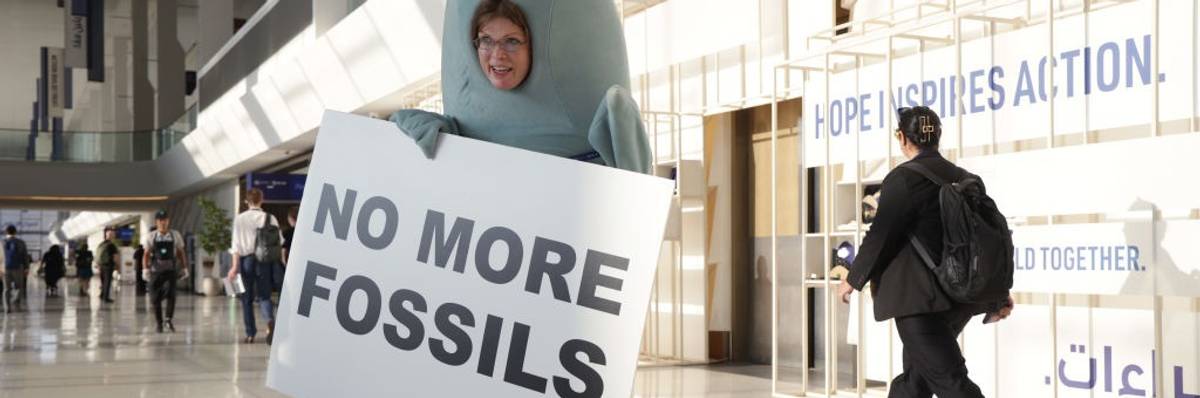
An environmental activist dressed as a dugong, a sea creature native to the United Arab Emirates, holds a sign that reads: "No More Fossils" in one of the plenary venues on day four of the UNFCCC COP28 Climate Conference at Expo City Dubai on December 03, 2023 in Dubai, United Arab Emirates.
The point of climate negotiations should not be to produce a deal, it’s to stop the flow of greenhouse gases into the atmosphere. And that means a full phaseout of fossil fuels.
U.N. Secretary General Antonio Guterres has been, for several years now, tied with Greta Thunberg as the most outspoken global leader in his attacks on the fossil fuel industry. (He memorably told oil industry executives, for instance, that “your core product is our core problem.”) And his introductory remarks at COP 28 this week were no exception.
“Earth’s vital signs are failing,” said the man with the best mandate to actually speak for the Earth. “Record emissions, ferocious fires, deadly droughts and the hottest year ever.”
But when he got to specifics, Guterres was even more on point. “The science is clear,” he said. “We must accelerate a just, equitable transition to renewables.”
“The 1.5-degree limit is only possible if we ultimately stop burning all fossil fuels.
Not reduce.
Not abate.
Phaseout – with a clear timeframe aligned with 1.5 degrees”
I want to focus on one word in that litany: “abate.”
What Guterres is trying to head off is the fossil fuel industry scam de jour decade. It’s abundantly clear that coal, oil and gas are breaking the climate system; it’s also abundantly clear that the people who own coal, oil and gas reserves don’t care. In an effort to keep burning them, so they can continue to collect the returns, they propose building vast engineering projects alongside fossil-fuel generating plants, to capture the carbon dioxide from the exhaust stream. That is, they want to “abate” the damage of their product.
Activists have been demanding a fossil fuel phase out, but the power brokers—U.S. climate envoy John Kerry chief among them—have been offering instead a phaseout of “unabated” fossil fuel.
It doesn’t really work—one attempt after another has been abandoned, and Stanford’s Mark Jacobson has shown why in a series of seminal papers. As the New York Times explained earlier this year, “after taking into account the energy used to capture and isolate CO2 from flue gas at a fossil fuel-burning industrial plant, the carbon capture system would reduce the plant’s net emissions by only 10 to 11 percent, not the estimated 80 to 90 percent cited by proponents.”
But even if you could physically make it work it would still be absurd, at least on our planet, which in 2023 has figured out how to cheaply capture the power of the sun to produce energy. If coal or gas-fired power is already considerably more expensive than solar energy, imagine what happens to that cost differential if you add an enormous complex of pipes and pumps to take the co2 and pump it off to some abandoned salt mine for storage.
In fact, the cost of doing this is so prohibitive that no coal or oil or gas company or utility wants to pay for it themselves—instead, they use their political power to make taxpayers foot the bill, so they can keep selling their product. In order to secure Joe Manchin’s vote for the Inflation Reduction Act, Biden had to lard it with billions of dollars in funding for this particular boondoggle.
And now the industry is using COP28 to try and enshrine this escape hatch permanently. Activists have been demanding a fossil fuel phase out, but the power brokers—U.S. climate envoy John Kerry chief among them—have been offering instead a phaseout of “unabated” fossil fuel. In April, as Reuters reported, “the Group of Seven industrialized nations, which includes the United States, agreed to speed up the "phase-out of unabated fossil fuels," and four days ago he repeated the phrase, saying this time he had China on board with the plan. Yesterday he took to X (the '“go fuck yourself” platform) to boast about joining an alliance to phase out “unabated coal use.”
In a rational world—one where political power was not determinative—we’d be spending every penny we had on solar panels, wind turbines, and batteries.
Jeremy Symons, the veteran energy analyst, has an important short essay this week pointing out that this endless sucking up to fossil fuel is enshrined in the whole climate negotiation process, ever since its first iteration at Rio in 1992 when delegates “described ‘fossil fuel production, use and exportation’ as an economic necessity. That unworkable deal has mapped the course of ineffectual climate talks for the past three decades. Lofty climate ambitions could be announced as long as the agreements do not interfere with the fossil fuel industries at the heart of the problem.” As Politico makes clear in a recent essay, Sultan Al-Jaber’s “leadership” of the talks has had no more important backer than Kerry.
One sympathizes with the former Secretary of State, at least to a degree. He’s trying to swing a deal that can include powers like the UAE, the Saudis, and the United States, all places where Big Oil is immensely politically powerful. But the deal’s not worth it if it sets us on a path of pretending we can economically capture the emissions from these fossil fuels. In a rational world—one where political power was not determinative—we’d be spending every penny we had on solar panels, wind turbines, and batteries. Because they’re cheap, and because they don’t produce emissions that you then have to pretend you’re capturing.
The point of the COP—the point of all climate efforts—should not be to produce a deal. Let me repeat myself. The point of climate negotiations should not be to produce a deal, no matter how many pixels are spilled about that prospect over the next two weeks. It’s to stop the flow of greenhouse gases into the atmosphere. And Guterres is right: there’s one way to do that, and it’s renewable energy. Phase out fossil fuels period, and stat.
Everything else is just smoke.
Dear Common Dreams reader, It’s been nearly 30 years since I co-founded Common Dreams with my late wife, Lina Newhouser. We had the radical notion that journalism should serve the public good, not corporate profits. It was clear to us from the outset what it would take to build such a project. No paid advertisements. No corporate sponsors. No millionaire publisher telling us what to think or do. Many people said we wouldn't last a year, but we proved those doubters wrong. Together with a tremendous team of journalists and dedicated staff, we built an independent media outlet free from the constraints of profits and corporate control. Our mission has always been simple: To inform. To inspire. To ignite change for the common good. Building Common Dreams was not easy. Our survival was never guaranteed. When you take on the most powerful forces—Wall Street greed, fossil fuel industry destruction, Big Tech lobbyists, and uber-rich oligarchs who have spent billions upon billions rigging the economy and democracy in their favor—the only bulwark you have is supporters who believe in your work. But here’s the urgent message from me today. It's never been this bad out there. And it's never been this hard to keep us going. At the very moment Common Dreams is most needed, the threats we face are intensifying. We need your support now more than ever. We don't accept corporate advertising and never will. We don't have a paywall because we don't think people should be blocked from critical news based on their ability to pay. Everything we do is funded by the donations of readers like you. When everyone does the little they can afford, we are strong. But if that support retreats or dries up, so do we. Will you donate now to make sure Common Dreams not only survives but thrives? —Craig Brown, Co-founder |
U.N. Secretary General Antonio Guterres has been, for several years now, tied with Greta Thunberg as the most outspoken global leader in his attacks on the fossil fuel industry. (He memorably told oil industry executives, for instance, that “your core product is our core problem.”) And his introductory remarks at COP 28 this week were no exception.
“Earth’s vital signs are failing,” said the man with the best mandate to actually speak for the Earth. “Record emissions, ferocious fires, deadly droughts and the hottest year ever.”
But when he got to specifics, Guterres was even more on point. “The science is clear,” he said. “We must accelerate a just, equitable transition to renewables.”
“The 1.5-degree limit is only possible if we ultimately stop burning all fossil fuels.
Not reduce.
Not abate.
Phaseout – with a clear timeframe aligned with 1.5 degrees”
I want to focus on one word in that litany: “abate.”
What Guterres is trying to head off is the fossil fuel industry scam de jour decade. It’s abundantly clear that coal, oil and gas are breaking the climate system; it’s also abundantly clear that the people who own coal, oil and gas reserves don’t care. In an effort to keep burning them, so they can continue to collect the returns, they propose building vast engineering projects alongside fossil-fuel generating plants, to capture the carbon dioxide from the exhaust stream. That is, they want to “abate” the damage of their product.
Activists have been demanding a fossil fuel phase out, but the power brokers—U.S. climate envoy John Kerry chief among them—have been offering instead a phaseout of “unabated” fossil fuel.
It doesn’t really work—one attempt after another has been abandoned, and Stanford’s Mark Jacobson has shown why in a series of seminal papers. As the New York Times explained earlier this year, “after taking into account the energy used to capture and isolate CO2 from flue gas at a fossil fuel-burning industrial plant, the carbon capture system would reduce the plant’s net emissions by only 10 to 11 percent, not the estimated 80 to 90 percent cited by proponents.”
But even if you could physically make it work it would still be absurd, at least on our planet, which in 2023 has figured out how to cheaply capture the power of the sun to produce energy. If coal or gas-fired power is already considerably more expensive than solar energy, imagine what happens to that cost differential if you add an enormous complex of pipes and pumps to take the co2 and pump it off to some abandoned salt mine for storage.
In fact, the cost of doing this is so prohibitive that no coal or oil or gas company or utility wants to pay for it themselves—instead, they use their political power to make taxpayers foot the bill, so they can keep selling their product. In order to secure Joe Manchin’s vote for the Inflation Reduction Act, Biden had to lard it with billions of dollars in funding for this particular boondoggle.
And now the industry is using COP28 to try and enshrine this escape hatch permanently. Activists have been demanding a fossil fuel phase out, but the power brokers—U.S. climate envoy John Kerry chief among them—have been offering instead a phaseout of “unabated” fossil fuel. In April, as Reuters reported, “the Group of Seven industrialized nations, which includes the United States, agreed to speed up the "phase-out of unabated fossil fuels," and four days ago he repeated the phrase, saying this time he had China on board with the plan. Yesterday he took to X (the '“go fuck yourself” platform) to boast about joining an alliance to phase out “unabated coal use.”
In a rational world—one where political power was not determinative—we’d be spending every penny we had on solar panels, wind turbines, and batteries.
Jeremy Symons, the veteran energy analyst, has an important short essay this week pointing out that this endless sucking up to fossil fuel is enshrined in the whole climate negotiation process, ever since its first iteration at Rio in 1992 when delegates “described ‘fossil fuel production, use and exportation’ as an economic necessity. That unworkable deal has mapped the course of ineffectual climate talks for the past three decades. Lofty climate ambitions could be announced as long as the agreements do not interfere with the fossil fuel industries at the heart of the problem.” As Politico makes clear in a recent essay, Sultan Al-Jaber’s “leadership” of the talks has had no more important backer than Kerry.
One sympathizes with the former Secretary of State, at least to a degree. He’s trying to swing a deal that can include powers like the UAE, the Saudis, and the United States, all places where Big Oil is immensely politically powerful. But the deal’s not worth it if it sets us on a path of pretending we can economically capture the emissions from these fossil fuels. In a rational world—one where political power was not determinative—we’d be spending every penny we had on solar panels, wind turbines, and batteries. Because they’re cheap, and because they don’t produce emissions that you then have to pretend you’re capturing.
The point of the COP—the point of all climate efforts—should not be to produce a deal. Let me repeat myself. The point of climate negotiations should not be to produce a deal, no matter how many pixels are spilled about that prospect over the next two weeks. It’s to stop the flow of greenhouse gases into the atmosphere. And Guterres is right: there’s one way to do that, and it’s renewable energy. Phase out fossil fuels period, and stat.
Everything else is just smoke.
U.N. Secretary General Antonio Guterres has been, for several years now, tied with Greta Thunberg as the most outspoken global leader in his attacks on the fossil fuel industry. (He memorably told oil industry executives, for instance, that “your core product is our core problem.”) And his introductory remarks at COP 28 this week were no exception.
“Earth’s vital signs are failing,” said the man with the best mandate to actually speak for the Earth. “Record emissions, ferocious fires, deadly droughts and the hottest year ever.”
But when he got to specifics, Guterres was even more on point. “The science is clear,” he said. “We must accelerate a just, equitable transition to renewables.”
“The 1.5-degree limit is only possible if we ultimately stop burning all fossil fuels.
Not reduce.
Not abate.
Phaseout – with a clear timeframe aligned with 1.5 degrees”
I want to focus on one word in that litany: “abate.”
What Guterres is trying to head off is the fossil fuel industry scam de jour decade. It’s abundantly clear that coal, oil and gas are breaking the climate system; it’s also abundantly clear that the people who own coal, oil and gas reserves don’t care. In an effort to keep burning them, so they can continue to collect the returns, they propose building vast engineering projects alongside fossil-fuel generating plants, to capture the carbon dioxide from the exhaust stream. That is, they want to “abate” the damage of their product.
Activists have been demanding a fossil fuel phase out, but the power brokers—U.S. climate envoy John Kerry chief among them—have been offering instead a phaseout of “unabated” fossil fuel.
It doesn’t really work—one attempt after another has been abandoned, and Stanford’s Mark Jacobson has shown why in a series of seminal papers. As the New York Times explained earlier this year, “after taking into account the energy used to capture and isolate CO2 from flue gas at a fossil fuel-burning industrial plant, the carbon capture system would reduce the plant’s net emissions by only 10 to 11 percent, not the estimated 80 to 90 percent cited by proponents.”
But even if you could physically make it work it would still be absurd, at least on our planet, which in 2023 has figured out how to cheaply capture the power of the sun to produce energy. If coal or gas-fired power is already considerably more expensive than solar energy, imagine what happens to that cost differential if you add an enormous complex of pipes and pumps to take the co2 and pump it off to some abandoned salt mine for storage.
In fact, the cost of doing this is so prohibitive that no coal or oil or gas company or utility wants to pay for it themselves—instead, they use their political power to make taxpayers foot the bill, so they can keep selling their product. In order to secure Joe Manchin’s vote for the Inflation Reduction Act, Biden had to lard it with billions of dollars in funding for this particular boondoggle.
And now the industry is using COP28 to try and enshrine this escape hatch permanently. Activists have been demanding a fossil fuel phase out, but the power brokers—U.S. climate envoy John Kerry chief among them—have been offering instead a phaseout of “unabated” fossil fuel. In April, as Reuters reported, “the Group of Seven industrialized nations, which includes the United States, agreed to speed up the "phase-out of unabated fossil fuels," and four days ago he repeated the phrase, saying this time he had China on board with the plan. Yesterday he took to X (the '“go fuck yourself” platform) to boast about joining an alliance to phase out “unabated coal use.”
In a rational world—one where political power was not determinative—we’d be spending every penny we had on solar panels, wind turbines, and batteries.
Jeremy Symons, the veteran energy analyst, has an important short essay this week pointing out that this endless sucking up to fossil fuel is enshrined in the whole climate negotiation process, ever since its first iteration at Rio in 1992 when delegates “described ‘fossil fuel production, use and exportation’ as an economic necessity. That unworkable deal has mapped the course of ineffectual climate talks for the past three decades. Lofty climate ambitions could be announced as long as the agreements do not interfere with the fossil fuel industries at the heart of the problem.” As Politico makes clear in a recent essay, Sultan Al-Jaber’s “leadership” of the talks has had no more important backer than Kerry.
One sympathizes with the former Secretary of State, at least to a degree. He’s trying to swing a deal that can include powers like the UAE, the Saudis, and the United States, all places where Big Oil is immensely politically powerful. But the deal’s not worth it if it sets us on a path of pretending we can economically capture the emissions from these fossil fuels. In a rational world—one where political power was not determinative—we’d be spending every penny we had on solar panels, wind turbines, and batteries. Because they’re cheap, and because they don’t produce emissions that you then have to pretend you’re capturing.
The point of the COP—the point of all climate efforts—should not be to produce a deal. Let me repeat myself. The point of climate negotiations should not be to produce a deal, no matter how many pixels are spilled about that prospect over the next two weeks. It’s to stop the flow of greenhouse gases into the atmosphere. And Guterres is right: there’s one way to do that, and it’s renewable energy. Phase out fossil fuels period, and stat.
Everything else is just smoke.