

SUBSCRIBE TO OUR FREE NEWSLETTER
Daily news & progressive opinion—funded by the people, not the corporations—delivered straight to your inbox.
5
#000000
#FFFFFF
To donate by check, phone, or other method, see our More Ways to Give page.
Daily news & progressive opinion—funded by the people, not the corporations—delivered straight to your inbox.

The Supreme Court this morning issued its ruling in 303 Creative v. Elenis. David Cole, Legal Director for the American Civil Liberties Union, offered the following response:
“The Supreme Court held today for the first time that a business offering customized expressive services has the right to violate state laws prohibiting such businesses from discrimination in sales. The Court’s decision opens the door to any business that claims to provide customized services to discriminate against historically-marginalized groups. The decision is fundamentally misguided. We will continue to fight to defend laws against discrimination from those who seek a license to discriminate.”
The American Civil Liberties Union and the ACLU of Colorado filed an amicus brief urging the Supreme Court to reject the First Amendment challenge to a Colorado civil rights law requiring businesses open to the public to treat customers equally.
303 Creative, Inc. v. Elenis is a part of the ACLU’s Joan and Irwin Jacobs Supreme Court Docket.
The American Civil Liberties Union was founded in 1920 and is our nation's guardian of liberty. The ACLU works in the courts, legislatures and communities to defend and preserve the individual rights and liberties guaranteed to all people in this country by the Constitution and laws of the United States.
(212) 549-2666
Police have used Flock cameras to stalk their exes, track abortion patients, and spy on protesters—among other abuses.
A new database launched Wednesday that details more than 100 cases of alleged abuse by law enforcement officers using Flock Safety's nationwide camera network is adding fresh urgency to the growing backlash against automated license plate readers.
The database, published by the Institute for Justice (IJ)—a libertarian nonprofit public interest law firm based in Arlington, Virginia—documents "romantic stalking, wrongful stops and detentions, non-law enforcement use, and other types of misconduct."
"Automated license plate readers (ALPRs) were sold to American communities as a targeted tool for catching car thieves and finding missing people," IJ said in an introduction to the database. "What they actually purchased has grown into something far broader and more frightening: an AI-powered network of cameras that photograph and log the movement of every driver who passes, whether or not they are suspected of any crime."
"Companies like Flock Safety have now blanketed thousands of communities with ALPRs, quietly assembling powerful mass surveillance systems that can reconstruct where people have been, when, and how often, all without a warrant," the institute continued. "This dragnet surveillance threatens the freedoms the Fourth Amendment was adopted to protect. These concerns aren’t just abstractions: Every day, innocent people are harmed by officials’ abuse and misuse of these ALPRs."
"When the government can track the everyday movements of ordinary people—to their jobs, their churches, their doctors, their protests—it holds a kind of power over private life that the Constitution does not allow," IJ added.
Among the cases highlighted in the database are those of a Florida sheriff's deputy who allegedly used an ALPR to track and pull over a woman after seeing her at a television shoot, a Texas deputy who reportedly searched tens of thousands of Flock cameras while trying to locate a woman who had allegedly obtained a medication abortion, and a Georgia police chief who reportedly tracked his former girlfriend and her teenage daughter hundreds of times.
The database's authors warn that even those 100-plus cases may represent only a fraction of the actual misconduct. Officers often provide vague explanations when searching ALPR databases, making systematic detection of abuse difficult. In one case in Norfolk, Virginia, for example, IJ found that three generic search terms accounted for nearly one-third of roughly 230,000 searches over two years. One officer repeatedly entered “la la la la” as a justification without apparently attracting scrutiny.
Growing public angst over ALPRs is increasingly transcending partisan lines. As Common Dreams reported last month, the backlash has prompted dozens of communities to cancel or reject Flock contracts. According to Ban Flock Cameras, 82 contracts across 28 states had been terminated between August 2021 and May 2026, including 39 cancellations during the first five months of this year alone.
"It's my professional opinion that Flock is a dystopian violation of our rights," Ohio State University professor Viet Trinh said Monday during a public safety audit in Columbus.
"What I mean by that is that it inverts the very nature of how police are supposed to function," he explained. "So in traditional investigations, a crime is supposed to happen first, and then detectives are supposed to identify a list of plausible suspects, and then those suspects are placed under investigation."
"But under Flock, we are all—everybody in this room, every day, every time we get into our cars—we are all under investigation at all times for all crimes," Trinh continued. "Then, when a crime actually does occur, the police have a list of pre-investigated suspects. That's you, that's me, that's everybody in this room who gets in a car, that's everybody in this city."
"So today in Columbus, our constitutional rights—especially our Fourth Amendment rights—are flagrantly violated every single day as a matter of regular government policy," he asserted.
Trinh contended that Flock "is not a tool for investigating crimes, and that misnomer has apparently bamboozled several people in this room."
"Flock is, at its very foundation, a tool for investigating pre-crimes," he stressed. "Not crimes, but pre-crimes."
"So others in this room have implied that we can reform Flock, we can have Flock and preserve our civil liberties, we can make this technology work for us," Trinh noted, adding that "it is not a technology that can be made righteous."
"On this matter, we cannot and we can never have our cake and eat it too," the professor added. "To believe otherwise is hubris."

"This is money they're taking out of your healthcare, your jobs, and your education," the California Democrat noted, calling on Republicans in Congress "to do their jobs."
Several Democrats in Congress on Wednesday blasted US President Donald Trump's plans to spend over $900 million—mostly taxpayer dollars—on construction projects on White House grounds, the details of which were first reported by The Washington Post.
"The Post previously reported that the projected cost of the East Wing construction alone was $600 million, with half coming from taxpayers," the newspaper detailed. Journalists reviewed confidential contracts and related planning documents that also "include the costs of upgrades to nearby Lafayette Square, construction of a helipad, a new visitor screening center, and other previously reported projects that would drive the total cost of work on the grounds to at least $927 million."
While the Post highlighted how the administration has "sidestepped Congress and shielded visibility into what would become the most expensive overhaul" of the property in decades, the White House declined to answer the newspaper's questions and claimed that the money is being spent in a "manner consistent with" congressional intent.
"President Trump continues to implement long-overdue and necessary renovations to beautify the People's House as we celebrate our great Nation’s 250th anniversary of independence," said White House spokesperson Davis Ingle. "Thanks to the Builder-in-Chief, the White House will be properly glorified and remain in excellent condition for generations to come."
The report came amid a court battle over Trump's proposed ballroom—for which he's already demolished the East Wing—and just days after journalist Scott MacFarlane revealed that, according to internal documents from the National Park Service, massive sums of money have been diverted to fund assorted projects commissioned by the president.
Responding to the Post's article on Bluesky, US Rep. Ro Khanna (D-Calif.), a potential 2028 presidential candidate, said that "the price of Trump's ballroom keeps going up, and he has lied to Americans about how much taxpayers will pay for it. This is money they're taking out of your healthcare, your jobs, and your education. I am calling on Republicans to do their jobs and block this wasteful spending."
Both chambers of Congress are narrowly controlled by Republicans, but that could change after the November midterm elections. Other lawmakers joined Khanna in calling out Trump's priorities, as Americans struggle with the high cost of necessities, from gasoline and groceries to healthcare and housing.
"The same president who says there's no money for daycare or healthcare wants to hand you a nearly $1 billion tab for his personal playground," stressed Congressman Richard Neal (D-Mass.). "There's a golden age happening alright, but only for residents at the White House."
Rep. Jared Huffman (D-Calif.) said that "when it comes to Trump, everything must be bigger, shinier, and all about him—including the White House. He's turning a place that belongs to the American people into his very own DC Mar-a-Lago on the taxpayers' dime. And the price tag keeps going up. It’s now at least $900 million. This is crazy corruption and a massive grift on Americans."
As inflation continues to spiral out of control and gas prices remain well above $4, this is how Donald Trump is spending your taxpayer dollars. $900 million for a gilded ballroom at the White House. $0 to lower your costs. The Trump White House in a nutshell.
[image or embed]
— Chuck Schumer (@schumer.senate.gov) August 12, 2026 at 10:14 AM
The Post reporting coincided with the US Bureau of Labor Statistics announcing the latest inflation figures, which underscored the financial strain that American consumers are enduring under Trump and the GOP-controlled Congress. Democrats who shared the article on social media emphasized the current affordability crisis.
"Trump secretly transferred $500 million taxpayer dollars into shadowy accounts to fund his White House construction spree. He even redirected funds allocated by Congress to hire more Secret Service agents," said Congressman Gabe Amo (D-RI). "Americans can't afford gas and groceries, but this is Trump's priority."
Similarly, Sen. Tammy Duckworth (D-Ill.) said: "While families are struggling to afford groceries, gas, and rent, Trump is spending at least $900 million on his latest cosmetic project. Trump's priorities? Trump."
Sen. John Hickenlooper (D-Colo.) declared that "Trump isn't helping your household afford the basics. He's too busy spending your tax dollars making the White House a tacky mess."

"The outbreak had a big head start, it is still way ahead of us, and we are playing catch-up," said WHO Director-General Tedros Adhanom Ghebreyesus.
The World Health Organization on Wednesday announced that the outbreak of Ebola in the Democratic Republic of Congo is on pace to become the deadliest in history.
In a press conference, WHO Director-General Tedros Adhanom Ghebreyesus said that the current Ebola epidemic is already the second-largest ever recorded, and "is moving faster than any previous Ebola outbreak."
"At its current pace," Tedros added, "it is on track to eclipse the West African Ebola outbreak of 2014 to 2016."
There have been more 4,400 confirmed cases and over 2,000 deaths during the current outbreak, with 80% of deaths occurring in the Ituri province in the northeastern corner of the country.
The WHO chief said he was particularly concerned that many deaths in the region are happening in communities instead of in treatment centers, which suggests there are "chains of transmission we don't know about" and need to be tracked down to contain the outbreak.
"The outbreak had a big head start," he said, "it is still way ahead of us, and we are playing catch-up."
Tedros also shared some encouraging news about the epidemic, highlighting nearly 900 Ebola patients who have recovered "even without specific therapeutics and vaccines," which he noted were still undergoing clinical trials.
"For the first time, two vaccines specifically designed against Ebola Bundibugyo virus have now entered phase one safety trials in humans," he said. "In addition, two new animal studies of the vaccine against Zaire ebolavirus—the more common species—have shown promising evidence of cross protection in animals. On that basis, WHO has recommended inclusion of the vaccine in a phase three trial, which we hope to start as soon as possible."

"All the lawyers want to know is, will there be a qualified physician on staff?" said one advocate. "The state of Tennessee has refused to answer this question."
A lawyer for Anthony Darrell Hines, a man who was convicted of the 1985 murder of Catherine Jean Jackson Jenkins in Kingston Springs, Tennessee, said the state's Republican governor will force a "grotesque spectacle" to move forward on Thursday by refusing to stop Hines' planned execution despite a botched lethal injection involving another death row inmate in May.
The lawyer, Kit Thomas, noted that Hines, 66, has experienced muscular atrophy after several recent strokes, has been in a wheelchair or confined to his bed for eight months, and has stiffness in his arm that forces his hand to remain clenched in a fist—medical issues that could make it challenging for physicians and staffers to establish an IV line to administer lethal drugs.
Hines' medical condition particularly raises alarm considering the Tennessee Department of Correction's attempt to execute Tony Carruthers earlier this year in an ordeal that continued for an hour and 15 minutes before a warden intervened.
An IV team and a physician, later publicly identified as Dr. Mark Fowler, attempted to locate veins in Carruthers' arms, legs, feet, shoulder, hands, and finally his neck, causing what one witness called a "bloody mess" as the inmate remained strapped to a gurney, groaning in pain.
An attorney for Carruthers described the scene as "outright barbaric."
Thomas has asked the US Supreme Court to intervene to stop Hines' lethal injection.
Gov. Bill Lee granted a one-year reprieve to Carruthers, and Fowler was deposed by attorneys—a process during which he admitted he had not placed an IV line since 2013.
Thomas said the Department of Correction had violated its own protocol by appointing an unqualified doctor to carry out Carruthers' execution, and Hines' legal team expressed concern that the state has not disclosed whether Fowler will be involved in the inmate's planned lethal injection.
Last week, the Tennessee Supreme Court rejected Hines' request to force the state to confirm whether Fowler will be administering the drugs.
"It’s particularly horrifying to think of them lifting a partially paralyzed man from his hospital bed, which he’s lived in for the last eight months, then strapping him to a gurney, while executioners attempt to establish IV access," Thomas said.
The advocacy group Death Penalty Action delivered a petition to Lee's office last week calling on him to halt Hines' execution.
Hines' legal team has also expressed concern about the leadership of Frank Strada, who oversees executions for the Department of Correction and was previously deputy director of the Arizona Department of Corrections, Rehabilitation, and Reentry.
During his tenure in Arizona, the three executions that took place were "marked by prolonged and problematic attempts to establish IV access."
Thomas has also called on the state to confirm that officials have done quality control testing on the drugs scheduled to be used Thursday and ensured they were properly stored and handled. Nine Republican state senators, all of whom support capital punishment, wrote to Lee in June, urging an independent review of Carruthers' botched execution and "independent testing" of the lethal drugs the state plans to use before it attempts another execution.
"All the lawyers want to know is, will there be a qualified physician on staff? That's a very reasonable request for them to make," Robin Maher, executive director of the Death Penalty Information Center, told Fox 17 in Nashville. "The state of Tennessee has refused to answer this question, and the Tennessee courts have not forced them to answer. So everyone is in the dark and concerns are mounting."

“It would be one thing if the US didn’t have an overt maritime strike campaign, but they do, and they’re posting snuff films of boats going up in flames regularly,” said one expert.
An investigation published Wednesday by The New York Times has raised fresh questions about who attacked three Ecuadorian fishing vessels in the Pacific Ocean earlier this year—but for fishers and their families in the South American nation, the mystery is hardly new.
According to the Times, Ecuadorian fishers aboard the Fiorella, Negra Francisca Duarte II, and Don Maca were separately attacked by what witnesses called unidentified "gringos" using drones. Survivors said they "came under attack by English-speaking assailants wearing matching uniforms with American flag patches, but without any clear insignia to link them to an official government force."
International rights groups have called for an investigation after the Fiorella and its crew of eight disappeared in January amid Operation Southern Spear, President Donald Trump's largely ineffective campaign of extrajudicial strikes on boats that the US administration claims, without evidence, were smuggling drugs.
By the Pentagon's own admission, more than 220 people have been killed in at least 66 such strikes since last September. The US military says no civilians were killed in the strikes, a claim that anonymous government officials called "a fucking joke" and "a total whitewash."
This is a very worrying story. Ecuadorian fishermen are being attacked and killed, and the perpetrators seem to be either the U.S. military engaged in clandestine operations or an American mercenary company working for Bukele or another Central American country.
[image or embed]
— Aaron Reichlin-Melnick (@reichlinmelnick.bsky.social) August 12, 2026 at 7:12 AM
Government officials in countries including Colombia and Venezuela, as well as victims' relatives, have contradicted the US claim. The families of two Trinidadian men killed in one strike earlier this year filed wrongful death lawsuits against the United States. Relatives of a Colombian slain in another US strike also filed a complaint at the Inter-American Commission on Human Rights.
Some of the Ecuadorian fishers featured in the new Times piece say they were seized and interrogated by the attackers before being handed over to the Salvadoran navy, which conducts long-range maritime patrols and counternarcotics operations in the Eastern Pacific and occasionally intercepts vessels.
The new Times report says that a maritime patrol aircraft based at a military facility in El Salvador repeatedly flew toward and tracked the Ecuadorian fishing boats in the days before they were attacked or disappeared. An analysis of flight data found that the aircraft's course appeared to follow the vessels over several days.
Yet the aircraft was not listed among Pentagon operational aircraft. According to the Times, it was registered to a private company whose address was a UPS store mailbox in Virginia, deepening the mystery over who was operating it—and for whom.
“It would be one thing if the US didn’t have an overt maritime strike campaign, but they do, and they’re posting snuff films of boats going up in flames regularly," Brian Finucane, a former State Department lawyer who specializes in the laws of war, told the Times.
"And that’s what makes this even more squirrelly," added Finucane, now a senior adviser in the US Program at the International Crisis Group. “Who are these people that are operating, and under what authority? And they are using a UPS store as their company address? Come on.”
The Pentagon has denied involvement, claiming that US Southern Command (SOUTHCOM) did not know about the attacks or have a role in them. But the new findings raise the possibility that the attacks could have involved a private military contractor or another force operating in coordination with Washington's expanding anti-drug campaign.
“Who are these people that are operating, and under what authority? And they are using a UPS store as their company address?"
In addition to the boat bombing campaign—which the Pentagon has replaced with the newly created Joint Task Force Western Hemisphere—SOUTHCOM has launched Operation Total Extermination, a joint counternarcotics operation with Ecuadorian forces involving the deployment of US ground troops into the Andean nation.
In one operation in the campaign, Ecuadorian soldiers raided and destroyed a dairy farm in San Martín, Sucumbíos, on March 3. Ecuador claimed the site was a traffickers’ camp, but investigations by The New York Times and, later, Human Rights Watch found substantial evidence that it was a working cattle and dairy farm with no credible evidence of a criminal connection. HRW said four workers at the farm were detained and tortured by Ecuadorian forces, and that the broader operation was carried out with US assistance.
The Times investigation published Wednesday followed months of reporting by Ecuadorian and international media and human rights groups, including HRW, on the three fishing vessels and their crews.
In April, Primicias reported growing fear among fishermen in Manabí, Ecuador's major fishing province, where crews said they had been intercepted and attacked at sea. Fishers from the Don Maca and Negra Francisca Duarte II separately described being surrounded by drones and subsequently detained by what they believed were US personnel.
Don Maca's crew told El Universo that drones bombed their boat without warning on March 26. Fishers aboard said they escaped in small boats, approached a foreign vessel for help, and were instead handcuffed and hooded before eventually being transferred to Salvadoran authorities.
El Universo also separately reported a strikingly similar account from the crew of the Negra Francisca Duarte II. Captain Hernán Flores said a drone struck the boat on March 17, setting it ablaze and forcing all 16 fishermen into the water. When they approached a nearby blue vessel seeking assistance, Flores said, armed foreign personnel pointed weapons at them, bound them, and covered their heads.
In the case of the Fiorella, Primicias and El Universo reported that two fishers who had separated from the boat in a smaller vessel saw a drone circling above shortly before they spotted smoke on the horizon. Fiorella and those aboard it have never been found.
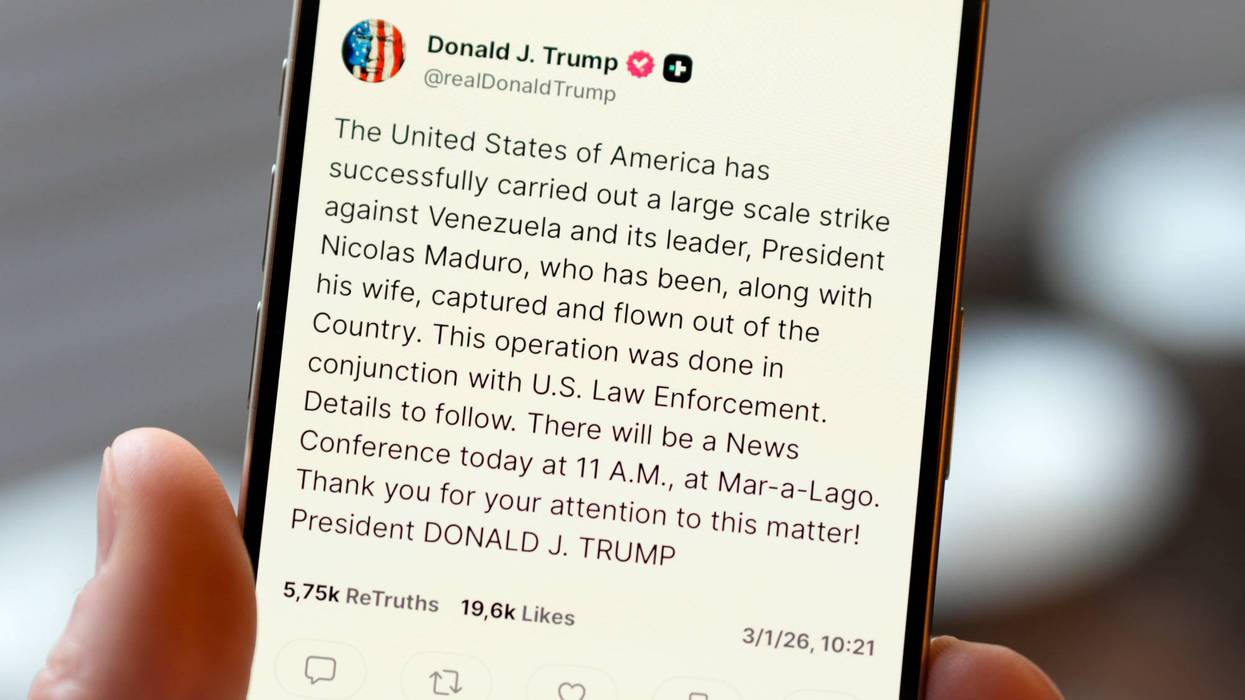
"Nothing could be more antithetical to the free, independent press than the president charging for early access to his public announcements."
A lawsuit filed on Wednesday is challenging the legality of Truth API, a recently unveiled initiative to allow Wall Street firms to pay up to $100,000 per month in exchange for early access to potentially market-moving social media posts from President Donald Trump.
The complaint, filed by the Freedom of the Press Foundation (FPF) and The Intercept, alleges Truth API violates the US Constitution's First Amendment by granting insiders special access to the president's announcements.
The scheme also violates the Constitution's Fifth Amendment by "charging unreasonable sums that cannot be justified to offset the cost" of receiving the benefit of information from the president, the complaint states.
The lawsuit describes Truth API as "profoundly corrupt," given that "the president stands to gain financially by giving 'market-moving' government information to those who are willing and able to pay his personal company."
In establishing the plaintiffs' standing, the complaint argues that The Intercept is being put at a competitive disadvantage by the scheme, given that the news outlet is "both unable and unwilling to subscribe" to it, even though it risks "losing out on timely news to competing organizations."
Ben Muessig, editor-in-chief of The Intercept, accused the president of "trying to enrich himself by privatizing government information that he has no right to sell," while vowing that "we won't let that stand."
David Bralow, chief legal officer for The Intercept, said that "nothing could be more antithetical to the free, independent press than the president charging for early access to his public announcements," emphasizing that "public information belongs to the public."
Seth Stern, chief of advocacy at FPF, said Truth API "is so blatantly corrupt and unconstitutional that it would have been hard to even fathom just a few years ago."
"Trump’s crooked scheme is particularly outrageous," Stern added, "because, as documented by our Trump Anti-Press Social Media Tracker, he frequently uses his Truth Social account to berate journalists and even to announce his plans to sue them and criminally investigate them. Then, he makes them wait in line behind paying customers to find out about it unless they’re willing to subsidize the platform he uses to attack them."
The Intercept and the FPF are being represented in the case by attorneys from Citizens for Responsibility and Ethics in Washington (CREW), the Yale Law School Media Freedom and Information Access Clinic, the Public Integrity Project, and Altshuler Berzon LLP.
Nikhel Sus, chief counsel at CREW, said his organization was "proud to represent our clients in their effort to end this corrupt and unconstitutional scheme" because "all Americans are entitled to timely access to their president’s public statements, not just those willing to pay the president’s company $100,000 a month."
Truth API has also drawn the attention of Rep. Jamie Raskin (D-Md.), ranking member of the US House Judiciary Committee, who announced a probe into the initiative last month, describing it as an "insider-information scheme" that "will enable Wall Street to profit from the president’s frequent market-moving posts on major businesses."

"Big Tech and Big Data companies like Thomson Reuters need to decide whether profiting from government surveillance is compatible with the values they claim to hold," said one tech watchdog.
More than two dozen watchdog organizations are calling on Congress to investigate reports that the data broker Thomson Reuters is making its investigative database available to US Immigration and Customs Enforcement, which they warn will make Americans vulnerable to Fourth Amendment violations.
Last month, documents unearthed by 404 Media revealed:
The Department of Homeland Security (DHS) plans to pay data broker giant Thomson Reuters $125 million for access to its databases of personal data—which includes peoples’ names, addresses, Social Security numbers, ethnicity, social media posts, and geolocation information—to help Immigration and Customs Enforcement (ICE) investigate what it describes as “voters fraud” and immigration fraud.
On Tuesday, a coalition of advocacy groups, including Public Citizen, ACLU, the Center for Democracy and Technology, Common Cause, the Leadership Conference on Civil and Human Rights, and the Electronic Privacy Information Center, sent a letter to members of the Senate Judiciary and Homeland Security committees warning about the deal.
"The reporting highlights a problem that has continued to grow in recent years: Federal agencies are purchasing access to commercially aggregated personal information that they could not otherwise obtain without judicial oversight," the letter says. "This growing practice threatens to erode the protections guaranteed by the Fourth Amendment and underscores the urgent need for Congress to close the data broker loophole."
Thomson Reuters is primarily known for its leading international news agency, but it is also a major data broker that sells access to its dozens of databases to businesses and governments.
ICE has been buying data from Thomson Reuters since 2008. But the Trump administration hopes to dramatically expand the scale of this data collection by accessing the company's CLEAR database, which compiles vast amounts of information, including addresses, phone records, utility information, vehicle registrations, license plate records, social media activity, geolocation data, and other information.
While much of this data could be acquired through other means, the watchdog groups explained that "aggregating them into searchable investigative dossiers dramatically expands government surveillance capabilities, which further run the risk of being supercharged by the rapid growth and use of artificial intelligence by the federal government."
A DHS procurement document reviewed by 404 stated that Thomson Reuters "is the only contractor able to provide ICE with a continuous monitoring and alert service for millions of individuals and entities of interest; this is essential for national security purposes.”
Thomson Reuters has denied that selling CLEAR access presents a constitutional risk, stating earlier this year that "CLEAR does not contain the types of information that law enforcement traditionally need a warrant to obtain, and CLEAR does not include information about an individual’s citizenship or immigration status."
The letter from advocacy groups also notes that the use of this technology in voter fraud investigations, in addition to immigration and national security, "demonstrates the broad range of government functions now supported by commercially acquired surveillance tools."
The documents do not make clear how ICE plans to use the data from Thomson Reuters in a voter fraud investigation.
Trump has directed the federal government to use DHS citizenship and immigration records to identify suspected noncitizen voters and commanded states—in an order that has been blocked by a federal judge—to turn over information about their voters.
While the administration says the goal is to root out noncitizen voters, voting rights advocates have warned that many eligible voters are also at risk of being wrongly purged.
As 404 pointed out, news of the agreement with Thomson Reuters came "after President [Donald] Trump held a conspiracy-laden and unhinged press conference about election security" in July, "setting the stage for potentially undermining the legitimacy of the upcoming midterm elections."
The letter urges Congress to hold oversight hearings examining federal agencies' acquisition and use of commercially available information from data brokers, require transparency about what data agencies are purchasing and how it's being used, and examine whether existing law surrounding data purchasing adequately protects constitutional rights.
It also calls on the government to pass the Fourth Amendment Is Not For Sale Act, a bipartisan piece of legislation that would close the data broker loophole by preventing the government from buying data from private companies that it would ordinarily need a judicial warrant to obtain directly from an individual or company.
"Americans should not lose their Fourth Amendment rights simply because the government is willing to purchase its way around our rights," said JB Branch, the director of federal AI governance and technology policy at Public Citizen. "Big Tech and Big Data companies like Thomson Reuters need to decide whether profiting from government surveillance is compatible with the values they claim to hold.”

"Settler violence has reached unprecedented levels," said a coordinator for the Middle East peace process. "Many incidents occurred in the presence of Israeli forces."
Home demolitions by Israeli forces; attacks on healthcare infrastructure, homes, and schools; mass displacement of Palestinians; and the expansion of illegal settlements across the West Bank have brought the occupied Palestinian territory to "the breaking point," said a top humanitarian official at the United Nations Security Council Tuesday, calling for a "coordinated international effort" to end the violent Israeli occupation.
At a meeting on the situation in the territory, Ramiz Alakbarov, the UN special coordinator for the Middle East peace process, addressed the council as families in the town of Qusra, northern Nablus, were facing days of attacks by Israeli settlers.
That violence exemplified what the Israeli human rights group B'Tselem called an escalating "ethnic cleansing" operation that Israel's military allows.
As B'Tselem said Wednesday, settlers had established an illegal outpost in the yards of two Palestinian families' homes, “forcing the families out and taking over their homes," and the US-backed Israel Defense Forces (IDF) had done nothing to protect the Palestinian residents.
“Israeli ethnic cleansing in the West Bank is accelerating and expanding in full view of everyone,” Yuli Novak, president of B'Tselem, told Anadolu Agency, adding that the settlers' seizure of the Palestinian homes was “not an isolated incident."
Breaking the Silence, an organization run by former IDF members who oppose the occupation, explained how settlers, with the backing of the military, essentially blockade individual homes as a method of driving Palestinians out.
"Violent settlers may do the 'dirty work' of daily terror against Palestinian men, women, and children, but neither this terror nor ethnic cleansing would be possible without the army’s support," said the group. "Village after village, house after house. It keeps happening because it is policy."
At the Security Council meeting, Alakbarov said Israeli forces have killed 76 Palestinians, including 18 children, in the West Bank in 2026 so far, while children make up nearly half of the 3,800 Palestinians who have been displaced by settler attacks, demolitions, and evictions.
"One hundred and twenty-seven Palestinian communities have experienced full or partial displacement since January 2023, including 47 that have been entirely displaced, affecting more than 6,390 Palestinians," said Alakbarov. "Settler violence has reached unprecedented levels. So far this year the UN has documented more than 1,430 incidents involving Israeli settlers that resulted in casualties, property damage, or both, affecting approximately 260 Palestinian communities. Many incidents occurred in the presence of Israeli forces."
As Alakbarov spoke Tuesday, the World Health Organization warned that the West Bank has also seen an uptick in violence against healthcare infrastructure, with Israeli carrying out 83 attacks on healthcare transport such as ambulances and 11 attacks on medical centers and facilities, injuring at least 33 people and killing four. July saw a surge in healthcare attacks—a hallmark of Israel's assault on Gaza that began in 2023—with 37 strikes on infrastructure.
Settler attacks were once mainly concentrated in Area C, which comprises about 60% of the West Bank and is under Israeli control.
But Alakbarov said settlers are increasingly waging violence against Palestinians in Areas A and B, which are under the administration of the Palestinian Authority.
“The future of the region is at stake,” the UN permanent observer for the state of Palestine, Riyad Mansour, told the Security Council. “International will cannot bow before the colonial whims of the Israeli government.”
Israeli officials in recent months have advanced and approved about 12,360 housing units in settlements across the West Bank this year, with the Security Cabinet signing off on 13 new settlements in the central part of the territory last month. The move further isolates East Jerusalem, which Palestinians consider the capital of a future Palestinian state, from the rest of the West Bank.
Last year Prime Minister Benjamin Netanyahu also signed an agreement to develop 3,400 new units in the E1 settlement, which would also cut off access to East Jerusalem. The prime minister said as he approved the deal, "There will be no Palestinian state."
The approvals of more settlement housing this year and the escalation in IDF-sanctioned violence against Palestinian communities across the West Bank "are interconnected steps, not isolated developments,” Alakbarov said Tuesday.
"The situation in the West Bank must be treated as an emergency requiring urgent action," he said. "The concern is not only the continued expansion of settlements, but the speed and systematic manner in which new facts are being created on the ground. New outposts are established, often with state support, and can be retroactively authorized or incorporated into the wider settlement system. From these outposts, settler violence and intimidation have driven the displacement of Palestinian communities."
He added that the spread of settler outposts in agricultural and grazing areas is "deeply troubling."
"Requiring only a small number of settlers, they enable control over vast areas of land," said Alakbarov. "Israeli monitoring organizations report that agricultural and pastoral outposts now exercise effective control over close to 20% of the West Bank."
Israeli forces also arrested 23 Palestinians on Tuesday, including two children, days after a large-scale operation at Qalandia refugee camp resulted in the detentions of more than 60 people.
Hannah Sulieman, deputy executive director of the UN Children's Fund (UNICEF), emphasized that 355 Palestinian children are currently being detained in Israeli military prisons—"the highest number in eight years."
The arrests and the violence mean that for children and their families in the West Bank, "the fundamental spaces of childhood—the home, the classroom, the street, the community—are becoming increasingly unsafe," said Sulieman.
“Children in the West Bank have the same rights as children everywhere,” she said. "To live, to learn, to be protected, and to imagine a future beyond violence and fear."

Francesca Hong said she looks forward to working with David Crowley to defeat Republican Rep. Tom Tiffany in November.
Francesca Hong on Wednesday unequivocally endorsed David Crowley in Wisconsin's gubernatorial contest following her razor-close loss in the Democratic primary, a show of unity in the face of the Republican Party's extremist nominee, Trump-endorsed US Rep. Tom Tiffany.
"Congratulations to David Crowley and his team," said Hong, a grassroots candidate who lost by less than one percentage point despite a massive fundraising disadvantage. "I fully support him and look forward to working with him to defeat Congressman Tiffany in November."
Hong said she is "overwhelmingly proud" of her campaign and emphasized that her run "was not about getting one person into office."
"It is about building a movement for permanent affordability and a government that puts working people first," said Hong. "Our movement is strong, and the work isn't done."
The last 11 months have been one of the greatest joys of my life. Traveling the state, meeting people in churches and dive bars and bike races and dance parties and in their homes, and hearing about what matters most to them informed every decision we made on the trail. It will… pic.twitter.com/Navh81hgvP
— Francesca Hong For Governor (@FrancescaHongWI) August 12, 2026
Crowley, the Milwaukee County executive who suspended his campaign in early July only to reenter the primary less than a month ago with the support of outgoing Democratic Gov. Tony Evers, echoed Hong's call for party unity to defeat the GOP in November.
“Every one of us has something much bigger to unite around,” Crowley said at a press conference on Wednesday. “And that is keeping MAGA extremism from bringing the chaos we see in Washington into our neighborhoods right here in the state of Wisconsin. From the very first day I announced this campaign, I said the real threat wasn’t any of my primary opponents. The real opponent has always been Tom Tiffany. That remains true today.”
Of the more than 311,000 Wisconsinites who voted for Hong on Tuesday, Crowley said, "I look forward to earning their support."
“We may not agree on every policy," said Crowley. "We may not use the same labels, but we all want safe communities, strong schools, affordable health care, good-paying jobs, and a brighter future for all of our children."
Trump is "trying to scare people into thinking he has more power than he has," said UCLA law professor Rick Hasen.
President Donald Trump raised eyebrows on Tuesday when he didn't rule out declaring a "national security emergency for elections" ahead of the 2026 midterms that would let him restrict the use of mail-in ballots and require voters to provide proof of citizenship.
Rick Hasen, a law professor at UCLA and an expert in election law, told The New Republic in an interview published Wednesday that simply declaring a national emergency related to election security wouldn't override states' voting laws.
"The United States Constitution does not give the president power over elections," Hasen explained. "We have a decentralized election system. Most of our election rules come from states, from state legislatures passing statutes."
Even though Trump cannot legally seize control of the country's elections systems, Hasen said, his "national emergency" declaration could be used as a tool to discredit Democratic victories in the midterms and also to more generally intimidate Democratic voters.
"He’s trying to scare people into thinking he has more power than he has," Hasen said. "That itself makes him powerful, because people are deterred by him. And maybe it deters people from showing up to vote in elections... We should not be complacent at all, even if Trump doesn’t have the power to actually do some of the stuff he’s threatened."
Hasen also speculated that Trump's executive order instructing the United States Postal Service to not deliver mail-in ballots to states that have not shared their voter data with the White House was also part of an intimidation operation.
"So everybody’s confidence in the elections goes down," Hasen said. "And it’s like, 'Why mail back my ballot if the post office isn’t going to deliver it? Why show up at the polling place if there’s going to be armed security there?' All of these things are, I think, scare tactics. And we shouldn’t give Trump the power—we shouldn’t give Trump room in our heads to panic over whether or not we're going to have free and fair elections."
In an analysis published Wednesday, progressive commentator Thom Hartmann described Trump as a "cornered rat" who will attempt any trick to maintain Republican majorities in Congress.
"It's going to be up to us and the individual states to make sure our voices are heard and our votes are properly counted," Hartmann wrote. "We should be thinking of this as an election continuity exercise that may not be necessary but, like wearing a seatbelt, could be essential if Trump tries to repeat 2020 in some way."
Hartmann also listed a number of recommendations for Democrats to combat Trump's election subversion attempts, including educating voters on the constitutional limits of the president's powers, being prepared to arrest any federal immigration enforcement officers who appear at polling locations, and encouraging early voting.
"For over a decade now, close races immediately produce Republican claims of fraud," Hartmann added. "Lawyers, election officials, and communications systems must be fully prepared to deal with lies and propaganda long before November."