SUBSCRIBE TO OUR FREE NEWSLETTER
Daily news & progressive opinion—funded by the people, not the corporations—delivered straight to your inbox.
5
#000000
#FFFFFF
To donate by check, phone, or other method, see our More Ways to Give page.


Daily news & progressive opinion—funded by the people, not the corporations—delivered straight to your inbox.
The National Gay and Lesbian Task Force applauds the Senate Judiciary Committee for its historic hearing today on the repeal of the Defense of Marriage Act (DOMA). It is the first such hearing on this issue. National Gay and Lesbian Task Force Executive Director Rea Carey submitted written testimony and attended the hearing.
The hearing follows the House and Senate introduction of the Respect for Marriage Act, which would repeal DOMA, the 1996 law that discriminatorily denies same-sex married couples the federal rights and responsibilities of marriage.
In her testimony, Carey called DOMA "one of the most discriminatory and farthest-reaching laws ever to emerge against our community."
Critical federal benefits -- ranging from immigration sponsorship to the ability to take time off to care for a sick spouse -- are denied to legally married couples on the basis of their sexual orientation due to DOMA.
This denial adversely affects the economic security of same-sex couples and their families at all stages of life. For example, children of same-sex parents cannot access Social Security survivor benefits upon the death of a non-biological, non-adoptive parent. With more than 250,000 children in the United States being raised by same-sex couples, these protections are of critical importance to lesbian, gay, bisexual and transgender (LGBT) families.
Same-sex spouses also suffer at the end of their lives due to the denial of these benefits. For example, an individual who survives her same-sex spouse has to pay a larger share of taxes when she inherits from her spouse's estate than does an individual who survives a spouse in an opposite-sex marriage.
"The law is grossly unjust and places significant harm on far too many families in our country. It is shocking that in 2011, legally married couples in the United States are being singled out and selectively denied fundamental rights by their own federal government. Too many have been hurt for too long because of DOMA, and its repeal is long overdue," Carey said.
The critical necessity of federal benefits is particularly true for marginalized people within the LGBT community and their children, who are more likely to live under the poverty line, and, therefore, need access to such benefits to create economic security. Data from the Williams Institute bear this out. It found that 31.6 percent of children being raised by black lesbians were found to be poor as compared to 9.4 percent of children with married, opposite-sex parents in general and 13.1 percent of married, opposite-sex black parents. The numbers are similar for Latina lesbians: nearly 32 percent of the children of these women are poor.
DOMA's discriminatory effects hit home for many same-sex couples. For example, Ralph Cherry, a retired federal employee who has been in a 32-year-long relationship, cannot add his partner to his health insurance, and his partner would not be eligible for survivor benefits should Cherry die first. This is particularly acute because Cherry's partner has a chronic health issue and is in severe pain.
Cherry writes: "Members of Congress: I am on the exact same Federal Employees Health Benefits Plan as you; imagine yourselves in this ridiculous position to know my frustration. The federal government is shooting itself in the foot with this outdated law, discouraging talented potential civil servants from applying for employment because they happen to be gay and can get humane treatment for their family members in the private sector."
Carey noted that such "stories of hardship under this law are heartbreaking. With the passage of the Respect for Marriage Act, Congress would begin to close this ugly chapter in our nation's history. It would end an egregious injustice against thousands of loving, committed couples who simply want the protections, rights and responsibilities already afforded other married couples."
The time for the legislative repeal of DOMA is now, as an increased number of same-sex couples enter marriages in states ranging from Iowa to New York. Polls by Gallup, CNN and ABC News/Washington Post all have shown that majorities of Americans favor marriage equality.
The National Gay and Lesbian Task Force thanks U.S. Sen. Patrick Leahy (D-Vt.) for his leadership on calling these historic hearings and the numerous senators who support the Respect for Marriage Act.
"Our country benefits when everyone is able to live their lives free from discrimination, and the repeal of DOMA is one critical step to this end," said Carey.
Read her full testimony here.
The National LGBTQ Task Force advances full freedom, justice and equality for LGBTQ people. We are building a future where everyone can be free to be their entire selves in every aspect of their lives. Today, despite all the progress we've made to end discrimination, millions of LGBTQ people face barriers in every aspect of their lives: in housing, employment, healthcare, retirement, and basic human rights. These barriers must go. That's why the Task Force is training and mobilizing millions of activists across our nation to deliver a world where you can be you. Join us!
"If a US role were to be confirmed, the strike would rank among the worst cases of civilian casualties in decades of US conflicts in the Middle East."
US investigators reportedly believe that American forces were behind the bombing of an Iranian girls' school that killed more than 160 people—mostly young children—during the initial wave of attacks launched Saturday by President Donald Trump in coordination with the Israeli military.
Citing two unnamed officials, Reuters reported Thursday that US military investigators have found it is "likely" that American forces were responsible for the deadly strike on the school in the southern Iranian town of Minab, though the investigation has not yet been completed. Schools are protected under international law, and targeting them is a war crime.
"Reuters was unable to determine more details about the investigation, including what evidence contributed to the tentative assessment, what type of munition was used, who was responsible, or why the U.S. might have struck the school," the outlet noted. "The officials, who spoke on condition of anonymity to discuss sensitive military matters, did not rule out the possibility that new evidence could emerge that absolves the U.S. of responsibility and points to another responsible party in the incident."
"If a US role were to be confirmed," Reuters added, "the strike would rank among the worst cases of civilian casualties in decades of US conflicts in the Middle East."
HuffPost's Akbar Shahid Ahmed echoed Reuters' reporting, writing that Pentagon officials "told Congress in multiple briefings this week that they believed the US was most likely responsible (though probe ongoing)."
The reporting came on the heels of a New York Times analysis that concluded the US was "most likely to have carried out the strike," given that American forces were simultaneously bombarding an adjacent Iranian naval base. The Times also rejected the claim that an Iranian missile hit the elementary school.
"The strikes were first reported on social media shortly after 11:30 am local time," the Times reported. "An analysis of those posts—as well as bystander photos and videos captured within an hour of the strikes—helps corroborate that the school was hit at the same time as the naval base. One video, pinpointed by geolocation experts, showed several large plumes of smoke billowing from the area of the base and the school."
Beth Van Schaack, a former State Department official who currently teaches at Stanford University’s Center for Human Rights and International Justice, told the Times that "given the US' intelligence capabilities, they should have known that a school was in the vicinity."
Trump administration officials have said very little about the Iranian school strike in their triumphant rhetoric about the war, which Pentagon Secretary Pete Hegseth hailed as the "most lethal, most complex, and most precise aerial operation in history." Hegseth has also openly dismissed what he's called "stupid rules of engagement," rejecting constraints on US forces that are designed to prevent the killing of civilians.
Asked about the school strike during a March 4 press conference, Hegseth responded: "All I know—all I can say is that we're investigating that. We, of course, never target civilian targets, but we're taking a look and investigating that."
US Secretary of State Marco Rubio referred reporters to the Pentagon when asked about the attack, but added that "the United States would not target, deliberately target, a school," in purported contrast to the Iranian government, which Rubio claimed is "deliberately targeting civilians" because "they are a terroristic regime."
Two first responders to the scene of the attack, as well as a parent of one of the killed children, told Middle East Eye earlier this week that the school was hit by two strikes, a possible "double-tap" attack. An Al Jazeera investigation concluded the attack on the school was likely deliberate.
Jeremy Konyndyk, president of Refugees International, called the school attack "a horrific US war crime, up there with My Lai," referring to US soldiers' massacre of Vietnamese civilians in 1968. The US military initially covered up the massacre.
"In a sane world, Hegseth would resign, Congress would hold immediate hearings and establish an investigation, and the US would come clean," Konyndyk wrote on social media. "None of that is likely, so international mechanisms should kick in, including the [International Criminal Court]. And Hegseth should probably talk to a lawyer."
On Thursday, as US and Israeli officials vowed to ramp up their assault on Iran, two boys' schools southwest of Tehran were reportedly bombed.
"The targeting of civilians, educational facilities, and medical institutions constitutes a grave violation of international humanitarian law and human rights law," a group of United Nations experts said earlier this week.
"This disgraceful vote does not change Congress' legal duty, and it certainly does not silence the millions of Americans who oppose another illegal war," said an ACLU director.
As US Defense Secretary Pete Hegseth declared Thursday that "the amount of firepower over Iran and over Tehran is about to surge dramatically," four Democrats in the House of Representatives voted with nearly all Republicans to reject a bipartisan war powers resolution that would have halted President Donald Trump and Israel's assault on the Middle East country.
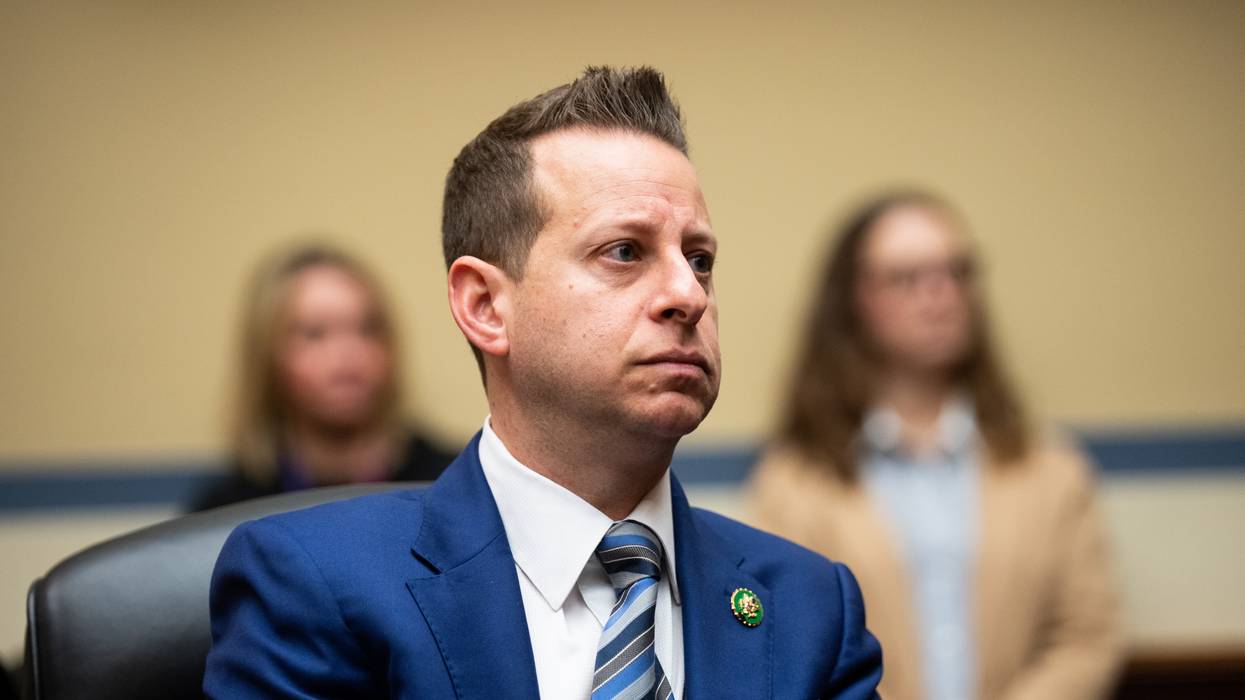
Democratic Reps. Henry Cuellar (Texas), Jared Golden (Maine), Greg Landsman (Ohio), and Juan Vargas (Calif.) stood with the GOP for the 212-219 vote against H.Con.Res.38, which was led by Reps. Ro Khanna (D-Calif.) and Thomas Massie (R-Ky.). The only other Republican to support the resolution was Rep. Warren Davidson (Ohio)—though GOP Rep. Tony Gonzales (Texas), who is facing an unrelated scandal, did not participate.
Dylan Williams, vice president for government affairs at the think tank Center for International Policy, highlighted that given Massie and Davidson's votes, "if those four Democrats had stuck with their caucus and their voters, it would have passed."
"Everyone who opposed the resolution owns this war—along with the casualties, rising gas prices, and regional chaos that comes with it."
The House vote came just a day after Democratic US Sen. John Fetterman (Pa.) and all of the chamber's Republicans but Sen. Rand Paul (Ky.) rejected S.J.Res.104, a similar resolution sponsored by Paul and Sen. Tim Kaine (D-Va.). As with the Wednesday vote, a range of critics called out Congress for enabling Trump's illegal and already seemingly endless war.
"This is a shameful abdication of Congress' constitutional authority to take the country to war," said Defending Rights & Dissent, noting the rising death toll. "US and Israeli strikes have hit elementary schools, hospitals, and the capital city of Tehran, home to 10 million. Six US service members have died. Trump is carrying out yet another regime change war of choice, and the American people have been overwhelmingly clear that they don't support it."
"This was Congress' best chance to stop further killings, to stop an all-out regional war with no end in sight, and to uphold the constitutional principle that prevents presidents from going rogue," the group continued. "We are deeply disappointed in both chambers' failure to stand up to this dangerous insanity."
Christopher Anders, director of the ACLU's democracy and technology division, stressed in a statement that "this failed war powers vote is nothing short of cowardly, but Congress can't dodge the Constitution forever."
"By refusing to rein in President Trump's unauthorized war with Iran, Congress has allowed President Trump to make a mockery of the Constitution and is trying to duck responsibility for putting service members and civilians in great danger," Anders added. "But, this disgraceful vote does not change Congress' legal duty, and it certainly does not silence the millions of Americans who oppose another illegal war. We will hold President Trump accountable for this abuse of power."
In the lead-up to Thursday's vote, one unnamed "senior progressive House Democrat" told Axios that the groups including Justice Democrats, MoveOn, Progressive Change Campaign Committee, and Our Revolution "will primary anyone" who votes no.
After the vote, Justice Democrats shared the congressional office numbers of the four Democrats, and said to "call these spineless Dems who support Trump's new forever war with Iran and tell them to go to war themselves if they want it so bad."
Another progressive group, a youth-led climate organization Sunrise Movement, also took aim at the House Democrats who voted with the GOP, declaring on social media: "Absolutely ridiculous. Call them out. Vote them out."
Council on American-Islamic Relations government affairs director Robert S. McCaw commended all lawmakers "who voted to uphold Congress' constitutional duty and demand an end to unauthorized hostilities with Iran," particularly Massie and Davidson for their "courage to break with their party and stand on principle."
It is also "deeply disappointing" that some Democrats "joined Republicans to defeat this effort and enable an unconstitutional war," he said, warning that "their votes helped give the administration a green light to continue a dangerous escalation that threatens American lives and regional stability."
Earlier this week, Cuellar, Golden, and Landsman joined Democratic Reps. Jim Costa (Calif.), Josh Gottheimer (NJ), and Jimmy Panetta (Calif.) to introduce a competing war powers resolution that would let Trump wage war on Iran for a month. Noting that proposal, McCaw argued that "Americans did not elect Congress to issue a '30 days of carnage hall pass' for an unauthorized war. If a war is unconstitutional today, it should not be allowed to continue for another month."
“The Constitution is clear: Congress, not the president, has the authority to decide when this nation goes to war," he added. "The American people must continue pressing their elected representatives to reclaim that authority and stop another disastrous war in the Middle East before it spirals further out of control."
As of Thursday, the Iranian government put the death toll at 1,230, though US and Israeli attacks continue, and Hegseth said that "we have only just begun to fight and fight decisively... If you think you've seen something, just wait. The amount of combat power that's still flowing, that's still coming, that we'll be able to project over Iran is a multiples of what it currently is right now."
On top of the lives lost, recent reporting suggests that Trump's war on Iran could be costing US taxpayers $1 billion per day. Calling the House vote "profoundly disappointing," Demand Progress senior policy adviser Cavan Kharrazian said that "everyone who opposed the resolution owns this war—along with the casualties, rising gas prices, and regional chaos that comes with it."
"Congress needs to stop listening to warmongering elites," Kharrazian added, "and start listening to the American people who are sick and tired of being dragged into forever wars."
"Israel built AI targeting systems in Gaza—approved kills in 20 seconds, 10% error rate accepted," said one expert. "Now those same systems are running over Iran... and there’s an arms industry IPO-ing off the back of it."
After Israel's unprecedented use of artificial intelligence to select bombing targets in Gaza, experts are now sounding the alarm regarding what one analyst on Thursday called a lack of human supervision over Israeli AI targeting in Iran.
"Similarities between Israel's bombing of Gaza and Tehran are growing stronger," Quincy Institute for Responsible Statecraft executive vice president Trita Parsi said Thursday on X. "In both cases, it appears Israel is using AI without any human oversight."
"For instance, Israel has bombed a park in Tehran called 'Police Park,'" Parsi added. "It has nothing to do with the police. But it appears AI identified it as a target since Israel is bombing all government-related buildings. No one in Israel bothered to check and find out that it is just a park."
Borrowing from startup vernacular, tech journalist Jacob Ward calls Israel's use and export of AI technology in the post-Gaza era "lethal beta."
"Gaza was the prototype," Ward explained in a video posted this week on Bluesky. "Iran is the launch."
"[It's] a live-fire, live-ordnance lab experiment on people, killing people, that creates a pipeline of exportable products to the rest of the world, and it has become a big industry in Israel—and it's something that we in the United States have been dealing with and doing business with for some time as well."
Israel built AI targeting systems in Gaza — approved kills in 20 seconds, 10% error rate accepted. Now those same systems are running over Iran and being exported all over the world. I’m calling this “lethal beta,” and there’s an arms industry IPO-ing off the back of it. Full breakdown at
[image or embed]
— Jacob Ward (@byjacobward.bsky.social) March 3, 2026 at 4:45 PM
Previous investigations have detailed how the IDF uses Habsora, an Israeli AI system that can automatically select airstrike targets at an exponentially faster rate than ever before. One Israeli intelligence source asserted that the technology has transformed the IDF into a “mass assassination factory” in which the “emphasis is on quantity and not quality” of kills.
Mistakes were all but inevitable, but expert critics argue Israeli policy has made matters worse. In the tense hours following the Hamas-led attack of October 7, 2023, mid-ranking IDF officers were empowered to order attacks on not only senior Hamas commanders but any fighter in the resistance group, no matter how low-ranking.
According to a New York Times investigation, IDF officers were also permitted to risk up to 20 civilian lives in each airstrike, and up to 500 noncombatant lives per day. Even that limit was lifted after just a few days. Officers could order any number of strikes as they believed were legal, with no limits on civilian harm.
Senior IDF commanders sometimes approved strikes they knew could kill more than 100 civilians if the target was considered high-value. In one AI-aided airstrike targeting one senior Hamas commander, the IDF dropped multiple US-supplied 2,000-pound bombs, which can level an entire city block, on the Jabalia refugee camp in October 2023.
That bombing killed at least 126 people, 68 of them children, and wounded 280 others. Hamas said four Israeli and three international hostages were also killed in the attack.
The Washington Post reported Wednesday that the US military in Iran has "leveraged the most advanced artificial intelligence it’s ever used in warfare, a tool that could be difficult for the Pentagon to give up even as it severs ties with the company that created it."
According to the Post, Palantir's Maven Smart System—which contains Anthropic's Claude AI language model—reportedly helped US commanders select 1,000 Iranian targets during the war's first 24 hours alone.
Experts are urging a more cautious approach to military AI use. Paul Scharre, executive vice president at the Center for a New American Security, told the Post that “AI gets it wrong... We need humans to check the output of generative AI when the stakes are life and death.”
It is not publicly known whether AI was used in connection with any of the deadliest massacres of the current war on Iran, which has left more than 1,000 Iranians dead, including around 175 children and others who were killed by what first responders and victims' relatives said was a double-tap strike on a girls' school last Saturday in the southern city of Minab.
Last week, Trump ordered all federal agencies including the Department of Defense to stop using all Anthropic products in apparent retaliation for the San Francisco-based company's refusal to allow unrestricted government and military use of its technology over fears it could be used for mass surveillance of Americans and in automated weapons systems, also known as "killer robots."
Trump gave the Pentagon six months to phase out Anthropic products, allowing their continued use in the Iran war pending replacements.
Project Nimbus—a $1.2 billion cloud-computing and AI contract signed in 2021 between the Israeli government and Amazon Web Services and Google Cloud—provides cloud infrastructure, AI tools, and data storage for the IDF and other agencies. The deal prohibits Google or Amazon from refusing service to Israeli government, military, or intelligence agencies.
Academics and jurists are gathered this week in Geneva, Switzerland—with a second four-day round of talks starting August 31—for a United Nations-sponsored conference on lethal autonomous weapons systems.
Attendees are examining the risks posed by killer robots that can select and engage targets without meaningful human control. They are also studying the legal, military, and technological implications of autonomous weapons systems and working to build international consensus on regulation.
“The current failure to regulate AI warfare, or to pause its usage until there is some agreement on lawful usage, seems to suggest potential proliferation of AI warfare is imminent,” Craig Jones, a political geographer at Newcastle University in England who researches military targeting, told Nature's Nicola Jones on Thursday.
While some proponents of AI weapons systems have claimed their use will reduce civilian harm, Jones stressed that "there is no evidence that AI lowers civilian deaths or wrongful targeting decisions—and it may be that the opposite is true."