SUBSCRIBE TO OUR FREE NEWSLETTER
Daily news & progressive opinion—funded by the people, not the corporations—delivered straight to your inbox.
5
#000000
#FFFFFF
To donate by check, phone, or other method, see our More Ways to Give page.
Daily news & progressive opinion—funded by the people, not the corporations—delivered straight to your inbox.
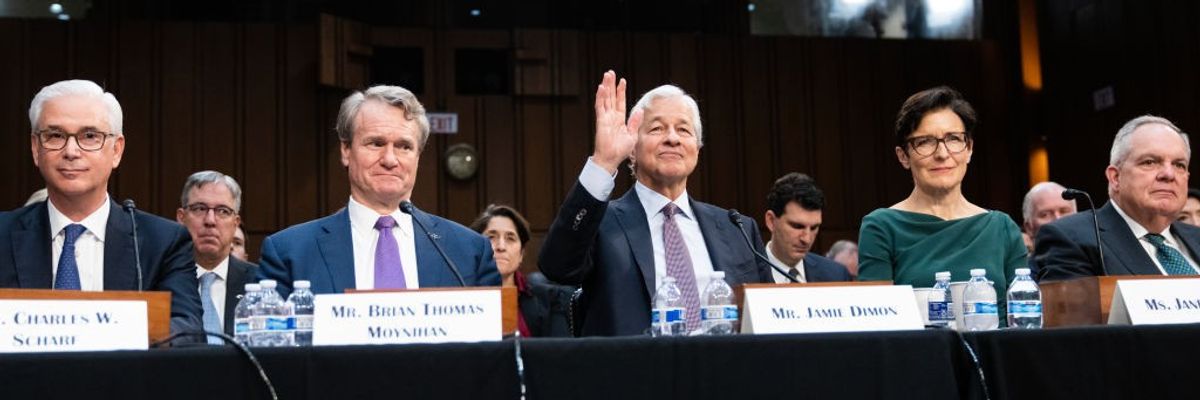
Big bank CEOs testify at a Senate hearing on December 6, 2023.
"Strong antitrust enforcement is not just good policy; it's also good politics," said the president of the American Antitrust Institute.
A survey released just over two weeks before the 2024 election found that a majority of U.S. voters in critical swing states agree that excessive corporate power is one of the nation's largest problems and favor robust enforcement action, a signal that the presidential candidate who takes the strongest position against monopolistic abuses could see a boost at the polls on November 5.
The survey, conducted by Lake Research Partners in partnership with the American Antitrust Institute (AAI) and the Committee to Support the Antitrust Laws (COSAL), found that 67% of likely general election voters in Arizona, Georgia, Michigan, Nevada, North Carolina, Ohio, Pennsylvania, and Wisconsin agree with the statement that "one of the biggest problems facing America today is that a handful of corporations have too much power and government is going too little to hold them accountable."
Additionally, 56% of voters in those battleground states said they would be much or somewhat more likely to vote for a candidate who "supported tougher government enforcement of antitrust laws to combat corporate monopolies."
The poll, published Monday, was conducted October 10-14 and has a sample size of 600, with a margin of error of +/- four percentage points.
"This poll shows that voters understand that big corporations that abuse their market power are harming the quality of life for the rest of us and we need to do more to hold them accountable," said Pamela Gilbert, COSAL's legislative counsel. "Public officials should pay attention and do more to strengthen public and private antitrust enforcement."
Randy Stutz, president of AAI, said the findings underscore that "strong antitrust enforcement is not just good policy; it's also good politics, whether you're a Democratic or a Republican."
The survey was released as Federal Trade Commission (FTC) Chairwoman Lina Khan—an antitrust trailblazer who has aggressively fought corporate consolidation and anti-consumer abuses since taking on her role—faced vocal criticism from billionaire supporters of Democratic nominee Kamala Harris, including investor Mark Cuban and LinkedIn founder Reid Hoffman.
Pointing to the newly released survey, The Lever's David Sirota wrote late Monday that "here's some empirical evidence that lots of swing voters might feel better about voting for Kamala Harris if she publicly rejects her billionaire donors' demand that she get rid of Lina Khan at FTC."
Harris, who has ties to Big Tech, has not yet said whether she intends to keep Khan as chair of the FTC if she defeats Republican nominee Donald Trump in next month's election.
A Trump victory would most likely spell an end to Khan's tenure as head of the agency, despite the bipartisan popularity of the kind of forceful antitrust action she has taken.
Neither Harris nor Trump has laid out a detailed antitrust agenda, but the Democratic vice president has vowed to take on corporate price gouging and backed legislation that would make algorithmic price-fixing in the U.S. rental housing market illegal under antitrust law.
Trump, for his part, doesn't mention antitrust in his campaign platform, and the former president recently signaled opposition to breaking up Google—a path the U.S. Justice Department is currently considering.
Dear Common Dreams reader, It’s been nearly 30 years since I co-founded Common Dreams with my late wife, Lina Newhouser. We had the radical notion that journalism should serve the public good, not corporate profits. It was clear to us from the outset what it would take to build such a project. No paid advertisements. No corporate sponsors. No millionaire publisher telling us what to think or do. Many people said we wouldn't last a year, but we proved those doubters wrong. Together with a tremendous team of journalists and dedicated staff, we built an independent media outlet free from the constraints of profits and corporate control. Our mission has always been simple: To inform. To inspire. To ignite change for the common good. Building Common Dreams was not easy. Our survival was never guaranteed. When you take on the most powerful forces—Wall Street greed, fossil fuel industry destruction, Big Tech lobbyists, and uber-rich oligarchs who have spent billions upon billions rigging the economy and democracy in their favor—the only bulwark you have is supporters who believe in your work. But here’s the urgent message from me today. It's never been this bad out there. And it's never been this hard to keep us going. At the very moment Common Dreams is most needed, the threats we face are intensifying. We need your support now more than ever. We don't accept corporate advertising and never will. We don't have a paywall because we don't think people should be blocked from critical news based on their ability to pay. Everything we do is funded by the donations of readers like you. When everyone does the little they can afford, we are strong. But if that support retreats or dries up, so do we. Will you donate now to make sure Common Dreams not only survives but thrives? —Craig Brown, Co-founder |
A survey released just over two weeks before the 2024 election found that a majority of U.S. voters in critical swing states agree that excessive corporate power is one of the nation's largest problems and favor robust enforcement action, a signal that the presidential candidate who takes the strongest position against monopolistic abuses could see a boost at the polls on November 5.
The survey, conducted by Lake Research Partners in partnership with the American Antitrust Institute (AAI) and the Committee to Support the Antitrust Laws (COSAL), found that 67% of likely general election voters in Arizona, Georgia, Michigan, Nevada, North Carolina, Ohio, Pennsylvania, and Wisconsin agree with the statement that "one of the biggest problems facing America today is that a handful of corporations have too much power and government is going too little to hold them accountable."
Additionally, 56% of voters in those battleground states said they would be much or somewhat more likely to vote for a candidate who "supported tougher government enforcement of antitrust laws to combat corporate monopolies."
The poll, published Monday, was conducted October 10-14 and has a sample size of 600, with a margin of error of +/- four percentage points.
"This poll shows that voters understand that big corporations that abuse their market power are harming the quality of life for the rest of us and we need to do more to hold them accountable," said Pamela Gilbert, COSAL's legislative counsel. "Public officials should pay attention and do more to strengthen public and private antitrust enforcement."
Randy Stutz, president of AAI, said the findings underscore that "strong antitrust enforcement is not just good policy; it's also good politics, whether you're a Democratic or a Republican."
The survey was released as Federal Trade Commission (FTC) Chairwoman Lina Khan—an antitrust trailblazer who has aggressively fought corporate consolidation and anti-consumer abuses since taking on her role—faced vocal criticism from billionaire supporters of Democratic nominee Kamala Harris, including investor Mark Cuban and LinkedIn founder Reid Hoffman.
Pointing to the newly released survey, The Lever's David Sirota wrote late Monday that "here's some empirical evidence that lots of swing voters might feel better about voting for Kamala Harris if she publicly rejects her billionaire donors' demand that she get rid of Lina Khan at FTC."
Harris, who has ties to Big Tech, has not yet said whether she intends to keep Khan as chair of the FTC if she defeats Republican nominee Donald Trump in next month's election.
A Trump victory would most likely spell an end to Khan's tenure as head of the agency, despite the bipartisan popularity of the kind of forceful antitrust action she has taken.
Neither Harris nor Trump has laid out a detailed antitrust agenda, but the Democratic vice president has vowed to take on corporate price gouging and backed legislation that would make algorithmic price-fixing in the U.S. rental housing market illegal under antitrust law.
Trump, for his part, doesn't mention antitrust in his campaign platform, and the former president recently signaled opposition to breaking up Google—a path the U.S. Justice Department is currently considering.
A survey released just over two weeks before the 2024 election found that a majority of U.S. voters in critical swing states agree that excessive corporate power is one of the nation's largest problems and favor robust enforcement action, a signal that the presidential candidate who takes the strongest position against monopolistic abuses could see a boost at the polls on November 5.
The survey, conducted by Lake Research Partners in partnership with the American Antitrust Institute (AAI) and the Committee to Support the Antitrust Laws (COSAL), found that 67% of likely general election voters in Arizona, Georgia, Michigan, Nevada, North Carolina, Ohio, Pennsylvania, and Wisconsin agree with the statement that "one of the biggest problems facing America today is that a handful of corporations have too much power and government is going too little to hold them accountable."
Additionally, 56% of voters in those battleground states said they would be much or somewhat more likely to vote for a candidate who "supported tougher government enforcement of antitrust laws to combat corporate monopolies."
The poll, published Monday, was conducted October 10-14 and has a sample size of 600, with a margin of error of +/- four percentage points.
"This poll shows that voters understand that big corporations that abuse their market power are harming the quality of life for the rest of us and we need to do more to hold them accountable," said Pamela Gilbert, COSAL's legislative counsel. "Public officials should pay attention and do more to strengthen public and private antitrust enforcement."
Randy Stutz, president of AAI, said the findings underscore that "strong antitrust enforcement is not just good policy; it's also good politics, whether you're a Democratic or a Republican."
The survey was released as Federal Trade Commission (FTC) Chairwoman Lina Khan—an antitrust trailblazer who has aggressively fought corporate consolidation and anti-consumer abuses since taking on her role—faced vocal criticism from billionaire supporters of Democratic nominee Kamala Harris, including investor Mark Cuban and LinkedIn founder Reid Hoffman.
Pointing to the newly released survey, The Lever's David Sirota wrote late Monday that "here's some empirical evidence that lots of swing voters might feel better about voting for Kamala Harris if she publicly rejects her billionaire donors' demand that she get rid of Lina Khan at FTC."
Harris, who has ties to Big Tech, has not yet said whether she intends to keep Khan as chair of the FTC if she defeats Republican nominee Donald Trump in next month's election.
A Trump victory would most likely spell an end to Khan's tenure as head of the agency, despite the bipartisan popularity of the kind of forceful antitrust action she has taken.
Neither Harris nor Trump has laid out a detailed antitrust agenda, but the Democratic vice president has vowed to take on corporate price gouging and backed legislation that would make algorithmic price-fixing in the U.S. rental housing market illegal under antitrust law.
Trump, for his part, doesn't mention antitrust in his campaign platform, and the former president recently signaled opposition to breaking up Google—a path the U.S. Justice Department is currently considering.