SUBSCRIBE TO OUR FREE NEWSLETTER
Daily news & progressive opinion—funded by the people, not the corporations—delivered straight to your inbox.
5
#000000
#FFFFFF
To donate by check, phone, or other method, see our More Ways to Give page.
Daily news & progressive opinion—funded by the people, not the corporations—delivered straight to your inbox.
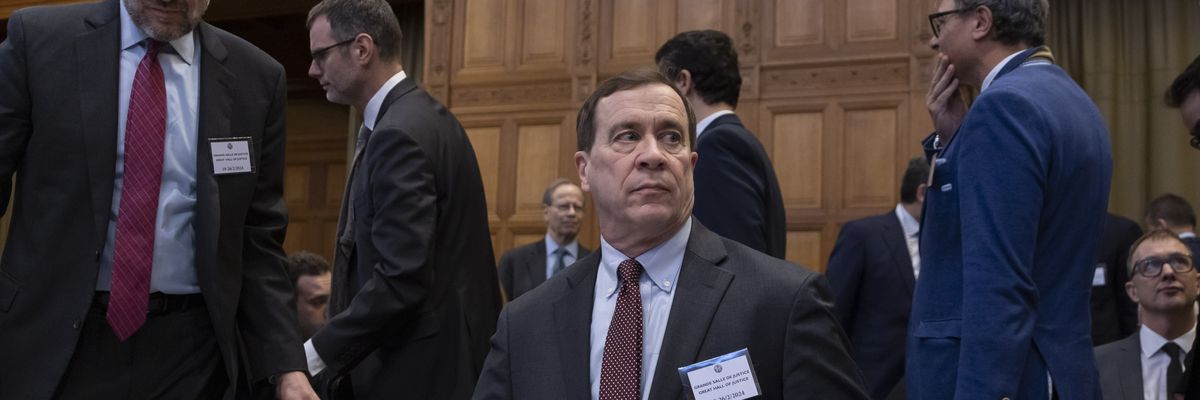
Richard Visek, acting legal adviser for the U.S. State Department, attends an International Court of Justice hearing on the legality of Israel's occupation of Palestinian territory on February 21, 2024 in The Hague, Netherlands.
A Cuban diplomat, meanwhile, slammed "those who for years have supported each and every one of the policies and practices of Israel, which denied the existence of the Palestinian people and their rights."
An attorney from the U.S. State Department told the International Court of Justice on Wednesday that it should not put its weight behind global calls for Israel to withdraw its forces from the occupied Palestinian territories.
Richard Visek, the U.S. State Department's acting legal adviser, argued that "it would not, as some participants suggest, be conducive to the achievement" of lasting peace for the United Nations' highest court to "issue an opinion that calls for the unilateral, immediate, and unconditional withdrawal that does not account for Israel's security needs."
"The court should not find that Israel is legally obligated to immediately and unconditionally withdraw from occupied territory," said the U.S. representative.
Visek reiterated the Biden administration's stated support for a two-state solution but rejected the argument—made by other nations before the International Court of Justice (ICJ)—that an end to Israel's illegal, decadeslong occupation of Gaza, the West Bank, and East Jerusalem is a necessary prerequisite to securing peace and a durable political solution.
"International law does not impose specific time limits on an occupation," Visek said Wednesday.
The U.S. presentation came two days after Paul Reichler, an American lawyer representing Palestine during the ICJ proceedings on Israel's occupation, said that "occupation can only be a temporary state of affairs" and criticized the U.S. government for defending "whatever offenses against international law Israel commits."
"A permanent occupation is a legal oxymoron," said Reichler. "What makes Israel's ongoing occupation of the Palestinian territory unlawful is precisely its permanent character."
Among nations participating in the ICJ proceedings on Israel's occupation, only the U.S. and Fiji are urging the court not to issue an opinion that declares the nearly six-decade occupation of Palestinian territory illegal.
Israel has opted not to take part in the hearings, with far-right Prime Minister Benjamin Netanyahu denouncing them as illegitimate.
The hearings come more than a year after the U.N. General Assembly requested a nonbinding opinion from the ICJ on the "legal consequences" of Israel's open-ended occupation of Palestinian territory. Just last month, the ICJ ruled that Israel's ongoing assault on the Gaza Strip plausibly amounts to genocide—a characterization that the U.S. and other Israeli allies have rejected.
Speaking just before Visek on Wednesday, representatives of Colombia, Cuba, and Egypt condemned the Israeli occupation and implored the ICJ to act decisively.
“The situation that is taking place in the eyes of all confirms the ongoing genocide. Innocent victims—girls, boys, women—number in the thousands," Cuban diplomat Anayansi Rodriguez Camejo said Wednesday, slamming "those who for years have supported each and every one of the policies and practices of Israel, which denied the existence of the Palestinian people and their rights."
"Taken in total," she said, "the unbearable situation of the Palestinian people the honorable International Court of Justice should take a stand in the clearest, strongest, and most forceful legal terms in support of international law."
Dear Common Dreams reader, It’s been nearly 30 years since I co-founded Common Dreams with my late wife, Lina Newhouser. We had the radical notion that journalism should serve the public good, not corporate profits. It was clear to us from the outset what it would take to build such a project. No paid advertisements. No corporate sponsors. No millionaire publisher telling us what to think or do. Many people said we wouldn't last a year, but we proved those doubters wrong. Together with a tremendous team of journalists and dedicated staff, we built an independent media outlet free from the constraints of profits and corporate control. Our mission has always been simple: To inform. To inspire. To ignite change for the common good. Building Common Dreams was not easy. Our survival was never guaranteed. When you take on the most powerful forces—Wall Street greed, fossil fuel industry destruction, Big Tech lobbyists, and uber-rich oligarchs who have spent billions upon billions rigging the economy and democracy in their favor—the only bulwark you have is supporters who believe in your work. But here’s the urgent message from me today. It's never been this bad out there. And it's never been this hard to keep us going. At the very moment Common Dreams is most needed, the threats we face are intensifying. We need your support now more than ever. We don't accept corporate advertising and never will. We don't have a paywall because we don't think people should be blocked from critical news based on their ability to pay. Everything we do is funded by the donations of readers like you. When everyone does the little they can afford, we are strong. But if that support retreats or dries up, so do we. Will you donate now to make sure Common Dreams not only survives but thrives? —Craig Brown, Co-founder |
An attorney from the U.S. State Department told the International Court of Justice on Wednesday that it should not put its weight behind global calls for Israel to withdraw its forces from the occupied Palestinian territories.
Richard Visek, the U.S. State Department's acting legal adviser, argued that "it would not, as some participants suggest, be conducive to the achievement" of lasting peace for the United Nations' highest court to "issue an opinion that calls for the unilateral, immediate, and unconditional withdrawal that does not account for Israel's security needs."
"The court should not find that Israel is legally obligated to immediately and unconditionally withdraw from occupied territory," said the U.S. representative.
Visek reiterated the Biden administration's stated support for a two-state solution but rejected the argument—made by other nations before the International Court of Justice (ICJ)—that an end to Israel's illegal, decadeslong occupation of Gaza, the West Bank, and East Jerusalem is a necessary prerequisite to securing peace and a durable political solution.
"International law does not impose specific time limits on an occupation," Visek said Wednesday.
The U.S. presentation came two days after Paul Reichler, an American lawyer representing Palestine during the ICJ proceedings on Israel's occupation, said that "occupation can only be a temporary state of affairs" and criticized the U.S. government for defending "whatever offenses against international law Israel commits."
"A permanent occupation is a legal oxymoron," said Reichler. "What makes Israel's ongoing occupation of the Palestinian territory unlawful is precisely its permanent character."
Among nations participating in the ICJ proceedings on Israel's occupation, only the U.S. and Fiji are urging the court not to issue an opinion that declares the nearly six-decade occupation of Palestinian territory illegal.
Israel has opted not to take part in the hearings, with far-right Prime Minister Benjamin Netanyahu denouncing them as illegitimate.
The hearings come more than a year after the U.N. General Assembly requested a nonbinding opinion from the ICJ on the "legal consequences" of Israel's open-ended occupation of Palestinian territory. Just last month, the ICJ ruled that Israel's ongoing assault on the Gaza Strip plausibly amounts to genocide—a characterization that the U.S. and other Israeli allies have rejected.
Speaking just before Visek on Wednesday, representatives of Colombia, Cuba, and Egypt condemned the Israeli occupation and implored the ICJ to act decisively.
“The situation that is taking place in the eyes of all confirms the ongoing genocide. Innocent victims—girls, boys, women—number in the thousands," Cuban diplomat Anayansi Rodriguez Camejo said Wednesday, slamming "those who for years have supported each and every one of the policies and practices of Israel, which denied the existence of the Palestinian people and their rights."
"Taken in total," she said, "the unbearable situation of the Palestinian people the honorable International Court of Justice should take a stand in the clearest, strongest, and most forceful legal terms in support of international law."
An attorney from the U.S. State Department told the International Court of Justice on Wednesday that it should not put its weight behind global calls for Israel to withdraw its forces from the occupied Palestinian territories.
Richard Visek, the U.S. State Department's acting legal adviser, argued that "it would not, as some participants suggest, be conducive to the achievement" of lasting peace for the United Nations' highest court to "issue an opinion that calls for the unilateral, immediate, and unconditional withdrawal that does not account for Israel's security needs."
"The court should not find that Israel is legally obligated to immediately and unconditionally withdraw from occupied territory," said the U.S. representative.
Visek reiterated the Biden administration's stated support for a two-state solution but rejected the argument—made by other nations before the International Court of Justice (ICJ)—that an end to Israel's illegal, decadeslong occupation of Gaza, the West Bank, and East Jerusalem is a necessary prerequisite to securing peace and a durable political solution.
"International law does not impose specific time limits on an occupation," Visek said Wednesday.
The U.S. presentation came two days after Paul Reichler, an American lawyer representing Palestine during the ICJ proceedings on Israel's occupation, said that "occupation can only be a temporary state of affairs" and criticized the U.S. government for defending "whatever offenses against international law Israel commits."
"A permanent occupation is a legal oxymoron," said Reichler. "What makes Israel's ongoing occupation of the Palestinian territory unlawful is precisely its permanent character."
Among nations participating in the ICJ proceedings on Israel's occupation, only the U.S. and Fiji are urging the court not to issue an opinion that declares the nearly six-decade occupation of Palestinian territory illegal.
Israel has opted not to take part in the hearings, with far-right Prime Minister Benjamin Netanyahu denouncing them as illegitimate.
The hearings come more than a year after the U.N. General Assembly requested a nonbinding opinion from the ICJ on the "legal consequences" of Israel's open-ended occupation of Palestinian territory. Just last month, the ICJ ruled that Israel's ongoing assault on the Gaza Strip plausibly amounts to genocide—a characterization that the U.S. and other Israeli allies have rejected.
Speaking just before Visek on Wednesday, representatives of Colombia, Cuba, and Egypt condemned the Israeli occupation and implored the ICJ to act decisively.
“The situation that is taking place in the eyes of all confirms the ongoing genocide. Innocent victims—girls, boys, women—number in the thousands," Cuban diplomat Anayansi Rodriguez Camejo said Wednesday, slamming "those who for years have supported each and every one of the policies and practices of Israel, which denied the existence of the Palestinian people and their rights."
"Taken in total," she said, "the unbearable situation of the Palestinian people the honorable International Court of Justice should take a stand in the clearest, strongest, and most forceful legal terms in support of international law."