SUBSCRIBE TO OUR FREE NEWSLETTER
Daily news & progressive opinion—funded by the people, not the corporations—delivered straight to your inbox.
5
#000000
#FFFFFF
To donate by check, phone, or other method, see our More Ways to Give page.
Daily news & progressive opinion—funded by the people, not the corporations—delivered straight to your inbox.
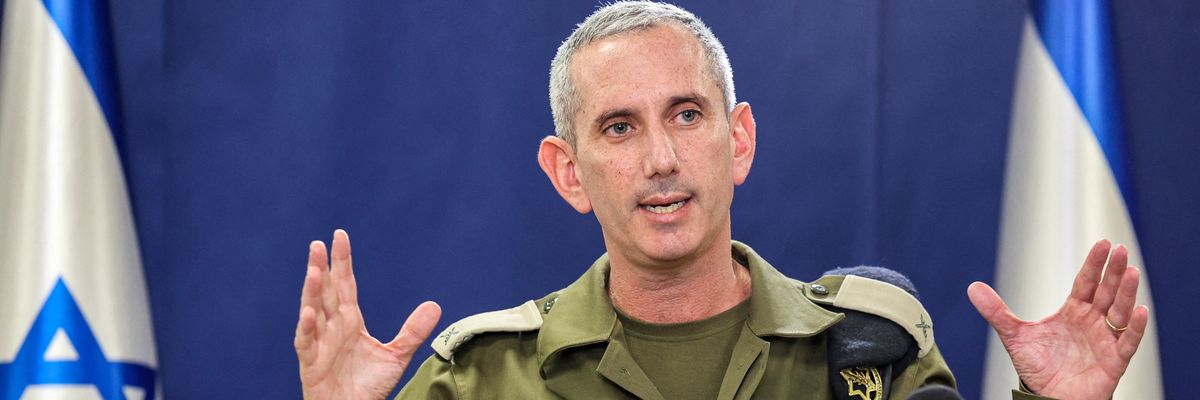
Israeli military spokesman Daniel Hagari speaks to the press in Tel Aviv on October 18, 2023.
A Washington Post investigation found Israel's evidence "falls short" of showing that Hamas used the facility as a command center.
The Israeli military launched a deadly assault on Gaza's largest hospital last month on the grounds that the facility concealed a sprawling Hamas command center.
But a detailed Washington Post investigation published Thursday found that the evidence Israel has presented in support of its claim "falls short" of demonstrating that Hamas used the al-Shifa Hospital Complex for any significant military operations.
U.S. President Joe Biden, who repeated the Israeli government's claim about al-Shifa, has not released any evidence to support the assertions.
"The claims were remarkably specific—that five hospital buildings were directly involved in Hamas activities; that the buildings sat atop underground tunnels that were used by militants to direct rocket attacks and command fighters; and that the tunnels could be accessed from inside hospital wards," the Post noted.
But the newspaper's examination of material released by the Israel Defense Forces, satellite imagery, and open-source visuals did not turn up anything resembling the "concrete evidence" that the IDF promised.
"Turns out the Shifa hospital wasn't a Hamas headquarters. Turns out the Israelis lied," MSNBC's Mehdi Hasan wrote in response to the investigation. "Turns out the Biden administration and U.S. intelligence were wrong."
"Who'd have guessed," he added sarcastically. "Well, a lot of us."
According to the Post:
Israel's raids on al-Shifa sparked international alarm, with United Nations officials warning at the time that the IDF's attack would put the lives of patients, healthcare workers, and displaced people at severe risk. Dozens of people—including several newborns—died during and following the IDF raids.
Hospitals are protected under international law, with military attacks on them prohibited unless they are used to "commit an act harmful to the enemy."
The Post's probe indicates that Israel has not produced nearly enough evidence to justify stripping al-Shifa of its protected status.
"Less than 24 hours after Israeli forces entered the complex, the IDF released video footage showing spokesman Jonathan Conricus walking through the radiology unit. Behind an MRI machine, he points out what he calls a 'grab bag' containing an AK-style rifle and an ammunition magazine," the Post reported. "Photos released by the military later that day purported to show the full haul of weapons recovered at the hospital—about 12 AK-style rifles, in addition to magazines of ammunition and several grenades and bulletproof vests."
"The Post was unable to independently verify to whom the weapons belonged or how they came to be inside the radiology unit," the newspaper added.
The BBC also scrutinized the video footage released by the IDF and similarly concluded that the evidence didn't match the Israeli government's description of al-Shifa as an "operational command center for Hamas."
The Post went on to analyze IDF visuals "showing the entrance to a tunnel shaft in a northeast corner of the hospital complex near the specialty surgery building," which was seen as a potential sign of Hamas activity below al-Shifa.
But after mapping the path of the tunnel and comparing the tunnel routes to an IDF map purporting to detail Hamas' command center infrastructure, the Post found that "none of the five buildings highlighted by the IDF appear to connect to the tunnels, and no evidence has been produced showing that the tunnels could be accessed from inside the hospital wards."
"If you don't end up finding what you said you were going to find, that justifies skepticism as to whether or not your assessment of military value in conducting the operation was legitimate," Geoffrey Corn, a law professor at Texas Tech University and a former senior law of war adviser to the U.S. Army, told the Post. "It's certainly not conclusive. The ultimate question is whether the assessment of military advantage was reasonable under the circumstances."
Al-Shifa is one of a number of Gaza hospitals that Israeli forces have attacked since October as part of what one U.N. official described as the IDF's "unrelenting war" on the territory's healthcare system.
Just nine of Gaza's 36 hospitals are still functioning. Tedros Adhanom Ghebreyesus, director-general of the World Health Organization, said Friday that northern Gaza currently has "no functional hospital."
"WHO will keep striving to supply health facilities in northern Gaza. But without medicines and other essential needs, all patients will die slowly and painfully," said Tedros. "More than ever, a humanitarian cease-fire is needed now to reinforce and restock remaining health facilities, deliver medical services needed by thousands of injured people and those needing other essential care, and, above all, to stop the bloodshed and death."
Dear Common Dreams reader, It’s been nearly 30 years since I co-founded Common Dreams with my late wife, Lina Newhouser. We had the radical notion that journalism should serve the public good, not corporate profits. It was clear to us from the outset what it would take to build such a project. No paid advertisements. No corporate sponsors. No millionaire publisher telling us what to think or do. Many people said we wouldn't last a year, but we proved those doubters wrong. Together with a tremendous team of journalists and dedicated staff, we built an independent media outlet free from the constraints of profits and corporate control. Our mission has always been simple: To inform. To inspire. To ignite change for the common good. Building Common Dreams was not easy. Our survival was never guaranteed. When you take on the most powerful forces—Wall Street greed, fossil fuel industry destruction, Big Tech lobbyists, and uber-rich oligarchs who have spent billions upon billions rigging the economy and democracy in their favor—the only bulwark you have is supporters who believe in your work. But here’s the urgent message from me today. It's never been this bad out there. And it's never been this hard to keep us going. At the very moment Common Dreams is most needed, the threats we face are intensifying. We need your support now more than ever. We don't accept corporate advertising and never will. We don't have a paywall because we don't think people should be blocked from critical news based on their ability to pay. Everything we do is funded by the donations of readers like you. When everyone does the little they can afford, we are strong. But if that support retreats or dries up, so do we. Will you donate now to make sure Common Dreams not only survives but thrives? —Craig Brown, Co-founder |
The Israeli military launched a deadly assault on Gaza's largest hospital last month on the grounds that the facility concealed a sprawling Hamas command center.
But a detailed Washington Post investigation published Thursday found that the evidence Israel has presented in support of its claim "falls short" of demonstrating that Hamas used the al-Shifa Hospital Complex for any significant military operations.
U.S. President Joe Biden, who repeated the Israeli government's claim about al-Shifa, has not released any evidence to support the assertions.
"The claims were remarkably specific—that five hospital buildings were directly involved in Hamas activities; that the buildings sat atop underground tunnels that were used by militants to direct rocket attacks and command fighters; and that the tunnels could be accessed from inside hospital wards," the Post noted.
But the newspaper's examination of material released by the Israel Defense Forces, satellite imagery, and open-source visuals did not turn up anything resembling the "concrete evidence" that the IDF promised.
"Turns out the Shifa hospital wasn't a Hamas headquarters. Turns out the Israelis lied," MSNBC's Mehdi Hasan wrote in response to the investigation. "Turns out the Biden administration and U.S. intelligence were wrong."
"Who'd have guessed," he added sarcastically. "Well, a lot of us."
According to the Post:
Israel's raids on al-Shifa sparked international alarm, with United Nations officials warning at the time that the IDF's attack would put the lives of patients, healthcare workers, and displaced people at severe risk. Dozens of people—including several newborns—died during and following the IDF raids.
Hospitals are protected under international law, with military attacks on them prohibited unless they are used to "commit an act harmful to the enemy."
The Post's probe indicates that Israel has not produced nearly enough evidence to justify stripping al-Shifa of its protected status.
"Less than 24 hours after Israeli forces entered the complex, the IDF released video footage showing spokesman Jonathan Conricus walking through the radiology unit. Behind an MRI machine, he points out what he calls a 'grab bag' containing an AK-style rifle and an ammunition magazine," the Post reported. "Photos released by the military later that day purported to show the full haul of weapons recovered at the hospital—about 12 AK-style rifles, in addition to magazines of ammunition and several grenades and bulletproof vests."
"The Post was unable to independently verify to whom the weapons belonged or how they came to be inside the radiology unit," the newspaper added.
The BBC also scrutinized the video footage released by the IDF and similarly concluded that the evidence didn't match the Israeli government's description of al-Shifa as an "operational command center for Hamas."
The Post went on to analyze IDF visuals "showing the entrance to a tunnel shaft in a northeast corner of the hospital complex near the specialty surgery building," which was seen as a potential sign of Hamas activity below al-Shifa.
But after mapping the path of the tunnel and comparing the tunnel routes to an IDF map purporting to detail Hamas' command center infrastructure, the Post found that "none of the five buildings highlighted by the IDF appear to connect to the tunnels, and no evidence has been produced showing that the tunnels could be accessed from inside the hospital wards."
"If you don't end up finding what you said you were going to find, that justifies skepticism as to whether or not your assessment of military value in conducting the operation was legitimate," Geoffrey Corn, a law professor at Texas Tech University and a former senior law of war adviser to the U.S. Army, told the Post. "It's certainly not conclusive. The ultimate question is whether the assessment of military advantage was reasonable under the circumstances."
Al-Shifa is one of a number of Gaza hospitals that Israeli forces have attacked since October as part of what one U.N. official described as the IDF's "unrelenting war" on the territory's healthcare system.
Just nine of Gaza's 36 hospitals are still functioning. Tedros Adhanom Ghebreyesus, director-general of the World Health Organization, said Friday that northern Gaza currently has "no functional hospital."
"WHO will keep striving to supply health facilities in northern Gaza. But without medicines and other essential needs, all patients will die slowly and painfully," said Tedros. "More than ever, a humanitarian cease-fire is needed now to reinforce and restock remaining health facilities, deliver medical services needed by thousands of injured people and those needing other essential care, and, above all, to stop the bloodshed and death."
The Israeli military launched a deadly assault on Gaza's largest hospital last month on the grounds that the facility concealed a sprawling Hamas command center.
But a detailed Washington Post investigation published Thursday found that the evidence Israel has presented in support of its claim "falls short" of demonstrating that Hamas used the al-Shifa Hospital Complex for any significant military operations.
U.S. President Joe Biden, who repeated the Israeli government's claim about al-Shifa, has not released any evidence to support the assertions.
"The claims were remarkably specific—that five hospital buildings were directly involved in Hamas activities; that the buildings sat atop underground tunnels that were used by militants to direct rocket attacks and command fighters; and that the tunnels could be accessed from inside hospital wards," the Post noted.
But the newspaper's examination of material released by the Israel Defense Forces, satellite imagery, and open-source visuals did not turn up anything resembling the "concrete evidence" that the IDF promised.
"Turns out the Shifa hospital wasn't a Hamas headquarters. Turns out the Israelis lied," MSNBC's Mehdi Hasan wrote in response to the investigation. "Turns out the Biden administration and U.S. intelligence were wrong."
"Who'd have guessed," he added sarcastically. "Well, a lot of us."
According to the Post:
Israel's raids on al-Shifa sparked international alarm, with United Nations officials warning at the time that the IDF's attack would put the lives of patients, healthcare workers, and displaced people at severe risk. Dozens of people—including several newborns—died during and following the IDF raids.
Hospitals are protected under international law, with military attacks on them prohibited unless they are used to "commit an act harmful to the enemy."
The Post's probe indicates that Israel has not produced nearly enough evidence to justify stripping al-Shifa of its protected status.
"Less than 24 hours after Israeli forces entered the complex, the IDF released video footage showing spokesman Jonathan Conricus walking through the radiology unit. Behind an MRI machine, he points out what he calls a 'grab bag' containing an AK-style rifle and an ammunition magazine," the Post reported. "Photos released by the military later that day purported to show the full haul of weapons recovered at the hospital—about 12 AK-style rifles, in addition to magazines of ammunition and several grenades and bulletproof vests."
"The Post was unable to independently verify to whom the weapons belonged or how they came to be inside the radiology unit," the newspaper added.
The BBC also scrutinized the video footage released by the IDF and similarly concluded that the evidence didn't match the Israeli government's description of al-Shifa as an "operational command center for Hamas."
The Post went on to analyze IDF visuals "showing the entrance to a tunnel shaft in a northeast corner of the hospital complex near the specialty surgery building," which was seen as a potential sign of Hamas activity below al-Shifa.
But after mapping the path of the tunnel and comparing the tunnel routes to an IDF map purporting to detail Hamas' command center infrastructure, the Post found that "none of the five buildings highlighted by the IDF appear to connect to the tunnels, and no evidence has been produced showing that the tunnels could be accessed from inside the hospital wards."
"If you don't end up finding what you said you were going to find, that justifies skepticism as to whether or not your assessment of military value in conducting the operation was legitimate," Geoffrey Corn, a law professor at Texas Tech University and a former senior law of war adviser to the U.S. Army, told the Post. "It's certainly not conclusive. The ultimate question is whether the assessment of military advantage was reasonable under the circumstances."
Al-Shifa is one of a number of Gaza hospitals that Israeli forces have attacked since October as part of what one U.N. official described as the IDF's "unrelenting war" on the territory's healthcare system.
Just nine of Gaza's 36 hospitals are still functioning. Tedros Adhanom Ghebreyesus, director-general of the World Health Organization, said Friday that northern Gaza currently has "no functional hospital."
"WHO will keep striving to supply health facilities in northern Gaza. But without medicines and other essential needs, all patients will die slowly and painfully," said Tedros. "More than ever, a humanitarian cease-fire is needed now to reinforce and restock remaining health facilities, deliver medical services needed by thousands of injured people and those needing other essential care, and, above all, to stop the bloodshed and death."