SUBSCRIBE TO OUR FREE NEWSLETTER
Daily news & progressive opinion—funded by the people, not the corporations—delivered straight to your inbox.
5
#000000
#FFFFFF
To donate by check, phone, or other method, see our More Ways to Give page.
Daily news & progressive opinion—funded by the people, not the corporations—delivered straight to your inbox.
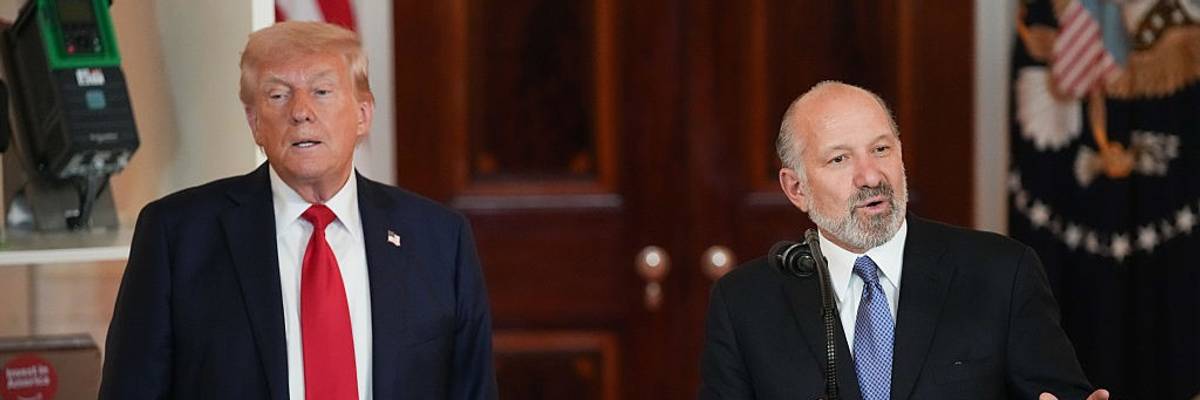
U.S. President Donald Trump listens as Commerce Secretary Howard Lutnick speaks on April 30, 2025 in Washington, D.C.
"This is a huge political defeat, and Trump has nobody to blame except his own overreach," wrote one economist.
A panel of three federal judges late Wednesday unanimously ruled that U.S. President Donald Trump overstepped his authority by invoking emergency powers to impose broad-based tariffs on imports, a significant blow to a trade agenda that has wreaked havoc on small businesses, consumers, and the global economy.
The judges on the U.S. Court of International Trade, including one Trump appointee, halted the 10% import tariffs that Trump unilaterally imposed in April on goods from nearly every country, as well as additional levies on certain products from Canada and Mexico.
The International Emergency Economic Powers Act of 1977, which Trump cited as the authority underlying his tariff scheme, does not confer "such unbounded authority" to the president, the court ruled Wednesday.
Melinda St. Louis, director of Public Citizen's Global Trade Watch, said in a statement that "Trump abused sweeping, unstrategic tariffs as part of a corrupt, authoritarian power grab to bully foreign countries and force U.S. companies to bend the knee to him and his billionaire friends."
"We welcome the court's decision striking down Trump's misuse of tariffs," St. Louis added.
The Trump administration almost immediately signaled plans to file an appeal in the case, which could ultimately wind up before the conservative-dominated U.S. Supreme Court.
Economist Paul Krugman wrote in response to the Wednesday decision that "presumably the Trumpists will try to undo this judgment, one way or another—exploiting other loopholes in the law, maybe trying to bully the court into submission, maybe just defying the court altogether."
"But this is a huge political defeat," Krugman added, "and Trump has nobody to blame except his own overreach."
Dear Common Dreams reader, It’s been nearly 30 years since I co-founded Common Dreams with my late wife, Lina Newhouser. We had the radical notion that journalism should serve the public good, not corporate profits. It was clear to us from the outset what it would take to build such a project. No paid advertisements. No corporate sponsors. No millionaire publisher telling us what to think or do. Many people said we wouldn't last a year, but we proved those doubters wrong. Together with a tremendous team of journalists and dedicated staff, we built an independent media outlet free from the constraints of profits and corporate control. Our mission has always been simple: To inform. To inspire. To ignite change for the common good. Building Common Dreams was not easy. Our survival was never guaranteed. When you take on the most powerful forces—Wall Street greed, fossil fuel industry destruction, Big Tech lobbyists, and uber-rich oligarchs who have spent billions upon billions rigging the economy and democracy in their favor—the only bulwark you have is supporters who believe in your work. But here’s the urgent message from me today. It's never been this bad out there. And it's never been this hard to keep us going. At the very moment Common Dreams is most needed, the threats we face are intensifying. We need your support now more than ever. We don't accept corporate advertising and never will. We don't have a paywall because we don't think people should be blocked from critical news based on their ability to pay. Everything we do is funded by the donations of readers like you. When everyone does the little they can afford, we are strong. But if that support retreats or dries up, so do we. Will you donate now to make sure Common Dreams not only survives but thrives? —Craig Brown, Co-founder |
A panel of three federal judges late Wednesday unanimously ruled that U.S. President Donald Trump overstepped his authority by invoking emergency powers to impose broad-based tariffs on imports, a significant blow to a trade agenda that has wreaked havoc on small businesses, consumers, and the global economy.
The judges on the U.S. Court of International Trade, including one Trump appointee, halted the 10% import tariffs that Trump unilaterally imposed in April on goods from nearly every country, as well as additional levies on certain products from Canada and Mexico.
The International Emergency Economic Powers Act of 1977, which Trump cited as the authority underlying his tariff scheme, does not confer "such unbounded authority" to the president, the court ruled Wednesday.
Melinda St. Louis, director of Public Citizen's Global Trade Watch, said in a statement that "Trump abused sweeping, unstrategic tariffs as part of a corrupt, authoritarian power grab to bully foreign countries and force U.S. companies to bend the knee to him and his billionaire friends."
"We welcome the court's decision striking down Trump's misuse of tariffs," St. Louis added.
The Trump administration almost immediately signaled plans to file an appeal in the case, which could ultimately wind up before the conservative-dominated U.S. Supreme Court.
Economist Paul Krugman wrote in response to the Wednesday decision that "presumably the Trumpists will try to undo this judgment, one way or another—exploiting other loopholes in the law, maybe trying to bully the court into submission, maybe just defying the court altogether."
"But this is a huge political defeat," Krugman added, "and Trump has nobody to blame except his own overreach."
A panel of three federal judges late Wednesday unanimously ruled that U.S. President Donald Trump overstepped his authority by invoking emergency powers to impose broad-based tariffs on imports, a significant blow to a trade agenda that has wreaked havoc on small businesses, consumers, and the global economy.
The judges on the U.S. Court of International Trade, including one Trump appointee, halted the 10% import tariffs that Trump unilaterally imposed in April on goods from nearly every country, as well as additional levies on certain products from Canada and Mexico.
The International Emergency Economic Powers Act of 1977, which Trump cited as the authority underlying his tariff scheme, does not confer "such unbounded authority" to the president, the court ruled Wednesday.
Melinda St. Louis, director of Public Citizen's Global Trade Watch, said in a statement that "Trump abused sweeping, unstrategic tariffs as part of a corrupt, authoritarian power grab to bully foreign countries and force U.S. companies to bend the knee to him and his billionaire friends."
"We welcome the court's decision striking down Trump's misuse of tariffs," St. Louis added.
The Trump administration almost immediately signaled plans to file an appeal in the case, which could ultimately wind up before the conservative-dominated U.S. Supreme Court.
Economist Paul Krugman wrote in response to the Wednesday decision that "presumably the Trumpists will try to undo this judgment, one way or another—exploiting other loopholes in the law, maybe trying to bully the court into submission, maybe just defying the court altogether."
"But this is a huge political defeat," Krugman added, "and Trump has nobody to blame except his own overreach."