SUBSCRIBE TO OUR FREE NEWSLETTER
Daily news & progressive opinion—funded by the people, not the corporations—delivered straight to your inbox.
5
#000000
#FFFFFF
To donate by check, phone, or other method, see our More Ways to Give page.
Daily news & progressive opinion—funded by the people, not the corporations—delivered straight to your inbox.
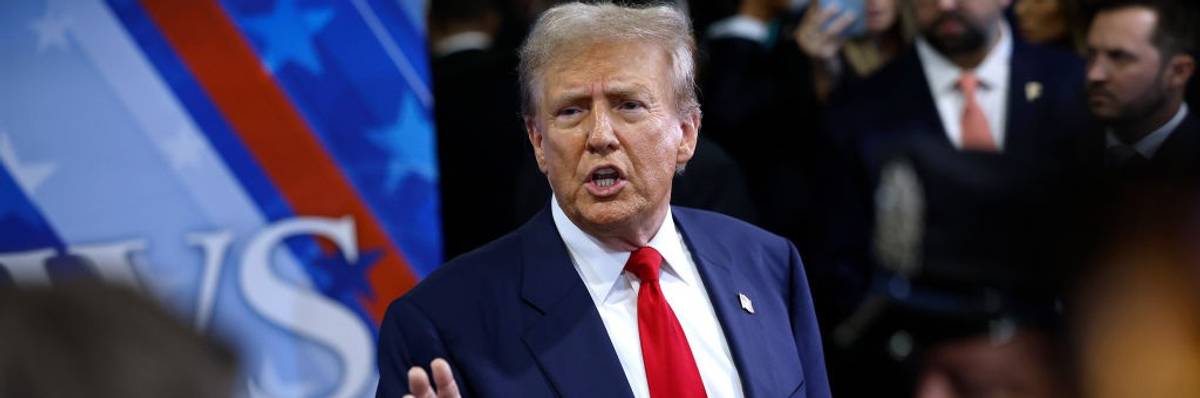
Republican presidential nominee Donald Trump talks to journalists after a debate on September 10, 2024.
"With 102 deniers on election boards in the swing states, the potential for creating chaos is enormous."
More than 100 election officials across eight swing states in the U.S. presidential race have engaged in partisan election denial in recent years, raising fears they could try to turn the November result in favor of Republican nominee Donald Trump, according to a report released Friday.
The 88-page report, produced by the Center for Media and Democracy (CMD), details the election denial history of 102 county and state election officials in Arizona, Wisconsin, Georgia, Nevada, New Mexico, North Carolina, Pennsylvania, and Michigan. The authors found that election deniers have majority control of 15 county election boards in those states and of the statewide board in Georgia.
"What was striking to us about our research is how much election denialism and the voter fraud lie have infiltrated and taken over the Republican apparatus in each of these critical states," Arn Pearson, CMD's executive director, told The Guardian.
"With 102 deniers on election boards in the swing states, the potential for creating chaos is enormous," Pearson added.
The three Republicans on the five-member Georgia state election board support Trump's baseless claims that the 2020 election was rigged. Last month, they changed the rules so that they'd have more power to refuse or delay certifying election results while conducting unspecified investigations, and they appear to be preparing more rules changes before November 5.
Trump recently commended the three Republicans by name at a rally in Atlanta, saying they were "on fire" and were "pit bulls fighting for honesty, transparency, and victory."
In 2020, Trump lost to President Joe Biden, a Democrat, by only about 12,000 votes in Georgia, one of the states expected to be closely contested again this year as the Republican former president faces off against Vice President Kamala Harris, the Democratic nominee.
Trump faces criminal charges in Georgia for trying to interfere in the 2020 presidential election. Four other defendants in the felony racketeering case have already pleaded guilty.
Marc Elias, an election lawyer who advises the Harris campaign, said the new rules in Georgia were "somewhere between insidious and insane." He and many other experts have emphasized that election boards are not meant to carry such power. Making a football analogy, Elias said that the rules gave "the scoreboard operator the opportunity to investigate for themselves whether a touchdown was scored," as he told The New Yorker Radio Hour.
Partisan conspiracy theories among election officials go well beyond Georgia, the CMD report shows. Pennsylvania has 29 election administration officials loyal to Trump—the most of any of the eight states—and they control the boards in seven counties there, the report says.
The report looks not just at election officials but also other Republican "election deniers" including U.S. congressional candidates and party officials from the eight states. The authors found 239 election deniers including the 102 election board officials.
CMD defined someone as an "election denier" if they had done any of the following: "denying that Joe Biden was the legitimate winner of the 2020 presidential election"; "espousing baseless claims or conspiracies about election and voter fraud during the 2020 election or subsequent elections"; "refusing to certify election results, or calling on others to refuse to certify, based on unfounded accusations of interference or fraud"; "expressing support for partisan or 'forensic' audits of 2020 election results"; "filing or expressing support for litigation aimed at overturning election results"; "participating in or supporting the January 6, 2021, assault on the U.S. Capitol or 'Stop the Steal' events."
Experts differ on whether Republican efforts to subvert the election, should Trump lose, will be more or less effective than in 2020.
"Our democracy's firewalls held fast in 2020, but election deniers and MAGA extremists have spent the last four years infiltrating election administration and political party positions in order to disrupt and cast doubt on the 2024 election results," Pearson said in a statement accompanying the report.
However, officials not loyal to Trump have also had more time to prepare for potential election interference, and the Electoral Count Reform Act, passed by Congress in 2022, could make it harder for Trump's efforts to succeed, experts say.
Pearson indicated that Trump's allies on election boards may not ultimately succeed at overturning the election but could sow doubt that damages democracy.
"While it is highly unlikely that these officials, along with deniers in Congress, will be able to prevent certification of the 2024 election results, they are in a prime position to force litigation and delay what should be a ministerial task while they and their allies whip up false claims of voter fraud, noncitizen voting, and a stolen election," he said.
CMD's report follows those of many other media outlets and watchdog groups in recent months, with broadly similar findings, if different exact figures. A CBS News investigation in May found 80 election-denying officials in seven battleground states. Rolling Stone and American Doom found nearly 70 in six states in July. And last month, Citizens for Responsibility and Ethics in Washington issued a detailed report identifying 35 "rogue" officials.
Dear Common Dreams reader, It’s been nearly 30 years since I co-founded Common Dreams with my late wife, Lina Newhouser. We had the radical notion that journalism should serve the public good, not corporate profits. It was clear to us from the outset what it would take to build such a project. No paid advertisements. No corporate sponsors. No millionaire publisher telling us what to think or do. Many people said we wouldn't last a year, but we proved those doubters wrong. Together with a tremendous team of journalists and dedicated staff, we built an independent media outlet free from the constraints of profits and corporate control. Our mission has always been simple: To inform. To inspire. To ignite change for the common good. Building Common Dreams was not easy. Our survival was never guaranteed. When you take on the most powerful forces—Wall Street greed, fossil fuel industry destruction, Big Tech lobbyists, and uber-rich oligarchs who have spent billions upon billions rigging the economy and democracy in their favor—the only bulwark you have is supporters who believe in your work. But here’s the urgent message from me today. It's never been this bad out there. And it's never been this hard to keep us going. At the very moment Common Dreams is most needed, the threats we face are intensifying. We need your support now more than ever. We don't accept corporate advertising and never will. We don't have a paywall because we don't think people should be blocked from critical news based on their ability to pay. Everything we do is funded by the donations of readers like you. When everyone does the little they can afford, we are strong. But if that support retreats or dries up, so do we. Will you donate now to make sure Common Dreams not only survives but thrives? —Craig Brown, Co-founder |
More than 100 election officials across eight swing states in the U.S. presidential race have engaged in partisan election denial in recent years, raising fears they could try to turn the November result in favor of Republican nominee Donald Trump, according to a report released Friday.
The 88-page report, produced by the Center for Media and Democracy (CMD), details the election denial history of 102 county and state election officials in Arizona, Wisconsin, Georgia, Nevada, New Mexico, North Carolina, Pennsylvania, and Michigan. The authors found that election deniers have majority control of 15 county election boards in those states and of the statewide board in Georgia.
"What was striking to us about our research is how much election denialism and the voter fraud lie have infiltrated and taken over the Republican apparatus in each of these critical states," Arn Pearson, CMD's executive director, told The Guardian.
"With 102 deniers on election boards in the swing states, the potential for creating chaos is enormous," Pearson added.
The three Republicans on the five-member Georgia state election board support Trump's baseless claims that the 2020 election was rigged. Last month, they changed the rules so that they'd have more power to refuse or delay certifying election results while conducting unspecified investigations, and they appear to be preparing more rules changes before November 5.
Trump recently commended the three Republicans by name at a rally in Atlanta, saying they were "on fire" and were "pit bulls fighting for honesty, transparency, and victory."
In 2020, Trump lost to President Joe Biden, a Democrat, by only about 12,000 votes in Georgia, one of the states expected to be closely contested again this year as the Republican former president faces off against Vice President Kamala Harris, the Democratic nominee.
Trump faces criminal charges in Georgia for trying to interfere in the 2020 presidential election. Four other defendants in the felony racketeering case have already pleaded guilty.
Marc Elias, an election lawyer who advises the Harris campaign, said the new rules in Georgia were "somewhere between insidious and insane." He and many other experts have emphasized that election boards are not meant to carry such power. Making a football analogy, Elias said that the rules gave "the scoreboard operator the opportunity to investigate for themselves whether a touchdown was scored," as he told The New Yorker Radio Hour.
Partisan conspiracy theories among election officials go well beyond Georgia, the CMD report shows. Pennsylvania has 29 election administration officials loyal to Trump—the most of any of the eight states—and they control the boards in seven counties there, the report says.
The report looks not just at election officials but also other Republican "election deniers" including U.S. congressional candidates and party officials from the eight states. The authors found 239 election deniers including the 102 election board officials.
CMD defined someone as an "election denier" if they had done any of the following: "denying that Joe Biden was the legitimate winner of the 2020 presidential election"; "espousing baseless claims or conspiracies about election and voter fraud during the 2020 election or subsequent elections"; "refusing to certify election results, or calling on others to refuse to certify, based on unfounded accusations of interference or fraud"; "expressing support for partisan or 'forensic' audits of 2020 election results"; "filing or expressing support for litigation aimed at overturning election results"; "participating in or supporting the January 6, 2021, assault on the U.S. Capitol or 'Stop the Steal' events."
Experts differ on whether Republican efforts to subvert the election, should Trump lose, will be more or less effective than in 2020.
"Our democracy's firewalls held fast in 2020, but election deniers and MAGA extremists have spent the last four years infiltrating election administration and political party positions in order to disrupt and cast doubt on the 2024 election results," Pearson said in a statement accompanying the report.
However, officials not loyal to Trump have also had more time to prepare for potential election interference, and the Electoral Count Reform Act, passed by Congress in 2022, could make it harder for Trump's efforts to succeed, experts say.
Pearson indicated that Trump's allies on election boards may not ultimately succeed at overturning the election but could sow doubt that damages democracy.
"While it is highly unlikely that these officials, along with deniers in Congress, will be able to prevent certification of the 2024 election results, they are in a prime position to force litigation and delay what should be a ministerial task while they and their allies whip up false claims of voter fraud, noncitizen voting, and a stolen election," he said.
CMD's report follows those of many other media outlets and watchdog groups in recent months, with broadly similar findings, if different exact figures. A CBS News investigation in May found 80 election-denying officials in seven battleground states. Rolling Stone and American Doom found nearly 70 in six states in July. And last month, Citizens for Responsibility and Ethics in Washington issued a detailed report identifying 35 "rogue" officials.
More than 100 election officials across eight swing states in the U.S. presidential race have engaged in partisan election denial in recent years, raising fears they could try to turn the November result in favor of Republican nominee Donald Trump, according to a report released Friday.
The 88-page report, produced by the Center for Media and Democracy (CMD), details the election denial history of 102 county and state election officials in Arizona, Wisconsin, Georgia, Nevada, New Mexico, North Carolina, Pennsylvania, and Michigan. The authors found that election deniers have majority control of 15 county election boards in those states and of the statewide board in Georgia.
"What was striking to us about our research is how much election denialism and the voter fraud lie have infiltrated and taken over the Republican apparatus in each of these critical states," Arn Pearson, CMD's executive director, told The Guardian.
"With 102 deniers on election boards in the swing states, the potential for creating chaos is enormous," Pearson added.
The three Republicans on the five-member Georgia state election board support Trump's baseless claims that the 2020 election was rigged. Last month, they changed the rules so that they'd have more power to refuse or delay certifying election results while conducting unspecified investigations, and they appear to be preparing more rules changes before November 5.
Trump recently commended the three Republicans by name at a rally in Atlanta, saying they were "on fire" and were "pit bulls fighting for honesty, transparency, and victory."
In 2020, Trump lost to President Joe Biden, a Democrat, by only about 12,000 votes in Georgia, one of the states expected to be closely contested again this year as the Republican former president faces off against Vice President Kamala Harris, the Democratic nominee.
Trump faces criminal charges in Georgia for trying to interfere in the 2020 presidential election. Four other defendants in the felony racketeering case have already pleaded guilty.
Marc Elias, an election lawyer who advises the Harris campaign, said the new rules in Georgia were "somewhere between insidious and insane." He and many other experts have emphasized that election boards are not meant to carry such power. Making a football analogy, Elias said that the rules gave "the scoreboard operator the opportunity to investigate for themselves whether a touchdown was scored," as he told The New Yorker Radio Hour.
Partisan conspiracy theories among election officials go well beyond Georgia, the CMD report shows. Pennsylvania has 29 election administration officials loyal to Trump—the most of any of the eight states—and they control the boards in seven counties there, the report says.
The report looks not just at election officials but also other Republican "election deniers" including U.S. congressional candidates and party officials from the eight states. The authors found 239 election deniers including the 102 election board officials.
CMD defined someone as an "election denier" if they had done any of the following: "denying that Joe Biden was the legitimate winner of the 2020 presidential election"; "espousing baseless claims or conspiracies about election and voter fraud during the 2020 election or subsequent elections"; "refusing to certify election results, or calling on others to refuse to certify, based on unfounded accusations of interference or fraud"; "expressing support for partisan or 'forensic' audits of 2020 election results"; "filing or expressing support for litigation aimed at overturning election results"; "participating in or supporting the January 6, 2021, assault on the U.S. Capitol or 'Stop the Steal' events."
Experts differ on whether Republican efforts to subvert the election, should Trump lose, will be more or less effective than in 2020.
"Our democracy's firewalls held fast in 2020, but election deniers and MAGA extremists have spent the last four years infiltrating election administration and political party positions in order to disrupt and cast doubt on the 2024 election results," Pearson said in a statement accompanying the report.
However, officials not loyal to Trump have also had more time to prepare for potential election interference, and the Electoral Count Reform Act, passed by Congress in 2022, could make it harder for Trump's efforts to succeed, experts say.
Pearson indicated that Trump's allies on election boards may not ultimately succeed at overturning the election but could sow doubt that damages democracy.
"While it is highly unlikely that these officials, along with deniers in Congress, will be able to prevent certification of the 2024 election results, they are in a prime position to force litigation and delay what should be a ministerial task while they and their allies whip up false claims of voter fraud, noncitizen voting, and a stolen election," he said.
CMD's report follows those of many other media outlets and watchdog groups in recent months, with broadly similar findings, if different exact figures. A CBS News investigation in May found 80 election-denying officials in seven battleground states. Rolling Stone and American Doom found nearly 70 in six states in July. And last month, Citizens for Responsibility and Ethics in Washington issued a detailed report identifying 35 "rogue" officials.