

SUBSCRIBE TO OUR FREE NEWSLETTER
Daily news & progressive opinion—funded by the people, not the corporations—delivered straight to your inbox.
5
#000000
#FFFFFF
To donate by check, phone, or other method, see our More Ways to Give page.
Daily news & progressive opinion—funded by the people, not the corporations—delivered straight to your inbox.
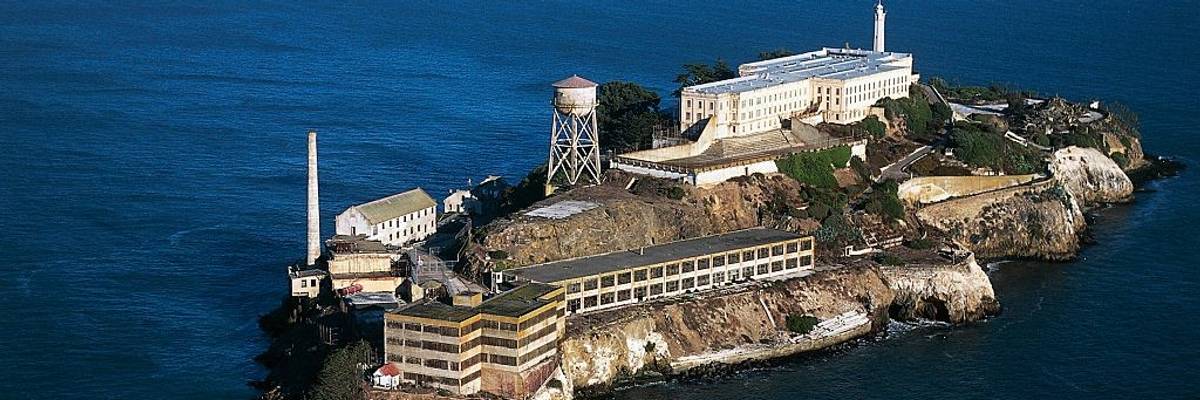
Aerial view of Alcatraz Island with The Rock, maximum security federal penitentiary from 1934 to 1963, San Francisco Bay, California, United States of America.
Less than two weeks ago, Trump's DOJ slashed nearly $1 billion from existing public safety grants that experts warn will "imperil public safety, not promote it."
Add "distraction" to the list of words being used to describe President Donald Trump's "psychotic," "deluded," and "unbefuckinglievable" talk about reopening the island prison of Alcatraz in California's San Francisco Bay.
In a statement to reporters on the White House lawn Sunday night, Trump said the idea for reopening Alcatraz—which he first floated in a social media post—was "just an idea I had" and that the prison was a "symbol of law and order."
But less than two weeks ago, the Trump administration ordered the cancellation of an estimated $811 million in grants for public safety from the Justice Department that experts and advocates say were proving successful at reducing crime and curbing harm in communities nationwide—all with bipartisan support.
"Alcatraz," said civil rights attorney Scott Hechinger in response to Trump's social media post—which sparked no shortage of headlines across the news media—is "no more than a sensational distraction from this: Trump just cut nearly $1 billion from bipartisan, proven, successful anti-crime, violence prevention programs around the country."
The various programs impacted by the grant cuts—including gun violence prevention and law enforcement trainings—said Hechinger, were designed to prevent crime "before people were ever harmed."
Arguing that Trump has made the country less safe, not more, by his policies, Hechinger added, "now he's stomping and parading around with big words and sensational capital letters about a wasteful reopening of a domestic torture complex that will never actually happen and do nothing to keep America safer. All while claiming to care about violence prevention. What a dangerous joke."
Lamenting the public safety grant cuts in a blog post last week, the Brennan Center for Justice's Rosemary Nidiry, senior counsel in the group's justice program, detailed how the grant funding slashed by Trump "filled critical gaps" in the nation's public safety infrastructure.
The grants, she noted, "supported victims of crime, trained law enforcement, offered treatment to people with behavioral health and substance issues, and helped people reintegrate into society after incarceration. They also promoted research used to create and guide effective policies. Many if not all were ended immediately and without warning, in the middle of a typical 3-year grant period, disrupting programs and creating financial strain for nonprofits."
"The slashed programs have been proven to make communities safer," wrote Nidiry, "and their end will in fact imperil public safety, not promote it."
When Alcatraz was closed by the Bureau of Prisons in 1963, the cost of running the crumbling facility was the primary driver of that decision.
As Newsweek reports, "Operating Alcatraz proved to be significantly more expensive than other federal prisons. In 1959, the daily per capita cost at Alcatraz was $10.10, compared with $3.00 at the U.S. Penitentiary in Atlanta, making it nearly three times more costly to operate. This high expense was largely due to the island's isolation, which necessitated that all supplies, including food, water, and fuel, be transported by boat. For instance, nearly one million gallons of fresh water had to be barged to the island each week."
In a letter on Friday, over three dozen Democratic lawmakers called on the Justice Department to reinstate $150 million in grants awarded for gun violence prevention.
"This funding, appropriated by Congress, directly contributes to making communities safer," the lawmakers stated in a letter. "We urge you to honor the grants already awarded and to implement this funding as Congress directed."
Dear Common Dreams reader, It’s been nearly 30 years since I co-founded Common Dreams with my late wife, Lina Newhouser. We had the radical notion that journalism should serve the public good, not corporate profits. It was clear to us from the outset what it would take to build such a project. No paid advertisements. No corporate sponsors. No millionaire publisher telling us what to think or do. Many people said we wouldn't last a year, but we proved those doubters wrong. Together with a tremendous team of journalists and dedicated staff, we built an independent media outlet free from the constraints of profits and corporate control. Our mission has always been simple: To inform. To inspire. To ignite change for the common good. Building Common Dreams was not easy. Our survival was never guaranteed. When you take on the most powerful forces—Wall Street greed, fossil fuel industry destruction, Big Tech lobbyists, and uber-rich oligarchs who have spent billions upon billions rigging the economy and democracy in their favor—the only bulwark you have is supporters who believe in your work. But here’s the urgent message from me today. It's never been this bad out there. And it's never been this hard to keep us going. At the very moment Common Dreams is most needed, the threats we face are intensifying. We need your support now more than ever. We don't accept corporate advertising and never will. We don't have a paywall because we don't think people should be blocked from critical news based on their ability to pay. Everything we do is funded by the donations of readers like you. When everyone does the little they can afford, we are strong. But if that support retreats or dries up, so do we. Will you donate now to make sure Common Dreams not only survives but thrives? —Craig Brown, Co-founder |
Add "distraction" to the list of words being used to describe President Donald Trump's "psychotic," "deluded," and "unbefuckinglievable" talk about reopening the island prison of Alcatraz in California's San Francisco Bay.
In a statement to reporters on the White House lawn Sunday night, Trump said the idea for reopening Alcatraz—which he first floated in a social media post—was "just an idea I had" and that the prison was a "symbol of law and order."
But less than two weeks ago, the Trump administration ordered the cancellation of an estimated $811 million in grants for public safety from the Justice Department that experts and advocates say were proving successful at reducing crime and curbing harm in communities nationwide—all with bipartisan support.
"Alcatraz," said civil rights attorney Scott Hechinger in response to Trump's social media post—which sparked no shortage of headlines across the news media—is "no more than a sensational distraction from this: Trump just cut nearly $1 billion from bipartisan, proven, successful anti-crime, violence prevention programs around the country."
The various programs impacted by the grant cuts—including gun violence prevention and law enforcement trainings—said Hechinger, were designed to prevent crime "before people were ever harmed."
Arguing that Trump has made the country less safe, not more, by his policies, Hechinger added, "now he's stomping and parading around with big words and sensational capital letters about a wasteful reopening of a domestic torture complex that will never actually happen and do nothing to keep America safer. All while claiming to care about violence prevention. What a dangerous joke."
Lamenting the public safety grant cuts in a blog post last week, the Brennan Center for Justice's Rosemary Nidiry, senior counsel in the group's justice program, detailed how the grant funding slashed by Trump "filled critical gaps" in the nation's public safety infrastructure.
The grants, she noted, "supported victims of crime, trained law enforcement, offered treatment to people with behavioral health and substance issues, and helped people reintegrate into society after incarceration. They also promoted research used to create and guide effective policies. Many if not all were ended immediately and without warning, in the middle of a typical 3-year grant period, disrupting programs and creating financial strain for nonprofits."
"The slashed programs have been proven to make communities safer," wrote Nidiry, "and their end will in fact imperil public safety, not promote it."
When Alcatraz was closed by the Bureau of Prisons in 1963, the cost of running the crumbling facility was the primary driver of that decision.
As Newsweek reports, "Operating Alcatraz proved to be significantly more expensive than other federal prisons. In 1959, the daily per capita cost at Alcatraz was $10.10, compared with $3.00 at the U.S. Penitentiary in Atlanta, making it nearly three times more costly to operate. This high expense was largely due to the island's isolation, which necessitated that all supplies, including food, water, and fuel, be transported by boat. For instance, nearly one million gallons of fresh water had to be barged to the island each week."
In a letter on Friday, over three dozen Democratic lawmakers called on the Justice Department to reinstate $150 million in grants awarded for gun violence prevention.
"This funding, appropriated by Congress, directly contributes to making communities safer," the lawmakers stated in a letter. "We urge you to honor the grants already awarded and to implement this funding as Congress directed."
Add "distraction" to the list of words being used to describe President Donald Trump's "psychotic," "deluded," and "unbefuckinglievable" talk about reopening the island prison of Alcatraz in California's San Francisco Bay.
In a statement to reporters on the White House lawn Sunday night, Trump said the idea for reopening Alcatraz—which he first floated in a social media post—was "just an idea I had" and that the prison was a "symbol of law and order."
But less than two weeks ago, the Trump administration ordered the cancellation of an estimated $811 million in grants for public safety from the Justice Department that experts and advocates say were proving successful at reducing crime and curbing harm in communities nationwide—all with bipartisan support.
"Alcatraz," said civil rights attorney Scott Hechinger in response to Trump's social media post—which sparked no shortage of headlines across the news media—is "no more than a sensational distraction from this: Trump just cut nearly $1 billion from bipartisan, proven, successful anti-crime, violence prevention programs around the country."
The various programs impacted by the grant cuts—including gun violence prevention and law enforcement trainings—said Hechinger, were designed to prevent crime "before people were ever harmed."
Arguing that Trump has made the country less safe, not more, by his policies, Hechinger added, "now he's stomping and parading around with big words and sensational capital letters about a wasteful reopening of a domestic torture complex that will never actually happen and do nothing to keep America safer. All while claiming to care about violence prevention. What a dangerous joke."
Lamenting the public safety grant cuts in a blog post last week, the Brennan Center for Justice's Rosemary Nidiry, senior counsel in the group's justice program, detailed how the grant funding slashed by Trump "filled critical gaps" in the nation's public safety infrastructure.
The grants, she noted, "supported victims of crime, trained law enforcement, offered treatment to people with behavioral health and substance issues, and helped people reintegrate into society after incarceration. They also promoted research used to create and guide effective policies. Many if not all were ended immediately and without warning, in the middle of a typical 3-year grant period, disrupting programs and creating financial strain for nonprofits."
"The slashed programs have been proven to make communities safer," wrote Nidiry, "and their end will in fact imperil public safety, not promote it."
When Alcatraz was closed by the Bureau of Prisons in 1963, the cost of running the crumbling facility was the primary driver of that decision.
As Newsweek reports, "Operating Alcatraz proved to be significantly more expensive than other federal prisons. In 1959, the daily per capita cost at Alcatraz was $10.10, compared with $3.00 at the U.S. Penitentiary in Atlanta, making it nearly three times more costly to operate. This high expense was largely due to the island's isolation, which necessitated that all supplies, including food, water, and fuel, be transported by boat. For instance, nearly one million gallons of fresh water had to be barged to the island each week."
In a letter on Friday, over three dozen Democratic lawmakers called on the Justice Department to reinstate $150 million in grants awarded for gun violence prevention.
"This funding, appropriated by Congress, directly contributes to making communities safer," the lawmakers stated in a letter. "We urge you to honor the grants already awarded and to implement this funding as Congress directed."

