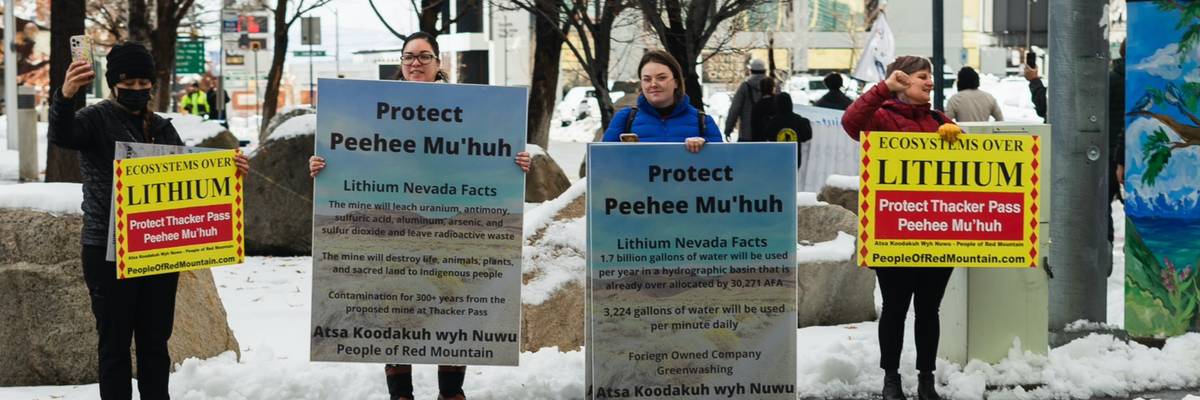
Indigenous and environmental activists protest against a proposed lithium mine at Thacker Pass, Nevada—the site of an 1865 massacre of Northern Paiute Indians by genocidal U.S. invaders.
'A Truly Unfortunate Outcome' as 9th Circuit Denies Injunction Against Nevada Lithium Mine
"This massive open-pit mine has been fast-tracked from start to finish in defiance of environmental laws, all in the name of 'green energy,' but its environmental impacts will be permanent and severe," said one opponent of the project.
Indigenous and environmental activists on Wednesday decried the 9th U.S. Circuit Court of Appeals' denial of an emergency injunction sought by conservation groups to block a proposed northern Nevada lithium mine that opponents argue was approved illegally and will harm the land and wildlife in the delicate desert ecosystem.
The San Francisco-based 9th Circuit denied a bid by the Western Watersheds Project (WWP) that would have stopped Lithium Nevada, a subsidiary of Canada-based Lithium Americas, from breaking ground on the Thacker Pass Lithium Mine in Humboldt County near the Oregon border.
Last month, WWP filed an emergency motion for injunction in the the U.S. District Court of Nevada after a federal judge ordered the Bureau of Land Management (BLM) to review part of its approval of the mine but allowed construction to proceed in the meantime. That request was denied last Friday.
"It's a truly unfortunate outcome for the land, wildlife, and cultural resources of this area," WWP staff attorney Talasi Brooks said in a statement. "This massive open-pit mine has been fast-tracked from start to finish in defiance of environmental laws, all in the name of 'green energy,' but its environmental impacts will be permanent and severe."
Opponents argue the Thacker Pass project—which would tap into the largest known source of lithium in the United States and was approved during the final days of the Trump administration—was unlawfully authorized and will irreparably damage lands and wildlife.
Three Native American tribes—the Reno-Sparks Indian Colony, Burns Paiute Tribe, and Summit Lake Paiute Tribe—are also suing in a bid to block construction of the mine, claiming that claimed BLM withheld key information from the Nevada State Historic Preservation Office and misrepresented how much the agency consulted with tribes prior to approving the project.
Thacker Pass—or Pass PeeHee Mu'Huh, which means "rotten moon" to all three tribes—is the site of a September 12, 1865 massacre of dozens and perhaps scores of Northern Paiute men, women, and children by U.S. Cavalry troops. The three tribes want all of Thacker Pass listed on the National Register of Historic Places.
"It is a disappointment to see valuable biological, cultural, and visual resources sacrificed for a stripmine that has been greenwashed to be good for the environment."
"It is a disappointment to see valuable biological, cultural, and visual resources sacrificed for a stripmine that has been greenwashed to be good for the environment," said Kevin Emmerich, co-founder of the advocacy group Basin and Range Watch.
"In reality, the mine will impact Great Basin wildlife and hydrology for centuries or more," Emmerich added. "We will not see any kind of recovery of this region in our lifetime."
Katie Fite of WildLands Defense said after Wednesday's ruling that "Thacker Pass lithium mining will deal a major blow to a critical sage-grouse population."
"BLM's rushed mine approval exposed that it continues to treat the West's irreplaceable sagebrush wild lands and cultural landscapes as sacrifice zones to industry," Fite added. "It's absurd for officials to greenwash this dirty lithium mine. We'll continue working to expose the ecological travesty taking place."
While global demand for lithium is surging, extraction of the metal can have harmful consequences, including the destruction of lands and ecosystems and water contamination.
Thacker Pass is believed to hold enough lithium to supply the needs of more than 1.5 million electric vehicles every year for 40 years, according to Lithium Americas.
"There are no other U.S. alternatives to Thacker Pass to provide lithium at the scale, grade, or timeline necessary to begin closing the gap between the lithium available and the lithium needed to achieve the U.S.' clean energy and transportation goals," lawyers for the company argued.
However, numerous lithium mining experts have asserted that the technology is not green—and comes with high environmental and social costs.
Lithium extraction, noted a 2021 Nature editorial, globally "requires large quantities of energy and water. Moreover, the work takes place in mines where workers—including children as young as seven—often face unsafe conditions."
We are at a crossroads
This country and this world are at a monumental crossroads. In a few short weeks, US voters will have an opportunity to beat back the forces of fascism and confront the billionaires who are rigging the economy, our media system, and our democracy, making it increasingly impossible for ordinary people to get by. We’re not just talking about the election. We’re talking about what must be done once these fascist elements are vanquished from power. We need a bolder set of solutions than what either major party has so far been willing to offer and a working-class movement ready to fight like hell for it. Trump didn't emerge from nowhere. The conditions that fueled MAGA authoritarianism were created by decades of radical neoliberal economic policies and a corrupt political system dominated by corporate interests. They slashed taxes on the super-rich, promising that the benefits would trickle down. They said giveaways to the corporate titans would make life more affordable for the rest of us. It was all bullshit. And when a bitter, betrayed populace searches for someone to blame, right-wing demagogues have little trouble finding scapegoats. People know when they're being lied to, but you won't hear any of this from the corporate media. Only independent journalism—powered and funded by people who believe in building a better world—can deliver truly trustworthy daily news. Our Fall Campaign is underway, and we need your help. To power our newsroom through the rest of the year, we need to raise $125,000 by midnight on October 31. So if you share our vision, please contribute whatever you can to sustain our work. |
Indigenous and environmental activists on Wednesday decried the 9th U.S. Circuit Court of Appeals' denial of an emergency injunction sought by conservation groups to block a proposed northern Nevada lithium mine that opponents argue was approved illegally and will harm the land and wildlife in the delicate desert ecosystem.
The San Francisco-based 9th Circuit denied a bid by the Western Watersheds Project (WWP) that would have stopped Lithium Nevada, a subsidiary of Canada-based Lithium Americas, from breaking ground on the Thacker Pass Lithium Mine in Humboldt County near the Oregon border.
Last month, WWP filed an emergency motion for injunction in the the U.S. District Court of Nevada after a federal judge ordered the Bureau of Land Management (BLM) to review part of its approval of the mine but allowed construction to proceed in the meantime. That request was denied last Friday.
"It's a truly unfortunate outcome for the land, wildlife, and cultural resources of this area," WWP staff attorney Talasi Brooks said in a statement. "This massive open-pit mine has been fast-tracked from start to finish in defiance of environmental laws, all in the name of 'green energy,' but its environmental impacts will be permanent and severe."
Opponents argue the Thacker Pass project—which would tap into the largest known source of lithium in the United States and was approved during the final days of the Trump administration—was unlawfully authorized and will irreparably damage lands and wildlife.
Three Native American tribes—the Reno-Sparks Indian Colony, Burns Paiute Tribe, and Summit Lake Paiute Tribe—are also suing in a bid to block construction of the mine, claiming that claimed BLM withheld key information from the Nevada State Historic Preservation Office and misrepresented how much the agency consulted with tribes prior to approving the project.
Thacker Pass—or Pass PeeHee Mu'Huh, which means "rotten moon" to all three tribes—is the site of a September 12, 1865 massacre of dozens and perhaps scores of Northern Paiute men, women, and children by U.S. Cavalry troops. The three tribes want all of Thacker Pass listed on the National Register of Historic Places.
"It is a disappointment to see valuable biological, cultural, and visual resources sacrificed for a stripmine that has been greenwashed to be good for the environment."
"It is a disappointment to see valuable biological, cultural, and visual resources sacrificed for a stripmine that has been greenwashed to be good for the environment," said Kevin Emmerich, co-founder of the advocacy group Basin and Range Watch.
"In reality, the mine will impact Great Basin wildlife and hydrology for centuries or more," Emmerich added. "We will not see any kind of recovery of this region in our lifetime."
Katie Fite of WildLands Defense said after Wednesday's ruling that "Thacker Pass lithium mining will deal a major blow to a critical sage-grouse population."
"BLM's rushed mine approval exposed that it continues to treat the West's irreplaceable sagebrush wild lands and cultural landscapes as sacrifice zones to industry," Fite added. "It's absurd for officials to greenwash this dirty lithium mine. We'll continue working to expose the ecological travesty taking place."
While global demand for lithium is surging, extraction of the metal can have harmful consequences, including the destruction of lands and ecosystems and water contamination.
Thacker Pass is believed to hold enough lithium to supply the needs of more than 1.5 million electric vehicles every year for 40 years, according to Lithium Americas.
"There are no other U.S. alternatives to Thacker Pass to provide lithium at the scale, grade, or timeline necessary to begin closing the gap between the lithium available and the lithium needed to achieve the U.S.' clean energy and transportation goals," lawyers for the company argued.
However, numerous lithium mining experts have asserted that the technology is not green—and comes with high environmental and social costs.
Lithium extraction, noted a 2021 Nature editorial, globally "requires large quantities of energy and water. Moreover, the work takes place in mines where workers—including children as young as seven—often face unsafe conditions."
Indigenous and environmental activists on Wednesday decried the 9th U.S. Circuit Court of Appeals' denial of an emergency injunction sought by conservation groups to block a proposed northern Nevada lithium mine that opponents argue was approved illegally and will harm the land and wildlife in the delicate desert ecosystem.
The San Francisco-based 9th Circuit denied a bid by the Western Watersheds Project (WWP) that would have stopped Lithium Nevada, a subsidiary of Canada-based Lithium Americas, from breaking ground on the Thacker Pass Lithium Mine in Humboldt County near the Oregon border.
Last month, WWP filed an emergency motion for injunction in the the U.S. District Court of Nevada after a federal judge ordered the Bureau of Land Management (BLM) to review part of its approval of the mine but allowed construction to proceed in the meantime. That request was denied last Friday.
"It's a truly unfortunate outcome for the land, wildlife, and cultural resources of this area," WWP staff attorney Talasi Brooks said in a statement. "This massive open-pit mine has been fast-tracked from start to finish in defiance of environmental laws, all in the name of 'green energy,' but its environmental impacts will be permanent and severe."
Opponents argue the Thacker Pass project—which would tap into the largest known source of lithium in the United States and was approved during the final days of the Trump administration—was unlawfully authorized and will irreparably damage lands and wildlife.
Three Native American tribes—the Reno-Sparks Indian Colony, Burns Paiute Tribe, and Summit Lake Paiute Tribe—are also suing in a bid to block construction of the mine, claiming that claimed BLM withheld key information from the Nevada State Historic Preservation Office and misrepresented how much the agency consulted with tribes prior to approving the project.
Thacker Pass—or Pass PeeHee Mu'Huh, which means "rotten moon" to all three tribes—is the site of a September 12, 1865 massacre of dozens and perhaps scores of Northern Paiute men, women, and children by U.S. Cavalry troops. The three tribes want all of Thacker Pass listed on the National Register of Historic Places.
"It is a disappointment to see valuable biological, cultural, and visual resources sacrificed for a stripmine that has been greenwashed to be good for the environment."
"It is a disappointment to see valuable biological, cultural, and visual resources sacrificed for a stripmine that has been greenwashed to be good for the environment," said Kevin Emmerich, co-founder of the advocacy group Basin and Range Watch.
"In reality, the mine will impact Great Basin wildlife and hydrology for centuries or more," Emmerich added. "We will not see any kind of recovery of this region in our lifetime."
Katie Fite of WildLands Defense said after Wednesday's ruling that "Thacker Pass lithium mining will deal a major blow to a critical sage-grouse population."
"BLM's rushed mine approval exposed that it continues to treat the West's irreplaceable sagebrush wild lands and cultural landscapes as sacrifice zones to industry," Fite added. "It's absurd for officials to greenwash this dirty lithium mine. We'll continue working to expose the ecological travesty taking place."
While global demand for lithium is surging, extraction of the metal can have harmful consequences, including the destruction of lands and ecosystems and water contamination.
Thacker Pass is believed to hold enough lithium to supply the needs of more than 1.5 million electric vehicles every year for 40 years, according to Lithium Americas.
"There are no other U.S. alternatives to Thacker Pass to provide lithium at the scale, grade, or timeline necessary to begin closing the gap between the lithium available and the lithium needed to achieve the U.S.' clean energy and transportation goals," lawyers for the company argued.
However, numerous lithium mining experts have asserted that the technology is not green—and comes with high environmental and social costs.
Lithium extraction, noted a 2021 Nature editorial, globally "requires large quantities of energy and water. Moreover, the work takes place in mines where workers—including children as young as seven—often face unsafe conditions."