

SUBSCRIBE TO OUR FREE NEWSLETTER
Daily news & progressive opinion—funded by the people, not the corporations—delivered straight to your inbox.
5
#000000
#FFFFFF
To donate by check, phone, or other method, see our More Ways to Give page.
Daily news & progressive opinion—funded by the people, not the corporations—delivered straight to your inbox.
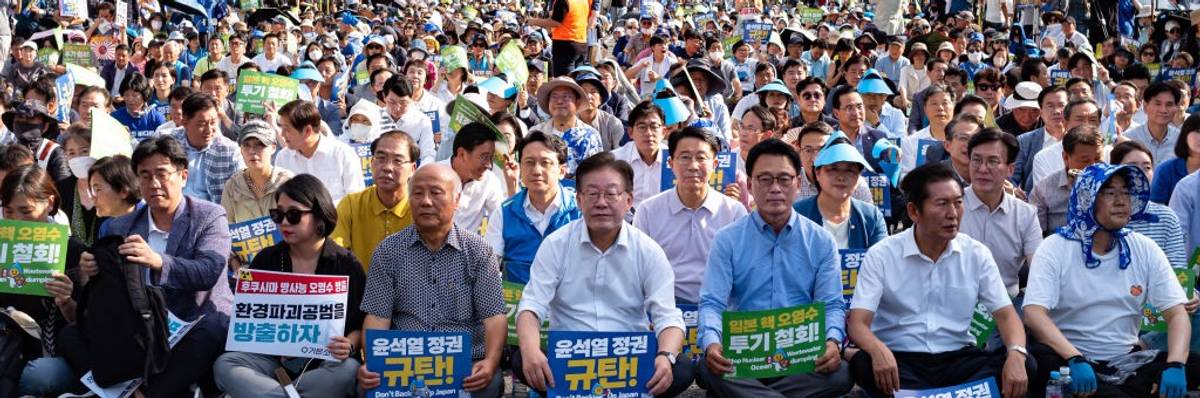
Lee Jae-myung (center), leader of the main opposition Democratic Party and member of congress and Tens of thousands of protested calling for an end to the marine discharge of nuclear-contaminated water from Fukushima, Japan on Saturday, September 2nd, 2023 in Seoul, South Korea.
'It is time for the international community to step in and call out this clear breach of the international law'
South Koreans have continued a weekend rally against Japan's dumping of Fukushima nuclear plant's contaminated radioactive wastewater into the ocean by holding a large demonstration on Saturday.
The protesters, including fishermen, activists and politicians, shouted slogans such as "Immediately stop the marine dumping of radioactive wastewater" and "Prohibit import of all Japanese aquatic products," as they urged the South Korean government to file a lawsuit with the International Tribunal for the Law of the Sea against the Japanese government.
On August 24th, Japan began dumping radioactive water from the crippled Fukushima Daiichi nuclear power plant into the Pacific Ocean.
The move resulted in a massive backlash across Asia and around the world.
While South Korea's opposition Democratic Party leader Lee Jae-myung calls the Fukushima release an "act of terror," the country's government under President Yoon Suk Yeol has backed Japan's decision, Deutsche Welle explained. However, the release is unpopular with the public, with more than 80% opposing the release and more than 60% vowing not to eat Japanese seafood afterward, The Associated Press reported.
According to The Korea Herald:
Democratic Party of Korea head Rep. Lee Jae-myung, on the fourth day of a hunger strike, said he would call on the international community to join his party’s protests against the Japanese government over the water’s release, in a press conference on Sunday.
“The dumping of the wastewater contaminated with radioactive materials by Japan is in direct violation of the London Convention on marine pollution,” he said. “It is time for the international community to step in and call out this clear breach of the international law, stop Japan’s misbehavior and stand united to preserve marine safety.”
The main opposition leader said he penned a letter to the heads of states and governments of the 86 signatories of the London Convention to collectively rally against the release of the Fukushima wastewater.
Xinhua news reports:
"Fukushima nuclear-contaminated wastewater has the nature of trash," Lee Seo-yoon, a mother of three children, said during the rally, adding that Japan regards the ocean as the largest and the cheapest trash bag.
Lee stressed that it would be absurd to hope that no one would be harmed after dumping the trash into the ocean, urging Tokyo to store the radioactive wastewater on its soil rather than dumping it in the sea.
"The ocean is the future of my family and the future of our descendants," said Kim Sam-ho, a fisherman who came from the country's southern coastal Wando County.
Kim raised his strong doubts about the safety of the radioactive wastewater, calling for the South Korean government to take necessary actions including supporting measures for fishermen.
"The major purpose of nuclear safety is to block radiation from reaching the environment and people," said Han Byung-sub, a nuclear expert who had worked at the Korea Atomic Energy Research Institute (KAERI) and the Korea Electric Power Corp. Engineering & Construction (KEPCO E&C).
Han noted that the proper measurement of radiation from Fukushima, involving groundwater flowing in and out of the destroyed reactor, was not carried out, urging the South Korean government to properly measure the radiation in waters off the country from now on.
Following the one-and-a-half-hour rally, the protesters marched about five km in downtown Seoul to the presidential office.
Dear Common Dreams reader, It’s been nearly 30 years since I co-founded Common Dreams with my late wife, Lina Newhouser. We had the radical notion that journalism should serve the public good, not corporate profits. It was clear to us from the outset what it would take to build such a project. No paid advertisements. No corporate sponsors. No millionaire publisher telling us what to think or do. Many people said we wouldn't last a year, but we proved those doubters wrong. Together with a tremendous team of journalists and dedicated staff, we built an independent media outlet free from the constraints of profits and corporate control. Our mission has always been simple: To inform. To inspire. To ignite change for the common good. Building Common Dreams was not easy. Our survival was never guaranteed. When you take on the most powerful forces—Wall Street greed, fossil fuel industry destruction, Big Tech lobbyists, and uber-rich oligarchs who have spent billions upon billions rigging the economy and democracy in their favor—the only bulwark you have is supporters who believe in your work. But here’s the urgent message from me today. It's never been this bad out there. And it's never been this hard to keep us going. At the very moment Common Dreams is most needed, the threats we face are intensifying. We need your support now more than ever. We don't accept corporate advertising and never will. We don't have a paywall because we don't think people should be blocked from critical news based on their ability to pay. Everything we do is funded by the donations of readers like you. When everyone does the little they can afford, we are strong. But if that support retreats or dries up, so do we. Will you donate now to make sure Common Dreams not only survives but thrives? —Craig Brown, Co-founder |
South Koreans have continued a weekend rally against Japan's dumping of Fukushima nuclear plant's contaminated radioactive wastewater into the ocean by holding a large demonstration on Saturday.
The protesters, including fishermen, activists and politicians, shouted slogans such as "Immediately stop the marine dumping of radioactive wastewater" and "Prohibit import of all Japanese aquatic products," as they urged the South Korean government to file a lawsuit with the International Tribunal for the Law of the Sea against the Japanese government.
On August 24th, Japan began dumping radioactive water from the crippled Fukushima Daiichi nuclear power plant into the Pacific Ocean.
The move resulted in a massive backlash across Asia and around the world.
While South Korea's opposition Democratic Party leader Lee Jae-myung calls the Fukushima release an "act of terror," the country's government under President Yoon Suk Yeol has backed Japan's decision, Deutsche Welle explained. However, the release is unpopular with the public, with more than 80% opposing the release and more than 60% vowing not to eat Japanese seafood afterward, The Associated Press reported.
According to The Korea Herald:
Democratic Party of Korea head Rep. Lee Jae-myung, on the fourth day of a hunger strike, said he would call on the international community to join his party’s protests against the Japanese government over the water’s release, in a press conference on Sunday.
“The dumping of the wastewater contaminated with radioactive materials by Japan is in direct violation of the London Convention on marine pollution,” he said. “It is time for the international community to step in and call out this clear breach of the international law, stop Japan’s misbehavior and stand united to preserve marine safety.”
The main opposition leader said he penned a letter to the heads of states and governments of the 86 signatories of the London Convention to collectively rally against the release of the Fukushima wastewater.
Xinhua news reports:
"Fukushima nuclear-contaminated wastewater has the nature of trash," Lee Seo-yoon, a mother of three children, said during the rally, adding that Japan regards the ocean as the largest and the cheapest trash bag.
Lee stressed that it would be absurd to hope that no one would be harmed after dumping the trash into the ocean, urging Tokyo to store the radioactive wastewater on its soil rather than dumping it in the sea.
"The ocean is the future of my family and the future of our descendants," said Kim Sam-ho, a fisherman who came from the country's southern coastal Wando County.
Kim raised his strong doubts about the safety of the radioactive wastewater, calling for the South Korean government to take necessary actions including supporting measures for fishermen.
"The major purpose of nuclear safety is to block radiation from reaching the environment and people," said Han Byung-sub, a nuclear expert who had worked at the Korea Atomic Energy Research Institute (KAERI) and the Korea Electric Power Corp. Engineering & Construction (KEPCO E&C).
Han noted that the proper measurement of radiation from Fukushima, involving groundwater flowing in and out of the destroyed reactor, was not carried out, urging the South Korean government to properly measure the radiation in waters off the country from now on.
Following the one-and-a-half-hour rally, the protesters marched about five km in downtown Seoul to the presidential office.
South Koreans have continued a weekend rally against Japan's dumping of Fukushima nuclear plant's contaminated radioactive wastewater into the ocean by holding a large demonstration on Saturday.
The protesters, including fishermen, activists and politicians, shouted slogans such as "Immediately stop the marine dumping of radioactive wastewater" and "Prohibit import of all Japanese aquatic products," as they urged the South Korean government to file a lawsuit with the International Tribunal for the Law of the Sea against the Japanese government.
On August 24th, Japan began dumping radioactive water from the crippled Fukushima Daiichi nuclear power plant into the Pacific Ocean.
The move resulted in a massive backlash across Asia and around the world.
While South Korea's opposition Democratic Party leader Lee Jae-myung calls the Fukushima release an "act of terror," the country's government under President Yoon Suk Yeol has backed Japan's decision, Deutsche Welle explained. However, the release is unpopular with the public, with more than 80% opposing the release and more than 60% vowing not to eat Japanese seafood afterward, The Associated Press reported.
According to The Korea Herald:
Democratic Party of Korea head Rep. Lee Jae-myung, on the fourth day of a hunger strike, said he would call on the international community to join his party’s protests against the Japanese government over the water’s release, in a press conference on Sunday.
“The dumping of the wastewater contaminated with radioactive materials by Japan is in direct violation of the London Convention on marine pollution,” he said. “It is time for the international community to step in and call out this clear breach of the international law, stop Japan’s misbehavior and stand united to preserve marine safety.”
The main opposition leader said he penned a letter to the heads of states and governments of the 86 signatories of the London Convention to collectively rally against the release of the Fukushima wastewater.
Xinhua news reports:
"Fukushima nuclear-contaminated wastewater has the nature of trash," Lee Seo-yoon, a mother of three children, said during the rally, adding that Japan regards the ocean as the largest and the cheapest trash bag.
Lee stressed that it would be absurd to hope that no one would be harmed after dumping the trash into the ocean, urging Tokyo to store the radioactive wastewater on its soil rather than dumping it in the sea.
"The ocean is the future of my family and the future of our descendants," said Kim Sam-ho, a fisherman who came from the country's southern coastal Wando County.
Kim raised his strong doubts about the safety of the radioactive wastewater, calling for the South Korean government to take necessary actions including supporting measures for fishermen.
"The major purpose of nuclear safety is to block radiation from reaching the environment and people," said Han Byung-sub, a nuclear expert who had worked at the Korea Atomic Energy Research Institute (KAERI) and the Korea Electric Power Corp. Engineering & Construction (KEPCO E&C).
Han noted that the proper measurement of radiation from Fukushima, involving groundwater flowing in and out of the destroyed reactor, was not carried out, urging the South Korean government to properly measure the radiation in waters off the country from now on.
Following the one-and-a-half-hour rally, the protesters marched about five km in downtown Seoul to the presidential office.

