SUBSCRIBE TO OUR FREE NEWSLETTER
Daily news & progressive opinion—funded by the people, not the corporations—delivered straight to your inbox.
5
#000000
#FFFFFF
To donate by check, phone, or other method, see our More Ways to Give page.
Daily news & progressive opinion—funded by the people, not the corporations—delivered straight to your inbox.
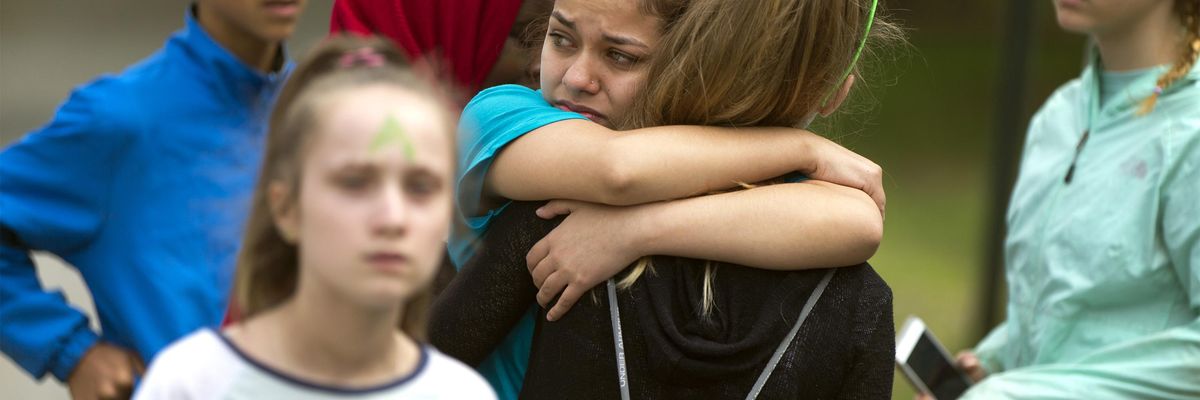
Two eighth grade students hug on May 24, 2017 outside Lewiston Middle School in Lewiston, Maine at a protest over the lack of response from administrators after a seventh-grader died by suicide.
"Young people in the U.S. are collectively experiencing a level of distress that calls on us to act," reads the study.
Child development experts and other advocates said Monday that new federal data regarding the struggles of adolescents in the United States should serve as an urgent call to action, as teenage girls reported facing rising levels of sexual violence as well as suicidal thoughts and depression in a survey taken by the Centers for Disease Control and Prevention.
The CDC's biennial Youth Risk Behavior Survey, which was given to 17,000 teenagers at public and private high schools across the U.S. in 2021, found that nearly 1 in 3 adolescent girls seriously considered suicide that year—representing an increase of 60% over the previous decade.
Thirteen percent said they had attempted suicide in the past year, while 7% of boys reported the same, and 57% of girls said they felt persistently sad or hopeless almost every day for at least two weeks in a row—"a possible indication of the experience of depressive symptoms," according to the CDC report.
"If you think about every 10 teen girls that you know, at least one and possibly more has been raped, and that is the highest level we've ever seen."
Among teenagers the CDC identified as LGBQ+, 69% reported feeling persistent sadness for at least two weeks in a row. The study did not specifically address the challenges faced by transgender students.
Twenty-two percent of LGBQ+ adolescents said they had attempted suicide.
Kathleen Ethier, director of the CDC's Division of Adolescent and School Health, told The Washington Post that high rates of depression and suicidal ideation among teenage girls was "almost certainly" linked to another finding in the survey: 14% of girls reported that they had been forced to have sex—an increase of 27% since the last time the survey was taken in 2019.
The rate of sexual assault was even higher among LGBQ+ teenagers, with 20% reporting they had been forced to have sex.
Regarding the hopelessness and desperation evident among LGBQ+ teenagers, Dr. Scott Hadland, chief of adolescent medicine at Massachusetts General Hospital said he was "sadly" unsurprised, considering the wave of legislative attacks on transgender and gender-nonconforming Americans, including youths.
"When we legislate against LGBTQ+ teens & their families, they're listening, internalizing, and struggling," said Hadland.
Educator and advocate Cathy Davidson pointed out that depression, suicidal ideation, and increased sexual violence directed at girls all come amid "assaults on women's rights to their bodies" in state legislatures across the country. Dozens of abortion restrictions were imposed in 2021.
The study did not include an accounting of what is behind the rise in sexual violence against teens, be it violence happening at home, at school, or in intimate relationships.
"It's really important to disentangle the relationships between the perpetrators and the victim-survivors to better understand the reasons why," Heather Hlavka, an associate professor of criminology and law studies at Marquette University, told The Post.
The CDC's recommendations focused on what policymakers and schools can do to better support teenagers, including implementing quality health education, improving school-based services for students who are struggling, and increasing school connectedness by providing "with social and emotional learning programs in early grades and youth development programs in middle and high school" and "professional development to educators on classroom management."
"These data make it clear," reads the report, "that young people in the U.S. are collectively experiencing a level of distress that calls on us to act."
Dear Common Dreams reader, It’s been nearly 30 years since I co-founded Common Dreams with my late wife, Lina Newhouser. We had the radical notion that journalism should serve the public good, not corporate profits. It was clear to us from the outset what it would take to build such a project. No paid advertisements. No corporate sponsors. No millionaire publisher telling us what to think or do. Many people said we wouldn't last a year, but we proved those doubters wrong. Together with a tremendous team of journalists and dedicated staff, we built an independent media outlet free from the constraints of profits and corporate control. Our mission has always been simple: To inform. To inspire. To ignite change for the common good. Building Common Dreams was not easy. Our survival was never guaranteed. When you take on the most powerful forces—Wall Street greed, fossil fuel industry destruction, Big Tech lobbyists, and uber-rich oligarchs who have spent billions upon billions rigging the economy and democracy in their favor—the only bulwark you have is supporters who believe in your work. But here’s the urgent message from me today. It's never been this bad out there. And it's never been this hard to keep us going. At the very moment Common Dreams is most needed, the threats we face are intensifying. We need your support now more than ever. We don't accept corporate advertising and never will. We don't have a paywall because we don't think people should be blocked from critical news based on their ability to pay. Everything we do is funded by the donations of readers like you. When everyone does the little they can afford, we are strong. But if that support retreats or dries up, so do we. Will you donate now to make sure Common Dreams not only survives but thrives? —Craig Brown, Co-founder |
Child development experts and other advocates said Monday that new federal data regarding the struggles of adolescents in the United States should serve as an urgent call to action, as teenage girls reported facing rising levels of sexual violence as well as suicidal thoughts and depression in a survey taken by the Centers for Disease Control and Prevention.
The CDC's biennial Youth Risk Behavior Survey, which was given to 17,000 teenagers at public and private high schools across the U.S. in 2021, found that nearly 1 in 3 adolescent girls seriously considered suicide that year—representing an increase of 60% over the previous decade.
Thirteen percent said they had attempted suicide in the past year, while 7% of boys reported the same, and 57% of girls said they felt persistently sad or hopeless almost every day for at least two weeks in a row—"a possible indication of the experience of depressive symptoms," according to the CDC report.
"If you think about every 10 teen girls that you know, at least one and possibly more has been raped, and that is the highest level we've ever seen."
Among teenagers the CDC identified as LGBQ+, 69% reported feeling persistent sadness for at least two weeks in a row. The study did not specifically address the challenges faced by transgender students.
Twenty-two percent of LGBQ+ adolescents said they had attempted suicide.
Kathleen Ethier, director of the CDC's Division of Adolescent and School Health, told The Washington Post that high rates of depression and suicidal ideation among teenage girls was "almost certainly" linked to another finding in the survey: 14% of girls reported that they had been forced to have sex—an increase of 27% since the last time the survey was taken in 2019.
The rate of sexual assault was even higher among LGBQ+ teenagers, with 20% reporting they had been forced to have sex.
Regarding the hopelessness and desperation evident among LGBQ+ teenagers, Dr. Scott Hadland, chief of adolescent medicine at Massachusetts General Hospital said he was "sadly" unsurprised, considering the wave of legislative attacks on transgender and gender-nonconforming Americans, including youths.
"When we legislate against LGBTQ+ teens & their families, they're listening, internalizing, and struggling," said Hadland.
Educator and advocate Cathy Davidson pointed out that depression, suicidal ideation, and increased sexual violence directed at girls all come amid "assaults on women's rights to their bodies" in state legislatures across the country. Dozens of abortion restrictions were imposed in 2021.
The study did not include an accounting of what is behind the rise in sexual violence against teens, be it violence happening at home, at school, or in intimate relationships.
"It's really important to disentangle the relationships between the perpetrators and the victim-survivors to better understand the reasons why," Heather Hlavka, an associate professor of criminology and law studies at Marquette University, told The Post.
The CDC's recommendations focused on what policymakers and schools can do to better support teenagers, including implementing quality health education, improving school-based services for students who are struggling, and increasing school connectedness by providing "with social and emotional learning programs in early grades and youth development programs in middle and high school" and "professional development to educators on classroom management."
"These data make it clear," reads the report, "that young people in the U.S. are collectively experiencing a level of distress that calls on us to act."
Child development experts and other advocates said Monday that new federal data regarding the struggles of adolescents in the United States should serve as an urgent call to action, as teenage girls reported facing rising levels of sexual violence as well as suicidal thoughts and depression in a survey taken by the Centers for Disease Control and Prevention.
The CDC's biennial Youth Risk Behavior Survey, which was given to 17,000 teenagers at public and private high schools across the U.S. in 2021, found that nearly 1 in 3 adolescent girls seriously considered suicide that year—representing an increase of 60% over the previous decade.
Thirteen percent said they had attempted suicide in the past year, while 7% of boys reported the same, and 57% of girls said they felt persistently sad or hopeless almost every day for at least two weeks in a row—"a possible indication of the experience of depressive symptoms," according to the CDC report.
"If you think about every 10 teen girls that you know, at least one and possibly more has been raped, and that is the highest level we've ever seen."
Among teenagers the CDC identified as LGBQ+, 69% reported feeling persistent sadness for at least two weeks in a row. The study did not specifically address the challenges faced by transgender students.
Twenty-two percent of LGBQ+ adolescents said they had attempted suicide.
Kathleen Ethier, director of the CDC's Division of Adolescent and School Health, told The Washington Post that high rates of depression and suicidal ideation among teenage girls was "almost certainly" linked to another finding in the survey: 14% of girls reported that they had been forced to have sex—an increase of 27% since the last time the survey was taken in 2019.
The rate of sexual assault was even higher among LGBQ+ teenagers, with 20% reporting they had been forced to have sex.
Regarding the hopelessness and desperation evident among LGBQ+ teenagers, Dr. Scott Hadland, chief of adolescent medicine at Massachusetts General Hospital said he was "sadly" unsurprised, considering the wave of legislative attacks on transgender and gender-nonconforming Americans, including youths.
"When we legislate against LGBTQ+ teens & their families, they're listening, internalizing, and struggling," said Hadland.
Educator and advocate Cathy Davidson pointed out that depression, suicidal ideation, and increased sexual violence directed at girls all come amid "assaults on women's rights to their bodies" in state legislatures across the country. Dozens of abortion restrictions were imposed in 2021.
The study did not include an accounting of what is behind the rise in sexual violence against teens, be it violence happening at home, at school, or in intimate relationships.
"It's really important to disentangle the relationships between the perpetrators and the victim-survivors to better understand the reasons why," Heather Hlavka, an associate professor of criminology and law studies at Marquette University, told The Post.
The CDC's recommendations focused on what policymakers and schools can do to better support teenagers, including implementing quality health education, improving school-based services for students who are struggling, and increasing school connectedness by providing "with social and emotional learning programs in early grades and youth development programs in middle and high school" and "professional development to educators on classroom management."
"These data make it clear," reads the report, "that young people in the U.S. are collectively experiencing a level of distress that calls on us to act."