SUBSCRIBE TO OUR FREE NEWSLETTER
Daily news & progressive opinion—funded by the people, not the corporations—delivered straight to your inbox.
5
#000000
#FFFFFF
To donate by check, phone, or other method, see our More Ways to Give page.
Daily news & progressive opinion—funded by the people, not the corporations—delivered straight to your inbox.
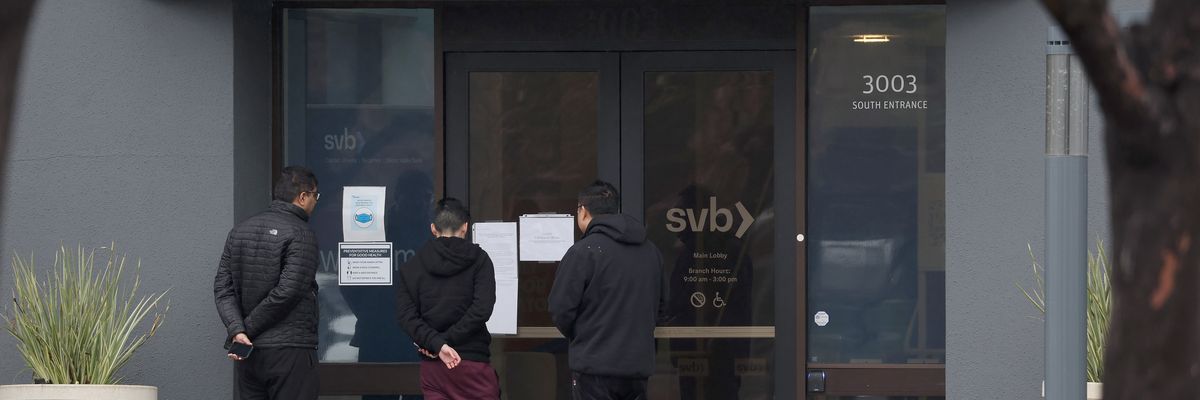
Employees stand outside of the shuttered Silicon Valley Bank (SVB) headquarters on March 10, 2023 in Santa Clara, California.
The bank's financial woes rattled Wall Street and left depositors scrambling to withdraw their money.
Santa Clara-based Silicon Valley Bank, a major lender to technology startups, collapsed on Friday after its emergency attempts to raise money and find a potential buyer failed, forcing regulators to step in and take over the institution.
The speed of SVB's collapse, the largest since the fall of Washington Mutual in 2008, stunned observers and rattled Wall Street, with bank stocks selling off heavily since news broke Wednesday that the California bank was in serious financial trouble.
Earlier this week, the SVB announced that it sold $21 billion worth of investments and moved to sell its stock in a last-ditch effort to raise funds. Those financial maneuvers sparked a bank run as panicked depositors rushed to pull their money, compounding the firm's crisis.
As late as Thursday afternoon, SVB Financial Group CEO Greg Becker was telling clients to "stay calm" and continue to support the bank, which was the 16th largest in the U.S. at the end of last year and had branches in California and Massachusetts.
"Banks fail, that's an intrinsic part of capitalism. But when large banks collapse, we must learn from them or we risk a systemically unstable financial system."
The Financial Times reported Friday that SVB's failure stemmed from "a decision made at the peak of the tech boom to park $91 billion of its deposits in long-dated securities such as mortgage bonds and U.S. Treasuries, which were deemed safe but are now worth $15 billion less than when SVB purchased them after the Federal Reserve aggressively raised interest rates."
The Federal Deposit Insurance Corporation (FDIC) seized SVB's assets on Friday after the company's emergency money-raising efforts fell flat.
In a statement, the FDIC said that it has established a new bank—the Deposit Insurance National Bank of Santa Clara—in order to "protect insured depositors."
"At the time of closing, the FDIC as receiver immediately transferred to the DINB all insured deposits of Silicon Valley Bank," the agency said. "All insured depositors will have full access to their insured deposits no later than Monday morning, March 13, 2023. The FDIC will pay uninsured depositors an advance dividend within the next week. Uninsured depositors will receive a receivership certificate for the remaining amount of their uninsured funds. As the FDIC sells the assets of Silicon Valley Bank, future dividend payments may be made to uninsured depositors."
A recent regulatory filing indicates that 93% of SVB's deposits are uninsured. The Wall Street Journal reported that "as of the end of last year, Silicon Valley Bank estimated that uninsured deposits exceeded those insured by FDIC by around $151 billion."
Business accounts are typically only FDIC-insured up to $250,000.
In response to Friday's developments, Bartlett Naylor, financial policy advocate at Public Citizen, said it's imperative that lawmakers get to the bottom of what happened at SBV.
"Congress must hold public hearings to investigate the causes and implications," said Naylor. "Among the issues to explore: How did the Dodd-Frank Wall Street Reform Act mitigate any systemic repercussions? Did the special nature of the bank's operations, including funding venture capital, play a role? Did specific accounting rules about realizing losses play a role? Should any rules that were eliminated or weakened under Trump's administration be reinstated or strengthened? Should banks have more capital and fewer bonds?"
"Banks fail, that's an intrinsic part of capitalism," Naylor added. "But when large banks collapse, we must learn from them or we risk a systemically unstable financial system."
The systemic impacts of SVB's collapse remain unclear.
Treasury Secretary Janet Yellen told lawmakers on Friday that she is "very carefully" monitoring a few banks amid the turmoil surrounding SVB.
This article has been updated to include comment from Public Citizen.
Dear Common Dreams reader, It’s been nearly 30 years since I co-founded Common Dreams with my late wife, Lina Newhouser. We had the radical notion that journalism should serve the public good, not corporate profits. It was clear to us from the outset what it would take to build such a project. No paid advertisements. No corporate sponsors. No millionaire publisher telling us what to think or do. Many people said we wouldn't last a year, but we proved those doubters wrong. Together with a tremendous team of journalists and dedicated staff, we built an independent media outlet free from the constraints of profits and corporate control. Our mission has always been simple: To inform. To inspire. To ignite change for the common good. Building Common Dreams was not easy. Our survival was never guaranteed. When you take on the most powerful forces—Wall Street greed, fossil fuel industry destruction, Big Tech lobbyists, and uber-rich oligarchs who have spent billions upon billions rigging the economy and democracy in their favor—the only bulwark you have is supporters who believe in your work. But here’s the urgent message from me today. It's never been this bad out there. And it's never been this hard to keep us going. At the very moment Common Dreams is most needed, the threats we face are intensifying. We need your support now more than ever. We don't accept corporate advertising and never will. We don't have a paywall because we don't think people should be blocked from critical news based on their ability to pay. Everything we do is funded by the donations of readers like you. When everyone does the little they can afford, we are strong. But if that support retreats or dries up, so do we. Will you donate now to make sure Common Dreams not only survives but thrives? —Craig Brown, Co-founder |
Santa Clara-based Silicon Valley Bank, a major lender to technology startups, collapsed on Friday after its emergency attempts to raise money and find a potential buyer failed, forcing regulators to step in and take over the institution.
The speed of SVB's collapse, the largest since the fall of Washington Mutual in 2008, stunned observers and rattled Wall Street, with bank stocks selling off heavily since news broke Wednesday that the California bank was in serious financial trouble.
Earlier this week, the SVB announced that it sold $21 billion worth of investments and moved to sell its stock in a last-ditch effort to raise funds. Those financial maneuvers sparked a bank run as panicked depositors rushed to pull their money, compounding the firm's crisis.
As late as Thursday afternoon, SVB Financial Group CEO Greg Becker was telling clients to "stay calm" and continue to support the bank, which was the 16th largest in the U.S. at the end of last year and had branches in California and Massachusetts.
"Banks fail, that's an intrinsic part of capitalism. But when large banks collapse, we must learn from them or we risk a systemically unstable financial system."
The Financial Times reported Friday that SVB's failure stemmed from "a decision made at the peak of the tech boom to park $91 billion of its deposits in long-dated securities such as mortgage bonds and U.S. Treasuries, which were deemed safe but are now worth $15 billion less than when SVB purchased them after the Federal Reserve aggressively raised interest rates."
The Federal Deposit Insurance Corporation (FDIC) seized SVB's assets on Friday after the company's emergency money-raising efforts fell flat.
In a statement, the FDIC said that it has established a new bank—the Deposit Insurance National Bank of Santa Clara—in order to "protect insured depositors."
"At the time of closing, the FDIC as receiver immediately transferred to the DINB all insured deposits of Silicon Valley Bank," the agency said. "All insured depositors will have full access to their insured deposits no later than Monday morning, March 13, 2023. The FDIC will pay uninsured depositors an advance dividend within the next week. Uninsured depositors will receive a receivership certificate for the remaining amount of their uninsured funds. As the FDIC sells the assets of Silicon Valley Bank, future dividend payments may be made to uninsured depositors."
A recent regulatory filing indicates that 93% of SVB's deposits are uninsured. The Wall Street Journal reported that "as of the end of last year, Silicon Valley Bank estimated that uninsured deposits exceeded those insured by FDIC by around $151 billion."
Business accounts are typically only FDIC-insured up to $250,000.
In response to Friday's developments, Bartlett Naylor, financial policy advocate at Public Citizen, said it's imperative that lawmakers get to the bottom of what happened at SBV.
"Congress must hold public hearings to investigate the causes and implications," said Naylor. "Among the issues to explore: How did the Dodd-Frank Wall Street Reform Act mitigate any systemic repercussions? Did the special nature of the bank's operations, including funding venture capital, play a role? Did specific accounting rules about realizing losses play a role? Should any rules that were eliminated or weakened under Trump's administration be reinstated or strengthened? Should banks have more capital and fewer bonds?"
"Banks fail, that's an intrinsic part of capitalism," Naylor added. "But when large banks collapse, we must learn from them or we risk a systemically unstable financial system."
The systemic impacts of SVB's collapse remain unclear.
Treasury Secretary Janet Yellen told lawmakers on Friday that she is "very carefully" monitoring a few banks amid the turmoil surrounding SVB.
This article has been updated to include comment from Public Citizen.
Santa Clara-based Silicon Valley Bank, a major lender to technology startups, collapsed on Friday after its emergency attempts to raise money and find a potential buyer failed, forcing regulators to step in and take over the institution.
The speed of SVB's collapse, the largest since the fall of Washington Mutual in 2008, stunned observers and rattled Wall Street, with bank stocks selling off heavily since news broke Wednesday that the California bank was in serious financial trouble.
Earlier this week, the SVB announced that it sold $21 billion worth of investments and moved to sell its stock in a last-ditch effort to raise funds. Those financial maneuvers sparked a bank run as panicked depositors rushed to pull their money, compounding the firm's crisis.
As late as Thursday afternoon, SVB Financial Group CEO Greg Becker was telling clients to "stay calm" and continue to support the bank, which was the 16th largest in the U.S. at the end of last year and had branches in California and Massachusetts.
"Banks fail, that's an intrinsic part of capitalism. But when large banks collapse, we must learn from them or we risk a systemically unstable financial system."
The Financial Times reported Friday that SVB's failure stemmed from "a decision made at the peak of the tech boom to park $91 billion of its deposits in long-dated securities such as mortgage bonds and U.S. Treasuries, which were deemed safe but are now worth $15 billion less than when SVB purchased them after the Federal Reserve aggressively raised interest rates."
The Federal Deposit Insurance Corporation (FDIC) seized SVB's assets on Friday after the company's emergency money-raising efforts fell flat.
In a statement, the FDIC said that it has established a new bank—the Deposit Insurance National Bank of Santa Clara—in order to "protect insured depositors."
"At the time of closing, the FDIC as receiver immediately transferred to the DINB all insured deposits of Silicon Valley Bank," the agency said. "All insured depositors will have full access to their insured deposits no later than Monday morning, March 13, 2023. The FDIC will pay uninsured depositors an advance dividend within the next week. Uninsured depositors will receive a receivership certificate for the remaining amount of their uninsured funds. As the FDIC sells the assets of Silicon Valley Bank, future dividend payments may be made to uninsured depositors."
A recent regulatory filing indicates that 93% of SVB's deposits are uninsured. The Wall Street Journal reported that "as of the end of last year, Silicon Valley Bank estimated that uninsured deposits exceeded those insured by FDIC by around $151 billion."
Business accounts are typically only FDIC-insured up to $250,000.
In response to Friday's developments, Bartlett Naylor, financial policy advocate at Public Citizen, said it's imperative that lawmakers get to the bottom of what happened at SBV.
"Congress must hold public hearings to investigate the causes and implications," said Naylor. "Among the issues to explore: How did the Dodd-Frank Wall Street Reform Act mitigate any systemic repercussions? Did the special nature of the bank's operations, including funding venture capital, play a role? Did specific accounting rules about realizing losses play a role? Should any rules that were eliminated or weakened under Trump's administration be reinstated or strengthened? Should banks have more capital and fewer bonds?"
"Banks fail, that's an intrinsic part of capitalism," Naylor added. "But when large banks collapse, we must learn from them or we risk a systemically unstable financial system."
The systemic impacts of SVB's collapse remain unclear.
Treasury Secretary Janet Yellen told lawmakers on Friday that she is "very carefully" monitoring a few banks amid the turmoil surrounding SVB.
This article has been updated to include comment from Public Citizen.