SUBSCRIBE TO OUR FREE NEWSLETTER
Daily news & progressive opinion—funded by the people, not the corporations—delivered straight to your inbox.
5
#000000
#FFFFFF
To donate by check, phone, or other method, see our More Ways to Give page.
Daily news & progressive opinion—funded by the people, not the corporations—delivered straight to your inbox.
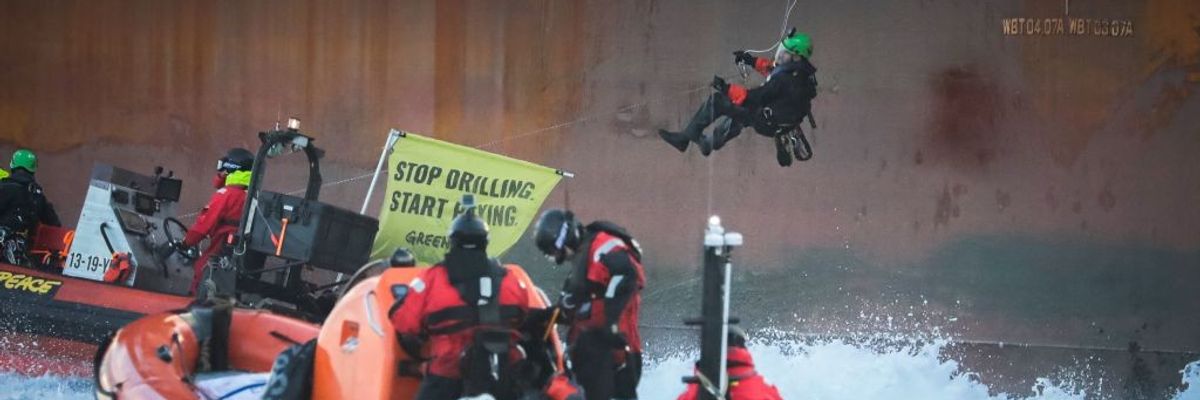
Greenpeace activists board a Shell platform headed toward the North Sea on February 6, 2023.
"Shell thought suing us for millions over a peaceful protest would intimidate us, but this case became a PR millstone tied around its neck," said the co-executive director of Greenpeace U.K.
The United Kingdom-based oil giant Shell agreed Tuesday to settle a major lawsuit the company brought against Greenpeace after activists from the group boarded and occupied a company oil platform last year to protest fossil fuel expansion.
Greenpeace said in a statement that as part of the settlement, it agreed to donate £300,000—roughly $382,000—to the Royal National Lifeboat Institution, a charity that helps save lives at sea, but will pay nothing to Shell and accept no liability. The donation represents a fraction of the over $11 million in damages and legal costs defendants faced, the group said.
The Greenpeace defendants have also "agreed to avoid protesting for a period at four Shell sites in the northern North Sea."
"Shell thought suing us for millions over a peaceful protest would intimidate us, but this case became a PR millstone tied around its neck," said Areeba Hamid, co-executive director of Greenpeace U.K. "The public backlash against its bullying tactics made it back down and settle out of court."
"This settlement shows that people power works. Thousands of ordinary people across the country backed our fight against Shell and their support means we stay independent and can keep holding Big Oil to account," Hamid added. "This legal battle might be over, but Big Oil's dirty tricks aren't going away. With Greenpeace facing further legal battles around the world, we won't stop campaigning until the fossil fuel industry stops drilling and starts paying for the damage it is causing to people and planet."
"These aggressive legal tactics, the huge sums of money, and attempts to block the right to protest pose a massive threat."
Shell brought the case, which Greenpeace characterized as a "textbook" strategic lawsuit against public participation (SLAPP), in February 2023 and sought $1 million in damages from activists who boarded a Shell-contracted ship carrying equipment to drill for oil in the North Sea.
"When the protest ended, the only damage Shell could find was a padlock which, they alleged, our activists broke. That's it," Greenpeace U.K. said Tuesday. "Yet they came after us with a million-dollar lawsuit, which they justified for their spending on safety."
The group, which warned that the case had dire implications for the right to protest, credited a "sustained, year-long campaign against the suit" for forcing the oil behemoth to back down. The campaign, according to Greenpeace, "turned the legal move into a PR embarrassment for Shell."
"The case was dubbed the 'Cousin Greg' lawsuit by Forbes after a scene in the Emmy-awarded drama Succession, in which the hapless character threatens to sue Greenpeace to universal dismay," the environmental group noted Tuesday.
Greenpeace is currently facing several other SLAPP suits, including one brought by Energy Transfer, majority-owner of the Dakota Access pipeline. The group said Tuesday that the Energy Transfer suit "threatens the very existence of Greenpeace in the U.S."
"These aggressive legal tactics, the huge sums of money, and attempts to block the right to protest pose a massive threat. It could stop Greenpeace being able to make a real difference on the things that matter most," the organization said Tuesday. "It's part of a growing trend by powerful corporations and governments to crush peaceful protest—using draconian laws or intimidation lawsuits like this."
"It seeks to silence the people most impacted by the climate crisis. This threatens the global fight for climate justice," the group added. "We won't give up. This is Shell versus all of us."
Dear Common Dreams reader, It’s been nearly 30 years since I co-founded Common Dreams with my late wife, Lina Newhouser. We had the radical notion that journalism should serve the public good, not corporate profits. It was clear to us from the outset what it would take to build such a project. No paid advertisements. No corporate sponsors. No millionaire publisher telling us what to think or do. Many people said we wouldn't last a year, but we proved those doubters wrong. Together with a tremendous team of journalists and dedicated staff, we built an independent media outlet free from the constraints of profits and corporate control. Our mission has always been simple: To inform. To inspire. To ignite change for the common good. Building Common Dreams was not easy. Our survival was never guaranteed. When you take on the most powerful forces—Wall Street greed, fossil fuel industry destruction, Big Tech lobbyists, and uber-rich oligarchs who have spent billions upon billions rigging the economy and democracy in their favor—the only bulwark you have is supporters who believe in your work. But here’s the urgent message from me today. It's never been this bad out there. And it's never been this hard to keep us going. At the very moment Common Dreams is most needed, the threats we face are intensifying. We need your support now more than ever. We don't accept corporate advertising and never will. We don't have a paywall because we don't think people should be blocked from critical news based on their ability to pay. Everything we do is funded by the donations of readers like you. When everyone does the little they can afford, we are strong. But if that support retreats or dries up, so do we. Will you donate now to make sure Common Dreams not only survives but thrives? —Craig Brown, Co-founder |
The United Kingdom-based oil giant Shell agreed Tuesday to settle a major lawsuit the company brought against Greenpeace after activists from the group boarded and occupied a company oil platform last year to protest fossil fuel expansion.
Greenpeace said in a statement that as part of the settlement, it agreed to donate £300,000—roughly $382,000—to the Royal National Lifeboat Institution, a charity that helps save lives at sea, but will pay nothing to Shell and accept no liability. The donation represents a fraction of the over $11 million in damages and legal costs defendants faced, the group said.
The Greenpeace defendants have also "agreed to avoid protesting for a period at four Shell sites in the northern North Sea."
"Shell thought suing us for millions over a peaceful protest would intimidate us, but this case became a PR millstone tied around its neck," said Areeba Hamid, co-executive director of Greenpeace U.K. "The public backlash against its bullying tactics made it back down and settle out of court."
"This settlement shows that people power works. Thousands of ordinary people across the country backed our fight against Shell and their support means we stay independent and can keep holding Big Oil to account," Hamid added. "This legal battle might be over, but Big Oil's dirty tricks aren't going away. With Greenpeace facing further legal battles around the world, we won't stop campaigning until the fossil fuel industry stops drilling and starts paying for the damage it is causing to people and planet."
"These aggressive legal tactics, the huge sums of money, and attempts to block the right to protest pose a massive threat."
Shell brought the case, which Greenpeace characterized as a "textbook" strategic lawsuit against public participation (SLAPP), in February 2023 and sought $1 million in damages from activists who boarded a Shell-contracted ship carrying equipment to drill for oil in the North Sea.
"When the protest ended, the only damage Shell could find was a padlock which, they alleged, our activists broke. That's it," Greenpeace U.K. said Tuesday. "Yet they came after us with a million-dollar lawsuit, which they justified for their spending on safety."
The group, which warned that the case had dire implications for the right to protest, credited a "sustained, year-long campaign against the suit" for forcing the oil behemoth to back down. The campaign, according to Greenpeace, "turned the legal move into a PR embarrassment for Shell."
"The case was dubbed the 'Cousin Greg' lawsuit by Forbes after a scene in the Emmy-awarded drama Succession, in which the hapless character threatens to sue Greenpeace to universal dismay," the environmental group noted Tuesday.
Greenpeace is currently facing several other SLAPP suits, including one brought by Energy Transfer, majority-owner of the Dakota Access pipeline. The group said Tuesday that the Energy Transfer suit "threatens the very existence of Greenpeace in the U.S."
"These aggressive legal tactics, the huge sums of money, and attempts to block the right to protest pose a massive threat. It could stop Greenpeace being able to make a real difference on the things that matter most," the organization said Tuesday. "It's part of a growing trend by powerful corporations and governments to crush peaceful protest—using draconian laws or intimidation lawsuits like this."
"It seeks to silence the people most impacted by the climate crisis. This threatens the global fight for climate justice," the group added. "We won't give up. This is Shell versus all of us."
The United Kingdom-based oil giant Shell agreed Tuesday to settle a major lawsuit the company brought against Greenpeace after activists from the group boarded and occupied a company oil platform last year to protest fossil fuel expansion.
Greenpeace said in a statement that as part of the settlement, it agreed to donate £300,000—roughly $382,000—to the Royal National Lifeboat Institution, a charity that helps save lives at sea, but will pay nothing to Shell and accept no liability. The donation represents a fraction of the over $11 million in damages and legal costs defendants faced, the group said.
The Greenpeace defendants have also "agreed to avoid protesting for a period at four Shell sites in the northern North Sea."
"Shell thought suing us for millions over a peaceful protest would intimidate us, but this case became a PR millstone tied around its neck," said Areeba Hamid, co-executive director of Greenpeace U.K. "The public backlash against its bullying tactics made it back down and settle out of court."
"This settlement shows that people power works. Thousands of ordinary people across the country backed our fight against Shell and their support means we stay independent and can keep holding Big Oil to account," Hamid added. "This legal battle might be over, but Big Oil's dirty tricks aren't going away. With Greenpeace facing further legal battles around the world, we won't stop campaigning until the fossil fuel industry stops drilling and starts paying for the damage it is causing to people and planet."
"These aggressive legal tactics, the huge sums of money, and attempts to block the right to protest pose a massive threat."
Shell brought the case, which Greenpeace characterized as a "textbook" strategic lawsuit against public participation (SLAPP), in February 2023 and sought $1 million in damages from activists who boarded a Shell-contracted ship carrying equipment to drill for oil in the North Sea.
"When the protest ended, the only damage Shell could find was a padlock which, they alleged, our activists broke. That's it," Greenpeace U.K. said Tuesday. "Yet they came after us with a million-dollar lawsuit, which they justified for their spending on safety."
The group, which warned that the case had dire implications for the right to protest, credited a "sustained, year-long campaign against the suit" for forcing the oil behemoth to back down. The campaign, according to Greenpeace, "turned the legal move into a PR embarrassment for Shell."
"The case was dubbed the 'Cousin Greg' lawsuit by Forbes after a scene in the Emmy-awarded drama Succession, in which the hapless character threatens to sue Greenpeace to universal dismay," the environmental group noted Tuesday.
Greenpeace is currently facing several other SLAPP suits, including one brought by Energy Transfer, majority-owner of the Dakota Access pipeline. The group said Tuesday that the Energy Transfer suit "threatens the very existence of Greenpeace in the U.S."
"These aggressive legal tactics, the huge sums of money, and attempts to block the right to protest pose a massive threat. It could stop Greenpeace being able to make a real difference on the things that matter most," the organization said Tuesday. "It's part of a growing trend by powerful corporations and governments to crush peaceful protest—using draconian laws or intimidation lawsuits like this."
"It seeks to silence the people most impacted by the climate crisis. This threatens the global fight for climate justice," the group added. "We won't give up. This is Shell versus all of us."