SUBSCRIBE TO OUR FREE NEWSLETTER
Daily news & progressive opinion—funded by the people, not the corporations—delivered straight to your inbox.
5
#000000
#FFFFFF
To donate by check, phone, or other method, see our More Ways to Give page.
Daily news & progressive opinion—funded by the people, not the corporations—delivered straight to your inbox.
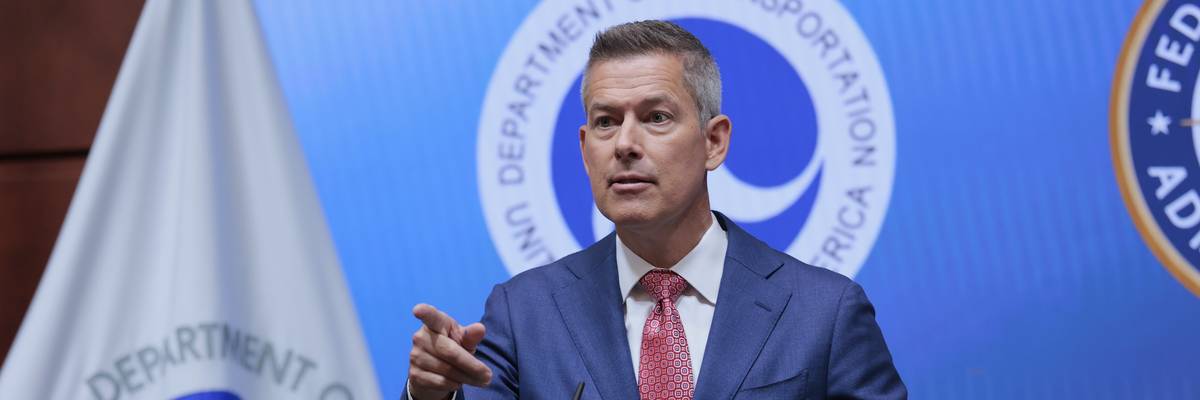
U.S. Transportation Secretary Sean Duffy speaks to reporters during a news conference on Newark Liberty International Airport at the Department of Transportation headquarters on May 12, 2025 in Washington, D.C.
The transportation secretary has called for upgrades to the systems used by air traffic controllers; he voted against such improvements when he was in Congress.
Travelers at Newark Liberty International Airport in New Jersey on Monday were still being impacted by flight delays and cancellations after numerous technical issues in recent days interrupted air traffic control operations—disruptions that U.S. Transportation Secretary Sean Duffy said Sunday are likely to spread to the nation's other airports.
Duffy told NBC's "Meet the Press" on Sunday that he is currently "concerned about the whole airspace," but said traveling by air is still safe.
"The lights are blinking, the sirens are turning," said Duffy. "What you see in Newark is gonna happen in other places across the country."
The Federal Aviation Administration (FAA) said in a statement that Newark's most recent technical disruption on Sunday was the result of a "telecommunications issue" at Philadelphia Terminal Radar Approach Control (TRACON) Area C facility, which guides aircraft in and out of Newark.
Air traffic control systems were also disrupted on Friday, with controllers at the same facility losing radar and radio contact for about 90 seconds.
At least five air traffic controllers at TRACON Area C are currently on 45 days of trauma leave after a similar incident on April 28 during a busy afternoon.
The air traffic control team at the facility lost contact with all planes while they were managing 15-20 flights. One air traffic controller at Newark told NBC News after this incident that the airport is "not a safe situation right now for the flying public."
The disruption led to thousands of flight cancellations and delays—some longer than five hours—in and out of Newark, which serves more than 24 million travelers per year and is the nation's 12th busiest airport.
Duffy denied on Sunday that job cuts affecting about 400 staffers at the FAA—spearheaded by the so-called Department of Government Efficiency, headed by billionaire tech mogul Elon Musk—had anything to do with the problems at Newark.
But representatives of the Professional Aviation Safety Specialists union, which represents about 11,000 employees who support air traffic controllers, warned earlier this year that layoffs would result in critical workers guiding planes in and out of airports with less support from the FAA.
The job cuts affected workers including administrative and logistics technicians, aeronautical information specialists, and maintenance mechanics.
The FAA has blamed many of the issues at Newark, where TRACON Area C has been affected by outages four times since November, on equipment failures and staffing shortages.
Duffy has called for air travel upgrades including investments in digital flight data management, improvements to radio systems, and extending the retirement age for air traffic controllers to 61, up from 56.
On CNN last week, Kaitlan Collins pointed out that Duffy, then a Republican member of the U.S. House, joined his party in voting against upgrades to air traffic control systems.
On Sunday, signs were already emerging that staffing and technical issues could be spreading to other airports with impacts on travel.
An equipment outage at Hartsfield-Jackson Atlanta International Airport—the busiest in the world—led to a ground stop for more than an hour, delaying 1,337 flights. FAA staffing shortages at a control tower in Austin, Texas also led to delays for 145 flights.
This country and this world are at a monumental crossroads. US voters have an opportunity to beat back the forces of fascism and confront the billionaires who are rigging the economy, our media system, and our democracy, making it increasingly impossible for ordinary people to get by. We’re not just talking about the election. We’re talking about what must be done once these fascist elements are vanquished from power. We need a bolder set of solutions than what either major party has so far been willing to offer and a working-class movement ready to fight like hell for it. Trump didn't emerge from nowhere. The conditions that fueled MAGA authoritarianism were created by decades of radical neoliberal economic policies and a corrupt political system dominated by corporate interests. They slashed taxes on the super-rich, promising that the benefits would trickle down. They said giveaways to the corporate titans would make life more affordable for the rest of us. It was all bullshit. And when a bitter, betrayed populace searches for someone to blame, right-wing demagogues have little trouble finding scapegoats. People know when they're being lied to, but you won't hear any of this from the corporate media. Only independent journalism—powered and funded by people who believe in building a better world—can deliver truly trustworthy daily news. If you share our vision, please contribute whatever you can to sustain our work. |
Travelers at Newark Liberty International Airport in New Jersey on Monday were still being impacted by flight delays and cancellations after numerous technical issues in recent days interrupted air traffic control operations—disruptions that U.S. Transportation Secretary Sean Duffy said Sunday are likely to spread to the nation's other airports.
Duffy told NBC's "Meet the Press" on Sunday that he is currently "concerned about the whole airspace," but said traveling by air is still safe.
"The lights are blinking, the sirens are turning," said Duffy. "What you see in Newark is gonna happen in other places across the country."
The Federal Aviation Administration (FAA) said in a statement that Newark's most recent technical disruption on Sunday was the result of a "telecommunications issue" at Philadelphia Terminal Radar Approach Control (TRACON) Area C facility, which guides aircraft in and out of Newark.
Air traffic control systems were also disrupted on Friday, with controllers at the same facility losing radar and radio contact for about 90 seconds.
At least five air traffic controllers at TRACON Area C are currently on 45 days of trauma leave after a similar incident on April 28 during a busy afternoon.
The air traffic control team at the facility lost contact with all planes while they were managing 15-20 flights. One air traffic controller at Newark told NBC News after this incident that the airport is "not a safe situation right now for the flying public."
The disruption led to thousands of flight cancellations and delays—some longer than five hours—in and out of Newark, which serves more than 24 million travelers per year and is the nation's 12th busiest airport.
Duffy denied on Sunday that job cuts affecting about 400 staffers at the FAA—spearheaded by the so-called Department of Government Efficiency, headed by billionaire tech mogul Elon Musk—had anything to do with the problems at Newark.
But representatives of the Professional Aviation Safety Specialists union, which represents about 11,000 employees who support air traffic controllers, warned earlier this year that layoffs would result in critical workers guiding planes in and out of airports with less support from the FAA.
The job cuts affected workers including administrative and logistics technicians, aeronautical information specialists, and maintenance mechanics.
The FAA has blamed many of the issues at Newark, where TRACON Area C has been affected by outages four times since November, on equipment failures and staffing shortages.
Duffy has called for air travel upgrades including investments in digital flight data management, improvements to radio systems, and extending the retirement age for air traffic controllers to 61, up from 56.
On CNN last week, Kaitlan Collins pointed out that Duffy, then a Republican member of the U.S. House, joined his party in voting against upgrades to air traffic control systems.
On Sunday, signs were already emerging that staffing and technical issues could be spreading to other airports with impacts on travel.
An equipment outage at Hartsfield-Jackson Atlanta International Airport—the busiest in the world—led to a ground stop for more than an hour, delaying 1,337 flights. FAA staffing shortages at a control tower in Austin, Texas also led to delays for 145 flights.