SUBSCRIBE TO OUR FREE NEWSLETTER
Daily news & progressive opinion—funded by the people, not the corporations—delivered straight to your inbox.
5
#000000
#FFFFFF
To donate by check, phone, or other method, see our More Ways to Give page.
Daily news & progressive opinion—funded by the people, not the corporations—delivered straight to your inbox.
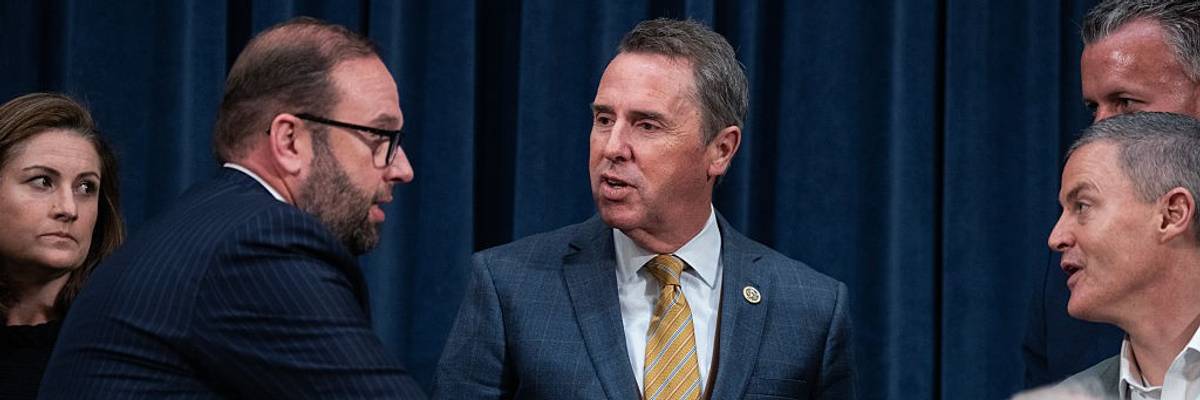
House Ways and Means Committee Chairman Jason Smith (R-Mo.) and others are pictured during a hearing on April 9, 2025.
"Clearly corporate cronyism is more important to Republicans than lowering costs for ordinary Americans and increasing the efficiency of government services."
In addition to showering rich Americans and large corporations with more tax breaks, legislation that Republicans advanced out of committee on Wednesday would officially eliminate the Internal Revenue Service's popular and free Direct File program, which allowed eligible taxpayers to sidestep private prep companies that have lobbied relentlessly against government-offered alternatives for decades.
The tax legislation that the GOP-controlled House Ways and Means Committee approved in a party-line vote contains an underlooked provision that requires the U.S. Treasury Department to "ensure that the Internal Revenue Service Direct File program has been terminated."
The bill also opens the door to a "partnership between the IRS and private-sector tax preparation services to provide for free tax filing" to replace Direct File, which has been in the crosshairs of the Trump administration and the Elon Musk-led Department of Government Efficiency.
Watchdogs said the measure's language reeks of corporate influence.
"Corporate monopolist Intuit spent millions lobbying Republicans to insulate TurboTax from competition," said Hannah Garden Monheit, a senior fellow at the American Economic Liberties Project. "Now, House Republicans are doing Intuit's bidding by killing the Direct File program, which provided free, simplified public tax filing software beloved by its users."
"Direct File saves the average American $160 in filing fees and hours of time each year, and continuing it would save $11 billion annually," she added. "Expanding and improving Direct File should've been an easy win for DOGE, but clearly corporate cronyism is more important to Republicans than lowering costs for ordinary Americans and increasing the efficiency of government services."
"Trump will force you to fork out hundreds of dollars each year to TurboTax so he can give tax breaks to billionaires."
Direct File, which began as a pilot program during the 2024 tax filing season, threatened the dominance of Intuit and H&R Block, corporate giants that control the private tax preparation space and have been accused of engaging in deceptive marketing practices—particularly in their promotion of "free" services.
A report published earlier this year by the consumer advocacy group Public Citizen noted that both companies have donated heavily to Republican lawmakers, including members of the House Ways and Means Committee.
Late last year, dozens of House Republicans signed a letter urging the then-incoming Trump administration to eliminate the Direct File program. Letter signatories had received $1.8 million in campaign contributions from corporate interests opposing Direct File, including lobbyists for the private tax prep industry, according to Public Citizen.
"During the 2024 cycle, 19 of the Republican signers received a PAC contribution from either H&R Block or Intuit," Public Citizen found. "One of the letter's drafters, Rep. Adrian Smith (R-Neb.), received a PAC contribution from both companies."
The tax prep industry has also recently ramped up its lobbying efforts. NOTUS reported last month that "Intuit spent $3.7 million on federal lobbying in 2024, more money than it has ever spent on federal lobbying in a single year."
Sen. Ron Wyden (D-Ore.), the ranking member of the Senate Finance Committee, called Republicans' push to terminate Direct File "an under-the-radar" part of their tax plan.
"Trump will force you to fork out hundreds of dollars each year to TurboTax so he can give tax breaks to billionaires," Wyden wrote Wednesday.
Dear Common Dreams reader, It’s been nearly 30 years since I co-founded Common Dreams with my late wife, Lina Newhouser. We had the radical notion that journalism should serve the public good, not corporate profits. It was clear to us from the outset what it would take to build such a project. No paid advertisements. No corporate sponsors. No millionaire publisher telling us what to think or do. Many people said we wouldn't last a year, but we proved those doubters wrong. Together with a tremendous team of journalists and dedicated staff, we built an independent media outlet free from the constraints of profits and corporate control. Our mission has always been simple: To inform. To inspire. To ignite change for the common good. Building Common Dreams was not easy. Our survival was never guaranteed. When you take on the most powerful forces—Wall Street greed, fossil fuel industry destruction, Big Tech lobbyists, and uber-rich oligarchs who have spent billions upon billions rigging the economy and democracy in their favor—the only bulwark you have is supporters who believe in your work. But here’s the urgent message from me today. It's never been this bad out there. And it's never been this hard to keep us going. At the very moment Common Dreams is most needed, the threats we face are intensifying. We need your support now more than ever. We don't accept corporate advertising and never will. We don't have a paywall because we don't think people should be blocked from critical news based on their ability to pay. Everything we do is funded by the donations of readers like you. When everyone does the little they can afford, we are strong. But if that support retreats or dries up, so do we. Will you donate now to make sure Common Dreams not only survives but thrives? —Craig Brown, Co-founder |
In addition to showering rich Americans and large corporations with more tax breaks, legislation that Republicans advanced out of committee on Wednesday would officially eliminate the Internal Revenue Service's popular and free Direct File program, which allowed eligible taxpayers to sidestep private prep companies that have lobbied relentlessly against government-offered alternatives for decades.
The tax legislation that the GOP-controlled House Ways and Means Committee approved in a party-line vote contains an underlooked provision that requires the U.S. Treasury Department to "ensure that the Internal Revenue Service Direct File program has been terminated."
The bill also opens the door to a "partnership between the IRS and private-sector tax preparation services to provide for free tax filing" to replace Direct File, which has been in the crosshairs of the Trump administration and the Elon Musk-led Department of Government Efficiency.
Watchdogs said the measure's language reeks of corporate influence.
"Corporate monopolist Intuit spent millions lobbying Republicans to insulate TurboTax from competition," said Hannah Garden Monheit, a senior fellow at the American Economic Liberties Project. "Now, House Republicans are doing Intuit's bidding by killing the Direct File program, which provided free, simplified public tax filing software beloved by its users."
"Direct File saves the average American $160 in filing fees and hours of time each year, and continuing it would save $11 billion annually," she added. "Expanding and improving Direct File should've been an easy win for DOGE, but clearly corporate cronyism is more important to Republicans than lowering costs for ordinary Americans and increasing the efficiency of government services."
"Trump will force you to fork out hundreds of dollars each year to TurboTax so he can give tax breaks to billionaires."
Direct File, which began as a pilot program during the 2024 tax filing season, threatened the dominance of Intuit and H&R Block, corporate giants that control the private tax preparation space and have been accused of engaging in deceptive marketing practices—particularly in their promotion of "free" services.
A report published earlier this year by the consumer advocacy group Public Citizen noted that both companies have donated heavily to Republican lawmakers, including members of the House Ways and Means Committee.
Late last year, dozens of House Republicans signed a letter urging the then-incoming Trump administration to eliminate the Direct File program. Letter signatories had received $1.8 million in campaign contributions from corporate interests opposing Direct File, including lobbyists for the private tax prep industry, according to Public Citizen.
"During the 2024 cycle, 19 of the Republican signers received a PAC contribution from either H&R Block or Intuit," Public Citizen found. "One of the letter's drafters, Rep. Adrian Smith (R-Neb.), received a PAC contribution from both companies."
The tax prep industry has also recently ramped up its lobbying efforts. NOTUS reported last month that "Intuit spent $3.7 million on federal lobbying in 2024, more money than it has ever spent on federal lobbying in a single year."
Sen. Ron Wyden (D-Ore.), the ranking member of the Senate Finance Committee, called Republicans' push to terminate Direct File "an under-the-radar" part of their tax plan.
"Trump will force you to fork out hundreds of dollars each year to TurboTax so he can give tax breaks to billionaires," Wyden wrote Wednesday.
In addition to showering rich Americans and large corporations with more tax breaks, legislation that Republicans advanced out of committee on Wednesday would officially eliminate the Internal Revenue Service's popular and free Direct File program, which allowed eligible taxpayers to sidestep private prep companies that have lobbied relentlessly against government-offered alternatives for decades.
The tax legislation that the GOP-controlled House Ways and Means Committee approved in a party-line vote contains an underlooked provision that requires the U.S. Treasury Department to "ensure that the Internal Revenue Service Direct File program has been terminated."
The bill also opens the door to a "partnership between the IRS and private-sector tax preparation services to provide for free tax filing" to replace Direct File, which has been in the crosshairs of the Trump administration and the Elon Musk-led Department of Government Efficiency.
Watchdogs said the measure's language reeks of corporate influence.
"Corporate monopolist Intuit spent millions lobbying Republicans to insulate TurboTax from competition," said Hannah Garden Monheit, a senior fellow at the American Economic Liberties Project. "Now, House Republicans are doing Intuit's bidding by killing the Direct File program, which provided free, simplified public tax filing software beloved by its users."
"Direct File saves the average American $160 in filing fees and hours of time each year, and continuing it would save $11 billion annually," she added. "Expanding and improving Direct File should've been an easy win for DOGE, but clearly corporate cronyism is more important to Republicans than lowering costs for ordinary Americans and increasing the efficiency of government services."
"Trump will force you to fork out hundreds of dollars each year to TurboTax so he can give tax breaks to billionaires."
Direct File, which began as a pilot program during the 2024 tax filing season, threatened the dominance of Intuit and H&R Block, corporate giants that control the private tax preparation space and have been accused of engaging in deceptive marketing practices—particularly in their promotion of "free" services.
A report published earlier this year by the consumer advocacy group Public Citizen noted that both companies have donated heavily to Republican lawmakers, including members of the House Ways and Means Committee.
Late last year, dozens of House Republicans signed a letter urging the then-incoming Trump administration to eliminate the Direct File program. Letter signatories had received $1.8 million in campaign contributions from corporate interests opposing Direct File, including lobbyists for the private tax prep industry, according to Public Citizen.
"During the 2024 cycle, 19 of the Republican signers received a PAC contribution from either H&R Block or Intuit," Public Citizen found. "One of the letter's drafters, Rep. Adrian Smith (R-Neb.), received a PAC contribution from both companies."
The tax prep industry has also recently ramped up its lobbying efforts. NOTUS reported last month that "Intuit spent $3.7 million on federal lobbying in 2024, more money than it has ever spent on federal lobbying in a single year."
Sen. Ron Wyden (D-Ore.), the ranking member of the Senate Finance Committee, called Republicans' push to terminate Direct File "an under-the-radar" part of their tax plan.
"Trump will force you to fork out hundreds of dollars each year to TurboTax so he can give tax breaks to billionaires," Wyden wrote Wednesday.