SUBSCRIBE TO OUR FREE NEWSLETTER
Daily news & progressive opinion—funded by the people, not the corporations—delivered straight to your inbox.
5
#000000
#FFFFFF
To donate by check, phone, or other method, see our More Ways to Give page.
Daily news & progressive opinion—funded by the people, not the corporations—delivered straight to your inbox.
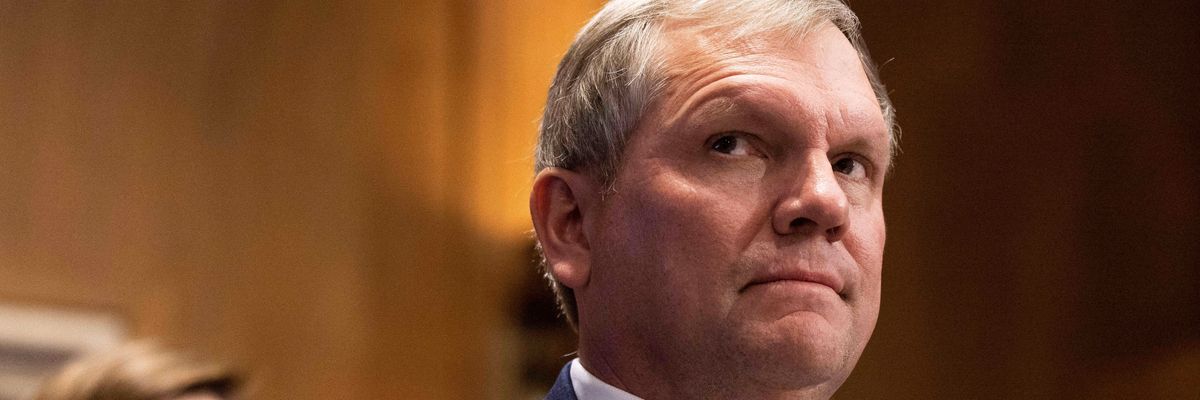
Norfolk Southern CEO Alan Shaw testifies at a Senate hearing on March 9, 2023.
"The longer we wait to act on rail safety, the deeper the railroad industry can dig in their claws and lobby against progress," warned Rep. Chris Deluzio.
Two trains operated by BNSF derailed in Washington state and Arizona on Thursday as the rail industry and its Republican allies in Congress fight bipartisan safety legislation introduced in the wake of the toxic crash in East Palestine, Ohio.
The Associated Press reported that the Washington derailment spilled 5,000 gallons of diesel fuel on tribal lands along Padilla Bay. State authorities said the fuel spill does not appear to have flowed toward the water—though such an assurance is cold comfort amid the disaster in eastern Ohio, where residents' concerns about the long-term impacts of the wreck on local water, soil, and air quality remain high more than a month after the crash.
In Arizona, eight BNSF train cars derailed Thursday near the state's border with California and Nevada, though it's unclear whether any spills occurred. The crash reportedly involved a train carrying corn syrup.
More than 1,000 trains derail in the United States each year, but the Norfolk Southern disaster in East Palestine has brought greater scrutiny to the industry's dangerous cost-cutting and lax safety practices—turning wrecks that would typically be consigned to local news coverage into national headlines.
With each derailment since early February, calls for substantive action in Congress to rein in the powerful industry have grown louder.
Under pressure from rail workers and others, a bipartisan group of lawmakers introduced legislation earlier this month that would impose stronger regulations on trains carrying hazardous materials—an effort that rail industry lobbying has defeated in the past.
While rail unions welcomed some provisions of the bill as decent starting points, they warned the measure has major loopholes and exceptions that rail giants wouldn't hesitate to exploit.
"If the language is not precise, the Class 1 railroads will avoid the scope of the law without violating the law, yet again putting the safety of our members and American communities into harm's way," said Eddie Hall, national president of the Brotherhood of Locomotive Engineers and Trainmen. "You can run a freight train through the loopholes."
Predictably, the rail industry is working to further water down the legislation or kill it entirely, pumping donations to Republican allies and running ads in major media outlets touting its supposedly ironclad commitment to safety.
Sludge's David Moore reported earlier this week that the PAC for Union Pacific—one of the largest Class 1 railroads in the U.S.—"made $15,000 in contributions last month, all to Republicans in the House and Senate, given less than two weeks after the Ohio derailment."
"Several House Republicans on committees that oversee transportation have sought to delay the bipartisan legislation to boost rail safety rules," Moore noted, "saying more information is needed after a potentially-lengthy study."
Rep. Troy Nehls (R-Texas), chair of the House Transportation and Infrastructure Subcommittee on Railroads, Pipelines, and Hazardous Materials, parroted industry talking points earlier this month when making the case against regulatory action, saying U.S. railroads have a "very high success rate of moving hazardous material—to the point of 99-percent-plus."
Days before Nehls' comment, the Association of American Railroads (AAR) declared in an ad appearing in a Politico newsletter that "while 99.9 percent of all hazmat shipments that move by rail reach their destination safely, we know a single incident can have significant impacts."
The AAR has dismissed demands for comprehensive rail safety reforms as "political."
In the Senate, meanwhile, John Thune (R-S.D.)—a former registered rail lobbyist—has emerged as a potentially key opponent of rail safety legislation, telling The Hill earlier this month that "we'll take a look at what's being proposed, but an immediate quick response heavy on regulation needs to be thoughtful and targeted."
During congressional testimony last week, Norfolk Southern CEO Alan Shaw refused to endorse the bipartisan Railway Safety Act, another indication that rail giants will continue their longstanding opposition to popular regulatory changes.
Over the past two decades, according to a recent OpenSecrets analysis, the rail industry has spent more than $650 million on federal lobbying.
"The longer we wait to act on rail safety, the deeper the railroad industry can dig in their claws and lobby against progress," Rep. Chris Deluzio (D-Pa.), a lead sponsor of separate rail safety legislation, warned Thursday.
Dear Common Dreams reader, It’s been nearly 30 years since I co-founded Common Dreams with my late wife, Lina Newhouser. We had the radical notion that journalism should serve the public good, not corporate profits. It was clear to us from the outset what it would take to build such a project. No paid advertisements. No corporate sponsors. No millionaire publisher telling us what to think or do. Many people said we wouldn't last a year, but we proved those doubters wrong. Together with a tremendous team of journalists and dedicated staff, we built an independent media outlet free from the constraints of profits and corporate control. Our mission has always been simple: To inform. To inspire. To ignite change for the common good. Building Common Dreams was not easy. Our survival was never guaranteed. When you take on the most powerful forces—Wall Street greed, fossil fuel industry destruction, Big Tech lobbyists, and uber-rich oligarchs who have spent billions upon billions rigging the economy and democracy in their favor—the only bulwark you have is supporters who believe in your work. But here’s the urgent message from me today. It's never been this bad out there. And it's never been this hard to keep us going. At the very moment Common Dreams is most needed, the threats we face are intensifying. We need your support now more than ever. We don't accept corporate advertising and never will. We don't have a paywall because we don't think people should be blocked from critical news based on their ability to pay. Everything we do is funded by the donations of readers like you. When everyone does the little they can afford, we are strong. But if that support retreats or dries up, so do we. Will you donate now to make sure Common Dreams not only survives but thrives? —Craig Brown, Co-founder |
Two trains operated by BNSF derailed in Washington state and Arizona on Thursday as the rail industry and its Republican allies in Congress fight bipartisan safety legislation introduced in the wake of the toxic crash in East Palestine, Ohio.
The Associated Press reported that the Washington derailment spilled 5,000 gallons of diesel fuel on tribal lands along Padilla Bay. State authorities said the fuel spill does not appear to have flowed toward the water—though such an assurance is cold comfort amid the disaster in eastern Ohio, where residents' concerns about the long-term impacts of the wreck on local water, soil, and air quality remain high more than a month after the crash.
In Arizona, eight BNSF train cars derailed Thursday near the state's border with California and Nevada, though it's unclear whether any spills occurred. The crash reportedly involved a train carrying corn syrup.
More than 1,000 trains derail in the United States each year, but the Norfolk Southern disaster in East Palestine has brought greater scrutiny to the industry's dangerous cost-cutting and lax safety practices—turning wrecks that would typically be consigned to local news coverage into national headlines.
With each derailment since early February, calls for substantive action in Congress to rein in the powerful industry have grown louder.
Under pressure from rail workers and others, a bipartisan group of lawmakers introduced legislation earlier this month that would impose stronger regulations on trains carrying hazardous materials—an effort that rail industry lobbying has defeated in the past.
While rail unions welcomed some provisions of the bill as decent starting points, they warned the measure has major loopholes and exceptions that rail giants wouldn't hesitate to exploit.
"If the language is not precise, the Class 1 railroads will avoid the scope of the law without violating the law, yet again putting the safety of our members and American communities into harm's way," said Eddie Hall, national president of the Brotherhood of Locomotive Engineers and Trainmen. "You can run a freight train through the loopholes."
Predictably, the rail industry is working to further water down the legislation or kill it entirely, pumping donations to Republican allies and running ads in major media outlets touting its supposedly ironclad commitment to safety.
Sludge's David Moore reported earlier this week that the PAC for Union Pacific—one of the largest Class 1 railroads in the U.S.—"made $15,000 in contributions last month, all to Republicans in the House and Senate, given less than two weeks after the Ohio derailment."
"Several House Republicans on committees that oversee transportation have sought to delay the bipartisan legislation to boost rail safety rules," Moore noted, "saying more information is needed after a potentially-lengthy study."
Rep. Troy Nehls (R-Texas), chair of the House Transportation and Infrastructure Subcommittee on Railroads, Pipelines, and Hazardous Materials, parroted industry talking points earlier this month when making the case against regulatory action, saying U.S. railroads have a "very high success rate of moving hazardous material—to the point of 99-percent-plus."
Days before Nehls' comment, the Association of American Railroads (AAR) declared in an ad appearing in a Politico newsletter that "while 99.9 percent of all hazmat shipments that move by rail reach their destination safely, we know a single incident can have significant impacts."
The AAR has dismissed demands for comprehensive rail safety reforms as "political."
In the Senate, meanwhile, John Thune (R-S.D.)—a former registered rail lobbyist—has emerged as a potentially key opponent of rail safety legislation, telling The Hill earlier this month that "we'll take a look at what's being proposed, but an immediate quick response heavy on regulation needs to be thoughtful and targeted."
During congressional testimony last week, Norfolk Southern CEO Alan Shaw refused to endorse the bipartisan Railway Safety Act, another indication that rail giants will continue their longstanding opposition to popular regulatory changes.
Over the past two decades, according to a recent OpenSecrets analysis, the rail industry has spent more than $650 million on federal lobbying.
"The longer we wait to act on rail safety, the deeper the railroad industry can dig in their claws and lobby against progress," Rep. Chris Deluzio (D-Pa.), a lead sponsor of separate rail safety legislation, warned Thursday.
Two trains operated by BNSF derailed in Washington state and Arizona on Thursday as the rail industry and its Republican allies in Congress fight bipartisan safety legislation introduced in the wake of the toxic crash in East Palestine, Ohio.
The Associated Press reported that the Washington derailment spilled 5,000 gallons of diesel fuel on tribal lands along Padilla Bay. State authorities said the fuel spill does not appear to have flowed toward the water—though such an assurance is cold comfort amid the disaster in eastern Ohio, where residents' concerns about the long-term impacts of the wreck on local water, soil, and air quality remain high more than a month after the crash.
In Arizona, eight BNSF train cars derailed Thursday near the state's border with California and Nevada, though it's unclear whether any spills occurred. The crash reportedly involved a train carrying corn syrup.
More than 1,000 trains derail in the United States each year, but the Norfolk Southern disaster in East Palestine has brought greater scrutiny to the industry's dangerous cost-cutting and lax safety practices—turning wrecks that would typically be consigned to local news coverage into national headlines.
With each derailment since early February, calls for substantive action in Congress to rein in the powerful industry have grown louder.
Under pressure from rail workers and others, a bipartisan group of lawmakers introduced legislation earlier this month that would impose stronger regulations on trains carrying hazardous materials—an effort that rail industry lobbying has defeated in the past.
While rail unions welcomed some provisions of the bill as decent starting points, they warned the measure has major loopholes and exceptions that rail giants wouldn't hesitate to exploit.
"If the language is not precise, the Class 1 railroads will avoid the scope of the law without violating the law, yet again putting the safety of our members and American communities into harm's way," said Eddie Hall, national president of the Brotherhood of Locomotive Engineers and Trainmen. "You can run a freight train through the loopholes."
Predictably, the rail industry is working to further water down the legislation or kill it entirely, pumping donations to Republican allies and running ads in major media outlets touting its supposedly ironclad commitment to safety.
Sludge's David Moore reported earlier this week that the PAC for Union Pacific—one of the largest Class 1 railroads in the U.S.—"made $15,000 in contributions last month, all to Republicans in the House and Senate, given less than two weeks after the Ohio derailment."
"Several House Republicans on committees that oversee transportation have sought to delay the bipartisan legislation to boost rail safety rules," Moore noted, "saying more information is needed after a potentially-lengthy study."
Rep. Troy Nehls (R-Texas), chair of the House Transportation and Infrastructure Subcommittee on Railroads, Pipelines, and Hazardous Materials, parroted industry talking points earlier this month when making the case against regulatory action, saying U.S. railroads have a "very high success rate of moving hazardous material—to the point of 99-percent-plus."
Days before Nehls' comment, the Association of American Railroads (AAR) declared in an ad appearing in a Politico newsletter that "while 99.9 percent of all hazmat shipments that move by rail reach their destination safely, we know a single incident can have significant impacts."
The AAR has dismissed demands for comprehensive rail safety reforms as "political."
In the Senate, meanwhile, John Thune (R-S.D.)—a former registered rail lobbyist—has emerged as a potentially key opponent of rail safety legislation, telling The Hill earlier this month that "we'll take a look at what's being proposed, but an immediate quick response heavy on regulation needs to be thoughtful and targeted."
During congressional testimony last week, Norfolk Southern CEO Alan Shaw refused to endorse the bipartisan Railway Safety Act, another indication that rail giants will continue their longstanding opposition to popular regulatory changes.
Over the past two decades, according to a recent OpenSecrets analysis, the rail industry has spent more than $650 million on federal lobbying.
"The longer we wait to act on rail safety, the deeper the railroad industry can dig in their claws and lobby against progress," Rep. Chris Deluzio (D-Pa.), a lead sponsor of separate rail safety legislation, warned Thursday.