SUBSCRIBE TO OUR FREE NEWSLETTER
Daily news & progressive opinion—funded by the people, not the corporations—delivered straight to your inbox.
5
#000000
#FFFFFF
To donate by check, phone, or other method, see our More Ways to Give page.
Daily news & progressive opinion—funded by the people, not the corporations—delivered straight to your inbox.
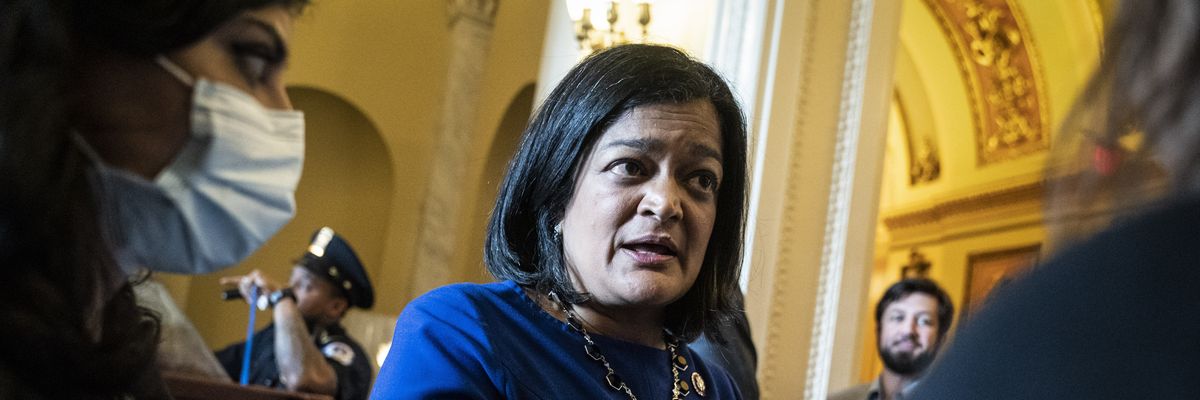
Rep. Pramila Jayapal (D-Wash.) speaks with reporters after a vote on Capitol Hill on July 28, 2022 in Washington, D.C.
"There is simply no reason for taxpayers to continue to pay for outrageously high budgets rife with waste, fraud, and abuse," said Rep. Pramila Jayapal.
Progressive lawmakers on Thursday voiced dismay that President Joe Biden is requesting a nearly $30 billion increase in U.S. military spending just months after the Pentagon failed its fifth consecutive audit, admitting it could not properly account for more than half of its trillions of dollars in assets.
Biden's budget framework for fiscal year 2024 calls for $886 billion in overall military spending—up from the current level of $858 billion—with $842 billion going to the Pentagon. More than half of the $1.7 trillion of discretionary spending in Biden's proposal is reserved for the military, which would get $170 billion for weapons procurement and $38 billion for nuke modernization.
Defense News reported that the president's budget would boost spending on "new drones, combat jets, hypersonic missiles, and submarines."
Rep. Pramila Jayapal (D-Wash.), chair of the Congressional Progressive Caucus, said in a statement late Thursday that the president's Pentagon blueprint requests "$26 billion more than Congress allocated in the previous budget—which itself was $63 billion more than the $773 billion the President requested for FY2023."
"This is a never-ending cycle of increased funds without accountability," said Jayapal. "There is simply no reason for taxpayers to continue to pay for outrageously high budgets rife with waste, fraud, and abuse. A recent CBO study confirmed that the Pentagon could cut $100 billion per year without compromising on national defense. This is long overdue. Progressives in Congress have been at the frontline of this fight for decades, and we will continue to push for sensible, targeted defense policy that prioritizes our national security over profit-hungry military contractors."
Given that roughly half of the Pentagon's annual budget has historically gone to military contractors such as Lockheed Martin and Raytheon, the National Priorities Project (NPP) noted Thursday that around 25% of Biden's total discretionary budget would likely wind up in the coffers of private companies.
"This military budget represents a shameful status quo that the country can no longer afford," said Lindsay Koshgarian, NPP's program director. "Families are struggling to afford basics like housing, food, and medicine, and our last pandemic-era protections are ending, all while Pentagon contractors pay their CEOs millions straight from the public treasury."
Led by Reps. Barbara Lee (D-Calif.) and Mark Pocan (D-Wis.), progressive lawmakers have been working for years to enact modest cuts to the Pentagon budget and redirect the savings toward healthcare, education, and other social investments.
But those efforts have repeatedly fallen short in the face of bipartisan opposition.
In 2022, Lee's proposal to cut $100 billion off the military budget's top line was defeated by an overwhelming vote of 78-350, with 141 House Democrats joining nearly every Republican in voting no. (NPP points out that $100 billion would be enough to send every U.S. household a $700 check or hire a million elementary school teachers.)
In a statement Thursday, Lee said she is "disappointed" that the president's new budget "continues the regressive trend of increasing our bloated, wasteful defense budget year after year with little oversight." Last month, Lee and Pocan reintroduced legislation that would reduce the U.S. military budget by $100 billion.
Top Republicans, meanwhile, signaled Thursday that they will try to pile more money on top of Biden's historically large military budget request as they simultaneously pursue cuts to Medicaid and food benefits.
Rep. Mike Rogers (R-Ala.), chair of the House Armed Services Committee, lamented that Biden's budget "proposes to increase non-defense spending at more than twice the rate of defense."
"The president’s incredibly misplaced priorities send all the wrong messages to our adversaries," said Rogers. "On the House Armed Services Committee, we are focused on building an NDAA that provides our warfighters with the capability and lethality to deter and, if necessary, defeat the grave threats facing our nation."
Sen. Roger Wicker (R-Miss.) sent a similar message, calling Biden's military budget request "woefully inadequate" and a "serious indication of President Biden's failure to prioritize national security."
But analysts argue that ballooning military spending does little to bolster U.S. national security. As William Hartung of the Quincy Institute for Responsible Statecraft wrote Thursday, "We can make America and its allies safer for far less money if we adopt a more realistic, restrained strategy and drive a harder bargain with weapons contractors that too often engage in price gouging and cost overruns while delivering dysfunctional systems that aren’t appropriate for addressing the biggest threats to our security."
"The Congressional Budget Office has crafted three illustrative options that could ensure our security while spending $1 trillion less over the next decade," Hartung noted. "A strategy that incorporates aspects of these plans and streamlines the Pentagon budget in other areas could be sustained at roughly $150 billion per year less than current levels."
Dear Common Dreams reader, It’s been nearly 30 years since I co-founded Common Dreams with my late wife, Lina Newhouser. We had the radical notion that journalism should serve the public good, not corporate profits. It was clear to us from the outset what it would take to build such a project. No paid advertisements. No corporate sponsors. No millionaire publisher telling us what to think or do. Many people said we wouldn't last a year, but we proved those doubters wrong. Together with a tremendous team of journalists and dedicated staff, we built an independent media outlet free from the constraints of profits and corporate control. Our mission has always been simple: To inform. To inspire. To ignite change for the common good. Building Common Dreams was not easy. Our survival was never guaranteed. When you take on the most powerful forces—Wall Street greed, fossil fuel industry destruction, Big Tech lobbyists, and uber-rich oligarchs who have spent billions upon billions rigging the economy and democracy in their favor—the only bulwark you have is supporters who believe in your work. But here’s the urgent message from me today. It's never been this bad out there. And it's never been this hard to keep us going. At the very moment Common Dreams is most needed, the threats we face are intensifying. We need your support now more than ever. We don't accept corporate advertising and never will. We don't have a paywall because we don't think people should be blocked from critical news based on their ability to pay. Everything we do is funded by the donations of readers like you. When everyone does the little they can afford, we are strong. But if that support retreats or dries up, so do we. Will you donate now to make sure Common Dreams not only survives but thrives? —Craig Brown, Co-founder |
Progressive lawmakers on Thursday voiced dismay that President Joe Biden is requesting a nearly $30 billion increase in U.S. military spending just months after the Pentagon failed its fifth consecutive audit, admitting it could not properly account for more than half of its trillions of dollars in assets.
Biden's budget framework for fiscal year 2024 calls for $886 billion in overall military spending—up from the current level of $858 billion—with $842 billion going to the Pentagon. More than half of the $1.7 trillion of discretionary spending in Biden's proposal is reserved for the military, which would get $170 billion for weapons procurement and $38 billion for nuke modernization.
Defense News reported that the president's budget would boost spending on "new drones, combat jets, hypersonic missiles, and submarines."
Rep. Pramila Jayapal (D-Wash.), chair of the Congressional Progressive Caucus, said in a statement late Thursday that the president's Pentagon blueprint requests "$26 billion more than Congress allocated in the previous budget—which itself was $63 billion more than the $773 billion the President requested for FY2023."
"This is a never-ending cycle of increased funds without accountability," said Jayapal. "There is simply no reason for taxpayers to continue to pay for outrageously high budgets rife with waste, fraud, and abuse. A recent CBO study confirmed that the Pentagon could cut $100 billion per year without compromising on national defense. This is long overdue. Progressives in Congress have been at the frontline of this fight for decades, and we will continue to push for sensible, targeted defense policy that prioritizes our national security over profit-hungry military contractors."
Given that roughly half of the Pentagon's annual budget has historically gone to military contractors such as Lockheed Martin and Raytheon, the National Priorities Project (NPP) noted Thursday that around 25% of Biden's total discretionary budget would likely wind up in the coffers of private companies.
"This military budget represents a shameful status quo that the country can no longer afford," said Lindsay Koshgarian, NPP's program director. "Families are struggling to afford basics like housing, food, and medicine, and our last pandemic-era protections are ending, all while Pentagon contractors pay their CEOs millions straight from the public treasury."
Led by Reps. Barbara Lee (D-Calif.) and Mark Pocan (D-Wis.), progressive lawmakers have been working for years to enact modest cuts to the Pentagon budget and redirect the savings toward healthcare, education, and other social investments.
But those efforts have repeatedly fallen short in the face of bipartisan opposition.
In 2022, Lee's proposal to cut $100 billion off the military budget's top line was defeated by an overwhelming vote of 78-350, with 141 House Democrats joining nearly every Republican in voting no. (NPP points out that $100 billion would be enough to send every U.S. household a $700 check or hire a million elementary school teachers.)
In a statement Thursday, Lee said she is "disappointed" that the president's new budget "continues the regressive trend of increasing our bloated, wasteful defense budget year after year with little oversight." Last month, Lee and Pocan reintroduced legislation that would reduce the U.S. military budget by $100 billion.
Top Republicans, meanwhile, signaled Thursday that they will try to pile more money on top of Biden's historically large military budget request as they simultaneously pursue cuts to Medicaid and food benefits.
Rep. Mike Rogers (R-Ala.), chair of the House Armed Services Committee, lamented that Biden's budget "proposes to increase non-defense spending at more than twice the rate of defense."
"The president’s incredibly misplaced priorities send all the wrong messages to our adversaries," said Rogers. "On the House Armed Services Committee, we are focused on building an NDAA that provides our warfighters with the capability and lethality to deter and, if necessary, defeat the grave threats facing our nation."
Sen. Roger Wicker (R-Miss.) sent a similar message, calling Biden's military budget request "woefully inadequate" and a "serious indication of President Biden's failure to prioritize national security."
But analysts argue that ballooning military spending does little to bolster U.S. national security. As William Hartung of the Quincy Institute for Responsible Statecraft wrote Thursday, "We can make America and its allies safer for far less money if we adopt a more realistic, restrained strategy and drive a harder bargain with weapons contractors that too often engage in price gouging and cost overruns while delivering dysfunctional systems that aren’t appropriate for addressing the biggest threats to our security."
"The Congressional Budget Office has crafted three illustrative options that could ensure our security while spending $1 trillion less over the next decade," Hartung noted. "A strategy that incorporates aspects of these plans and streamlines the Pentagon budget in other areas could be sustained at roughly $150 billion per year less than current levels."
Progressive lawmakers on Thursday voiced dismay that President Joe Biden is requesting a nearly $30 billion increase in U.S. military spending just months after the Pentagon failed its fifth consecutive audit, admitting it could not properly account for more than half of its trillions of dollars in assets.
Biden's budget framework for fiscal year 2024 calls for $886 billion in overall military spending—up from the current level of $858 billion—with $842 billion going to the Pentagon. More than half of the $1.7 trillion of discretionary spending in Biden's proposal is reserved for the military, which would get $170 billion for weapons procurement and $38 billion for nuke modernization.
Defense News reported that the president's budget would boost spending on "new drones, combat jets, hypersonic missiles, and submarines."
Rep. Pramila Jayapal (D-Wash.), chair of the Congressional Progressive Caucus, said in a statement late Thursday that the president's Pentagon blueprint requests "$26 billion more than Congress allocated in the previous budget—which itself was $63 billion more than the $773 billion the President requested for FY2023."
"This is a never-ending cycle of increased funds without accountability," said Jayapal. "There is simply no reason for taxpayers to continue to pay for outrageously high budgets rife with waste, fraud, and abuse. A recent CBO study confirmed that the Pentagon could cut $100 billion per year without compromising on national defense. This is long overdue. Progressives in Congress have been at the frontline of this fight for decades, and we will continue to push for sensible, targeted defense policy that prioritizes our national security over profit-hungry military contractors."
Given that roughly half of the Pentagon's annual budget has historically gone to military contractors such as Lockheed Martin and Raytheon, the National Priorities Project (NPP) noted Thursday that around 25% of Biden's total discretionary budget would likely wind up in the coffers of private companies.
"This military budget represents a shameful status quo that the country can no longer afford," said Lindsay Koshgarian, NPP's program director. "Families are struggling to afford basics like housing, food, and medicine, and our last pandemic-era protections are ending, all while Pentagon contractors pay their CEOs millions straight from the public treasury."
Led by Reps. Barbara Lee (D-Calif.) and Mark Pocan (D-Wis.), progressive lawmakers have been working for years to enact modest cuts to the Pentagon budget and redirect the savings toward healthcare, education, and other social investments.
But those efforts have repeatedly fallen short in the face of bipartisan opposition.
In 2022, Lee's proposal to cut $100 billion off the military budget's top line was defeated by an overwhelming vote of 78-350, with 141 House Democrats joining nearly every Republican in voting no. (NPP points out that $100 billion would be enough to send every U.S. household a $700 check or hire a million elementary school teachers.)
In a statement Thursday, Lee said she is "disappointed" that the president's new budget "continues the regressive trend of increasing our bloated, wasteful defense budget year after year with little oversight." Last month, Lee and Pocan reintroduced legislation that would reduce the U.S. military budget by $100 billion.
Top Republicans, meanwhile, signaled Thursday that they will try to pile more money on top of Biden's historically large military budget request as they simultaneously pursue cuts to Medicaid and food benefits.
Rep. Mike Rogers (R-Ala.), chair of the House Armed Services Committee, lamented that Biden's budget "proposes to increase non-defense spending at more than twice the rate of defense."
"The president’s incredibly misplaced priorities send all the wrong messages to our adversaries," said Rogers. "On the House Armed Services Committee, we are focused on building an NDAA that provides our warfighters with the capability and lethality to deter and, if necessary, defeat the grave threats facing our nation."
Sen. Roger Wicker (R-Miss.) sent a similar message, calling Biden's military budget request "woefully inadequate" and a "serious indication of President Biden's failure to prioritize national security."
But analysts argue that ballooning military spending does little to bolster U.S. national security. As William Hartung of the Quincy Institute for Responsible Statecraft wrote Thursday, "We can make America and its allies safer for far less money if we adopt a more realistic, restrained strategy and drive a harder bargain with weapons contractors that too often engage in price gouging and cost overruns while delivering dysfunctional systems that aren’t appropriate for addressing the biggest threats to our security."
"The Congressional Budget Office has crafted three illustrative options that could ensure our security while spending $1 trillion less over the next decade," Hartung noted. "A strategy that incorporates aspects of these plans and streamlines the Pentagon budget in other areas could be sustained at roughly $150 billion per year less than current levels."