SUBSCRIBE TO OUR FREE NEWSLETTER
Daily news & progressive opinion—funded by the people, not the corporations—delivered straight to your inbox.
5
#000000
#FFFFFF
To donate by check, phone, or other method, see our More Ways to Give page.
Daily news & progressive opinion—funded by the people, not the corporations—delivered straight to your inbox.
There are nearly 360,000 American behind bars due to a drug offense, according to the Drug Policy Alliance.
With only weeks left of his administration, President Joe Biden has earned praise from rights groups and advocates for exercising his clemency powers, including announcing Monday that he is commuting the death sentences of 37 individuals on federal death row—but the Congressional Progressive Caucus is urging him to go further.
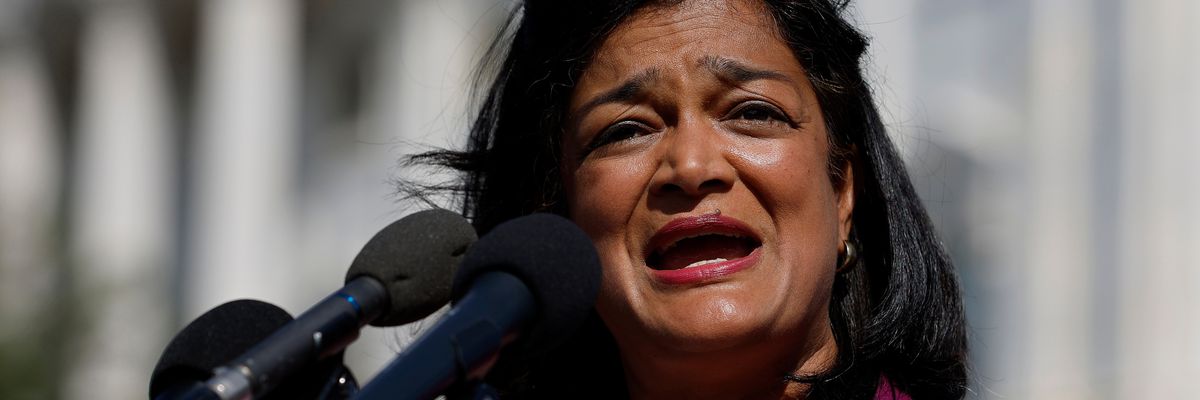
"We thank the president for this significant step and urge him to use his last few days in office to commute the sentences of the thousands of Americans impacted by the War on Drugs and decades of harmful, disparate convictions and sentencing," wrote Congressional Progressive Caucus Chair Rep. Pramila Jayapal (D-Wash.) in a statement on Monday.
Per Drug Policy Alliance, a nonprofit that addresses the harms of drug use and drug criminalization, there are nearly 360,000 American behind bars due to a drug offense. "This includes thousands of people charged with federal marijuana offenses or who are serving long federal mandatory minimum sentences due to the unfair crack-powder cocaine sentencing disparity," according to the group.
On December 12, Biden commuted the sentences of nearly 1,500 Americans and pardoned 39 people convicted of nonviolent crimes, a move the White House called "the largest single-day grant of clemency in modern history."
Reacting to those commutations and pardons, the Drug Policy Alliance wrote that "President Biden's historic actions today acknowledge what Americans have long known: that our country's practice of doling out lengthy prison sentences to people for drug offenses has put lives at risk, broken families apart, and wasted billions of dollars."
However, the group continued, "he must issue additional pardons and commutations to bring all victims of our country's failed drug war home. But we cannot stop there. President Biden can still play a role in mitigating the harms of federal marijuana criminalization through executive action."
The Drug Policy Alliance has drafted a proposed executive order for Biden to issue that would create a council to guide the federal government in repairing harms caused by marijuana criminalization and advance more fair and just policies in future, and mandate that federal agencies be tasked with evaluating how their-marijuana related policies and programs created barriers for underserved communities, among other actions.
Biden did in 2022 grant full and unconditional pardons to all U.S. citizens convicted of simple federal marijuana possession—a move that was cheered by advocates.
In her statement on Monday, Jayapal called Biden's decision to largely clear federal death row an "extraordinary act" that was only possible thanks to "tireless organizing and activism of progressives in Congress and on the ground."
Three people, Dylann Roof, Robert Bowers, and Dzhokhar Tsarnaev, will remain on death row. The 37 people whose sentences were commuted will receive life in prison without the possibility of parole.
Dear Common Dreams reader, It’s been nearly 30 years since I co-founded Common Dreams with my late wife, Lina Newhouser. We had the radical notion that journalism should serve the public good, not corporate profits. It was clear to us from the outset what it would take to build such a project. No paid advertisements. No corporate sponsors. No millionaire publisher telling us what to think or do. Many people said we wouldn't last a year, but we proved those doubters wrong. Together with a tremendous team of journalists and dedicated staff, we built an independent media outlet free from the constraints of profits and corporate control. Our mission has always been simple: To inform. To inspire. To ignite change for the common good. Building Common Dreams was not easy. Our survival was never guaranteed. When you take on the most powerful forces—Wall Street greed, fossil fuel industry destruction, Big Tech lobbyists, and uber-rich oligarchs who have spent billions upon billions rigging the economy and democracy in their favor—the only bulwark you have is supporters who believe in your work. But here’s the urgent message from me today. It's never been this bad out there. And it's never been this hard to keep us going. At the very moment Common Dreams is most needed, the threats we face are intensifying. We need your support now more than ever. We don't accept corporate advertising and never will. We don't have a paywall because we don't think people should be blocked from critical news based on their ability to pay. Everything we do is funded by the donations of readers like you. When everyone does the little they can afford, we are strong. But if that support retreats or dries up, so do we. Will you donate now to make sure Common Dreams not only survives but thrives? —Craig Brown, Co-founder |
With only weeks left of his administration, President Joe Biden has earned praise from rights groups and advocates for exercising his clemency powers, including announcing Monday that he is commuting the death sentences of 37 individuals on federal death row—but the Congressional Progressive Caucus is urging him to go further.
"We thank the president for this significant step and urge him to use his last few days in office to commute the sentences of the thousands of Americans impacted by the War on Drugs and decades of harmful, disparate convictions and sentencing," wrote Congressional Progressive Caucus Chair Rep. Pramila Jayapal (D-Wash.) in a statement on Monday.
Per Drug Policy Alliance, a nonprofit that addresses the harms of drug use and drug criminalization, there are nearly 360,000 American behind bars due to a drug offense. "This includes thousands of people charged with federal marijuana offenses or who are serving long federal mandatory minimum sentences due to the unfair crack-powder cocaine sentencing disparity," according to the group.
On December 12, Biden commuted the sentences of nearly 1,500 Americans and pardoned 39 people convicted of nonviolent crimes, a move the White House called "the largest single-day grant of clemency in modern history."
Reacting to those commutations and pardons, the Drug Policy Alliance wrote that "President Biden's historic actions today acknowledge what Americans have long known: that our country's practice of doling out lengthy prison sentences to people for drug offenses has put lives at risk, broken families apart, and wasted billions of dollars."
However, the group continued, "he must issue additional pardons and commutations to bring all victims of our country's failed drug war home. But we cannot stop there. President Biden can still play a role in mitigating the harms of federal marijuana criminalization through executive action."
The Drug Policy Alliance has drafted a proposed executive order for Biden to issue that would create a council to guide the federal government in repairing harms caused by marijuana criminalization and advance more fair and just policies in future, and mandate that federal agencies be tasked with evaluating how their-marijuana related policies and programs created barriers for underserved communities, among other actions.
Biden did in 2022 grant full and unconditional pardons to all U.S. citizens convicted of simple federal marijuana possession—a move that was cheered by advocates.
In her statement on Monday, Jayapal called Biden's decision to largely clear federal death row an "extraordinary act" that was only possible thanks to "tireless organizing and activism of progressives in Congress and on the ground."
Three people, Dylann Roof, Robert Bowers, and Dzhokhar Tsarnaev, will remain on death row. The 37 people whose sentences were commuted will receive life in prison without the possibility of parole.
With only weeks left of his administration, President Joe Biden has earned praise from rights groups and advocates for exercising his clemency powers, including announcing Monday that he is commuting the death sentences of 37 individuals on federal death row—but the Congressional Progressive Caucus is urging him to go further.
"We thank the president for this significant step and urge him to use his last few days in office to commute the sentences of the thousands of Americans impacted by the War on Drugs and decades of harmful, disparate convictions and sentencing," wrote Congressional Progressive Caucus Chair Rep. Pramila Jayapal (D-Wash.) in a statement on Monday.
Per Drug Policy Alliance, a nonprofit that addresses the harms of drug use and drug criminalization, there are nearly 360,000 American behind bars due to a drug offense. "This includes thousands of people charged with federal marijuana offenses or who are serving long federal mandatory minimum sentences due to the unfair crack-powder cocaine sentencing disparity," according to the group.
On December 12, Biden commuted the sentences of nearly 1,500 Americans and pardoned 39 people convicted of nonviolent crimes, a move the White House called "the largest single-day grant of clemency in modern history."
Reacting to those commutations and pardons, the Drug Policy Alliance wrote that "President Biden's historic actions today acknowledge what Americans have long known: that our country's practice of doling out lengthy prison sentences to people for drug offenses has put lives at risk, broken families apart, and wasted billions of dollars."
However, the group continued, "he must issue additional pardons and commutations to bring all victims of our country's failed drug war home. But we cannot stop there. President Biden can still play a role in mitigating the harms of federal marijuana criminalization through executive action."
The Drug Policy Alliance has drafted a proposed executive order for Biden to issue that would create a council to guide the federal government in repairing harms caused by marijuana criminalization and advance more fair and just policies in future, and mandate that federal agencies be tasked with evaluating how their-marijuana related policies and programs created barriers for underserved communities, among other actions.
Biden did in 2022 grant full and unconditional pardons to all U.S. citizens convicted of simple federal marijuana possession—a move that was cheered by advocates.
In her statement on Monday, Jayapal called Biden's decision to largely clear federal death row an "extraordinary act" that was only possible thanks to "tireless organizing and activism of progressives in Congress and on the ground."
Three people, Dylann Roof, Robert Bowers, and Dzhokhar Tsarnaev, will remain on death row. The 37 people whose sentences were commuted will receive life in prison without the possibility of parole.