SUBSCRIBE TO OUR FREE NEWSLETTER
Daily news & progressive opinion—funded by the people, not the corporations—delivered straight to your inbox.
5
#000000
#FFFFFF
To donate by check, phone, or other method, see our More Ways to Give page.
Daily news & progressive opinion—funded by the people, not the corporations—delivered straight to your inbox.
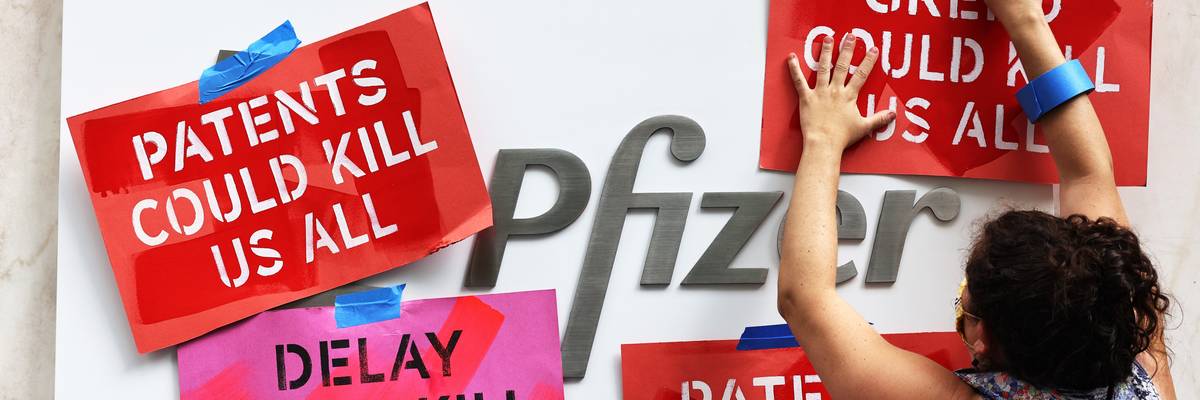
A demonstrator tapes protests signs to the Pfizer logo in Manhattan, New York on July 14, 2021.
"Pharmaceutical companies have sold a false narrative to the public; that it was their investment which gave us mRNA vaccines and that they deserve the $75 billion profit."
Vaccine equity campaigners said Thursday that a new peer-reviewed study published in a major medical journal should put to rest the pharmaceutical industry's "false narrative" that its own investments were responsible for the rapid development of mRNA vaccines to fight the coronavirus pandemic.
The study, published in The BMJ on Wednesday, estimates that the U.S. federal government has invested at least $31.9 billion in the development, production, and purchase of mRNA coronavirus vaccines—a finding that the People's Vaccine Alliance said undercuts pharmaceutical companies' attempts to take credit for the innovations that made the lifesaving shots possible.
"Pharmaceutical companies have sold a false narrative to the public; that it was their investment which gave us mRNA vaccines and that they deserve the $75 billion profit made from Covid-19 vaccines. As this research shows, that claim is a total myth," Mohga Kamal-Yanni, policy co-lead for the People's Vaccine Alliance, said in a statement Thursday.
"Without public investment, there would be no mRNA vaccines. Yet just three pharmaceutical companies have been handed monopolies on this lifesaving public science," Kamal-Yanni continued. "These are the people's vaccines, and the technology behind them should be shared with the world."
The new study, which tracks U.S. public investments in mRNA vaccine technology dating back decades, identifies 34 National Institutes of Health (NIH)-funded research grants that were "directly related to mRNA Covid-19 vaccines."
The authors summarized their findings:
Pre-pandemic, the NIH invested $116 million (35%) in basic and translational science related to mRNA vaccine technology, and the Biomedical Advanced Research and Development Authority (BARDA) ($148 million; 44%) and the Department of Defense ($72 million; 21%) invested in vaccine development. After the pandemic started, $29.2 billion (92%) of U.S. public funds purchased vaccines, $2.2 billion (7%) supported clinical trials, and $108 million (<1%) supported manufacturing plus basic and translational science...
These public investments translated into millions of lives saved and were crucial in developing the mRNA vaccine technology that also has the potential to tackle future pandemics and to treat diseases beyond Covid-19. To maximize overall health impact, policymakers should ensure equitable global access to publicly funded health technologies.
Though their successes were enabled at every step by government support, pharmaceutical companies—including Moderna and Pfizer, the manufacturers of the two available mRNA Covid-19 vaccines—have resisted the notion that federal research and funding was critical to the rapid development of coronavirus shots.
Speaking to Barron's in July 2020, before any coronavirus vaccines had received emergency authorization, Pfizer CEO Albert Bourla scoffed at the notion that pharmaceutical companies should forgo any profits from coronavirus vaccines and therapeutics.
"I think it's very wrong. You need to be very fanatic and radical to say something like that right now," Bourla said. "Who is finding the solution? The private sector found the solution for diagnostics, and the private sector found the solution for therapeutics and is along [the] way to find more solutions for therapeutics and vaccines."
Pfizer posted $31.4 billion in profits in 2022, a sum advocates condemned as "sickening"—particularly as many people in low-income countries still lack access to coronavirus vaccines.
While Moderna's billionaire CEO Stéphane Bancel has acknowledged that "we didn't do this alone" and that government financial backing played an important role in the development of Covid-19 vaccines, the company is fighting with the NIH over patent rights to spike-protein technology that is central to the mRNA shots.
The New York Times reported last month that Moderna recently agreed to make a $400 million payment for using a chemical technique that was developed with government funding. The payment will be shared by the NIH and two U.S. universities involved in the invention of the technique.
But the Times noted that "Moderna is still locked in a separate high-stakes dispute with the NIH over who invented the central component of the vaccine, the genetic sequence that helps recipients produce an immune response."
Peter Maybarduk, director of the Access to Medicines program at Public Citizen, said in response to Moderna's $400 million payment that it "amounts to little more than 1% of its $36 billion in global sales."
"Considering Moderna's soup-to-nuts reliance on U.S. government support, the public deserves a much better deal, including vaccines made available free or at cost today," said Maybarduk. "The government should have insisted on affordability from the start, and should insist on essentially free vaccines today. There would be no NIH-Moderna vaccine without the NIH."
The People's Vaccine Alliance and Oxfam International echoed that sentiment in a statement earlier this week as a World Health Organization body kicked off negotiations over an international pandemic accord.
"Medical technologies related to pathogens with pandemic potential must be treated as global common goods—be available to all who need them at the same time," the groups said. "Global common goods must take precedence over private commercial interests."
Dear Common Dreams reader, It’s been nearly 30 years since I co-founded Common Dreams with my late wife, Lina Newhouser. We had the radical notion that journalism should serve the public good, not corporate profits. It was clear to us from the outset what it would take to build such a project. No paid advertisements. No corporate sponsors. No millionaire publisher telling us what to think or do. Many people said we wouldn't last a year, but we proved those doubters wrong. Together with a tremendous team of journalists and dedicated staff, we built an independent media outlet free from the constraints of profits and corporate control. Our mission has always been simple: To inform. To inspire. To ignite change for the common good. Building Common Dreams was not easy. Our survival was never guaranteed. When you take on the most powerful forces—Wall Street greed, fossil fuel industry destruction, Big Tech lobbyists, and uber-rich oligarchs who have spent billions upon billions rigging the economy and democracy in their favor—the only bulwark you have is supporters who believe in your work. But here’s the urgent message from me today. It's never been this bad out there. And it's never been this hard to keep us going. At the very moment Common Dreams is most needed, the threats we face are intensifying. We need your support now more than ever. We don't accept corporate advertising and never will. We don't have a paywall because we don't think people should be blocked from critical news based on their ability to pay. Everything we do is funded by the donations of readers like you. When everyone does the little they can afford, we are strong. But if that support retreats or dries up, so do we. Will you donate now to make sure Common Dreams not only survives but thrives? —Craig Brown, Co-founder |
Vaccine equity campaigners said Thursday that a new peer-reviewed study published in a major medical journal should put to rest the pharmaceutical industry's "false narrative" that its own investments were responsible for the rapid development of mRNA vaccines to fight the coronavirus pandemic.
The study, published in The BMJ on Wednesday, estimates that the U.S. federal government has invested at least $31.9 billion in the development, production, and purchase of mRNA coronavirus vaccines—a finding that the People's Vaccine Alliance said undercuts pharmaceutical companies' attempts to take credit for the innovations that made the lifesaving shots possible.
"Pharmaceutical companies have sold a false narrative to the public; that it was their investment which gave us mRNA vaccines and that they deserve the $75 billion profit made from Covid-19 vaccines. As this research shows, that claim is a total myth," Mohga Kamal-Yanni, policy co-lead for the People's Vaccine Alliance, said in a statement Thursday.
"Without public investment, there would be no mRNA vaccines. Yet just three pharmaceutical companies have been handed monopolies on this lifesaving public science," Kamal-Yanni continued. "These are the people's vaccines, and the technology behind them should be shared with the world."
The new study, which tracks U.S. public investments in mRNA vaccine technology dating back decades, identifies 34 National Institutes of Health (NIH)-funded research grants that were "directly related to mRNA Covid-19 vaccines."
The authors summarized their findings:
Pre-pandemic, the NIH invested $116 million (35%) in basic and translational science related to mRNA vaccine technology, and the Biomedical Advanced Research and Development Authority (BARDA) ($148 million; 44%) and the Department of Defense ($72 million; 21%) invested in vaccine development. After the pandemic started, $29.2 billion (92%) of U.S. public funds purchased vaccines, $2.2 billion (7%) supported clinical trials, and $108 million (<1%) supported manufacturing plus basic and translational science...
These public investments translated into millions of lives saved and were crucial in developing the mRNA vaccine technology that also has the potential to tackle future pandemics and to treat diseases beyond Covid-19. To maximize overall health impact, policymakers should ensure equitable global access to publicly funded health technologies.
Though their successes were enabled at every step by government support, pharmaceutical companies—including Moderna and Pfizer, the manufacturers of the two available mRNA Covid-19 vaccines—have resisted the notion that federal research and funding was critical to the rapid development of coronavirus shots.
Speaking to Barron's in July 2020, before any coronavirus vaccines had received emergency authorization, Pfizer CEO Albert Bourla scoffed at the notion that pharmaceutical companies should forgo any profits from coronavirus vaccines and therapeutics.
"I think it's very wrong. You need to be very fanatic and radical to say something like that right now," Bourla said. "Who is finding the solution? The private sector found the solution for diagnostics, and the private sector found the solution for therapeutics and is along [the] way to find more solutions for therapeutics and vaccines."
Pfizer posted $31.4 billion in profits in 2022, a sum advocates condemned as "sickening"—particularly as many people in low-income countries still lack access to coronavirus vaccines.
While Moderna's billionaire CEO Stéphane Bancel has acknowledged that "we didn't do this alone" and that government financial backing played an important role in the development of Covid-19 vaccines, the company is fighting with the NIH over patent rights to spike-protein technology that is central to the mRNA shots.
The New York Times reported last month that Moderna recently agreed to make a $400 million payment for using a chemical technique that was developed with government funding. The payment will be shared by the NIH and two U.S. universities involved in the invention of the technique.
But the Times noted that "Moderna is still locked in a separate high-stakes dispute with the NIH over who invented the central component of the vaccine, the genetic sequence that helps recipients produce an immune response."
Peter Maybarduk, director of the Access to Medicines program at Public Citizen, said in response to Moderna's $400 million payment that it "amounts to little more than 1% of its $36 billion in global sales."
"Considering Moderna's soup-to-nuts reliance on U.S. government support, the public deserves a much better deal, including vaccines made available free or at cost today," said Maybarduk. "The government should have insisted on affordability from the start, and should insist on essentially free vaccines today. There would be no NIH-Moderna vaccine without the NIH."
The People's Vaccine Alliance and Oxfam International echoed that sentiment in a statement earlier this week as a World Health Organization body kicked off negotiations over an international pandemic accord.
"Medical technologies related to pathogens with pandemic potential must be treated as global common goods—be available to all who need them at the same time," the groups said. "Global common goods must take precedence over private commercial interests."
Vaccine equity campaigners said Thursday that a new peer-reviewed study published in a major medical journal should put to rest the pharmaceutical industry's "false narrative" that its own investments were responsible for the rapid development of mRNA vaccines to fight the coronavirus pandemic.
The study, published in The BMJ on Wednesday, estimates that the U.S. federal government has invested at least $31.9 billion in the development, production, and purchase of mRNA coronavirus vaccines—a finding that the People's Vaccine Alliance said undercuts pharmaceutical companies' attempts to take credit for the innovations that made the lifesaving shots possible.
"Pharmaceutical companies have sold a false narrative to the public; that it was their investment which gave us mRNA vaccines and that they deserve the $75 billion profit made from Covid-19 vaccines. As this research shows, that claim is a total myth," Mohga Kamal-Yanni, policy co-lead for the People's Vaccine Alliance, said in a statement Thursday.
"Without public investment, there would be no mRNA vaccines. Yet just three pharmaceutical companies have been handed monopolies on this lifesaving public science," Kamal-Yanni continued. "These are the people's vaccines, and the technology behind them should be shared with the world."
The new study, which tracks U.S. public investments in mRNA vaccine technology dating back decades, identifies 34 National Institutes of Health (NIH)-funded research grants that were "directly related to mRNA Covid-19 vaccines."
The authors summarized their findings:
Pre-pandemic, the NIH invested $116 million (35%) in basic and translational science related to mRNA vaccine technology, and the Biomedical Advanced Research and Development Authority (BARDA) ($148 million; 44%) and the Department of Defense ($72 million; 21%) invested in vaccine development. After the pandemic started, $29.2 billion (92%) of U.S. public funds purchased vaccines, $2.2 billion (7%) supported clinical trials, and $108 million (<1%) supported manufacturing plus basic and translational science...
These public investments translated into millions of lives saved and were crucial in developing the mRNA vaccine technology that also has the potential to tackle future pandemics and to treat diseases beyond Covid-19. To maximize overall health impact, policymakers should ensure equitable global access to publicly funded health technologies.
Though their successes were enabled at every step by government support, pharmaceutical companies—including Moderna and Pfizer, the manufacturers of the two available mRNA Covid-19 vaccines—have resisted the notion that federal research and funding was critical to the rapid development of coronavirus shots.
Speaking to Barron's in July 2020, before any coronavirus vaccines had received emergency authorization, Pfizer CEO Albert Bourla scoffed at the notion that pharmaceutical companies should forgo any profits from coronavirus vaccines and therapeutics.
"I think it's very wrong. You need to be very fanatic and radical to say something like that right now," Bourla said. "Who is finding the solution? The private sector found the solution for diagnostics, and the private sector found the solution for therapeutics and is along [the] way to find more solutions for therapeutics and vaccines."
Pfizer posted $31.4 billion in profits in 2022, a sum advocates condemned as "sickening"—particularly as many people in low-income countries still lack access to coronavirus vaccines.
While Moderna's billionaire CEO Stéphane Bancel has acknowledged that "we didn't do this alone" and that government financial backing played an important role in the development of Covid-19 vaccines, the company is fighting with the NIH over patent rights to spike-protein technology that is central to the mRNA shots.
The New York Times reported last month that Moderna recently agreed to make a $400 million payment for using a chemical technique that was developed with government funding. The payment will be shared by the NIH and two U.S. universities involved in the invention of the technique.
But the Times noted that "Moderna is still locked in a separate high-stakes dispute with the NIH over who invented the central component of the vaccine, the genetic sequence that helps recipients produce an immune response."
Peter Maybarduk, director of the Access to Medicines program at Public Citizen, said in response to Moderna's $400 million payment that it "amounts to little more than 1% of its $36 billion in global sales."
"Considering Moderna's soup-to-nuts reliance on U.S. government support, the public deserves a much better deal, including vaccines made available free or at cost today," said Maybarduk. "The government should have insisted on affordability from the start, and should insist on essentially free vaccines today. There would be no NIH-Moderna vaccine without the NIH."
The People's Vaccine Alliance and Oxfam International echoed that sentiment in a statement earlier this week as a World Health Organization body kicked off negotiations over an international pandemic accord.
"Medical technologies related to pathogens with pandemic potential must be treated as global common goods—be available to all who need them at the same time," the groups said. "Global common goods must take precedence over private commercial interests."