SUBSCRIBE TO OUR FREE NEWSLETTER
Daily news & progressive opinion—funded by the people, not the corporations—delivered straight to your inbox.
5
#000000
#FFFFFF
To donate by check, phone, or other method, see our More Ways to Give page.
Daily news & progressive opinion—funded by the people, not the corporations—delivered straight to your inbox.
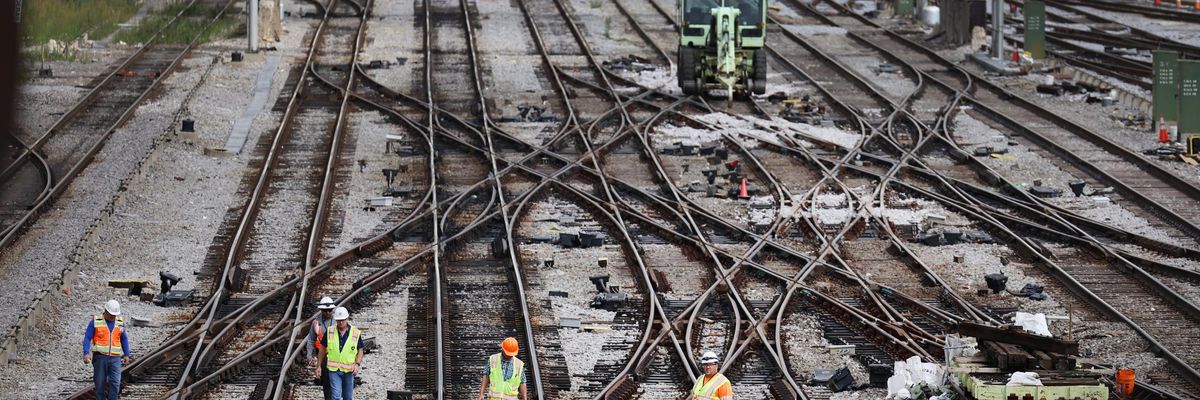
Workers service the tracks at a railroad yard on September 13, 2022 in Chicago, Illinois.
"You can't just replace the manpower with a machine when it's not always as effective," said one railroad worker.
With railroad operator Norfolk Southern involved in numerous significant train derailments and other accidents in recent weeks, the company on Monday unveiled a "six-point safety plan" that officials claimed would "immediately enhance the safety of its operations."
But critics including rail workers were quick to point out that one aspect of the plan could worsen the growing problem of reduced railroad crews, which they say has contributed to dangerous conditions on railroads.
The plan calls for a number of improvements to Norfolk Southern's systems to detect overheated wheel bearings, which the National Transportation Safety Board said in a preliminary report appeared to be the cause of the train derailment in East Palestine, Ohio on February 3.
In addition, Norfolk Southern said it aims to accelerate its "digital train inspection program" by partnering with Georgia Tech Research Institute to develop new safety inspection technology the company claims could "identify defects and needed repairs much more effectively than traditional human inspection."
The technology would use "machine vision and algorithms powered by artificial intelligence," the plan reads—offering what journalist Sam Sacks said is likely a thinly veiled proposal for "further reductions" in the company's workforce.
As Common Dreams reported last month, the national inter-union organization Railroad Workers United (RWU) has called for comprehensive legislation and robust action from regulators to keep rail workers and communities safe, warning that rail companies including Norfolk Southern have been lobbying for years for federal approval to reduce train crews and loosen safety protocols.
Rather than rail companies developing safety plans themselves, federal action is needed to guarantee "proper and adequate maintenance and inspection of rail cars and locomotives, track, signals, and other infrastructure, RWU co-chair Gabe Christenson said in a statement Monday.
Rail workers have "predicted stuff like" an increased reliance on automation, railroad worker and RWU steering committee member Matt Weaver told Common Dreams on Tuesday, as "the Precision Scheduled Railroading [PSR] business model" used by rail companies "calls for doing more with less."
Under PSR, rail companies attempt to maximize profits by running trains on strict schedules and cutting back on equipment and staff. Railroad unions have said the system and the resulting lax safety protocols are an underlying cause of recent train accidents including the East Palestine derailment, another derailment that took place in Michigan less than two weeks later, and a collision between a Norfolk Southern train and a dump truck on Tuesday in Ohio, in which conductor Louis Shuster was killed.
Weaver noted that RWU and his own union, the Brotherhood of Maintenance of Way Employes Division (BMWED), aren't opposed to the use of automation in inspections entirely.
"We used to have 12-man gangs that put all the ties in by hand and everything, and now we have lots of machines which do help us live longer and not have our backs or our hips, knees, shoulders [get injured]," he told Common Dreams. "But you can't just replace the manpower with a machine when it's not always as effective. Eyes on the rails and the tracks can catch some things the machines do not."
"We've accepted those as additional help," he added. "Not as a replacement."
Last year, as railroad companies including Norfolk Southern demanded that the Federal Railroad Administration (FRA) allow them to continue pilot programs testing automated safety inspections, BMWED noted that according to FRA data, the causes of 48 train accidents that took place between 2016 and 2021 could only be detected through visual inspections while just 14 could be detected through "enhanced track geometry inspection" done by machines.
"Over 50% of the accidents that happened from 2016 to 2021 do not even have the ability to be found by the technology that they're looking to use," Roy Morrison, director of safety for the union, told Freight Waves last May.
In recent days rail unions have denounced an attempt by Norfolk Southern to use workers' demands for paid sick leave against them—offering BMWED members four days of sick leave in exchange for the union's support for its automated inspection program.
"Norfolk Southern's proposal was ultimately for the union to be complicit in Norfolk Southern's effort to reduce legally required minimum track safety standards through supporting their experimental track inspection program without a sensible fail-safe or safety precautions to help ensure trains would not derail," wrote Jonathon Long, general chairman of the American Rail System Federation of the BMWED, in a letter to Ohio Gov. Mike DeWine. "In other words, Norfolk Southern's proposal was to use your community's safety as their bargaining chip to further pursue their record profits under their cost-cutting business model."
Weaver argued that strong comprehensive railroad safety legislation is needed to compel railroad companies to keep workers and communities safe. RWU has expressed support for some aspects of the bipartisan Railway Safety Act of 2023, introduced last week, but warned that loopholes will allow companies to "avoid the scope of the law without violating the law" and ultimately use the legislation to reduce staff.
"That's kind of their ultimate goal," Weaver told Common Dreams. "And you can't trust a capitalist industry, a for-profit industry to self-regulate. We have to have government intervention. So it's time for the regulators to regulate and the public servants to serve the public."
Dear Common Dreams reader, It’s been nearly 30 years since I co-founded Common Dreams with my late wife, Lina Newhouser. We had the radical notion that journalism should serve the public good, not corporate profits. It was clear to us from the outset what it would take to build such a project. No paid advertisements. No corporate sponsors. No millionaire publisher telling us what to think or do. Many people said we wouldn't last a year, but we proved those doubters wrong. Together with a tremendous team of journalists and dedicated staff, we built an independent media outlet free from the constraints of profits and corporate control. Our mission has always been simple: To inform. To inspire. To ignite change for the common good. Building Common Dreams was not easy. Our survival was never guaranteed. When you take on the most powerful forces—Wall Street greed, fossil fuel industry destruction, Big Tech lobbyists, and uber-rich oligarchs who have spent billions upon billions rigging the economy and democracy in their favor—the only bulwark you have is supporters who believe in your work. But here’s the urgent message from me today. It's never been this bad out there. And it's never been this hard to keep us going. At the very moment Common Dreams is most needed, the threats we face are intensifying. We need your support now more than ever. We don't accept corporate advertising and never will. We don't have a paywall because we don't think people should be blocked from critical news based on their ability to pay. Everything we do is funded by the donations of readers like you. When everyone does the little they can afford, we are strong. But if that support retreats or dries up, so do we. Will you donate now to make sure Common Dreams not only survives but thrives? —Craig Brown, Co-founder |
With railroad operator Norfolk Southern involved in numerous significant train derailments and other accidents in recent weeks, the company on Monday unveiled a "six-point safety plan" that officials claimed would "immediately enhance the safety of its operations."
But critics including rail workers were quick to point out that one aspect of the plan could worsen the growing problem of reduced railroad crews, which they say has contributed to dangerous conditions on railroads.
The plan calls for a number of improvements to Norfolk Southern's systems to detect overheated wheel bearings, which the National Transportation Safety Board said in a preliminary report appeared to be the cause of the train derailment in East Palestine, Ohio on February 3.
In addition, Norfolk Southern said it aims to accelerate its "digital train inspection program" by partnering with Georgia Tech Research Institute to develop new safety inspection technology the company claims could "identify defects and needed repairs much more effectively than traditional human inspection."
The technology would use "machine vision and algorithms powered by artificial intelligence," the plan reads—offering what journalist Sam Sacks said is likely a thinly veiled proposal for "further reductions" in the company's workforce.
As Common Dreams reported last month, the national inter-union organization Railroad Workers United (RWU) has called for comprehensive legislation and robust action from regulators to keep rail workers and communities safe, warning that rail companies including Norfolk Southern have been lobbying for years for federal approval to reduce train crews and loosen safety protocols.
Rather than rail companies developing safety plans themselves, federal action is needed to guarantee "proper and adequate maintenance and inspection of rail cars and locomotives, track, signals, and other infrastructure, RWU co-chair Gabe Christenson said in a statement Monday.
Rail workers have "predicted stuff like" an increased reliance on automation, railroad worker and RWU steering committee member Matt Weaver told Common Dreams on Tuesday, as "the Precision Scheduled Railroading [PSR] business model" used by rail companies "calls for doing more with less."
Under PSR, rail companies attempt to maximize profits by running trains on strict schedules and cutting back on equipment and staff. Railroad unions have said the system and the resulting lax safety protocols are an underlying cause of recent train accidents including the East Palestine derailment, another derailment that took place in Michigan less than two weeks later, and a collision between a Norfolk Southern train and a dump truck on Tuesday in Ohio, in which conductor Louis Shuster was killed.
Weaver noted that RWU and his own union, the Brotherhood of Maintenance of Way Employes Division (BMWED), aren't opposed to the use of automation in inspections entirely.
"We used to have 12-man gangs that put all the ties in by hand and everything, and now we have lots of machines which do help us live longer and not have our backs or our hips, knees, shoulders [get injured]," he told Common Dreams. "But you can't just replace the manpower with a machine when it's not always as effective. Eyes on the rails and the tracks can catch some things the machines do not."
"We've accepted those as additional help," he added. "Not as a replacement."
Last year, as railroad companies including Norfolk Southern demanded that the Federal Railroad Administration (FRA) allow them to continue pilot programs testing automated safety inspections, BMWED noted that according to FRA data, the causes of 48 train accidents that took place between 2016 and 2021 could only be detected through visual inspections while just 14 could be detected through "enhanced track geometry inspection" done by machines.
"Over 50% of the accidents that happened from 2016 to 2021 do not even have the ability to be found by the technology that they're looking to use," Roy Morrison, director of safety for the union, told Freight Waves last May.
In recent days rail unions have denounced an attempt by Norfolk Southern to use workers' demands for paid sick leave against them—offering BMWED members four days of sick leave in exchange for the union's support for its automated inspection program.
"Norfolk Southern's proposal was ultimately for the union to be complicit in Norfolk Southern's effort to reduce legally required minimum track safety standards through supporting their experimental track inspection program without a sensible fail-safe or safety precautions to help ensure trains would not derail," wrote Jonathon Long, general chairman of the American Rail System Federation of the BMWED, in a letter to Ohio Gov. Mike DeWine. "In other words, Norfolk Southern's proposal was to use your community's safety as their bargaining chip to further pursue their record profits under their cost-cutting business model."
Weaver argued that strong comprehensive railroad safety legislation is needed to compel railroad companies to keep workers and communities safe. RWU has expressed support for some aspects of the bipartisan Railway Safety Act of 2023, introduced last week, but warned that loopholes will allow companies to "avoid the scope of the law without violating the law" and ultimately use the legislation to reduce staff.
"That's kind of their ultimate goal," Weaver told Common Dreams. "And you can't trust a capitalist industry, a for-profit industry to self-regulate. We have to have government intervention. So it's time for the regulators to regulate and the public servants to serve the public."
With railroad operator Norfolk Southern involved in numerous significant train derailments and other accidents in recent weeks, the company on Monday unveiled a "six-point safety plan" that officials claimed would "immediately enhance the safety of its operations."
But critics including rail workers were quick to point out that one aspect of the plan could worsen the growing problem of reduced railroad crews, which they say has contributed to dangerous conditions on railroads.
The plan calls for a number of improvements to Norfolk Southern's systems to detect overheated wheel bearings, which the National Transportation Safety Board said in a preliminary report appeared to be the cause of the train derailment in East Palestine, Ohio on February 3.
In addition, Norfolk Southern said it aims to accelerate its "digital train inspection program" by partnering with Georgia Tech Research Institute to develop new safety inspection technology the company claims could "identify defects and needed repairs much more effectively than traditional human inspection."
The technology would use "machine vision and algorithms powered by artificial intelligence," the plan reads—offering what journalist Sam Sacks said is likely a thinly veiled proposal for "further reductions" in the company's workforce.
As Common Dreams reported last month, the national inter-union organization Railroad Workers United (RWU) has called for comprehensive legislation and robust action from regulators to keep rail workers and communities safe, warning that rail companies including Norfolk Southern have been lobbying for years for federal approval to reduce train crews and loosen safety protocols.
Rather than rail companies developing safety plans themselves, federal action is needed to guarantee "proper and adequate maintenance and inspection of rail cars and locomotives, track, signals, and other infrastructure, RWU co-chair Gabe Christenson said in a statement Monday.
Rail workers have "predicted stuff like" an increased reliance on automation, railroad worker and RWU steering committee member Matt Weaver told Common Dreams on Tuesday, as "the Precision Scheduled Railroading [PSR] business model" used by rail companies "calls for doing more with less."
Under PSR, rail companies attempt to maximize profits by running trains on strict schedules and cutting back on equipment and staff. Railroad unions have said the system and the resulting lax safety protocols are an underlying cause of recent train accidents including the East Palestine derailment, another derailment that took place in Michigan less than two weeks later, and a collision between a Norfolk Southern train and a dump truck on Tuesday in Ohio, in which conductor Louis Shuster was killed.
Weaver noted that RWU and his own union, the Brotherhood of Maintenance of Way Employes Division (BMWED), aren't opposed to the use of automation in inspections entirely.
"We used to have 12-man gangs that put all the ties in by hand and everything, and now we have lots of machines which do help us live longer and not have our backs or our hips, knees, shoulders [get injured]," he told Common Dreams. "But you can't just replace the manpower with a machine when it's not always as effective. Eyes on the rails and the tracks can catch some things the machines do not."
"We've accepted those as additional help," he added. "Not as a replacement."
Last year, as railroad companies including Norfolk Southern demanded that the Federal Railroad Administration (FRA) allow them to continue pilot programs testing automated safety inspections, BMWED noted that according to FRA data, the causes of 48 train accidents that took place between 2016 and 2021 could only be detected through visual inspections while just 14 could be detected through "enhanced track geometry inspection" done by machines.
"Over 50% of the accidents that happened from 2016 to 2021 do not even have the ability to be found by the technology that they're looking to use," Roy Morrison, director of safety for the union, told Freight Waves last May.
In recent days rail unions have denounced an attempt by Norfolk Southern to use workers' demands for paid sick leave against them—offering BMWED members four days of sick leave in exchange for the union's support for its automated inspection program.
"Norfolk Southern's proposal was ultimately for the union to be complicit in Norfolk Southern's effort to reduce legally required minimum track safety standards through supporting their experimental track inspection program without a sensible fail-safe or safety precautions to help ensure trains would not derail," wrote Jonathon Long, general chairman of the American Rail System Federation of the BMWED, in a letter to Ohio Gov. Mike DeWine. "In other words, Norfolk Southern's proposal was to use your community's safety as their bargaining chip to further pursue their record profits under their cost-cutting business model."
Weaver argued that strong comprehensive railroad safety legislation is needed to compel railroad companies to keep workers and communities safe. RWU has expressed support for some aspects of the bipartisan Railway Safety Act of 2023, introduced last week, but warned that loopholes will allow companies to "avoid the scope of the law without violating the law" and ultimately use the legislation to reduce staff.
"That's kind of their ultimate goal," Weaver told Common Dreams. "And you can't trust a capitalist industry, a for-profit industry to self-regulate. We have to have government intervention. So it's time for the regulators to regulate and the public servants to serve the public."