

SUBSCRIBE TO OUR FREE NEWSLETTER
Daily news & progressive opinion—funded by the people, not the corporations—delivered straight to your inbox.
5
#000000
#FFFFFF
To donate by check, phone, or other method, see our More Ways to Give page.
Daily news & progressive opinion—funded by the people, not the corporations—delivered straight to your inbox.
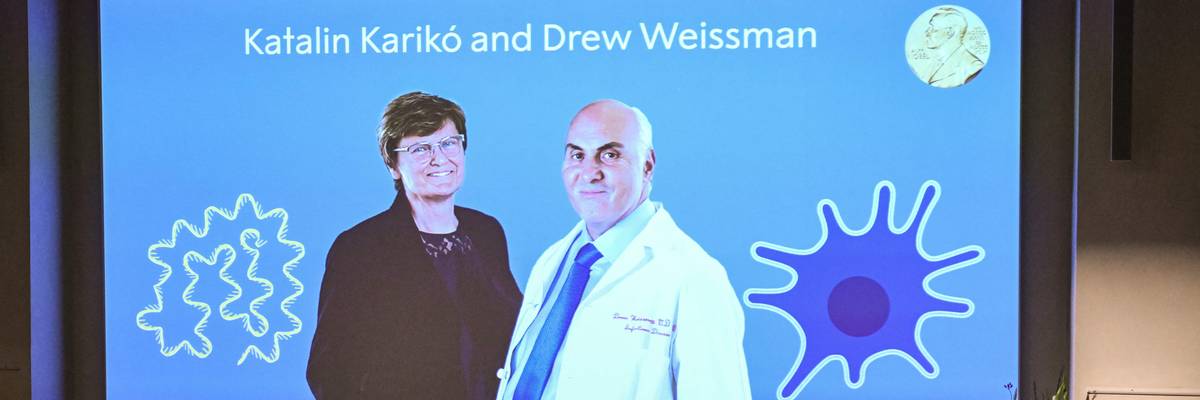
A screen at the Karolinska Institute shows Katalin Karikó and Drew Weissman, the winners of the 2023 Nobel Prize in Physiology or Medicine, during the formal award announcement in Stockholm on October 2, 2023.
"Public funding delivers incredible medical advances and that should be a priority for all countries, but pharmaceutical companies cannot be trusted to share technology with the world."
Scientists Katalin Karikó and Drew Weissman were awarded the Nobel Prize in Physiology or Medicine on Monday for research that paved the way for the messenger RNA vaccines against Covid-19—critical work that, as campaigners quickly pointed out, benefited from substantial U.S. government funding.
Dr. Mohga Kamal-Yanni, policy co-lead for the People's Vaccine Alliance, said in a statement that "this award challenges the claim that it was solely big pharmaceutical companies who saved the world from Covid-19."
"Just like the Oxford-AstraZeneca vaccine, Karikó and Weissman's groundbreaking work on mRNA vaccines received a huge amount of public funding," said Kamal-Yanni. "Pharmaceutical companies have refused to share mRNA technologies with developers and researchers in developing countries."
The Nobel Prize committee credited Karikó and Weissman with fundamentally changing "our understanding of how mRNA interacts with our immune system."
"The laureates contributed to the unprecedented rate of vaccine development during one of the greatest threats to human health in modern times," the committee said.
As The Washington Post summarized, the pair "discovered how to chemically tweak messenger RNA, turning basic biology into a technology ready to change the world when the pandemic struck. Their discovery is incorporated into the coronavirus vaccines made by Moderna and Pfizer and its German partner, BioNTech, which have now been given billions of times."
But the Post and other major outlets covering Karikó and Weissman's Nobel prize-winning contributions did not emphasize—or even mention—that some of the scientists' work was funded by the National Institutes of Health. Karikó and Weissman patented their findings in 2006 and later licensed the patents to Moderna and BioNTech, Pfizer's coronavirus vaccine partner.
According to an analysis by Knowledge Ecology International (KEI), Weissman "appears as the principal investigator on a total of 42 projects funded by the National Institutes of Health (NIH) between 1998 and 2020, representing $18,323,060 in costs."
"Karikó was the principal investigator of four projects funded by the NIH between 2007 and 2011, totaling $1,234,462 in costs," KEI observed. "In other words, the United States government funded and has certain rights over at least some of the foundational Karikó and Weissman patents directed to mRNA discoveries."
"As governments discuss how to prepare for the next pandemic, they should learn from the story of mRNA."
Throughout the pandemic and into the present, vaccine makers such as Pfizer and Moderna have opposed global calls to share their vaccine recipes and technology with the world, fiercely clinging to their monopoly control over production and using that control to force governments into one-sided contracts favorable to the pharmaceutical industry—even though their vaccines were developed with massive public support.
A
study published in The BMJ earlier this year estimated that the U.S. government pumped nearly $32 billion into the development, production, and purchase of mRNA coronavirus vaccines.
The Biden administration, meanwhile, has declined to use its ownership of key patents or the leverage provided by public funding to force pharmaceutical companies to do everything they can to ensure the equitable distribution of lifesaving vaccine technology.
Kamal-Yanni of the People's Vaccine Alliance said Monday that "fortunately, Weissman is helping a WHO-backed mRNA program which aims to develop mRNA technology in lower-income countries, even while pharmaceutical companies refuse to share their know-how."
"As governments discuss how to prepare for the next pandemic, they should learn from the story of mRNA," said Kamal-Yanni. "Public funding delivers incredible medical advances and that should be a priority for all countries, but pharmaceutical companies cannot be trusted to share technology with the world."
Peter Maybarduk, director of the Access to Medicines program at Public Citizen, echoed that message, saying in a statement that "today's Nobel must ring as a call for equity and health justice, and a call to change a massively unjust pharmaceutical industry."
"Moderna, Pfizer, and BioNTech still largely control the available vaccines and in some countries have significantly increased their price, despite the billions in public funding on which the vaccines rely," said Maybarduk. "By supporting initiatives to share science and technology, and by funding vaccine infrastructure, governments can help blunt the effects of disease, and bring a coda of justice to a terribly unjust time."
This story has been updated to include a statement from Public Citizen.
Dear Common Dreams reader, It’s been nearly 30 years since I co-founded Common Dreams with my late wife, Lina Newhouser. We had the radical notion that journalism should serve the public good, not corporate profits. It was clear to us from the outset what it would take to build such a project. No paid advertisements. No corporate sponsors. No millionaire publisher telling us what to think or do. Many people said we wouldn't last a year, but we proved those doubters wrong. Together with a tremendous team of journalists and dedicated staff, we built an independent media outlet free from the constraints of profits and corporate control. Our mission has always been simple: To inform. To inspire. To ignite change for the common good. Building Common Dreams was not easy. Our survival was never guaranteed. When you take on the most powerful forces—Wall Street greed, fossil fuel industry destruction, Big Tech lobbyists, and uber-rich oligarchs who have spent billions upon billions rigging the economy and democracy in their favor—the only bulwark you have is supporters who believe in your work. But here’s the urgent message from me today. It's never been this bad out there. And it's never been this hard to keep us going. At the very moment Common Dreams is most needed, the threats we face are intensifying. We need your support now more than ever. We don't accept corporate advertising and never will. We don't have a paywall because we don't think people should be blocked from critical news based on their ability to pay. Everything we do is funded by the donations of readers like you. When everyone does the little they can afford, we are strong. But if that support retreats or dries up, so do we. Will you donate now to make sure Common Dreams not only survives but thrives? —Craig Brown, Co-founder |
Scientists Katalin Karikó and Drew Weissman were awarded the Nobel Prize in Physiology or Medicine on Monday for research that paved the way for the messenger RNA vaccines against Covid-19—critical work that, as campaigners quickly pointed out, benefited from substantial U.S. government funding.
Dr. Mohga Kamal-Yanni, policy co-lead for the People's Vaccine Alliance, said in a statement that "this award challenges the claim that it was solely big pharmaceutical companies who saved the world from Covid-19."
"Just like the Oxford-AstraZeneca vaccine, Karikó and Weissman's groundbreaking work on mRNA vaccines received a huge amount of public funding," said Kamal-Yanni. "Pharmaceutical companies have refused to share mRNA technologies with developers and researchers in developing countries."
The Nobel Prize committee credited Karikó and Weissman with fundamentally changing "our understanding of how mRNA interacts with our immune system."
"The laureates contributed to the unprecedented rate of vaccine development during one of the greatest threats to human health in modern times," the committee said.
As The Washington Post summarized, the pair "discovered how to chemically tweak messenger RNA, turning basic biology into a technology ready to change the world when the pandemic struck. Their discovery is incorporated into the coronavirus vaccines made by Moderna and Pfizer and its German partner, BioNTech, which have now been given billions of times."
But the Post and other major outlets covering Karikó and Weissman's Nobel prize-winning contributions did not emphasize—or even mention—that some of the scientists' work was funded by the National Institutes of Health. Karikó and Weissman patented their findings in 2006 and later licensed the patents to Moderna and BioNTech, Pfizer's coronavirus vaccine partner.
According to an analysis by Knowledge Ecology International (KEI), Weissman "appears as the principal investigator on a total of 42 projects funded by the National Institutes of Health (NIH) between 1998 and 2020, representing $18,323,060 in costs."
"Karikó was the principal investigator of four projects funded by the NIH between 2007 and 2011, totaling $1,234,462 in costs," KEI observed. "In other words, the United States government funded and has certain rights over at least some of the foundational Karikó and Weissman patents directed to mRNA discoveries."
"As governments discuss how to prepare for the next pandemic, they should learn from the story of mRNA."
Throughout the pandemic and into the present, vaccine makers such as Pfizer and Moderna have opposed global calls to share their vaccine recipes and technology with the world, fiercely clinging to their monopoly control over production and using that control to force governments into one-sided contracts favorable to the pharmaceutical industry—even though their vaccines were developed with massive public support.
A
study published in The BMJ earlier this year estimated that the U.S. government pumped nearly $32 billion into the development, production, and purchase of mRNA coronavirus vaccines.
The Biden administration, meanwhile, has declined to use its ownership of key patents or the leverage provided by public funding to force pharmaceutical companies to do everything they can to ensure the equitable distribution of lifesaving vaccine technology.
Kamal-Yanni of the People's Vaccine Alliance said Monday that "fortunately, Weissman is helping a WHO-backed mRNA program which aims to develop mRNA technology in lower-income countries, even while pharmaceutical companies refuse to share their know-how."
"As governments discuss how to prepare for the next pandemic, they should learn from the story of mRNA," said Kamal-Yanni. "Public funding delivers incredible medical advances and that should be a priority for all countries, but pharmaceutical companies cannot be trusted to share technology with the world."
Peter Maybarduk, director of the Access to Medicines program at Public Citizen, echoed that message, saying in a statement that "today's Nobel must ring as a call for equity and health justice, and a call to change a massively unjust pharmaceutical industry."
"Moderna, Pfizer, and BioNTech still largely control the available vaccines and in some countries have significantly increased their price, despite the billions in public funding on which the vaccines rely," said Maybarduk. "By supporting initiatives to share science and technology, and by funding vaccine infrastructure, governments can help blunt the effects of disease, and bring a coda of justice to a terribly unjust time."
This story has been updated to include a statement from Public Citizen.
Scientists Katalin Karikó and Drew Weissman were awarded the Nobel Prize in Physiology or Medicine on Monday for research that paved the way for the messenger RNA vaccines against Covid-19—critical work that, as campaigners quickly pointed out, benefited from substantial U.S. government funding.
Dr. Mohga Kamal-Yanni, policy co-lead for the People's Vaccine Alliance, said in a statement that "this award challenges the claim that it was solely big pharmaceutical companies who saved the world from Covid-19."
"Just like the Oxford-AstraZeneca vaccine, Karikó and Weissman's groundbreaking work on mRNA vaccines received a huge amount of public funding," said Kamal-Yanni. "Pharmaceutical companies have refused to share mRNA technologies with developers and researchers in developing countries."
The Nobel Prize committee credited Karikó and Weissman with fundamentally changing "our understanding of how mRNA interacts with our immune system."
"The laureates contributed to the unprecedented rate of vaccine development during one of the greatest threats to human health in modern times," the committee said.
As The Washington Post summarized, the pair "discovered how to chemically tweak messenger RNA, turning basic biology into a technology ready to change the world when the pandemic struck. Their discovery is incorporated into the coronavirus vaccines made by Moderna and Pfizer and its German partner, BioNTech, which have now been given billions of times."
But the Post and other major outlets covering Karikó and Weissman's Nobel prize-winning contributions did not emphasize—or even mention—that some of the scientists' work was funded by the National Institutes of Health. Karikó and Weissman patented their findings in 2006 and later licensed the patents to Moderna and BioNTech, Pfizer's coronavirus vaccine partner.
According to an analysis by Knowledge Ecology International (KEI), Weissman "appears as the principal investigator on a total of 42 projects funded by the National Institutes of Health (NIH) between 1998 and 2020, representing $18,323,060 in costs."
"Karikó was the principal investigator of four projects funded by the NIH between 2007 and 2011, totaling $1,234,462 in costs," KEI observed. "In other words, the United States government funded and has certain rights over at least some of the foundational Karikó and Weissman patents directed to mRNA discoveries."
"As governments discuss how to prepare for the next pandemic, they should learn from the story of mRNA."
Throughout the pandemic and into the present, vaccine makers such as Pfizer and Moderna have opposed global calls to share their vaccine recipes and technology with the world, fiercely clinging to their monopoly control over production and using that control to force governments into one-sided contracts favorable to the pharmaceutical industry—even though their vaccines were developed with massive public support.
A
study published in The BMJ earlier this year estimated that the U.S. government pumped nearly $32 billion into the development, production, and purchase of mRNA coronavirus vaccines.
The Biden administration, meanwhile, has declined to use its ownership of key patents or the leverage provided by public funding to force pharmaceutical companies to do everything they can to ensure the equitable distribution of lifesaving vaccine technology.
Kamal-Yanni of the People's Vaccine Alliance said Monday that "fortunately, Weissman is helping a WHO-backed mRNA program which aims to develop mRNA technology in lower-income countries, even while pharmaceutical companies refuse to share their know-how."
"As governments discuss how to prepare for the next pandemic, they should learn from the story of mRNA," said Kamal-Yanni. "Public funding delivers incredible medical advances and that should be a priority for all countries, but pharmaceutical companies cannot be trusted to share technology with the world."
Peter Maybarduk, director of the Access to Medicines program at Public Citizen, echoed that message, saying in a statement that "today's Nobel must ring as a call for equity and health justice, and a call to change a massively unjust pharmaceutical industry."
"Moderna, Pfizer, and BioNTech still largely control the available vaccines and in some countries have significantly increased their price, despite the billions in public funding on which the vaccines rely," said Maybarduk. "By supporting initiatives to share science and technology, and by funding vaccine infrastructure, governments can help blunt the effects of disease, and bring a coda of justice to a terribly unjust time."
This story has been updated to include a statement from Public Citizen.

