SUBSCRIBE TO OUR FREE NEWSLETTER
Daily news & progressive opinion—funded by the people, not the corporations—delivered straight to your inbox.
5
#000000
#FFFFFF
To donate by check, phone, or other method, see our More Ways to Give page.
Daily news & progressive opinion—funded by the people, not the corporations—delivered straight to your inbox.
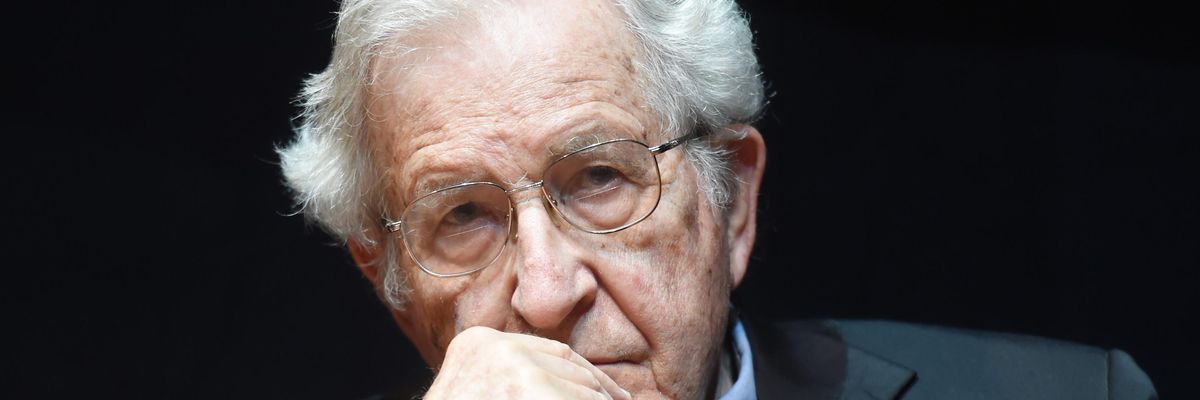
"Shameful and sad that Valéria Chomsky had to deny news of Noam Chomsky's death," said one Brazilian academic who spoke to the renowned leftist's wife.
Some popular media outlets and international political figures came under fire Tuesday for falsely reporting the death of U.S. academic and social critic Noam Chomsky, who is fighting to recover in Brazil after suffering a massive stroke last year.
"Chomsky did not die. I just spoke to Valéria, his wife," said Brazilian journalist Cauê Seigner Ameni.
"He is well," Valéria Chomsky confirmed to ABC's Chris Looft.
Beneficência Portuguesa de São Paulo, a hospital in Brazil's largest city, said in a statement that Chomsky was discharged on Tuesday to continue his treatment at home, according to The Associated Press.
The New Statesman ran—and subsequently deleted—a Chomsky obituary Tuesday following rumors of the 95-year-old's passing. Other outlets including Jacobin kept or tweaked Chomsky obits, with telltale signs like the word "obituary" in their URLs belying their inaccuracy.
Commentators from across the political spectrum also posted reaction—from mournful on the progressive left to gleeful among liberals and right-wingers—to false reports of Chomsky's death.
"Shameful and sad that Valéria Chomsky had to deny news of Noam Chomsky's death over the phone here in Brazil, because a bunch of places decided to publish pre-written obituaries and posts at the first online rumor," Brazilian academic Sabrina Fernandes said on social media.
"Since no outlet that reported the death decided to post an errata, it only got worse," she added, condemning "the online scoop and attention industry... waiting... like vultures."
Responding to numerous reports of Chomsky's death in the Latin American corporate media, Andrew Kennis—a journalism and social media professor at Rutgers University whose book Digital Age Resistance contains a foreword co-authored by Chomsky—told Common Dreams that "it is both a fitting and cruel irony that the fundamentally flawed, trillion-dollar-valued, conglomerate-owned, mainstream news media system has once again erred in its ways."
"No, Noam is not dead. Instead, he's struggling to recover with the unflagging dedication of his partner, who transported him the first chance Noam's health permitted her to do so to receive top-rate medical care in Brazil," Kennis added.
Some observers worked the title of one of Chomsky's more than 100 books—Manufacturing Consent, which he wrote with Edward Herman—into their commentary on the false reports.
"Chomsky is NOT dead. If Chomsky was dead, he would be turning in his grave to see how quickly rumors spread and how social media functions," said Croatian philosopher and Chomsky collaborator Srećko Horvat. "He might as well still call it: 'manufacturing obituaries'."
Dear Common Dreams reader, It’s been nearly 30 years since I co-founded Common Dreams with my late wife, Lina Newhouser. We had the radical notion that journalism should serve the public good, not corporate profits. It was clear to us from the outset what it would take to build such a project. No paid advertisements. No corporate sponsors. No millionaire publisher telling us what to think or do. Many people said we wouldn't last a year, but we proved those doubters wrong. Together with a tremendous team of journalists and dedicated staff, we built an independent media outlet free from the constraints of profits and corporate control. Our mission has always been simple: To inform. To inspire. To ignite change for the common good. Building Common Dreams was not easy. Our survival was never guaranteed. When you take on the most powerful forces—Wall Street greed, fossil fuel industry destruction, Big Tech lobbyists, and uber-rich oligarchs who have spent billions upon billions rigging the economy and democracy in their favor—the only bulwark you have is supporters who believe in your work. But here’s the urgent message from me today. It's never been this bad out there. And it's never been this hard to keep us going. At the very moment Common Dreams is most needed, the threats we face are intensifying. We need your support now more than ever. We don't accept corporate advertising and never will. We don't have a paywall because we don't think people should be blocked from critical news based on their ability to pay. Everything we do is funded by the donations of readers like you. When everyone does the little they can afford, we are strong. But if that support retreats or dries up, so do we. Will you donate now to make sure Common Dreams not only survives but thrives? —Craig Brown, Co-founder |
Some popular media outlets and international political figures came under fire Tuesday for falsely reporting the death of U.S. academic and social critic Noam Chomsky, who is fighting to recover in Brazil after suffering a massive stroke last year.
"Chomsky did not die. I just spoke to Valéria, his wife," said Brazilian journalist Cauê Seigner Ameni.
"He is well," Valéria Chomsky confirmed to ABC's Chris Looft.
Beneficência Portuguesa de São Paulo, a hospital in Brazil's largest city, said in a statement that Chomsky was discharged on Tuesday to continue his treatment at home, according to The Associated Press.
The New Statesman ran—and subsequently deleted—a Chomsky obituary Tuesday following rumors of the 95-year-old's passing. Other outlets including Jacobin kept or tweaked Chomsky obits, with telltale signs like the word "obituary" in their URLs belying their inaccuracy.
Commentators from across the political spectrum also posted reaction—from mournful on the progressive left to gleeful among liberals and right-wingers—to false reports of Chomsky's death.
"Shameful and sad that Valéria Chomsky had to deny news of Noam Chomsky's death over the phone here in Brazil, because a bunch of places decided to publish pre-written obituaries and posts at the first online rumor," Brazilian academic Sabrina Fernandes said on social media.
"Since no outlet that reported the death decided to post an errata, it only got worse," she added, condemning "the online scoop and attention industry... waiting... like vultures."
Responding to numerous reports of Chomsky's death in the Latin American corporate media, Andrew Kennis—a journalism and social media professor at Rutgers University whose book Digital Age Resistance contains a foreword co-authored by Chomsky—told Common Dreams that "it is both a fitting and cruel irony that the fundamentally flawed, trillion-dollar-valued, conglomerate-owned, mainstream news media system has once again erred in its ways."
"No, Noam is not dead. Instead, he's struggling to recover with the unflagging dedication of his partner, who transported him the first chance Noam's health permitted her to do so to receive top-rate medical care in Brazil," Kennis added.
Some observers worked the title of one of Chomsky's more than 100 books—Manufacturing Consent, which he wrote with Edward Herman—into their commentary on the false reports.
"Chomsky is NOT dead. If Chomsky was dead, he would be turning in his grave to see how quickly rumors spread and how social media functions," said Croatian philosopher and Chomsky collaborator Srećko Horvat. "He might as well still call it: 'manufacturing obituaries'."
Some popular media outlets and international political figures came under fire Tuesday for falsely reporting the death of U.S. academic and social critic Noam Chomsky, who is fighting to recover in Brazil after suffering a massive stroke last year.
"Chomsky did not die. I just spoke to Valéria, his wife," said Brazilian journalist Cauê Seigner Ameni.
"He is well," Valéria Chomsky confirmed to ABC's Chris Looft.
Beneficência Portuguesa de São Paulo, a hospital in Brazil's largest city, said in a statement that Chomsky was discharged on Tuesday to continue his treatment at home, according to The Associated Press.
The New Statesman ran—and subsequently deleted—a Chomsky obituary Tuesday following rumors of the 95-year-old's passing. Other outlets including Jacobin kept or tweaked Chomsky obits, with telltale signs like the word "obituary" in their URLs belying their inaccuracy.
Commentators from across the political spectrum also posted reaction—from mournful on the progressive left to gleeful among liberals and right-wingers—to false reports of Chomsky's death.
"Shameful and sad that Valéria Chomsky had to deny news of Noam Chomsky's death over the phone here in Brazil, because a bunch of places decided to publish pre-written obituaries and posts at the first online rumor," Brazilian academic Sabrina Fernandes said on social media.
"Since no outlet that reported the death decided to post an errata, it only got worse," she added, condemning "the online scoop and attention industry... waiting... like vultures."
Responding to numerous reports of Chomsky's death in the Latin American corporate media, Andrew Kennis—a journalism and social media professor at Rutgers University whose book Digital Age Resistance contains a foreword co-authored by Chomsky—told Common Dreams that "it is both a fitting and cruel irony that the fundamentally flawed, trillion-dollar-valued, conglomerate-owned, mainstream news media system has once again erred in its ways."
"No, Noam is not dead. Instead, he's struggling to recover with the unflagging dedication of his partner, who transported him the first chance Noam's health permitted her to do so to receive top-rate medical care in Brazil," Kennis added.
Some observers worked the title of one of Chomsky's more than 100 books—Manufacturing Consent, which he wrote with Edward Herman—into their commentary on the false reports.
"Chomsky is NOT dead. If Chomsky was dead, he would be turning in his grave to see how quickly rumors spread and how social media functions," said Croatian philosopher and Chomsky collaborator Srećko Horvat. "He might as well still call it: 'manufacturing obituaries'."