SUBSCRIBE TO OUR FREE NEWSLETTER
Daily news & progressive opinion—funded by the people, not the corporations—delivered straight to your inbox.
5
#000000
#FFFFFF
To donate by check, phone, or other method, see our More Ways to Give page.
Daily news & progressive opinion—funded by the people, not the corporations—delivered straight to your inbox.
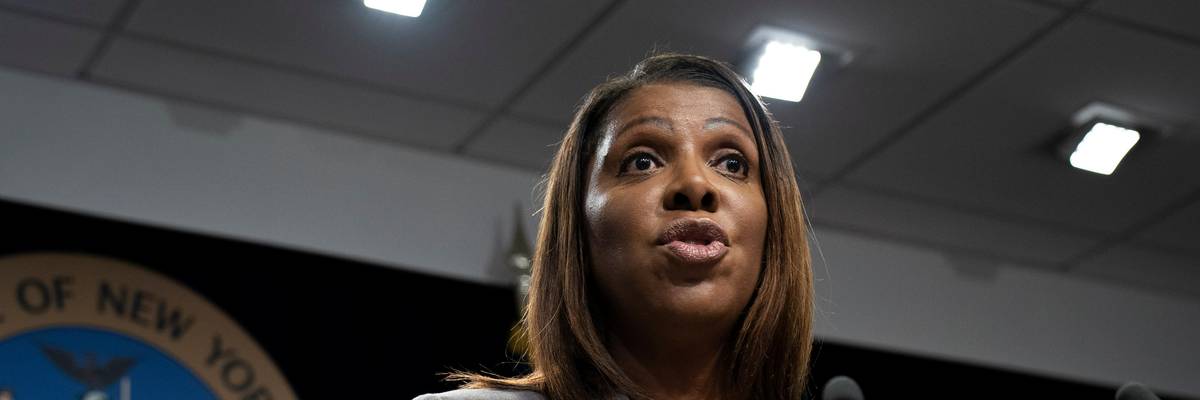
New York Attorney General Letitia James speaks during a June 11, 2019 press conference in New York.
James's warning to MSG Entertainment illustrates the "growing consensus against the use of facial recognition in places of public accommodation," said one advocate.
The digital rights group Fight for the Future was among those applauding New York Attorney General Letitia James on Wednesday as she demanded answers from MSG Entertainment, the owner of Madison Square Garden and Radio City Music Hall, over its use of facial recognition technology to deny entry to lawyers whose firms represent people suing the company.
James wrote to MSG Entertainment and its CEO, James Dolan, to warn that they may be violating civil rights laws in New York by barring attorneys from entering their properties, even if they are not involved in litigation against the company.
"Such practices certainly run counter to the spirit and purpose of such laws, and laws promoting equal access to the courts: forbidding entry to lawyers representing clients who have engaged in litigation against the company may dissuade such lawyers from taking on legitimate cases, including sexual harassment or employment discrimination claims," wrote the attorney general.
James's letter shows that there is a "growing consensus against the use of facial recognition in places of public accommodation," said Fight for the Future director Evan Greer.
The letter came a month after The New York Times reported that Kelly Conlon, a personal injury attorney, had been informed by security guards at Radio City Music Hall that she was on an "attorney exclusion list" when she tried to enter the theater for a show in November. Conlon had been identified by facial recognition technology and flagged as being prohibited from entering because her law firm is involved in litigation against one of MSG Entertainment's restaurants.
"Reports indicate that approximately 90 law firms are impacted by the company's policy, constituting thousands of lawyers," James wrote to the company.
Since October, MSG Entertainment has removed at least four attorneys from their properties, forbidding them from attending sports games and concerts because of where they work. Dolan has claimed the policy is aimed at preventing attorneys from collecting evidence "outside proper litigation discovery channels."
Employment lawyer Benjamin Noren told the Times earlier this month that despite Dolan's claims, the policy is "a transparent effort... to stop attorneys from suing them."
"MSG Entertainment cannot fight their legal battles in their own arenas," James said in a statement. "Madison Square Garden and Radio City Music Hall are world-renowned venues and should treat all patrons who purchased tickets with fairness and respect. Anyone with a ticket to an event should not be concerned that they may be wrongfully denied entry based on their appearance, and we're urging MSG Entertainment to reverse this policy."
Caitlin Seeley George, campaigns and managing director at Fight for the Future, said MSG Entertainment's use of facial recognition illustrates "the crux of the threat of this technology" and how it is "an inherently dangerous affront to peoples' rights."
"Despite the current attention on how this policy is impacting lawyers, the truth is the impact will always be disproportionately greater for marginalized communities," said Seeley George. "James Dolan and Madison Square Garden Entertainment are adding to the long history of people in power using surveillance to silence opposition. We need lawmakers to defend peoples' rights and put an end to facial recognition in public places immediately."
Dear Common Dreams reader, It’s been nearly 30 years since I co-founded Common Dreams with my late wife, Lina Newhouser. We had the radical notion that journalism should serve the public good, not corporate profits. It was clear to us from the outset what it would take to build such a project. No paid advertisements. No corporate sponsors. No millionaire publisher telling us what to think or do. Many people said we wouldn't last a year, but we proved those doubters wrong. Together with a tremendous team of journalists and dedicated staff, we built an independent media outlet free from the constraints of profits and corporate control. Our mission has always been simple: To inform. To inspire. To ignite change for the common good. Building Common Dreams was not easy. Our survival was never guaranteed. When you take on the most powerful forces—Wall Street greed, fossil fuel industry destruction, Big Tech lobbyists, and uber-rich oligarchs who have spent billions upon billions rigging the economy and democracy in their favor—the only bulwark you have is supporters who believe in your work. But here’s the urgent message from me today. It's never been this bad out there. And it's never been this hard to keep us going. At the very moment Common Dreams is most needed, the threats we face are intensifying. We need your support now more than ever. We don't accept corporate advertising and never will. We don't have a paywall because we don't think people should be blocked from critical news based on their ability to pay. Everything we do is funded by the donations of readers like you. When everyone does the little they can afford, we are strong. But if that support retreats or dries up, so do we. Will you donate now to make sure Common Dreams not only survives but thrives? —Craig Brown, Co-founder |
The digital rights group Fight for the Future was among those applauding New York Attorney General Letitia James on Wednesday as she demanded answers from MSG Entertainment, the owner of Madison Square Garden and Radio City Music Hall, over its use of facial recognition technology to deny entry to lawyers whose firms represent people suing the company.
James wrote to MSG Entertainment and its CEO, James Dolan, to warn that they may be violating civil rights laws in New York by barring attorneys from entering their properties, even if they are not involved in litigation against the company.
"Such practices certainly run counter to the spirit and purpose of such laws, and laws promoting equal access to the courts: forbidding entry to lawyers representing clients who have engaged in litigation against the company may dissuade such lawyers from taking on legitimate cases, including sexual harassment or employment discrimination claims," wrote the attorney general.
James's letter shows that there is a "growing consensus against the use of facial recognition in places of public accommodation," said Fight for the Future director Evan Greer.
The letter came a month after The New York Times reported that Kelly Conlon, a personal injury attorney, had been informed by security guards at Radio City Music Hall that she was on an "attorney exclusion list" when she tried to enter the theater for a show in November. Conlon had been identified by facial recognition technology and flagged as being prohibited from entering because her law firm is involved in litigation against one of MSG Entertainment's restaurants.
"Reports indicate that approximately 90 law firms are impacted by the company's policy, constituting thousands of lawyers," James wrote to the company.
Since October, MSG Entertainment has removed at least four attorneys from their properties, forbidding them from attending sports games and concerts because of where they work. Dolan has claimed the policy is aimed at preventing attorneys from collecting evidence "outside proper litigation discovery channels."
Employment lawyer Benjamin Noren told the Times earlier this month that despite Dolan's claims, the policy is "a transparent effort... to stop attorneys from suing them."
"MSG Entertainment cannot fight their legal battles in their own arenas," James said in a statement. "Madison Square Garden and Radio City Music Hall are world-renowned venues and should treat all patrons who purchased tickets with fairness and respect. Anyone with a ticket to an event should not be concerned that they may be wrongfully denied entry based on their appearance, and we're urging MSG Entertainment to reverse this policy."
Caitlin Seeley George, campaigns and managing director at Fight for the Future, said MSG Entertainment's use of facial recognition illustrates "the crux of the threat of this technology" and how it is "an inherently dangerous affront to peoples' rights."
"Despite the current attention on how this policy is impacting lawyers, the truth is the impact will always be disproportionately greater for marginalized communities," said Seeley George. "James Dolan and Madison Square Garden Entertainment are adding to the long history of people in power using surveillance to silence opposition. We need lawmakers to defend peoples' rights and put an end to facial recognition in public places immediately."
The digital rights group Fight for the Future was among those applauding New York Attorney General Letitia James on Wednesday as she demanded answers from MSG Entertainment, the owner of Madison Square Garden and Radio City Music Hall, over its use of facial recognition technology to deny entry to lawyers whose firms represent people suing the company.
James wrote to MSG Entertainment and its CEO, James Dolan, to warn that they may be violating civil rights laws in New York by barring attorneys from entering their properties, even if they are not involved in litigation against the company.
"Such practices certainly run counter to the spirit and purpose of such laws, and laws promoting equal access to the courts: forbidding entry to lawyers representing clients who have engaged in litigation against the company may dissuade such lawyers from taking on legitimate cases, including sexual harassment or employment discrimination claims," wrote the attorney general.
James's letter shows that there is a "growing consensus against the use of facial recognition in places of public accommodation," said Fight for the Future director Evan Greer.
The letter came a month after The New York Times reported that Kelly Conlon, a personal injury attorney, had been informed by security guards at Radio City Music Hall that she was on an "attorney exclusion list" when she tried to enter the theater for a show in November. Conlon had been identified by facial recognition technology and flagged as being prohibited from entering because her law firm is involved in litigation against one of MSG Entertainment's restaurants.
"Reports indicate that approximately 90 law firms are impacted by the company's policy, constituting thousands of lawyers," James wrote to the company.
Since October, MSG Entertainment has removed at least four attorneys from their properties, forbidding them from attending sports games and concerts because of where they work. Dolan has claimed the policy is aimed at preventing attorneys from collecting evidence "outside proper litigation discovery channels."
Employment lawyer Benjamin Noren told the Times earlier this month that despite Dolan's claims, the policy is "a transparent effort... to stop attorneys from suing them."
"MSG Entertainment cannot fight their legal battles in their own arenas," James said in a statement. "Madison Square Garden and Radio City Music Hall are world-renowned venues and should treat all patrons who purchased tickets with fairness and respect. Anyone with a ticket to an event should not be concerned that they may be wrongfully denied entry based on their appearance, and we're urging MSG Entertainment to reverse this policy."
Caitlin Seeley George, campaigns and managing director at Fight for the Future, said MSG Entertainment's use of facial recognition illustrates "the crux of the threat of this technology" and how it is "an inherently dangerous affront to peoples' rights."
"Despite the current attention on how this policy is impacting lawyers, the truth is the impact will always be disproportionately greater for marginalized communities," said Seeley George. "James Dolan and Madison Square Garden Entertainment are adding to the long history of people in power using surveillance to silence opposition. We need lawmakers to defend peoples' rights and put an end to facial recognition in public places immediately."