SUBSCRIBE TO OUR FREE NEWSLETTER
Daily news & progressive opinion—funded by the people, not the corporations—delivered straight to your inbox.
5
#000000
#FFFFFF
To donate by check, phone, or other method, see our More Ways to Give page.


Daily news & progressive opinion—funded by the people, not the corporations—delivered straight to your inbox.

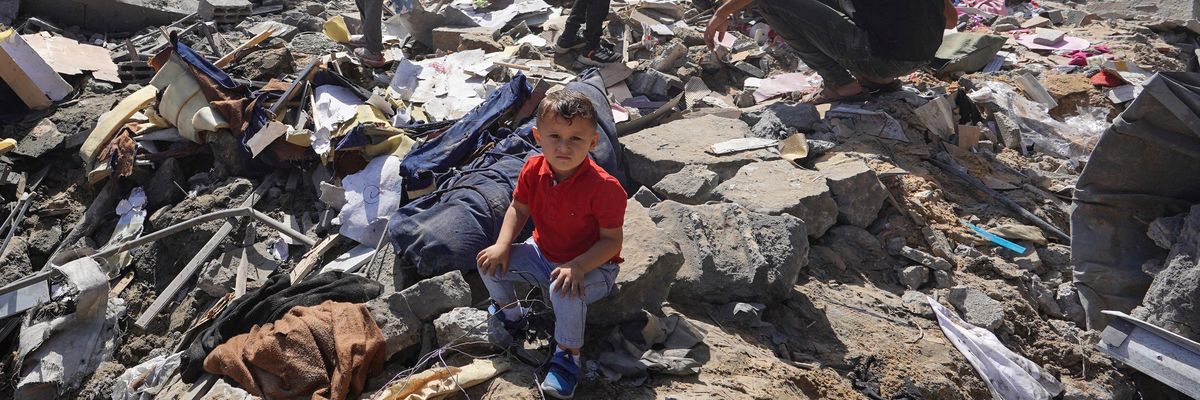
A Palestinian boy sits as people search the rubble of a family destroyed in overnight Israeli strikes in the al-Bureij refugee camp in the central Gaza Strip on June 18, 2024.
A new OHCHR report details how Israeli "attacks of an apparent indiscriminate nature" fit a wider pattern for hundreds of such bombings that may violate international laws of war.
The United Nations Human Rights Office released a report Wednesday concluding that the Israeli military's repeated use of heavy weaponry—including 2,000-pound bombs supplied by the United States—in the Gaza Strip has likely violated international laws of war barring the targeting of civilians and disproportionate attacks.
The new report specifically examines six Israeli attacks that the U.N. Human Rights Offices says are "emblematic" of the Israel Defense Forces' (IDF) broader assault on Gaza, which has killed more than 37,000 people, unleashed a hellish humanitarian crisis, and destroyed much of the Palestinian enclave's infrastructure—including education, healthcare, and water facilities.
The attacks analyzed by the U.N. took place between October 9 and December 2 of last year and involved the use of 2,000-pound, 1,000-pound, and 250-pound bombs on residential buildings, a market, refugee camps, and a school. At least 218 people were killed in the six Israeli attacks, the U.N. found, and evidence suggests the actual number of fatalities "could be much higher."
The report says Israeli forces used roughly nine 2,000-pound bombs in a December 2 attack on a neighborhood in Gaza City, causing destruction across a distance of 130 meters.
"These attacks of an apparent indiscriminate nature are among hundreds of a similar nature, giving rise to the appearance of a pattern of attacks over months," the report states. "The pattern of Israeli strikes exemplified by the six incidents above indicates that the IDF may have systematically violated the principles of distinction, proportionality, and precautions in attack—fundamental principles of international humanitarian law on the conduct of hostilities—in the course of its attacks in Gaza since 7 October 2023."
"The requirement to select means and methods of warfare that avoid or at the very least minimize to every extent civilian harm appears to have been consistently violated in Israel's bombing campaign."
Volker Türk, the U.N. high commissioner for human rights, said in a statement Wednesday that "the requirement to select means and methods of warfare that avoid or at the very least minimize to every extent civilian harm appears to have been consistently violated in Israel's bombing campaign."
The human rights office's report is the latest of several recent U.N. analyses accusing Israeli forces of committing grave war crimes in Gaza—including torture, using starvation as a weapon of war, and genocide—as Israeli Prime Minister Benjamin Netanyahu demands more weaponry from the U.S. to continue its devastating assault.
Reuters reported Wednesday that "Israeli tanks backed by warplanes and drones advanced deeper into the western part of the Gaza Strip city of Rafah," killing at least eight people and forcing more residents to run for their lives. At least a million people have fled Rafah since Israel began invading the city last month.
"Residents said the tanks moved into five neighborhoods after midnight," Reuters noted Wednesday. "Heavy shelling and gunfire hit the tents of displaced families in the Al-Mawasi area, further to the west of the coastal enclave... Residents said Israeli army forces blew up several homes in western Rafah, which had sheltered over half of Gaza's 2.3 million people before last month, when Israel began its ground offensive and forced most of the population to head northwards."
Dear Common Dreams reader, It’s been nearly 30 years since I co-founded Common Dreams with my late wife, Lina Newhouser. We had the radical notion that journalism should serve the public good, not corporate profits. It was clear to us from the outset what it would take to build such a project. No paid advertisements. No corporate sponsors. No millionaire publisher telling us what to think or do. Many people said we wouldn't last a year, but we proved those doubters wrong. Together with a tremendous team of journalists and dedicated staff, we built an independent media outlet free from the constraints of profits and corporate control. Our mission has always been simple: To inform. To inspire. To ignite change for the common good. Building Common Dreams was not easy. Our survival was never guaranteed. When you take on the most powerful forces—Wall Street greed, fossil fuel industry destruction, Big Tech lobbyists, and uber-rich oligarchs who have spent billions upon billions rigging the economy and democracy in their favor—the only bulwark you have is supporters who believe in your work. But here’s the urgent message from me today. It's never been this bad out there. And it's never been this hard to keep us going. At the very moment Common Dreams is most needed, the threats we face are intensifying. We need your support now more than ever. We don't accept corporate advertising and never will. We don't have a paywall because we don't think people should be blocked from critical news based on their ability to pay. Everything we do is funded by the donations of readers like you. When everyone does the little they can afford, we are strong. But if that support retreats or dries up, so do we. Will you donate now to make sure Common Dreams not only survives but thrives? —Craig Brown, Co-founder |
The United Nations Human Rights Office released a report Wednesday concluding that the Israeli military's repeated use of heavy weaponry—including 2,000-pound bombs supplied by the United States—in the Gaza Strip has likely violated international laws of war barring the targeting of civilians and disproportionate attacks.
The new report specifically examines six Israeli attacks that the U.N. Human Rights Offices says are "emblematic" of the Israel Defense Forces' (IDF) broader assault on Gaza, which has killed more than 37,000 people, unleashed a hellish humanitarian crisis, and destroyed much of the Palestinian enclave's infrastructure—including education, healthcare, and water facilities.
The attacks analyzed by the U.N. took place between October 9 and December 2 of last year and involved the use of 2,000-pound, 1,000-pound, and 250-pound bombs on residential buildings, a market, refugee camps, and a school. At least 218 people were killed in the six Israeli attacks, the U.N. found, and evidence suggests the actual number of fatalities "could be much higher."
The report says Israeli forces used roughly nine 2,000-pound bombs in a December 2 attack on a neighborhood in Gaza City, causing destruction across a distance of 130 meters.
"These attacks of an apparent indiscriminate nature are among hundreds of a similar nature, giving rise to the appearance of a pattern of attacks over months," the report states. "The pattern of Israeli strikes exemplified by the six incidents above indicates that the IDF may have systematically violated the principles of distinction, proportionality, and precautions in attack—fundamental principles of international humanitarian law on the conduct of hostilities—in the course of its attacks in Gaza since 7 October 2023."
"The requirement to select means and methods of warfare that avoid or at the very least minimize to every extent civilian harm appears to have been consistently violated in Israel's bombing campaign."
Volker Türk, the U.N. high commissioner for human rights, said in a statement Wednesday that "the requirement to select means and methods of warfare that avoid or at the very least minimize to every extent civilian harm appears to have been consistently violated in Israel's bombing campaign."
The human rights office's report is the latest of several recent U.N. analyses accusing Israeli forces of committing grave war crimes in Gaza—including torture, using starvation as a weapon of war, and genocide—as Israeli Prime Minister Benjamin Netanyahu demands more weaponry from the U.S. to continue its devastating assault.
Reuters reported Wednesday that "Israeli tanks backed by warplanes and drones advanced deeper into the western part of the Gaza Strip city of Rafah," killing at least eight people and forcing more residents to run for their lives. At least a million people have fled Rafah since Israel began invading the city last month.
"Residents said the tanks moved into five neighborhoods after midnight," Reuters noted Wednesday. "Heavy shelling and gunfire hit the tents of displaced families in the Al-Mawasi area, further to the west of the coastal enclave... Residents said Israeli army forces blew up several homes in western Rafah, which had sheltered over half of Gaza's 2.3 million people before last month, when Israel began its ground offensive and forced most of the population to head northwards."
The United Nations Human Rights Office released a report Wednesday concluding that the Israeli military's repeated use of heavy weaponry—including 2,000-pound bombs supplied by the United States—in the Gaza Strip has likely violated international laws of war barring the targeting of civilians and disproportionate attacks.
The new report specifically examines six Israeli attacks that the U.N. Human Rights Offices says are "emblematic" of the Israel Defense Forces' (IDF) broader assault on Gaza, which has killed more than 37,000 people, unleashed a hellish humanitarian crisis, and destroyed much of the Palestinian enclave's infrastructure—including education, healthcare, and water facilities.
The attacks analyzed by the U.N. took place between October 9 and December 2 of last year and involved the use of 2,000-pound, 1,000-pound, and 250-pound bombs on residential buildings, a market, refugee camps, and a school. At least 218 people were killed in the six Israeli attacks, the U.N. found, and evidence suggests the actual number of fatalities "could be much higher."
The report says Israeli forces used roughly nine 2,000-pound bombs in a December 2 attack on a neighborhood in Gaza City, causing destruction across a distance of 130 meters.
"These attacks of an apparent indiscriminate nature are among hundreds of a similar nature, giving rise to the appearance of a pattern of attacks over months," the report states. "The pattern of Israeli strikes exemplified by the six incidents above indicates that the IDF may have systematically violated the principles of distinction, proportionality, and precautions in attack—fundamental principles of international humanitarian law on the conduct of hostilities—in the course of its attacks in Gaza since 7 October 2023."
"The requirement to select means and methods of warfare that avoid or at the very least minimize to every extent civilian harm appears to have been consistently violated in Israel's bombing campaign."
Volker Türk, the U.N. high commissioner for human rights, said in a statement Wednesday that "the requirement to select means and methods of warfare that avoid or at the very least minimize to every extent civilian harm appears to have been consistently violated in Israel's bombing campaign."
The human rights office's report is the latest of several recent U.N. analyses accusing Israeli forces of committing grave war crimes in Gaza—including torture, using starvation as a weapon of war, and genocide—as Israeli Prime Minister Benjamin Netanyahu demands more weaponry from the U.S. to continue its devastating assault.
Reuters reported Wednesday that "Israeli tanks backed by warplanes and drones advanced deeper into the western part of the Gaza Strip city of Rafah," killing at least eight people and forcing more residents to run for their lives. At least a million people have fled Rafah since Israel began invading the city last month.
"Residents said the tanks moved into five neighborhoods after midnight," Reuters noted Wednesday. "Heavy shelling and gunfire hit the tents of displaced families in the Al-Mawasi area, further to the west of the coastal enclave... Residents said Israeli army forces blew up several homes in western Rafah, which had sheltered over half of Gaza's 2.3 million people before last month, when Israel began its ground offensive and forced most of the population to head northwards."