SUBSCRIBE TO OUR FREE NEWSLETTER
Daily news & progressive opinion—funded by the people, not the corporations—delivered straight to your inbox.
5
#000000
#FFFFFF
To donate by check, phone, or other method, see our More Ways to Give page.
Daily news & progressive opinion—funded by the people, not the corporations—delivered straight to your inbox.
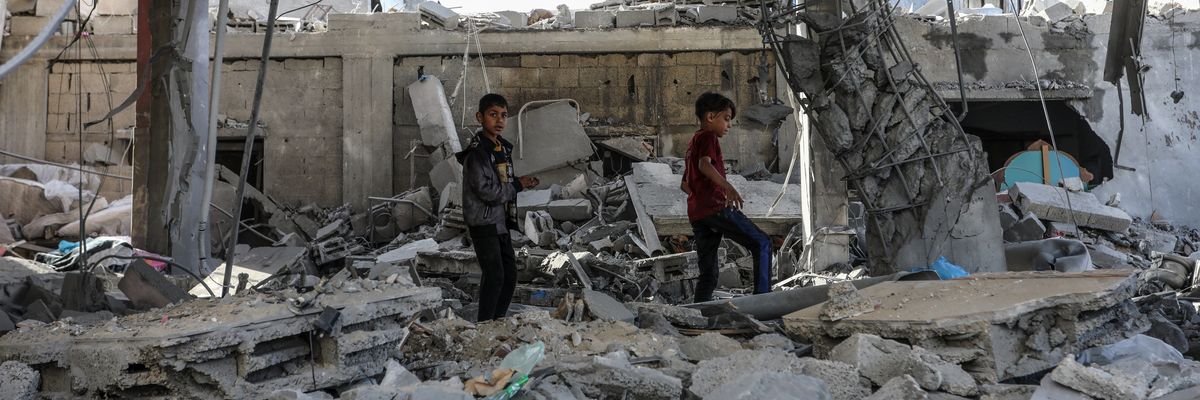
Palestinian children collect belongings from the rubble of destroyed houses after Israeli attacks on Rafah, Gaza on May 3, 2024.
"These new figures warn that the suffering in Gaza will not end when the war does."
A study released Thursday by a pair of United Nations agencies finds Israel's monthslong U.S.-backed war on the Gaza Strip has inflicted unparalleled damage on the occupied territory's population, housing stock, and overall economy—destruction that will reverberate for generations.
As of April 12, Israeli forces have killed or injured 5% of Gaza's population and left thousands more missing, including many who are believed to be buried under the rubble of the enclave's decimated infrastructure, according to the new study by the United Nations Development Program (UNDP) and the Economic and Social Commission for Western Asia (ESCWA).
The report says the level of damage Israel's military has caused to Gaza's housing infrastructure has not been seen since World War II and will likely take decades—and tens of billions of dollars—to recover from.
Achim Steiner, the UNDP's administrator, said in a statement that "every additional day that this war continues is exacting huge and compounding costs to Gazans and all Palestinians, now and in the medium- and long-term."
"These new figures warn that the suffering in Gaza will not end when the war does," said Steiner. "Unprecedented levels of human losses, capital destruction, and the steep rise in poverty in such a short period of time will precipitate a serious development crisis that jeopardizes the future of generations to come."
"Unlike previous wars, the destruction in Gaza today is unprecedented in scope and scale."
Abdallah Al Dardari, the UNDP's regional director for Arab states, said during a press conference unveiling the report on Thursday that there were 2.4 million tons of debris in Gaza after Israel's 2014 assault on the enclave.
Israel's current assault, which historians have described as one of the worst bombing campaigns in modern history, has left 37 million tons of debris in the occupied territory.
The U.N. report was published as Israel's assault on Gaza nears its seventh month and as the Netanyahu government appears poised to launch a ground invasion of Rafah, the southern Gaza city that's currently home to 1.4 million displaced Palestinians.
Citing unnamed Egyptian officials, The Wall Street Journal reported Friday that Israel intends to invade Rafah in a week if Hamas does not agree to a hostage-release deal.
The World Health Organization (WHO) warned Friday that an invasion of Rafah, which Israel has been bombing for months, "could lead to a bloodbath."
The new U.N. report states that if Israel's assault on Gaza continues for another two months, it will leave 1.86 million people in poverty and set back the territory's progress in life expectancy, education, and gross national income growth by more than 20 years.
After months of Israeli attacks on agriculture and other key sectors, the "productive basis" of Gaza's economy "has been destroyed," the report notes.
"Unlike previous wars, the destruction in Gaza today is unprecedented in scope and scale and coupled with the loss of homes, livelihoods, natural resources, infrastructure as well as institutional capacities, may have deep and systemic impacts for decades to come," said Rola Dashti, ESCWA's executive secretary.
"This assessment projects that Gaza will be rendered fully dependent on external assistance on a scale not seen since 1948, as it will be left without a functional economy, or any means of production, self-sustainment, employment, or capacity for trade," Dashti added.
Dear Common Dreams reader, It’s been nearly 30 years since I co-founded Common Dreams with my late wife, Lina Newhouser. We had the radical notion that journalism should serve the public good, not corporate profits. It was clear to us from the outset what it would take to build such a project. No paid advertisements. No corporate sponsors. No millionaire publisher telling us what to think or do. Many people said we wouldn't last a year, but we proved those doubters wrong. Together with a tremendous team of journalists and dedicated staff, we built an independent media outlet free from the constraints of profits and corporate control. Our mission has always been simple: To inform. To inspire. To ignite change for the common good. Building Common Dreams was not easy. Our survival was never guaranteed. When you take on the most powerful forces—Wall Street greed, fossil fuel industry destruction, Big Tech lobbyists, and uber-rich oligarchs who have spent billions upon billions rigging the economy and democracy in their favor—the only bulwark you have is supporters who believe in your work. But here’s the urgent message from me today. It's never been this bad out there. And it's never been this hard to keep us going. At the very moment Common Dreams is most needed, the threats we face are intensifying. We need your support now more than ever. We don't accept corporate advertising and never will. We don't have a paywall because we don't think people should be blocked from critical news based on their ability to pay. Everything we do is funded by the donations of readers like you. When everyone does the little they can afford, we are strong. But if that support retreats or dries up, so do we. Will you donate now to make sure Common Dreams not only survives but thrives? —Craig Brown, Co-founder |
A study released Thursday by a pair of United Nations agencies finds Israel's monthslong U.S.-backed war on the Gaza Strip has inflicted unparalleled damage on the occupied territory's population, housing stock, and overall economy—destruction that will reverberate for generations.
As of April 12, Israeli forces have killed or injured 5% of Gaza's population and left thousands more missing, including many who are believed to be buried under the rubble of the enclave's decimated infrastructure, according to the new study by the United Nations Development Program (UNDP) and the Economic and Social Commission for Western Asia (ESCWA).
The report says the level of damage Israel's military has caused to Gaza's housing infrastructure has not been seen since World War II and will likely take decades—and tens of billions of dollars—to recover from.
Achim Steiner, the UNDP's administrator, said in a statement that "every additional day that this war continues is exacting huge and compounding costs to Gazans and all Palestinians, now and in the medium- and long-term."
"These new figures warn that the suffering in Gaza will not end when the war does," said Steiner. "Unprecedented levels of human losses, capital destruction, and the steep rise in poverty in such a short period of time will precipitate a serious development crisis that jeopardizes the future of generations to come."
"Unlike previous wars, the destruction in Gaza today is unprecedented in scope and scale."
Abdallah Al Dardari, the UNDP's regional director for Arab states, said during a press conference unveiling the report on Thursday that there were 2.4 million tons of debris in Gaza after Israel's 2014 assault on the enclave.
Israel's current assault, which historians have described as one of the worst bombing campaigns in modern history, has left 37 million tons of debris in the occupied territory.
The U.N. report was published as Israel's assault on Gaza nears its seventh month and as the Netanyahu government appears poised to launch a ground invasion of Rafah, the southern Gaza city that's currently home to 1.4 million displaced Palestinians.
Citing unnamed Egyptian officials, The Wall Street Journal reported Friday that Israel intends to invade Rafah in a week if Hamas does not agree to a hostage-release deal.
The World Health Organization (WHO) warned Friday that an invasion of Rafah, which Israel has been bombing for months, "could lead to a bloodbath."
The new U.N. report states that if Israel's assault on Gaza continues for another two months, it will leave 1.86 million people in poverty and set back the territory's progress in life expectancy, education, and gross national income growth by more than 20 years.
After months of Israeli attacks on agriculture and other key sectors, the "productive basis" of Gaza's economy "has been destroyed," the report notes.
"Unlike previous wars, the destruction in Gaza today is unprecedented in scope and scale and coupled with the loss of homes, livelihoods, natural resources, infrastructure as well as institutional capacities, may have deep and systemic impacts for decades to come," said Rola Dashti, ESCWA's executive secretary.
"This assessment projects that Gaza will be rendered fully dependent on external assistance on a scale not seen since 1948, as it will be left without a functional economy, or any means of production, self-sustainment, employment, or capacity for trade," Dashti added.
A study released Thursday by a pair of United Nations agencies finds Israel's monthslong U.S.-backed war on the Gaza Strip has inflicted unparalleled damage on the occupied territory's population, housing stock, and overall economy—destruction that will reverberate for generations.
As of April 12, Israeli forces have killed or injured 5% of Gaza's population and left thousands more missing, including many who are believed to be buried under the rubble of the enclave's decimated infrastructure, according to the new study by the United Nations Development Program (UNDP) and the Economic and Social Commission for Western Asia (ESCWA).
The report says the level of damage Israel's military has caused to Gaza's housing infrastructure has not been seen since World War II and will likely take decades—and tens of billions of dollars—to recover from.
Achim Steiner, the UNDP's administrator, said in a statement that "every additional day that this war continues is exacting huge and compounding costs to Gazans and all Palestinians, now and in the medium- and long-term."
"These new figures warn that the suffering in Gaza will not end when the war does," said Steiner. "Unprecedented levels of human losses, capital destruction, and the steep rise in poverty in such a short period of time will precipitate a serious development crisis that jeopardizes the future of generations to come."
"Unlike previous wars, the destruction in Gaza today is unprecedented in scope and scale."
Abdallah Al Dardari, the UNDP's regional director for Arab states, said during a press conference unveiling the report on Thursday that there were 2.4 million tons of debris in Gaza after Israel's 2014 assault on the enclave.
Israel's current assault, which historians have described as one of the worst bombing campaigns in modern history, has left 37 million tons of debris in the occupied territory.
The U.N. report was published as Israel's assault on Gaza nears its seventh month and as the Netanyahu government appears poised to launch a ground invasion of Rafah, the southern Gaza city that's currently home to 1.4 million displaced Palestinians.
Citing unnamed Egyptian officials, The Wall Street Journal reported Friday that Israel intends to invade Rafah in a week if Hamas does not agree to a hostage-release deal.
The World Health Organization (WHO) warned Friday that an invasion of Rafah, which Israel has been bombing for months, "could lead to a bloodbath."
The new U.N. report states that if Israel's assault on Gaza continues for another two months, it will leave 1.86 million people in poverty and set back the territory's progress in life expectancy, education, and gross national income growth by more than 20 years.
After months of Israeli attacks on agriculture and other key sectors, the "productive basis" of Gaza's economy "has been destroyed," the report notes.
"Unlike previous wars, the destruction in Gaza today is unprecedented in scope and scale and coupled with the loss of homes, livelihoods, natural resources, infrastructure as well as institutional capacities, may have deep and systemic impacts for decades to come," said Rola Dashti, ESCWA's executive secretary.
"This assessment projects that Gaza will be rendered fully dependent on external assistance on a scale not seen since 1948, as it will be left without a functional economy, or any means of production, self-sustainment, employment, or capacity for trade," Dashti added.