SUBSCRIBE TO OUR FREE NEWSLETTER
Daily news & progressive opinion—funded by the people, not the corporations—delivered straight to your inbox.
5
#000000
#FFFFFF
To donate by check, phone, or other method, see our More Ways to Give page.
Daily news & progressive opinion—funded by the people, not the corporations—delivered straight to your inbox.
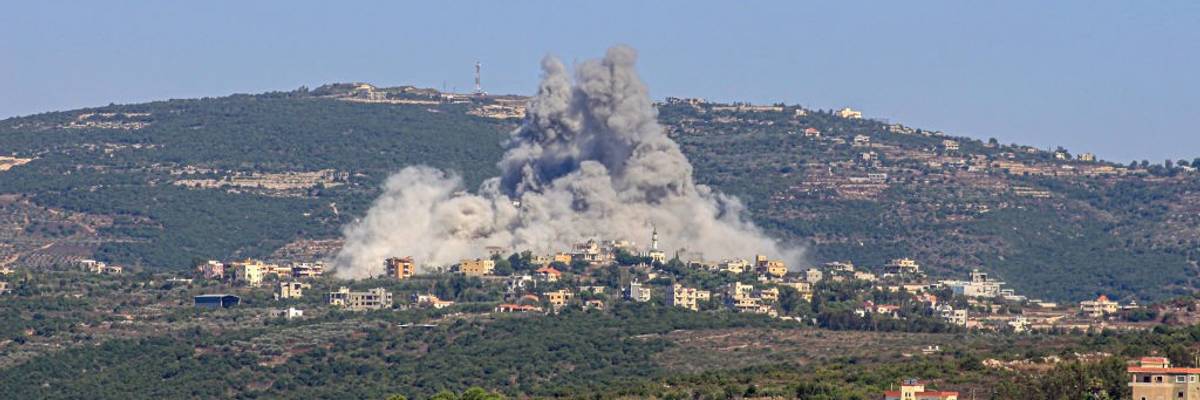
Smoke billows following an Israeli airstrike in the southern Lebanese border village of Chihine on July 28, 2024.
A barrage of Israeli strikes across Gaza killed many dozen Palestinians over the weekend, while a strike attributed to Hezbollah killed 12 children in Israeli-controlled territory.
Israel's war in Gaza continued in full force on Saturday and Sunday, with at least 66 Palestinians killed in roughly the last 24 hours, as international attention shifted to concern about an all-out war with Lebanon following an attack on Israeli-controlled territory that killed 12 children, with international diplomats pushing for deescalation.
At least 66 people were killed in Israeli strikes across Gaza in a 24-hour period, and another 241 were injured, the enclave's health ministry reported Sunday. Fifteen were also killed in strikes on Khan Younis that apparently weren't included in the 24-hour count, including a four-month-old girl, Al Jazeera reported.
The strikes in Gaza came as the conflict between Israel and Hezbollah, a heavily armed militia and political party in Lebanon, intensified. A rocket attack on a soccer field in the town of Majdal Shams in the Golan Heights, an Israeli-controlled territory, killed 12 children—the most deadly attack on Israeli-controlled land since October. The victims were Druze Arab; it's not clear from media reports if they were Israeli citizens.
Israel blamed Hezbollah for the attack, and U.S. Secretary of State Antony Blinken said there was "every indication" that the group was behind it, though Hezbollah denied responsibility, which it hasn't done for previous strikes.
"Hezbollah will pay a heavy price, which it has not paid up to now," Israel Prime Minister Benjamin Netanyahu's office said in an overnight statement.
The Israel-Hezbollah conflict, featuring cross-border strikes, has killed more than 500 since October, including more than 100 civilians, but has thus far remained relatively contained, with both sides saying that they are willing to engage in full-scale war but want to avoid it. About 100,000 people in Lebanon and 60,000 in Israel have been already displaced due to the strikes.
Hezbollah is seen as far stronger and better equipped than Hamas, the Palestinian militant and political group which Israel is seeking to eliminate, following the group's massacre of more than 1,100 Israelis on October 7. Both groups are classified by the U.S. State Department as foreign terrorist organizations.
Israel's conflicts with the two groups are related and ending one could help end the other. Hezbollah has said it would stop its attacks if a cease-fire in Gaza is reached.
Experts are calling on U.S. diplomats not just to diffuse Israel-Hezbollah tensions but also to use its leverage, as the main arms supplier and backer of Israel, to bring an end to the assault on Gaza.
"The U.S. administration has not done enough to [reach a ceasefire] in Gaza," Heiko Wimmen, an analyst at the International Crisis Group, told Al Jazeera on Sunday. "The incident in Majdal Shams is a potent reminder of why it is necessary to bring this unending conflict to an end."
For now, the violence continues on multiple fronts. An Israeli drone strike killed two Palestinians in the West Bank on Saturday and injured 28, according to Al Jazeera.
Dear Common Dreams reader, It’s been nearly 30 years since I co-founded Common Dreams with my late wife, Lina Newhouser. We had the radical notion that journalism should serve the public good, not corporate profits. It was clear to us from the outset what it would take to build such a project. No paid advertisements. No corporate sponsors. No millionaire publisher telling us what to think or do. Many people said we wouldn't last a year, but we proved those doubters wrong. Together with a tremendous team of journalists and dedicated staff, we built an independent media outlet free from the constraints of profits and corporate control. Our mission has always been simple: To inform. To inspire. To ignite change for the common good. Building Common Dreams was not easy. Our survival was never guaranteed. When you take on the most powerful forces—Wall Street greed, fossil fuel industry destruction, Big Tech lobbyists, and uber-rich oligarchs who have spent billions upon billions rigging the economy and democracy in their favor—the only bulwark you have is supporters who believe in your work. But here’s the urgent message from me today. It's never been this bad out there. And it's never been this hard to keep us going. At the very moment Common Dreams is most needed, the threats we face are intensifying. We need your support now more than ever. We don't accept corporate advertising and never will. We don't have a paywall because we don't think people should be blocked from critical news based on their ability to pay. Everything we do is funded by the donations of readers like you. When everyone does the little they can afford, we are strong. But if that support retreats or dries up, so do we. Will you donate now to make sure Common Dreams not only survives but thrives? —Craig Brown, Co-founder |
Israel's war in Gaza continued in full force on Saturday and Sunday, with at least 66 Palestinians killed in roughly the last 24 hours, as international attention shifted to concern about an all-out war with Lebanon following an attack on Israeli-controlled territory that killed 12 children, with international diplomats pushing for deescalation.
At least 66 people were killed in Israeli strikes across Gaza in a 24-hour period, and another 241 were injured, the enclave's health ministry reported Sunday. Fifteen were also killed in strikes on Khan Younis that apparently weren't included in the 24-hour count, including a four-month-old girl, Al Jazeera reported.
The strikes in Gaza came as the conflict between Israel and Hezbollah, a heavily armed militia and political party in Lebanon, intensified. A rocket attack on a soccer field in the town of Majdal Shams in the Golan Heights, an Israeli-controlled territory, killed 12 children—the most deadly attack on Israeli-controlled land since October. The victims were Druze Arab; it's not clear from media reports if they were Israeli citizens.
Israel blamed Hezbollah for the attack, and U.S. Secretary of State Antony Blinken said there was "every indication" that the group was behind it, though Hezbollah denied responsibility, which it hasn't done for previous strikes.
"Hezbollah will pay a heavy price, which it has not paid up to now," Israel Prime Minister Benjamin Netanyahu's office said in an overnight statement.
The Israel-Hezbollah conflict, featuring cross-border strikes, has killed more than 500 since October, including more than 100 civilians, but has thus far remained relatively contained, with both sides saying that they are willing to engage in full-scale war but want to avoid it. About 100,000 people in Lebanon and 60,000 in Israel have been already displaced due to the strikes.
Hezbollah is seen as far stronger and better equipped than Hamas, the Palestinian militant and political group which Israel is seeking to eliminate, following the group's massacre of more than 1,100 Israelis on October 7. Both groups are classified by the U.S. State Department as foreign terrorist organizations.
Israel's conflicts with the two groups are related and ending one could help end the other. Hezbollah has said it would stop its attacks if a cease-fire in Gaza is reached.
Experts are calling on U.S. diplomats not just to diffuse Israel-Hezbollah tensions but also to use its leverage, as the main arms supplier and backer of Israel, to bring an end to the assault on Gaza.
"The U.S. administration has not done enough to [reach a ceasefire] in Gaza," Heiko Wimmen, an analyst at the International Crisis Group, told Al Jazeera on Sunday. "The incident in Majdal Shams is a potent reminder of why it is necessary to bring this unending conflict to an end."
For now, the violence continues on multiple fronts. An Israeli drone strike killed two Palestinians in the West Bank on Saturday and injured 28, according to Al Jazeera.
Israel's war in Gaza continued in full force on Saturday and Sunday, with at least 66 Palestinians killed in roughly the last 24 hours, as international attention shifted to concern about an all-out war with Lebanon following an attack on Israeli-controlled territory that killed 12 children, with international diplomats pushing for deescalation.
At least 66 people were killed in Israeli strikes across Gaza in a 24-hour period, and another 241 were injured, the enclave's health ministry reported Sunday. Fifteen were also killed in strikes on Khan Younis that apparently weren't included in the 24-hour count, including a four-month-old girl, Al Jazeera reported.
The strikes in Gaza came as the conflict between Israel and Hezbollah, a heavily armed militia and political party in Lebanon, intensified. A rocket attack on a soccer field in the town of Majdal Shams in the Golan Heights, an Israeli-controlled territory, killed 12 children—the most deadly attack on Israeli-controlled land since October. The victims were Druze Arab; it's not clear from media reports if they were Israeli citizens.
Israel blamed Hezbollah for the attack, and U.S. Secretary of State Antony Blinken said there was "every indication" that the group was behind it, though Hezbollah denied responsibility, which it hasn't done for previous strikes.
"Hezbollah will pay a heavy price, which it has not paid up to now," Israel Prime Minister Benjamin Netanyahu's office said in an overnight statement.
The Israel-Hezbollah conflict, featuring cross-border strikes, has killed more than 500 since October, including more than 100 civilians, but has thus far remained relatively contained, with both sides saying that they are willing to engage in full-scale war but want to avoid it. About 100,000 people in Lebanon and 60,000 in Israel have been already displaced due to the strikes.
Hezbollah is seen as far stronger and better equipped than Hamas, the Palestinian militant and political group which Israel is seeking to eliminate, following the group's massacre of more than 1,100 Israelis on October 7. Both groups are classified by the U.S. State Department as foreign terrorist organizations.
Israel's conflicts with the two groups are related and ending one could help end the other. Hezbollah has said it would stop its attacks if a cease-fire in Gaza is reached.
Experts are calling on U.S. diplomats not just to diffuse Israel-Hezbollah tensions but also to use its leverage, as the main arms supplier and backer of Israel, to bring an end to the assault on Gaza.
"The U.S. administration has not done enough to [reach a ceasefire] in Gaza," Heiko Wimmen, an analyst at the International Crisis Group, told Al Jazeera on Sunday. "The incident in Majdal Shams is a potent reminder of why it is necessary to bring this unending conflict to an end."
For now, the violence continues on multiple fronts. An Israeli drone strike killed two Palestinians in the West Bank on Saturday and injured 28, according to Al Jazeera.