SUBSCRIBE TO OUR FREE NEWSLETTER
Daily news & progressive opinion—funded by the people, not the corporations—delivered straight to your inbox.
5
#000000
#FFFFFF
To donate by check, phone, or other method, see our More Ways to Give page.
Daily news & progressive opinion—funded by the people, not the corporations—delivered straight to your inbox.
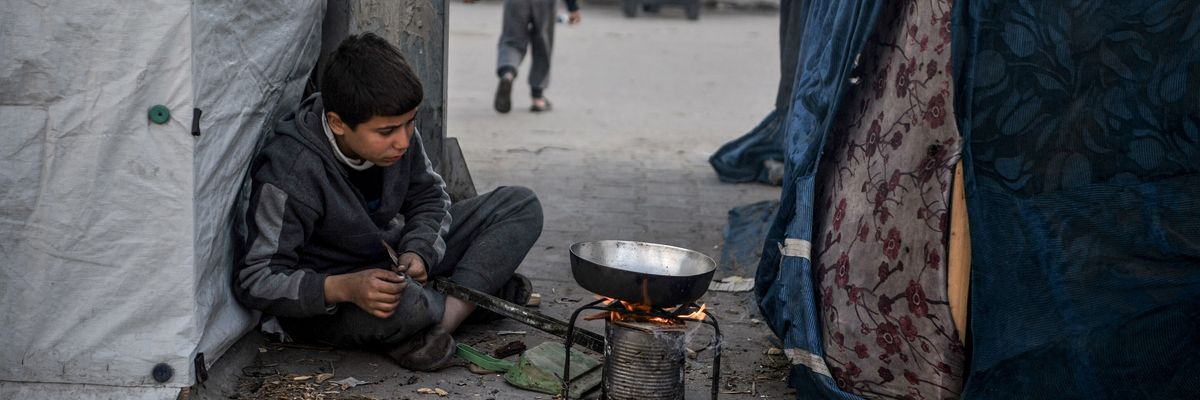
A Palestinian boy who took refuge in Rafah cooks a meal among makeshift tents on January 17, 2024.
"I walked for 13 kilometers before the Israeli army opened their machine gun fire," said one eyewitness. "We were hit by shells fired, resulting in several casualties. I managed to survive, without receiving any flour."
A Geneva-based human rights organization said Tuesday that its field teams inside the Gaza Strip have documented cases of Israeli soldiers firing on Palestinians desperately seeking food aid as much of the enclave's population faces the imminent risk of starvation.
The Euro-Mediterranean Human Rights Monitor said in a statement that the Israeli army used artillery shells, live ammunition, and drones to attack "hundreds of starving civilians who gathered on Salah al-Din Road near the Kuwait roundabout, southeast of Gaza City, to wait for U.N. trucks carrying limited aid supplies, killing and injuring a number of them."
A 46-year-old parent of five told the group in an interview that their children "have been starving for more than a month, and we do not have any flour."
"We eat a small amount of rice each day, so when I learned that flour aid was available, I walked for 13 kilometers before the Israeli army opened their machine gun fire," said the person, who requested anonymity for safety reasons. "We were hit by shells fired, resulting in several casualties. I managed to survive, without receiving any flour."
"It is unprecedented to make an entire civilian population go hungry this completely and quickly."
Euro-Med Monitor's findings bolster other eyewitness accounts of Israeli forces attacking Gazans in search of food for themselves and their families. Middle East Eye reported last week that on January 11, "a large crowd waiting for a food truck on al-Rasheed Street [in northern Gaza] came under fire from the Israeli military, with dozens killed and wounded in the attack."
"As we crossed the Nabulsi roundabout, an Israeli army tank appeared from behind a sand hill and started shooting at the people randomly," one eyewitness told the outlet. "At the same time, quadcopter planes started attacking us and the hundreds of people, including children, around us."
The eyewitness, identified as 27-year-old Muhammad Al-Salim, said two girls in front of him were shot. Al-Salim said he and others returned to the scene shortly after the Israeli attack to receive flour, canned goods, and medicine.
"Many people returned to await the trucks as we did, despite their injuries and the dead bodies around us. They were trying to catch the trucks, to make sure they got some food for their families," said Al-Salim. "I saw two girls running by the truck to get some flour, they ran so hard but were caught under the truck. They died immediately."
The World Food Program said Tuesday that it's been extremely difficult to get aid to large swaths of Gaza—particularly in the northern part of the enclave—as Israel's airstrikes and ground assault continue, risking "pockets of famine" throughout the besieged territory.
"We pretend to the children that we're not hungry or too busy to eat," one Palestinian mother of two living in overcrowded makeshift tents in Rafah told the Financial Times, adding that adults have curbed their food intake so their kids can eat. "We've all lost weight."
Israeli Prime Minister Benjamin Netanyahu has admitted to allowing only minimal aid to enter the Gaza Strip, where nearly the entire population is internally displaced. Israeli soldiers have filmed themselves setting fire to food supplies meant for hungry Gazans.
According to United Nations human rights experts, Gazans currently make up 80% of "all people facing famine or catastrophic hunger worldwide."
"Currently every single person in Gaza is hungry, a quarter of the population are starving and struggling to find food and drinkable water, and famine is imminent," a group of U.N. experts said in a joint statement last week. "Pregnant women are not receiving adequate nutrition and healthcare, putting their lives at risk. In addition, all children under five—335,000—are at high risk of severe malnutrition as the risk of famine conditions continues to increase, a whole generation is now in danger of suffering from stunting."
"It is unprecedented to make an entire civilian population go hungry this completely and quickly," the experts added. "Israel is destroying Gaza's food system and using food as a weapon against the Palestinian people."
Amid the catastrophic humanitarian crisis, Israel's assault on Gaza has shown no sign of letting up, killing more than 239 people on average each day. Reuters reported Tuesday that Israeli forces have advanced "deep into western Khan Younis in Gaza's bloodiest fighting so far in January, stormed one hospital, and put another under siege on Monday, cutting off the wounded from trauma care."
"Troops advanced for the first time into the al-Mawasi district near the Mediterranean Coast, west of Khan Younis, the main city in southern Gaza. There, they stormed the Al-Khair hospital and were arresting medical staff," the outlet added, citing a spokesperson for Gaza's health ministry.
Dear Common Dreams reader, It’s been nearly 30 years since I co-founded Common Dreams with my late wife, Lina Newhouser. We had the radical notion that journalism should serve the public good, not corporate profits. It was clear to us from the outset what it would take to build such a project. No paid advertisements. No corporate sponsors. No millionaire publisher telling us what to think or do. Many people said we wouldn't last a year, but we proved those doubters wrong. Together with a tremendous team of journalists and dedicated staff, we built an independent media outlet free from the constraints of profits and corporate control. Our mission has always been simple: To inform. To inspire. To ignite change for the common good. Building Common Dreams was not easy. Our survival was never guaranteed. When you take on the most powerful forces—Wall Street greed, fossil fuel industry destruction, Big Tech lobbyists, and uber-rich oligarchs who have spent billions upon billions rigging the economy and democracy in their favor—the only bulwark you have is supporters who believe in your work. But here’s the urgent message from me today. It's never been this bad out there. And it's never been this hard to keep us going. At the very moment Common Dreams is most needed, the threats we face are intensifying. We need your support now more than ever. We don't accept corporate advertising and never will. We don't have a paywall because we don't think people should be blocked from critical news based on their ability to pay. Everything we do is funded by the donations of readers like you. When everyone does the little they can afford, we are strong. But if that support retreats or dries up, so do we. Will you donate now to make sure Common Dreams not only survives but thrives? —Craig Brown, Co-founder |
A Geneva-based human rights organization said Tuesday that its field teams inside the Gaza Strip have documented cases of Israeli soldiers firing on Palestinians desperately seeking food aid as much of the enclave's population faces the imminent risk of starvation.
The Euro-Mediterranean Human Rights Monitor said in a statement that the Israeli army used artillery shells, live ammunition, and drones to attack "hundreds of starving civilians who gathered on Salah al-Din Road near the Kuwait roundabout, southeast of Gaza City, to wait for U.N. trucks carrying limited aid supplies, killing and injuring a number of them."
A 46-year-old parent of five told the group in an interview that their children "have been starving for more than a month, and we do not have any flour."
"We eat a small amount of rice each day, so when I learned that flour aid was available, I walked for 13 kilometers before the Israeli army opened their machine gun fire," said the person, who requested anonymity for safety reasons. "We were hit by shells fired, resulting in several casualties. I managed to survive, without receiving any flour."
"It is unprecedented to make an entire civilian population go hungry this completely and quickly."
Euro-Med Monitor's findings bolster other eyewitness accounts of Israeli forces attacking Gazans in search of food for themselves and their families. Middle East Eye reported last week that on January 11, "a large crowd waiting for a food truck on al-Rasheed Street [in northern Gaza] came under fire from the Israeli military, with dozens killed and wounded in the attack."
"As we crossed the Nabulsi roundabout, an Israeli army tank appeared from behind a sand hill and started shooting at the people randomly," one eyewitness told the outlet. "At the same time, quadcopter planes started attacking us and the hundreds of people, including children, around us."
The eyewitness, identified as 27-year-old Muhammad Al-Salim, said two girls in front of him were shot. Al-Salim said he and others returned to the scene shortly after the Israeli attack to receive flour, canned goods, and medicine.
"Many people returned to await the trucks as we did, despite their injuries and the dead bodies around us. They were trying to catch the trucks, to make sure they got some food for their families," said Al-Salim. "I saw two girls running by the truck to get some flour, they ran so hard but were caught under the truck. They died immediately."
The World Food Program said Tuesday that it's been extremely difficult to get aid to large swaths of Gaza—particularly in the northern part of the enclave—as Israel's airstrikes and ground assault continue, risking "pockets of famine" throughout the besieged territory.
"We pretend to the children that we're not hungry or too busy to eat," one Palestinian mother of two living in overcrowded makeshift tents in Rafah told the Financial Times, adding that adults have curbed their food intake so their kids can eat. "We've all lost weight."
Israeli Prime Minister Benjamin Netanyahu has admitted to allowing only minimal aid to enter the Gaza Strip, where nearly the entire population is internally displaced. Israeli soldiers have filmed themselves setting fire to food supplies meant for hungry Gazans.
According to United Nations human rights experts, Gazans currently make up 80% of "all people facing famine or catastrophic hunger worldwide."
"Currently every single person in Gaza is hungry, a quarter of the population are starving and struggling to find food and drinkable water, and famine is imminent," a group of U.N. experts said in a joint statement last week. "Pregnant women are not receiving adequate nutrition and healthcare, putting their lives at risk. In addition, all children under five—335,000—are at high risk of severe malnutrition as the risk of famine conditions continues to increase, a whole generation is now in danger of suffering from stunting."
"It is unprecedented to make an entire civilian population go hungry this completely and quickly," the experts added. "Israel is destroying Gaza's food system and using food as a weapon against the Palestinian people."
Amid the catastrophic humanitarian crisis, Israel's assault on Gaza has shown no sign of letting up, killing more than 239 people on average each day. Reuters reported Tuesday that Israeli forces have advanced "deep into western Khan Younis in Gaza's bloodiest fighting so far in January, stormed one hospital, and put another under siege on Monday, cutting off the wounded from trauma care."
"Troops advanced for the first time into the al-Mawasi district near the Mediterranean Coast, west of Khan Younis, the main city in southern Gaza. There, they stormed the Al-Khair hospital and were arresting medical staff," the outlet added, citing a spokesperson for Gaza's health ministry.
A Geneva-based human rights organization said Tuesday that its field teams inside the Gaza Strip have documented cases of Israeli soldiers firing on Palestinians desperately seeking food aid as much of the enclave's population faces the imminent risk of starvation.
The Euro-Mediterranean Human Rights Monitor said in a statement that the Israeli army used artillery shells, live ammunition, and drones to attack "hundreds of starving civilians who gathered on Salah al-Din Road near the Kuwait roundabout, southeast of Gaza City, to wait for U.N. trucks carrying limited aid supplies, killing and injuring a number of them."
A 46-year-old parent of five told the group in an interview that their children "have been starving for more than a month, and we do not have any flour."
"We eat a small amount of rice each day, so when I learned that flour aid was available, I walked for 13 kilometers before the Israeli army opened their machine gun fire," said the person, who requested anonymity for safety reasons. "We were hit by shells fired, resulting in several casualties. I managed to survive, without receiving any flour."
"It is unprecedented to make an entire civilian population go hungry this completely and quickly."
Euro-Med Monitor's findings bolster other eyewitness accounts of Israeli forces attacking Gazans in search of food for themselves and their families. Middle East Eye reported last week that on January 11, "a large crowd waiting for a food truck on al-Rasheed Street [in northern Gaza] came under fire from the Israeli military, with dozens killed and wounded in the attack."
"As we crossed the Nabulsi roundabout, an Israeli army tank appeared from behind a sand hill and started shooting at the people randomly," one eyewitness told the outlet. "At the same time, quadcopter planes started attacking us and the hundreds of people, including children, around us."
The eyewitness, identified as 27-year-old Muhammad Al-Salim, said two girls in front of him were shot. Al-Salim said he and others returned to the scene shortly after the Israeli attack to receive flour, canned goods, and medicine.
"Many people returned to await the trucks as we did, despite their injuries and the dead bodies around us. They were trying to catch the trucks, to make sure they got some food for their families," said Al-Salim. "I saw two girls running by the truck to get some flour, they ran so hard but were caught under the truck. They died immediately."
The World Food Program said Tuesday that it's been extremely difficult to get aid to large swaths of Gaza—particularly in the northern part of the enclave—as Israel's airstrikes and ground assault continue, risking "pockets of famine" throughout the besieged territory.
"We pretend to the children that we're not hungry or too busy to eat," one Palestinian mother of two living in overcrowded makeshift tents in Rafah told the Financial Times, adding that adults have curbed their food intake so their kids can eat. "We've all lost weight."
Israeli Prime Minister Benjamin Netanyahu has admitted to allowing only minimal aid to enter the Gaza Strip, where nearly the entire population is internally displaced. Israeli soldiers have filmed themselves setting fire to food supplies meant for hungry Gazans.
According to United Nations human rights experts, Gazans currently make up 80% of "all people facing famine or catastrophic hunger worldwide."
"Currently every single person in Gaza is hungry, a quarter of the population are starving and struggling to find food and drinkable water, and famine is imminent," a group of U.N. experts said in a joint statement last week. "Pregnant women are not receiving adequate nutrition and healthcare, putting their lives at risk. In addition, all children under five—335,000—are at high risk of severe malnutrition as the risk of famine conditions continues to increase, a whole generation is now in danger of suffering from stunting."
"It is unprecedented to make an entire civilian population go hungry this completely and quickly," the experts added. "Israel is destroying Gaza's food system and using food as a weapon against the Palestinian people."
Amid the catastrophic humanitarian crisis, Israel's assault on Gaza has shown no sign of letting up, killing more than 239 people on average each day. Reuters reported Tuesday that Israeli forces have advanced "deep into western Khan Younis in Gaza's bloodiest fighting so far in January, stormed one hospital, and put another under siege on Monday, cutting off the wounded from trauma care."
"Troops advanced for the first time into the al-Mawasi district near the Mediterranean Coast, west of Khan Younis, the main city in southern Gaza. There, they stormed the Al-Khair hospital and were arresting medical staff," the outlet added, citing a spokesperson for Gaza's health ministry.